What are the safety measures for commercial roof and floor cleaning?
Commercial roof and floor cleaning safety measures include a site-specific risk assessment, suitable access equipment, edge protection, personal protective equipment, controlled work areas and safe handling of water, chemicals and machinery. Trained operatives should also manage drainage, weather conditions, slip hazards, falling debris and nearby building users throughout the work.
Commercial roof and floor cleaning should be planned around a site-specific risk assessment, suitable access equipment, competent operatives, controlled work areas and safe handling of water, chemicals and machinery. The controls must protect cleaning staff, other contractors, building users, the public, the building itself and the surrounding environment.
Site assessment and method statement
Before work starts, the cleaning contractor should inspect the roof, floors, access routes, drainage arrangements and surrounding activities. The assessment should identify fragile surfaces, roof lights, unprotected edges, changes in level, trip hazards, overhead services, electrical equipment, vehicle movements, restricted areas and the potential for falling debris or overspray. The findings should be recorded in a suitable risk assessment and method statement, with control measures explained to everyone involved.
The plan should also account for the building’s use. Cleaning a warehouse, retail premises, school, healthcare site, car park or active construction project may require different arrangements for deliveries, pedestrians, tenants, vehicles and emergency access. Where work forms part of a construction project, duties under the Construction (Design and Management) Regulations may also apply. The responsible site contact should agree working times, isolation requirements, access restrictions and emergency procedures before cleaning begins.
Safe access and work at height
Roof cleaning presents a significant fall risk, particularly where surfaces are wet, moss-covered, fragile or sloping. Operatives should use the safest practical access method for the task, which may include fixed access systems, properly erected scaffolding, mobile elevating work platforms, roof ladders or other suitable equipment. Ladders should not be treated as a general work platform where a safer alternative is reasonably practicable.
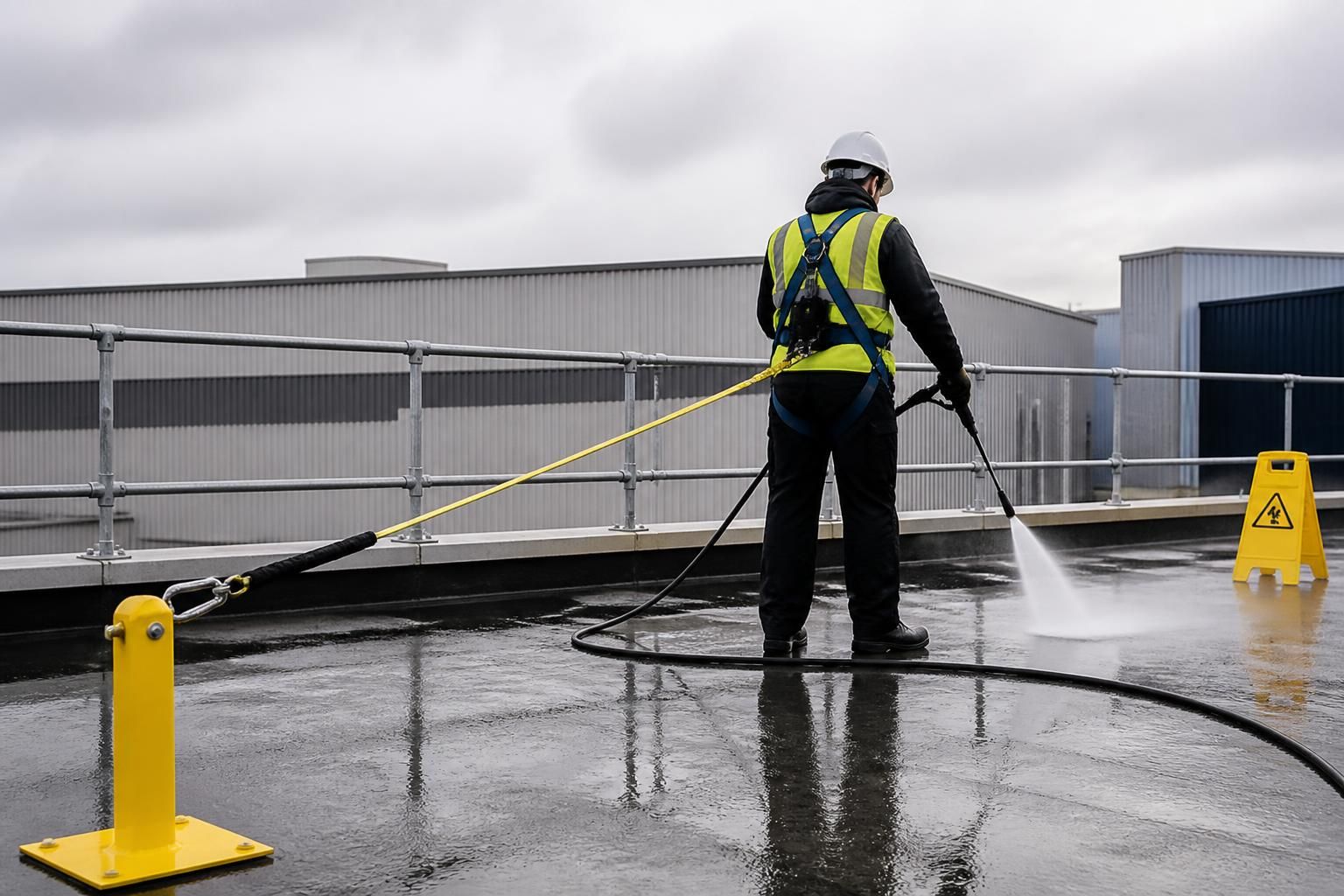
Work at height must be planned and supervised by competent people, with equipment selected for the roof structure, height, reach and ground conditions. Edge protection, guardrails, barriers, personal fall protection systems or other appropriate controls may be required. Fragile roof sheets, roof lights and concealed openings must be identified and protected; operatives should never assume that a surface will support their weight simply because it appears intact.
Access equipment should be inspected before use and positioned on stable ground. Mobile elevating work platforms require suitable operator training, adequate clearance, ground assessment and controls against unauthorised use. Where harnesses or restraint systems are needed, they must be compatible with the anchorage system and supported by a realistic rescue plan. A harness is not a substitute for planning how a suspended or fallen operative will be recovered.
Personal protective equipment
PPE is selected after other controls have been considered, rather than used as the only protection. Depending on the task, this may include safety footwear with suitable slip resistance, gloves, eye protection, protective clothing, hearing protection, hard hats and respiratory protective equipment. Roof work may also require fall restraint or fall arrest equipment.
PPE must be suitable for the cleaning chemicals, pressure, temperature and working environment. It should be maintained, checked and replaced when damaged or contaminated. Respiratory protection, where required by the product assessment or cleaning method, needs to be correctly selected, fitted and used by trained operatives.
Controlling pressure, steam and falling debris
Pressure washing and steam cleaning can dislodge tiles, mortar, coatings, cladding components, moss and accumulated dirt. Operatives should establish a controlled exclusion zone below and around the work area, using barriers and warning signs where appropriate. People should not pass beneath active roof cleaning or stand within the likely path of debris, spray or discharge.
The equipment and pressure should be matched to the surface. Excessive pressure can damage roof coverings, pointings, sealants, coatings, vents, membranes, windows and building services. Operatives should work methodically, maintain a safe stance and avoid directing water towards people, live electrical equipment, vulnerable openings or areas where water could enter the building.
Steam and hot water introduce additional risks, including burns, heat exposure and reduced visibility from vapour. Hoses should be routed to prevent trip hazards, secured where necessary and kept away from sharp edges, hot surfaces and vehicle routes. Equipment must be isolated before maintenance, nozzle changes or clearing blockages.
Floor cleaning and slip prevention
Wet floors can create immediate slip hazards for operatives, employees, visitors and members of the public. Work areas should be segregated with suitable barriers and clear warning signs, and cleaning should be scheduled when footfall and vehicle movements are lowest where possible. The team should clean in manageable sections rather than allowing uncontrolled water to spread across active routes.
Safe floor cleaning also involves controlling hoses, cables, pressure-washing equipment, recovery machines and displaced items. Suitable footwear, adequate lighting and clearly defined pedestrian diversions help reduce risk. Wet areas should be recovered, squeegeed or allowed to dry as appropriate, and the area should only be reopened after a competent person has checked that it is safe.
In car parks, loading bays and industrial settings, the plan should separate cleaning activity from moving vehicles and mobile plant. Traffic routes may need temporary closure, a banksman or agreed vehicle controls. Cleaning water must not be allowed to carry silt, oil or chemicals into areas where it could create a further hazard.
Water, drainage and electrical safety
Before using water, the team should confirm where it will drain and whether drainage points are clear and suitable. Gullies may need protection from solids, moss, silt and chemical residues, while contaminated water may require collection and disposal rather than discharge. Water should be kept away from door thresholds, ventilation systems, lift shafts, stock, sensitive equipment and electrical installations.
Electrical equipment must be suitable for the conditions and protected from water ingress. Cables, plugs and connections should be inspected, and portable electrical equipment should be used with appropriate protection. Any electrical systems or machinery that could be affected by water should be isolated in agreement with the responsible site representative. Operatives should never rely on apparent distance or temporary covers where water could reach live equipment.
Chemical handling and biological contamination
Biocides, detergents, degreasers and other treatments must be used in accordance with their product labels and safety data sheets. A COSHH assessment should consider exposure through skin contact, inhalation, splashes, accidental ingestion, storage, mixing and disposal. Chemicals should not be mixed unless the manufacturer specifically permits it, as incompatible products can produce dangerous reactions or harmful vapours.
Operatives should use the specified dilution, application method and contact time, with suitable gloves, eye protection and other PPE. Nearby people, vehicles, plants, watercourses and vulnerable surfaces should be protected from drift and run-off. Moss, bird fouling, mould and other organic deposits may carry biological hazards, so contaminated material should be handled hygienically and removed without creating unnecessary dust or aerosol.
Weather and environmental conditions
Weather conditions can change the risk profile of roof and floor cleaning. High winds may make access equipment, hoses, sheeting and fall protection unsafe. Rain, frost and ice increase slip risks, while extreme heat can affect operatives, chemical performance and equipment. Lightning presents a particular danger when using elevated equipment or working on exposed roofs.
Work should be postponed, reduced or stopped when conditions exceed the limits set by the equipment manufacturer, risk assessment or site procedure. The supervisor should reassess conditions throughout the job rather than relying only on the forecast made at the start.
Training, supervision and communication
Operatives should be trained and competent in the cleaning method, access equipment, chemical controls, manual handling, emergency arrangements and relevant site rules. They should understand the agreed method statement and know who has authority to stop work if conditions become unsafe.
Clear communication with the customer and other contractors is essential. The site contact should be told when areas are being closed, when water or electricity needs to be isolated, and when the work is complete. Barriers and warning signs should remain in place for as long as a residual hazard exists, not simply until the cleaning equipment has been removed.
Emergency arrangements and completion checks
The work plan should cover falls from height, chemical splashes, burns, electric shock, equipment failure, structural damage, uncontrolled water, fire and injury to members of the public. First-aid arrangements, emergency contact details, access for emergency services and rescue procedures should be confirmed before work starts. Incidents and near misses should be recorded and reviewed.
At completion, the area should be inspected for remaining slip hazards, loose debris, damaged surfaces, exposed cables, blocked drains and unsecured equipment. Roof access points should be closed or secured, barriers removed only when safe, and any defects or limitations reported to the customer. These final checks help confirm that the premises are safe to return to normal use and that cleaning has not introduced a new risk.
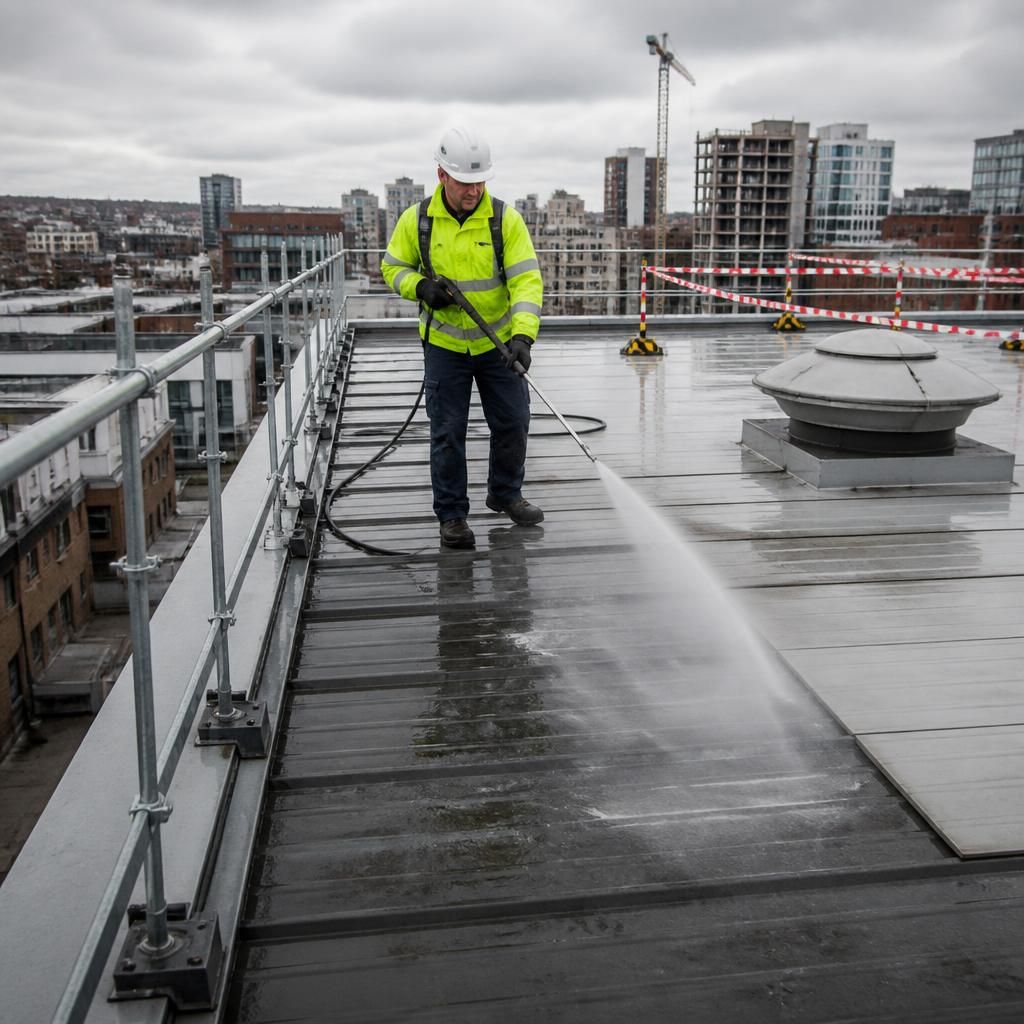
Safe access and controlled work areas are essential measures for commercial roof and floor cleaning. Roof work must use suitable access equipment, edge protection and fall-prevention controls, while floor cleaning areas must be separated from pedestrians, vehicles and other contractors.
Before cleaning begins, the team should identify fragile roof surfaces, roof lights, unprotected edges, changes in level, moving vehicles and electrical hazards. Barriers and warning signs should prevent access beneath active roof work or across wet floors. Hoses and cables must be routed safely, and cleaned areas should remain closed until water has been recovered or the surface is safe to walk on.
Arrange a Commercial Roof and Floor Cleaning Safety Assessment
Arrange a commercial roof and floor cleaning safety assessment with Encanto Exterior Cleaning to review access, surface, drainage, chemical and work-area requirements before cleaning begins.

For a free quote & consultation
Contact usAccreditations