
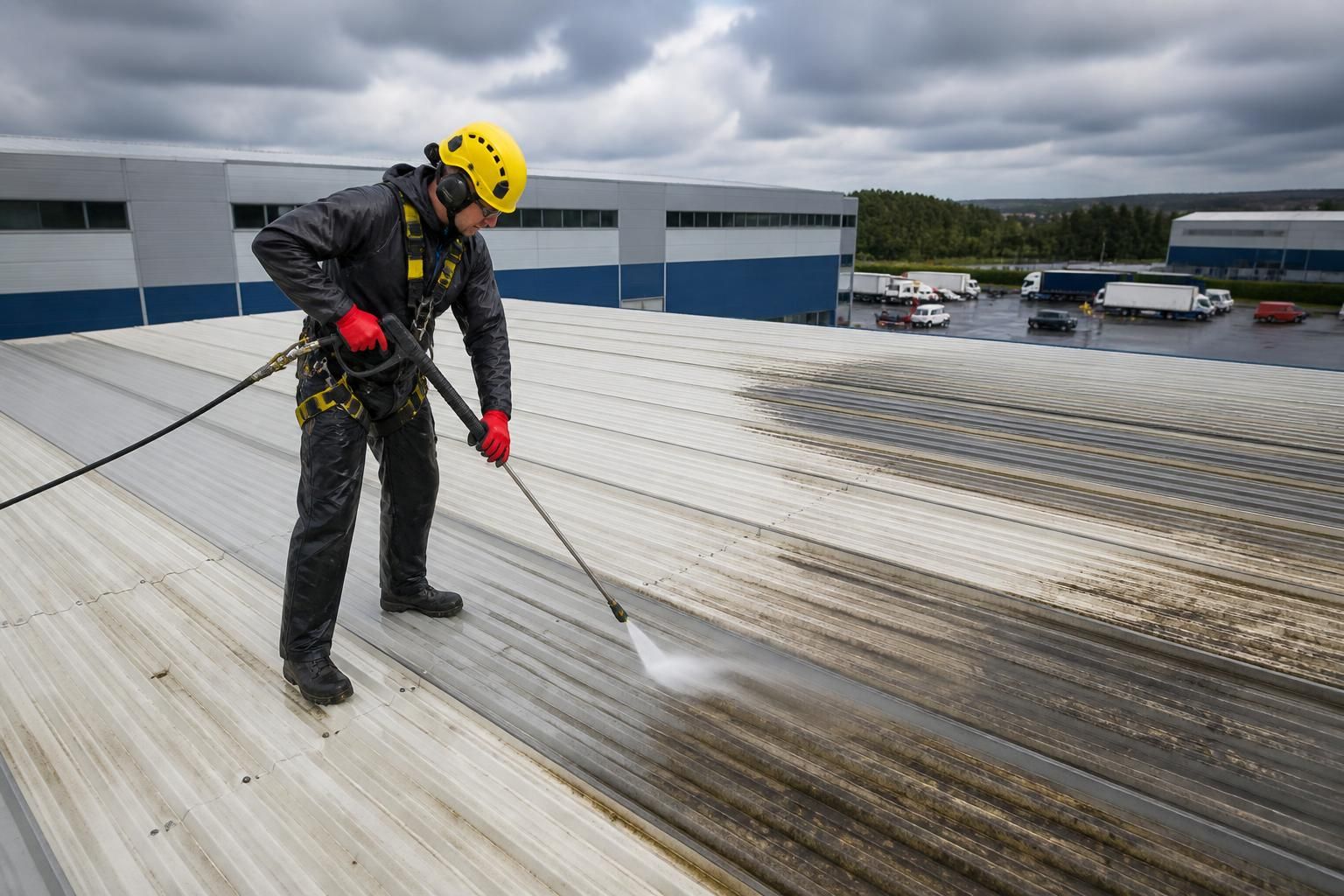
What safety measures should professionals employ when conducting roof pressure cleaning or soft washing?
Professionals should begin with a site-specific risk assessment covering roof condition, fragile areas, access, weather, electrical hazards, chemical exposure and surface-water control. They should use suitable access and fall-protection equipment, appropriate PPE, trained operators, controlled pressure or chemical application, and measures to protect people, property, plants and drainage during the work.
Professional roof pressure cleaning and soft washing require a planned system of work that controls falls, fragile surfaces, pressurised water, cleaning chemicals, electrical hazards, falling debris and contaminated run-off. Before work starts, the contractor should complete a site-specific risk assessment and method statement, select suitable access and fall-protection equipment, brief the team, and confirm that the roof and surrounding areas can be cleaned without exposing people or property to unacceptable risk.
Complete a site and roof assessment
The roof should be inspected from a safe position before anyone accesses it. The assessment should consider the roof covering, age, condition, pitch, load-bearing capacity, fragile areas, rooflights, skylights, valleys, gutters, parapets, plant and solar equipment. Moss, algae and debris can conceal defects, so operatives should not assume that a roof is safe simply because it appears intact.
- Identify fragile roof sheets, translucent panels, rooflights, loose tiles, deteriorated mortar, unstable edging and areas affected by water ingress.
- Locate overhead and nearby electrical services, gas or ventilation equipment, antennas, flues and other obstructions.
- Assess ground conditions, vehicle movements, public access, neighbouring buildings and the possibility of falling materials reaching people or vehicles below.
- Check where water and chemical run-off will travel, including drains, gullies, watercourses, planted areas and adjoining premises.
- Record any pre-existing damage with photographs or an inspection report so that cleaning does not obscure responsibility for defects.
If the roof cannot be safely accessed, cleaning should be carried out from another position or postponed until an appropriate access solution is available. A professional should never treat a fragile roof covering as a working platform.
Use suitable access and fall protection
Work at height should be avoided where the task can be completed safely from ground level, but roof cleaning commonly requires controlled access. The equipment should be selected for the specific building and used by trained, competent operatives. Depending on the site, this may include properly erected scaffolding, edge protection, a mobile elevating work platform, a roof ladder, crawling boards, temporary barriers or a designed anchor and restraint system.
- Access equipment should be inspected before use and positioned on stable, suitable ground.
- Guardrails, toe boards, barriers and exclusion zones should be used where there is a risk of falling from an edge or of tools and debris falling below.
- Harnesses, lanyards and anchor points should be suitable for the intended system and used in accordance with the manufacturer’s instructions. A harness is not a substitute for a suitable rescue plan.
- Roof ladders and crawling boards should be secured and used to distribute weight across suitable areas rather than relying on individual tiles or sheets.
- Access routes should remain clear, and operatives should not climb on pipes, roof plant, parapets or unsupported coverings.
Where fall-arrest equipment is used, the plan must address suspension and rescue. Someone should know how to raise the alarm and recover an operative promptly; calling emergency services alone may not provide a sufficient rescue arrangement.
Control weather and working conditions
Rain, frost, ice, high winds and poor visibility can make a roof unsafe and can reduce control of spray and chemicals. Work should be postponed when conditions compromise footing, access equipment, visibility, chemical performance or the protection of people and property. Wind is particularly important when using a lance, applying treatment from an elevated position or operating a platform, because spray drift and loss of balance become more likely.
Operatives should also consider heat, sun exposure, dehydration and cold-weather effects. Weather conditions should be monitored throughout the work rather than checked only at the start.
Choose the correct cleaning method and equipment
Pressure should be matched to the roof material and its condition. The operator should use the lowest effective pressure, maintain a controlled distance, avoid directing water beneath tiles or into joints, and test an inconspicuous area before treating the full roof. High pressure can dislodge tiles, strip protective finishes, force water into the building or damage fragile pointing, membranes and cladding.
Soft washing is not risk-free. It involves applying cleaning solutions at low pressure, but the solution still needs controlled handling. Spray should be kept away from vents, open windows, air-intake systems, electrical components, people, animals, vehicles and sensitive finishes. Equipment should be checked for leaks, damaged hoses, faulty triggers and loose connections before use. Hoses should be routed to prevent trip hazards and should not place strain on roof edges or access equipment.
Manage chemicals under COSHH principles
Before a soft-washing treatment, the contractor should identify the product, review its safety data sheet and complete a control of substances hazardous to health assessment. Operatives should understand the required dilution, contact time, storage, incompatibilities, first-aid measures and spill response. Chemicals should never be mixed unless the manufacturer specifically permits it; incompatible products can create hazardous reactions or harmful vapours.
- Wear chemical-resistant gloves, suitable eye or face protection and protective clothing appropriate to the product and application method.
- Use respiratory protection only where the assessment requires it, with the correct filter, fit testing and maintenance arrangements.
- Keep containers labelled, secured and upright, and transport them in a way that prevents spills.
- Provide clean water and suitable arrangements for dealing with splashes or contamination.
- Keep unprotected workers and members of the public away from the application area until the risk has passed.
The selected treatment should be appropriate for the roof and surrounding environment. A professional should explain any precautions needed for plants, painted surfaces, metals, glazing, rainwater systems and adjacent properties before application.
Wear and maintain appropriate PPE
Personal protective equipment should support, rather than replace, safer planning and collective protection. Depending on the work, PPE may include a safety helmet with suitable retention, non-slip safety footwear, gloves, eye protection, hearing protection, waterproof or chemical-resistant clothing, and a harness where required by the access system. Pressure-washing operators may need additional face and body protection because spray can rebound from the roof surface and carry dirt or biological material.
PPE should be compatible with other equipment, inspected before use and replaced when worn or contaminated. Footwear must provide reliable grip on the actual surface being cleaned; ordinary trainers are not suitable for roof work.
Protect people, property and the surrounding site
A controlled work zone should be established below and around the building. Barriers, warning signs and, where necessary, a banksman or site marshal can prevent pedestrians, residents, staff and vehicles from entering areas exposed to falling debris or spray. Doors, windows and air intakes should be closed or protected, and nearby vehicles and vulnerable equipment should be covered or moved.
- Secure tools, hoses and loose materials so they cannot fall from the roof or platform.
- Prevent spray from reaching electrical installations, lighting, cameras, alarms, signage and finished surfaces.
- Protect gutters, downpipes and outlets from blockages caused by moss, silt and loosened debris.
- Keep building occupants informed about access restrictions, noise, water supplies and any temporary loss of parking or pedestrian routes.
- Use a suitable method to collect or contain removed moss, coatings and debris rather than allowing them to enter public drainage.
Control water and chemical run-off
Run-off should be planned before cleaning begins. Pressure cleaning can mobilise dirt, moss, bird fouling, old coatings and other contaminants, while soft washing can carry active treatment into drains, soil and watercourses. Downpipes may need to be temporarily disconnected or protected, and drain covers, bunds, wet vacuums, collection points or other containment measures may be required.
The correct disposal route depends on the material removed and the treatment used. Wastewater should not be discharged to a surface-water drain or natural watercourse without confirming that this is permitted. If contamination, a spill or uncontrolled discharge occurs, work should stop and the site’s spill-response procedure should be followed.
Use competent operatives and clear procedures
Roof cleaning should be carried out by people trained in the relevant access equipment, pressure-washing system, chemical handling and emergency procedures. The team should understand the method statement, exclusion zones, communication arrangements and stop-work criteria. Equipment should be maintained and inspected in line with manufacturer instructions and applicable workplace requirements, including the principles of the Work at Height Regulations, COSHH and PUWER where relevant.
A competent supervisor should check that the planned controls remain effective as the work progresses. The assessment may need to be revised if the roof condition differs from the initial inspection, if weather changes, if unexpected materials are discovered or if the work expands beyond the agreed scope.
Have an emergency and first-aid plan
The site should have a communicated procedure for falls, chemical splashes, electric shock, injury from pressurised water, structural failure, fire, spills and sudden weather deterioration. It should identify emergency contacts, first-aid arrangements, the site address, access for emergency services and the location of isolation points. Operatives should know how to stop the pressure washer or chemical feed quickly.
Any incident, near miss or property damage should be recorded and reviewed before work resumes. Cleaning should stop immediately if tiles or sheets become unstable, water enters the building, spray cannot be contained, access equipment moves, visibility is lost or a person enters the exclusion zone.
These measures allow the contractor to select pressure cleaning or soft washing based on the roof’s construction and condition rather than treating either method as universally safe. A professional inspection, documented method statement, suitable access system, controlled application and effective run-off management are the essential safeguards for a compliant roof-cleaning project.
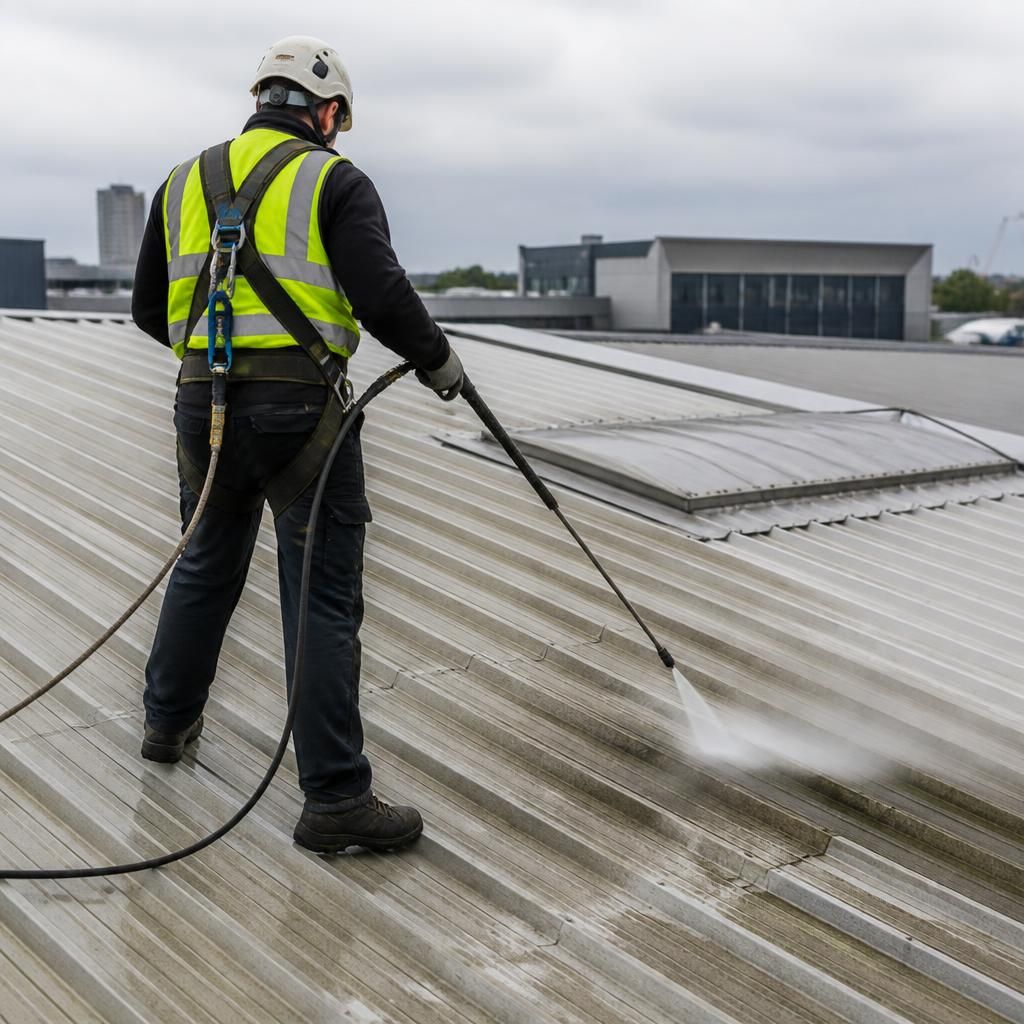
Fall protection is the primary safety control when professionals clean a roof. Before work begins, the contractor should assess the roof’s pitch, condition, fragile areas, rooflights and edges, then select suitable equipment such as scaffold, edge protection, a mobile elevating work platform, roof ladders or crawling boards.
Access equipment must be inspected, secured and used by trained operatives. Harnesses and lanyards should only be connected to suitable anchor systems, with a rescue plan in place for a fall. Roofers should never rely on loose tiles, rooflights, parapets or gutters for support, and work should stop if rain, ice, high winds or poor visibility make footing or spray control unsafe.