
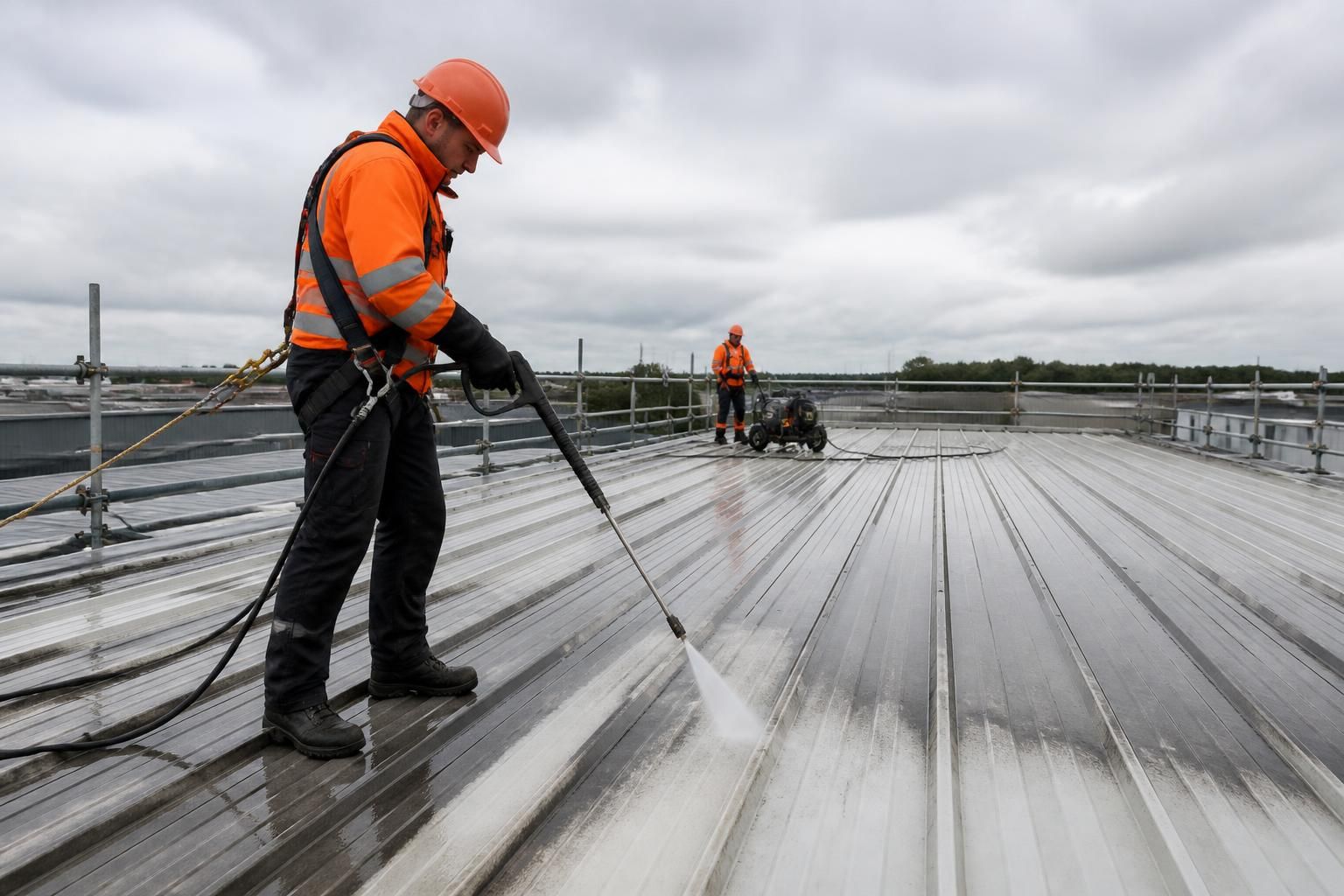
What safety measures should be considered when performing roof pressure cleaning or soft wash?
Roof pressure cleaning and soft washing should be carried out following a site-specific risk assessment, with suitable access equipment, fall protection, personal protective equipment (PPE), weather controls and measures to protect people, property and surrounding areas. Pressure should be appropriate for the roof material, while soft-wash chemicals must be handled, applied and contained safely to prevent injury, surface damage, contamination and uncontrolled runoff.
Roof pressure cleaning and soft washing should only be carried out after a site-specific risk assessment and method statement have identified the roof condition, access requirements, fall hazards, cleaning method, chemical controls, weather limitations and emergency arrangements. The controls must protect operatives, building users, the public, the roof structure, surrounding property and the drainage environment.
Assess the roof and site before work starts. A competent person should inspect the roof covering, roof lights, fragile areas, plant, skylights, parapets, gutters, overhead services and access points. The assessment should consider the roof’s age, condition, pitch, loading capacity and any evidence of rot, corrosion, loose coverings or structural weakness. Areas that cannot safely support a person should not be walked on. The cleaning plan should also identify where water, debris or cleaning solution could enter the building or affect vehicles, pedestrians, neighbouring property and drainage systems.
Plan safe access and fall protection. Suitable equipment may include scaffolding, edge protection, properly secured ladders, mobile access platforms, roof access systems or a suitably designed fall-restraint or fall-arrest arrangement. Equipment must be selected for the roof and site, installed or operated by competent people, and inspected as required. Operatives should avoid relying on ladders as a working platform for prolonged cleaning. Where harnesses are used, there must be suitable anchor points, compatible equipment and a rescue plan; a harness alone does not prevent a fall or address suspension after a fall.
Work at height should be planned and supervised in line with the UK Work at Height Regulations. Access routes, exclusion zones and emergency access should remain clear. Fragile roof surfaces and roof lights should be clearly identified and protected with suitable barriers or crawling boards where appropriate. Operatives should never step on translucent roof panels, unsupported sheets or surfaces obscured by moss, algae or standing water.
Control weather and site conditions. Roof cleaning should be postponed when high winds, lightning, ice, heavy rain or poor visibility make access or equipment use unsafe. Wet, moss-covered surfaces can become particularly slippery, while strong wind can affect spray, access platforms, hoses and chemical drift. The supervisor should continue monitoring conditions throughout the work rather than relying only on the forecast made at the start of the day.
Use appropriate personal protective equipment. PPE should be selected following the risk assessment and may include slip-resistant safety footwear, protective clothing, eye or face protection, gloves, head protection, hearing protection and respiratory protection where required. Chemical-resistant gloves and clothing are important for soft washing, but PPE is the last layer of control and must not replace safer application methods, ventilation and good handling procedures. PPE should be compatible with harnesses and other access equipment, kept in good condition and replaced when contaminated or damaged.
Apply pressure carefully. Pressure cleaning should be matched to the roof covering and its condition. Excessive pressure can dislodge tiles, force water beneath laps, damage membranes, remove protective coatings, loosen pointing or drive water into the building. Operators should use controlled pressure, suitable nozzles and a safe working distance, and should test an inconspicuous area where the material or coating is uncertain. The spray must be directed away from vents, joints, flashings, electrical equipment and openings unless those areas have been specifically protected.
Hoses and cables should be routed to prevent trip hazards, snagging and damage to roof components. Equipment must be checked for leaks, damaged couplings and defective triggers before use. Operatives should maintain stable footing and avoid directing a high-pressure lance while overreaching or standing close to an unprotected edge.
Manage soft-wash chemicals under COSHH controls. The product safety data sheet should be available, and the assessment should cover mixing, dilution, storage, application, contact with skin or eyes, inhalation, accidental release and disposal. Chemicals must be labelled, stored securely and kept away from incompatible substances. They should never be mixed unless the manufacturer’s instructions specifically permit it. Operatives need suitable training, washing facilities and access to clean water or an eyewash arrangement appropriate to the products being used.
Soft-wash solution should be applied in a controlled manner to minimise aerosol, drift and overspray. Nearby people, vehicles, glazing, painted surfaces, plants, air-intake systems and sensitive materials should be protected or moved. Application should stop if wind carries spray beyond the controlled area. The product must be suitable for the roof material and used at the manufacturer’s recommended concentration and contact time; stronger is not automatically safer or more effective.
Prevent pollution and uncontrolled runoff. Before cleaning, gutters, downpipes and outlets should be assessed so that loosened moss, dirt and solution do not enter watercourses or cause blockages. Runoff should be contained, diverted, collected or treated in accordance with the site assessment and applicable environmental requirements. Storm drains must not be used for contaminated discharge without confirmation that this is permitted. Absorbent materials, drain covers and spill-response equipment should be available where there is a risk of release, and waste should be removed through an appropriate disposal route.
Protect people and property below. A clearly marked exclusion zone should be established beneath the work area, with barriers, warning signs and a banksman or spotter where necessary. The public, building occupants and other contractors should be kept away from falling debris, spray, hoses and access equipment. Windows, doors, vents, vehicles, façade finishes, lighting and sensitive plant should be covered or otherwise protected. Cleaning should be coordinated with the client so that affected entrances, loading areas and walkways can be closed or safely redirected.
Consider electrical and fire risks. Operatives should identify overhead cables, roof-mounted electrical installations, photovoltaic panels, lightning protection and plant before using water or access equipment. Water and electrical systems must be kept safely separated, and relevant equipment should be isolated by an authorised person where necessary. Portable electrical equipment should be suitable for the conditions and protected by the required safety devices. Chemicals and fuels should be stored away from ignition sources and secured against unauthorised access.
Have emergency arrangements in place. The site team should know how to respond to a fall, chemical splash, exposure, equipment failure, structural damage, spill or sudden weather change. The plan should include a reliable means of communication, first-aid arrangements, site address and access details for emergency services, and a practical rescue procedure for anyone using fall-arrest equipment. After an incident or near miss, work should stop until the cause has been reviewed and controls have been updated.
On completion, the supervisor should check the roof, gutters, façades, access equipment and surrounding ground for damage, residue, blocked drainage or remaining slip hazards. Any defects identified before or during cleaning should be recorded and reported rather than concealed by the cleaning process. For commercial and industrial premises, the completed method statement, COSHH information, equipment checks and inspection records should be retained where required by the client’s site procedures.
Professional roof cleaning is therefore not simply a choice between pressure and soft wash. The safer method depends on the roof material, condition, access, surrounding environment and contaminants present. A competent contractor should explain the proposed controls before work begins and should be prepared to change the method or postpone the work if the roof or site cannot be cleaned safely.
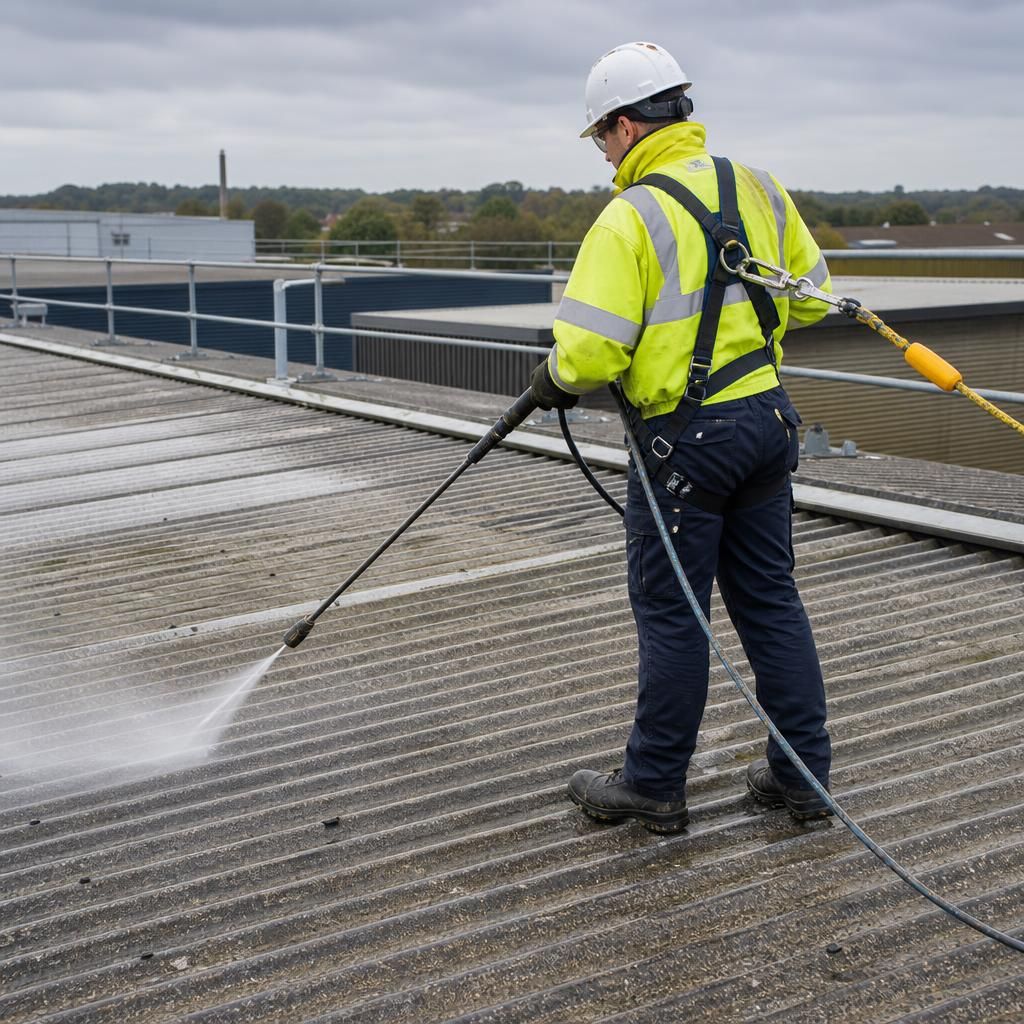
Safe roof cleaning depends on properly planned access and fall protection, not simply on wearing a harness. Before work begins, the roof should be assessed for fragile coverings, roof lights, steep sections, parapets, plant and unstable areas. Suitable controls may include scaffolding, edge protection, a mobile access platform, secured access equipment or a designed fall-restraint system.
Where a harness is required, it must be attached to a suitable anchor point using compatible equipment, with a practical rescue plan in place. Operatives should not walk on translucent panels, unsupported sheets or surfaces made slippery by moss and standing water. Hoses and cables should be routed to prevent trips and snagging, while an exclusion zone below protects occupants, pedestrians and vehicles from falling debris or spray.