
What safety measures should be considered during roof tile and gutter cleaning?
Roof tile and gutter cleaning should begin with a site-specific risk assessment, safe access equipment and suitable fall protection, with work stopped in unsafe weather conditions. Contractors should also use appropriate PPE, control falling debris and water, protect occupants and property, and follow safe procedures around fragile tiles, electrical services and traffic.
Safe roof tile and gutter cleaning requires a site-specific risk assessment, suitable access equipment, effective fall protection and controls for falling debris, water, chemicals, electricity, traffic and members of the public. Work should be planned by competent people, carried out with appropriate personal protective equipment (PPE), and stopped if weather or site conditions make the task unsafe.
Complete a site-specific risk assessment
Before equipment is brought onto site, the contractor should assess the roof design, pitch, height, tile condition, access points, gutter layout and the ground below. The assessment should identify fragile or damaged tiles, skylights, roof lights, steep sections, overhead cables, nearby roads, entrances, public walkways, parked vehicles and areas where water or debris could cause damage.
The assessment should also consider the building’s occupants and any other contractors working nearby. A method statement should set out the proposed cleaning process, access arrangements, exclusion zones, equipment checks, emergency procedures and responsibilities of the team. Conditions should be reviewed if the weather changes, the roof is found to be more fragile than expected or the agreed work area changes.
Use safe access rather than relying on the roof surface
Roof workers should not walk directly on roof tiles unless the system has been assessed as suitable and there is a controlled method for doing so. Tiles can crack, become slippery when wet and conceal weak areas. Safe access may include properly positioned ladders, scaffold towers, temporary roof access systems, edge protection, mobile elevated work platforms or other suitable access equipment. The choice depends on the height, roof profile, ground conditions, duration of the work and the need to reach gutters safely.
Access equipment must be placed on stable ground, inspected before use and positioned so that workers do not overreach. Ladders are generally for suitable short-duration tasks and should not be treated as a substitute for a more robust working platform where extended cleaning, high-pressure equipment or two-handed work is required. Where access equipment could affect pedestrians, vehicles or the building, the area should be securely controlled.
Provide appropriate fall protection
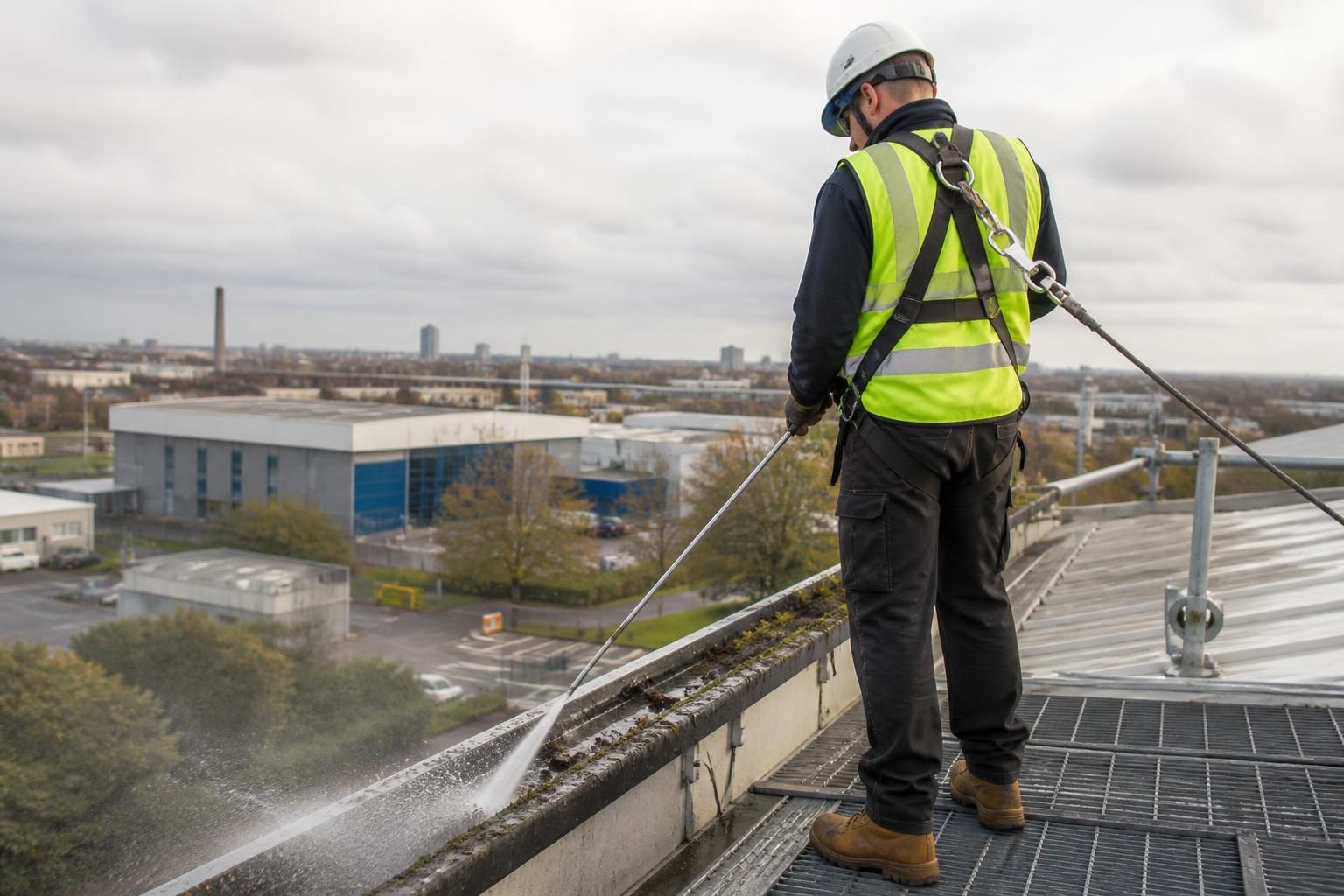
Falls from height are a primary hazard during roof and gutter cleaning. Protection should follow the recognised hierarchy of control: avoid work at height where possible, use collective protection such as scaffolding or edge protection where practicable, and use personal fall-restraint or fall-arrest systems where other measures cannot provide sufficient protection.
Harnesses, lanyards, anchor points and lifelines must be suitable for the task, compatible with one another and inspected before use. Workers need training in their correct use, including how to avoid swing falls and what to do if a person is suspended after a fall. A rescue plan must be in place before relying on fall-arrest equipment; calling the emergency services alone may not provide a sufficiently prompt recovery.
Check for fragile materials and roof defects
Tiles, slates, roof lights, asbestos-containing materials and concealed roof areas may not support a person’s weight. Workers should identify fragile surfaces before starting and use designated access routes, crawling boards, roof ladders or alternative equipment where appropriate. Damaged, loose or displaced tiles should not be disturbed unnecessarily. Any defects discovered during cleaning should be recorded and reported rather than treated as part of the cleaning operation without authorisation.
Pressure washing can dislodge tiles, ridge components, flashing and pointing if the pressure or direction is unsuitable. The cleaning method should therefore be matched to the tile type and condition, with low-pressure or soft-washing techniques used where they provide adequate cleaning with less risk of damage. Operators should avoid directing water beneath laps, flashings or roof coverings.
Work within safe weather limits
Rain, frost, ice, high winds and poor visibility can make access equipment, roof coverings and walkways unsafe. Wet tiles and gutters become particularly slippery, while wind can affect ladders, scaffold, temporary sheeting, hoses and lightweight equipment. Electrical equipment and water also present increased risks during wet conditions. Work should be postponed or suspended when the site cannot be controlled safely, rather than relying on additional caution alone.
Wear task-appropriate PPE
PPE does not replace safe access or other control measures, but it provides an important final layer of protection. Depending on the task, this may include a safety helmet with a secure chin strap, slip-resistant safety footwear, gloves suitable for wet work and cleaning chemicals, eye protection or a face shield, protective clothing and hearing protection.
Respiratory protection may be needed where the process creates dust, mist or chemical vapour, but it must be selected, fitted, maintained and used correctly. Disposable masks should not automatically be treated as suitable for every substance or cleaning method. PPE should be kept clean and inspected for damage before use.
Control falling debris and contaminated water
Loose moss, leaves, silt, broken tile fragments and gutter contents can fall from height and injure people or damage property. Establishing a clearly marked exclusion zone beneath the work area helps prevent access by occupants, pedestrians and other workers. Warning signs, barriers, a banksman or temporary closure of a walkway may be necessary, particularly around commercial premises and public areas.
Gutter waste should be collected rather than allowed to enter drains, neighbouring property or landscaped areas. Downpipes may need to be disconnected, filtered or temporarily protected so that moss, silt and cleaning residues do not cause blockages. Run-off should be directed and contained, with care taken around entrances, electrical points, ventilation openings, sensitive façades and stored materials. Any chemical used must be handled and disposed of in accordance with its safety information and relevant environmental requirements.
Manage pressure-washing equipment and hoses
Pressure washers can cause serious injection injuries, cuts, eye injuries and slips. Operators should never point a lance at another person, use unsuitable nozzles or work beyond the safe operating range of the surface and equipment. Hoses should be routed to avoid trip hazards, sharp edges, doorways and vehicle routes, and connections should be checked before pressurising the system.
Electrical supplies, extension leads and portable equipment must be suitable for wet conditions and protected against damage. Equipment should be inspected and maintained in line with the manufacturer’s instructions and the requirements applying to work equipment. Fuel-powered machines require adequate ventilation and must not be used where exhaust fumes could enter the building.
Identify electrical and other building services
Roof and gutter work may take place close to overhead power lines, solar panels, external lighting, aerials, alarm systems and other services. These should be identified before work begins, with safe clearance distances and isolation arrangements agreed where necessary. Workers should not assume that a cable is safe because it is insulated or appears inactive. Water must not be directed towards electrical installations, openings or equipment that has not been protected.
Protect people, vehicles and the building
Commercial sites often remain occupied during cleaning, so the work area should be coordinated with the client’s site contact. Doors, entrances, loading bays, car parks and pedestrian routes may need temporary protection or diversion. A banksman can help manage reversing vehicles and deliveries where hoses, access platforms or barriers affect traffic movement.
Windows, vents, signage, painted surfaces, render, external lighting and plant should be protected from pressure, chemicals and dirty run-off. Before cleaning, the contractor should agree how vulnerable surfaces and stored items will be covered or isolated. The work area should be left free from standing water, loose debris and trip hazards at the end of each shift.
Use competent personnel and maintain emergency arrangements
Anyone carrying out the work should be competent for the access equipment, cleaning machinery, chemicals and fall-protection systems involved. Supervision should reflect the complexity and risks of the site. Teams should know how to report damaged tiles, equipment failure, chemical exposure, electrical contact, falling objects and near misses.
Emergency arrangements should include first-aid provision, communication methods, site access for emergency responders, a rescue procedure for work at height and arrangements for dealing with spills or uncontrolled water. Equipment inspections, ladder and harness checks, weather decisions and any incidents should be recorded where appropriate. Following the Work at Height Regulations and other applicable health and safety requirements, including controls for hazardous substances and work equipment, helps ensure that roof tile and gutter cleaning is planned and delivered responsibly.
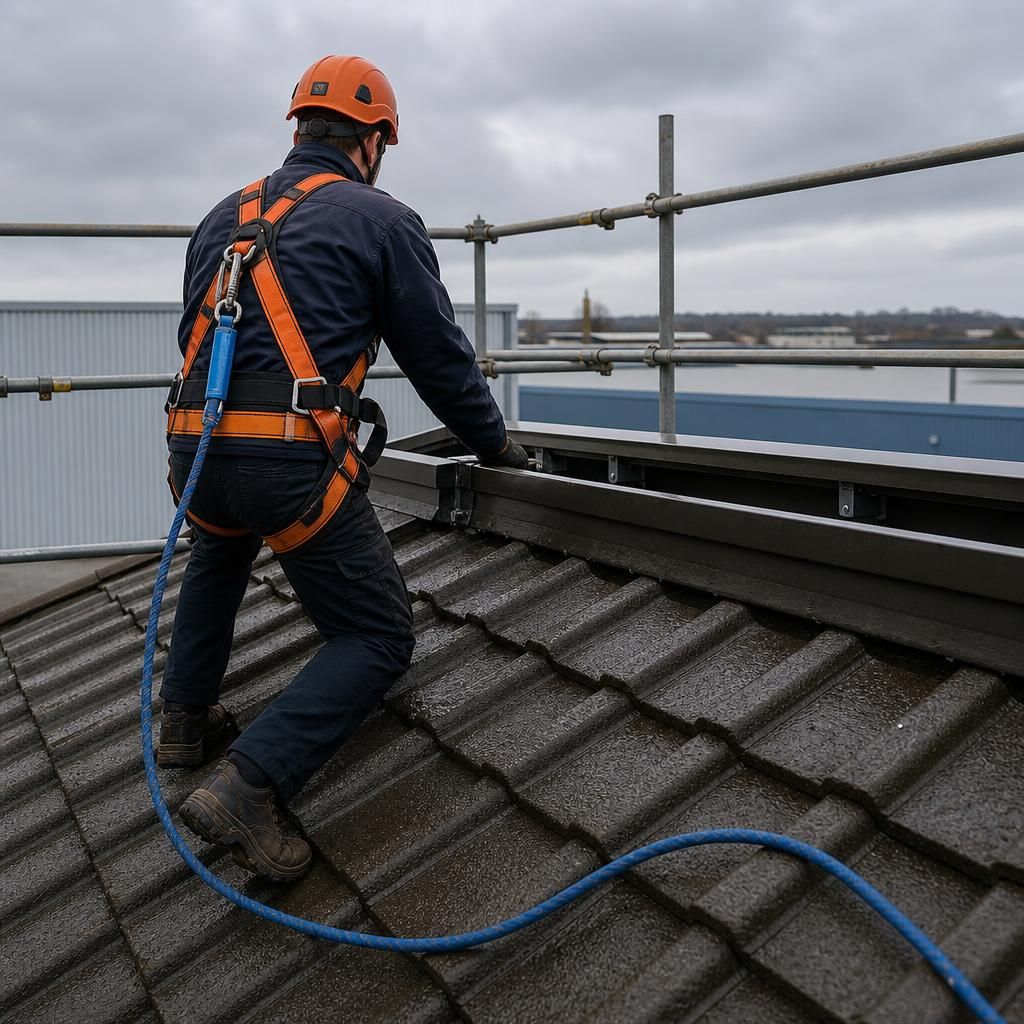
Fall protection is a core safety requirement during roof tile and gutter cleaning because wet surfaces, fragile tiles and changes in roof level can make a fall more likely. Contractors should use suitable collective protection, such as scaffolding, edge protection or a secure working platform, wherever practicable, rather than relying solely on a harness.
Where personal fall-restraint or fall-arrest equipment is necessary, the harness, lanyard, lifeline and anchor points must be compatible, inspected and used by trained personnel. A rescue plan should be agreed before work begins, so anyone suspended after a fall can be recovered promptly and safely.