
What qualifications and certifications should a professional roof tile and gutter cleaning service possess?
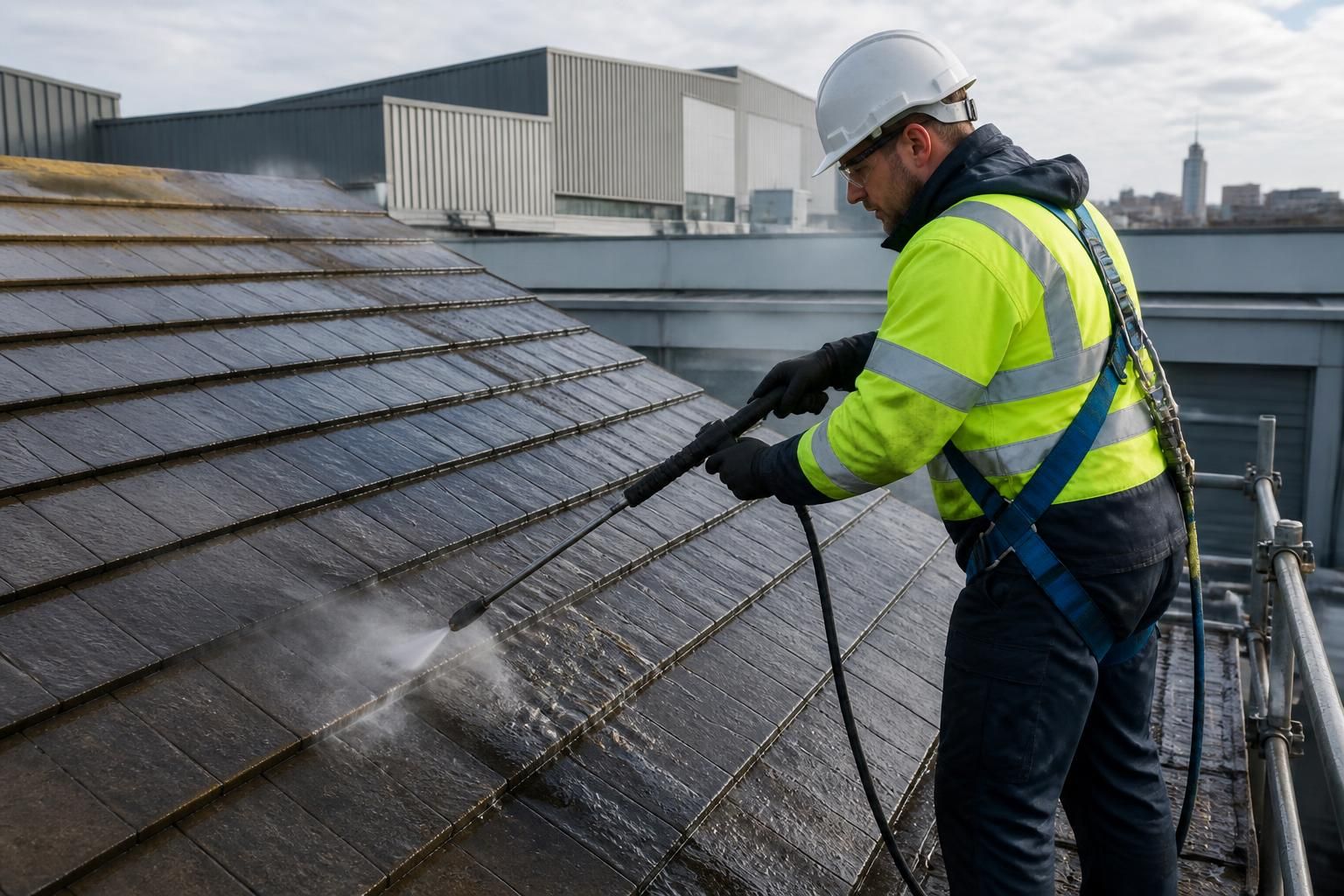
A professional roof tile and gutter cleaning service should be able to demonstrate relevant work-at-height training, trained operators, suitable insurance and documented health and safety procedures. Where access equipment is used, look for appropriate certifications such as IPAF or PASMA, alongside evidence of environmental compliance, risk assessments and experience with different roof and gutter materials.
A professional roof tile and gutter cleaning service should be able to demonstrate competent work-at-height training, suitably trained equipment operators, appropriate insurance, documented risk assessments and effective health and safety procedures. Where access equipment is used, relevant training such as IPAF for powered access platforms or PASMA for mobile access towers may be appropriate. The contractor should also understand different roof and gutter materials, manage cleaning chemicals and waste responsibly, and provide clear evidence that the work will be carried out safely and lawfully.
There is no single UK qualification that automatically makes a company competent to clean every type of roof tile and gutter. Competence is normally demonstrated through a combination of training, practical experience, supervision, suitable equipment and documented procedures. A reputable contractor should be able to explain who will carry out the work, how they have been trained and why the proposed method is suitable for the building.
Work-at-height competence
Roof and gutter cleaning often involves ladders, scaffold, towers, mobile elevating work platforms or roof-access systems. Anyone working at height should have suitable training and understand how to prevent falls, protect other people below and respond to changing weather or site conditions. Training should cover equipment selection, inspection, positioning, safe movement and emergency arrangements rather than simply confirming that an operative has used a ladder before.
For higher-risk work, the contractor should be able to provide evidence of training for the access equipment being used. IPAF training is relevant to powered access platforms, while PASMA training is relevant where mobile access towers are erected and used. These certificates do not replace a site-specific risk assessment, and they are only useful when the equipment and task match the operator’s training.
Roof work may also require knowledge of fragile surfaces, skylights, roof edges, unprotected openings and safe access routes. Operatives should never assume that roof tiles can support their weight. A competent service will identify whether cleaning can be completed from ground level or from a platform, and will avoid walking on the roof where this could crack tiles or damage the underlying structure.
Health and safety documentation
Before work begins, the contractor should prepare a site-specific risk assessment and method statement, often referred to as RAMS. These documents should address:
- Access and work-at-height arrangements
- The condition, pitch and fragility of the roof
- Public access, vehicles, neighbouring properties and falling debris
- Use of pressure washers, steam equipment, gutter vacuums and other machinery
- Water run-off, blocked drains and slip hazards
- Cleaning products, exposure controls and required personal protective equipment
- Weather limits, emergency procedures and rescue arrangements
- Protection of windows, façades, landscaping, vehicles and building services
The method statement should describe the actual building and proposed cleaning process. A generic document that does not account for roof materials, access restrictions or nearby members of the public provides little assurance.
Training for equipment and cleaning methods
Operatives should be trained to use pressure washing, steam cleaning and vacuum equipment safely and to select the lowest-impact method that will achieve the required result. Excessive pressure can dislodge pointing, drive water beneath tiles, damage coatings or force water into the building. Training should therefore include pressure control, nozzle selection, safe distances, run-off management and inspection of cleaned surfaces.
Where biocides, detergents or other treatments are used, the contractor should understand the product instructions, dilution requirements, application controls and first-aid measures. COSHH assessments should identify the risks from substances used at the site and specify suitable storage, handling, PPE and spill response. Chemical treatment should not be presented as a substitute for assessing whether the roof covering can safely tolerate the process.
Insurance and business documentation
Public liability insurance is essential for work that could cause injury to members of the public or damage to a customer’s property. If the business employs staff, employers’ liability insurance is also generally required. The contractor should provide current insurance details on request, including the policy scope and expiry date. Cover should be appropriate to roof access, powered equipment, chemical use and the type of commercial premises being serviced.
Insurance is not proof of technical competence, but a reluctance to provide evidence of suitable cover is a significant concern. Professional indemnity insurance may also be relevant where the contractor provides design, specification or consultancy advice, although it is not normally the main form of cover for routine cleaning.
Equipment inspection and legal compliance
Access equipment, lifting equipment and powered machinery should be maintained and inspected in accordance with the manufacturer’s instructions and applicable UK requirements. The contractor should keep inspection records for items such as towers, platforms, ladders, lifting accessories and fall-protection equipment. Depending on the equipment, duties under PUWER or LOLER may apply. These requirements concern the safe provision, use, examination and maintenance of work equipment; they do not remove the need for trained operators and proper supervision.
Equipment should be selected for the site rather than used simply because it is available. For example, a gutter vacuum may reduce the need for roof access, while a properly positioned platform may be safer than repeated ladder movement. Cables, hoses and discharge pipes should be managed so that they do not create trip hazards or obstruct emergency routes.
Material-specific experience
Evidence of experience with different roof coverings and gutter materials is particularly important. Clay and concrete tiles, slate, coated metal, fibre cement, plastics and older or weathered materials do not all respond to the same pressure, temperature or chemical treatment. A competent contractor should inspect the surface first, identify defects and explain any areas that should be excluded or treated differently.
They should also recognise warning signs such as loose or slipped tiles, damaged ridge or verge details, failed sealant, corroded metal, defective fixings and unstable guttering. Cleaning is not a repair service unless repairs have been agreed separately. Existing defects should be recorded before work, with photographs where appropriate, so that cleaning does not create confusion about pre-existing damage.
Environmental and waste responsibilities
Professional practice includes controlling dirty water, algae, moss, sediment and chemical residues so they do not enter surface-water drains or neighbouring land. The proposed method should explain how run-off will be contained, filtered, collected or safely discharged. Where waste is removed from site, the contractor should follow applicable waste duties and use the appropriate registration or documentation for transporting and disposing of it.
Where an older roof or building may contain asbestos-containing materials, the contractor should have appropriate asbestos awareness and know when work must stop for further assessment. Suspected asbestos should not be disturbed by pressure washing, scraping or drilling. The same principle applies to lead coatings, contaminated deposits and other hazardous materials.
Accreditations and checks to request
Industry accreditations or membership of a recognised assessment scheme can provide additional evidence that a company has been checked for matters such as insurance, health and safety and business procedures. They should be treated as supporting evidence rather than a replacement for task-specific competence. Ask for the scope and current status of any accreditation, because an organisation’s membership does not automatically mean that every operative has the required training.
Before appointing a service, it is reasonable to request:
- Relevant work-at-height and access-equipment training records
- Current public liability and, where applicable, employers’ liability insurance
- A site-specific risk assessment and method statement
- COSHH assessments and product information for any treatments
- Equipment inspection and maintenance records
- Evidence of waste-handling arrangements where material or contaminated water will be removed
- Details of previous experience with the building’s roof and gutter materials
- A clear explanation of exclusions, likely risks and any repairs identified during inspection
For commercial, industrial and public-sector properties, procurement teams may also request additional health and safety information, competence questionnaires, environmental policies and contractor pre-qualification evidence. The exact requirements should reflect the site risk, the access method and the client’s own contractor-management procedures.
The strongest qualification is therefore a documented combination of relevant training, practical roof and gutter experience, safe systems of work, suitable insurance and responsible environmental controls. Certificates should support the assessment, not replace it. If a contractor cannot explain the proposed method, identify the risks or provide basic evidence of competence, they should not be selected for roof tile and gutter cleaning.
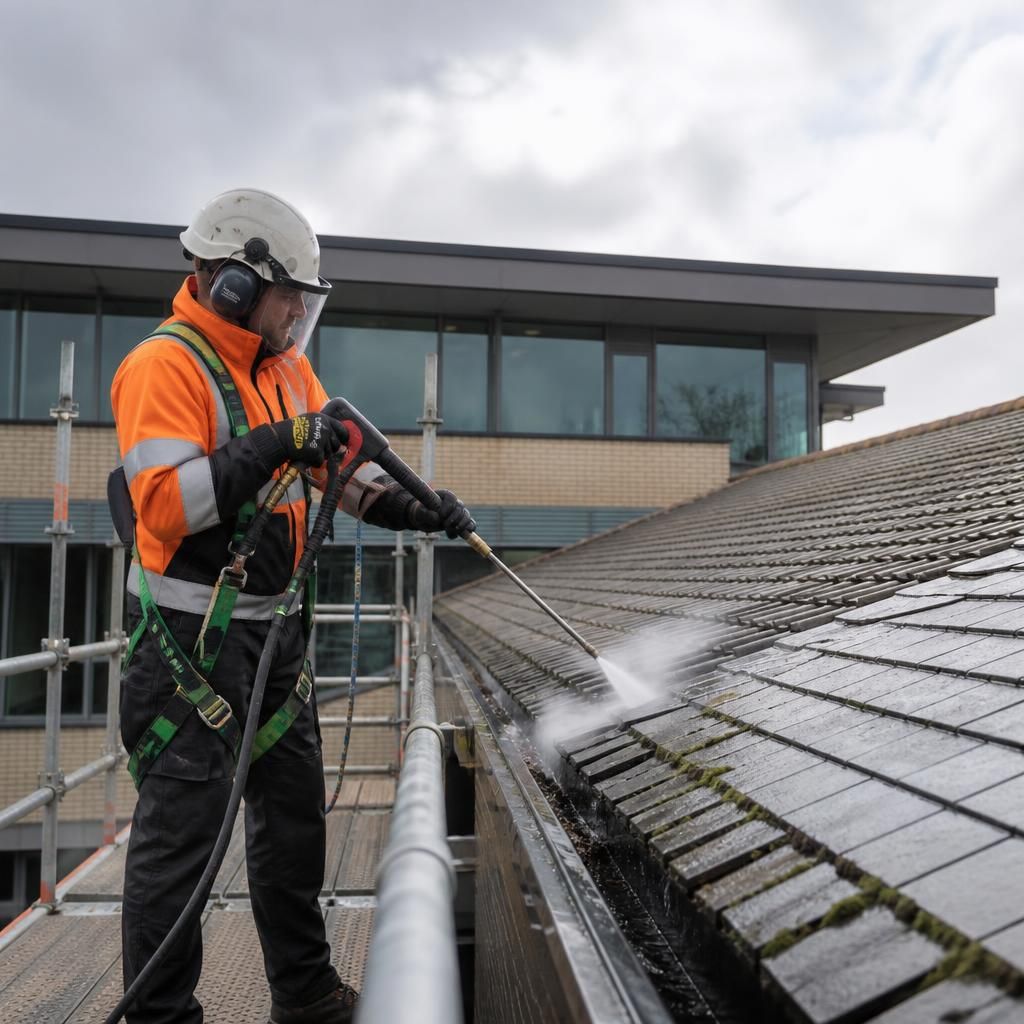
A qualified roof tile and gutter cleaning service should be able to demonstrate competence in work at height, access equipment operation and the safe use of cleaning methods. Relevant training may include IPAF for powered access platforms or PASMA for mobile access towers, where those systems are used.
These certificates support, but do not replace, a site-specific risk assessment and method statement. The contractor should also provide suitable insurance, equipment inspection records and evidence that operatives understand the risks associated with fragile tiles, roof edges, falling debris, water run-off and cleaning treatments. This combination of training, practical experience and documented controls is a more reliable indicator of competence than a certificate alone.
Check Your Roof Cleaning Contractor’s Qualifications
Before arranging roof tile and gutter cleaning, ask Encanto Exterior Cleaning to confirm the proposed access method, relevant training, insurance and site-specific risk controls. We can assess your roof and gutters and explain the safest suitable cleaning approach.