
What safety standards should be followed during playground maintenance?
Playground maintenance should follow relevant UK safety guidance, including BS EN 1176, with documented risk assessments, routine inspections, competent maintenance work and suitable controls for cleaning equipment, chemicals and access operations. The play area should be isolated during work and only reopened after hazards, defects, contamination and residual cleaning risks have been checked and addressed.
Playground maintenance should follow the relevant UK safety standards and site-specific risk controls, particularly the BS EN 1176 series for play equipment and BS EN 1177 for impact-attenuating playground surfacing. Safe maintenance also requires documented risk assessments, competent personnel, controlled use of cleaning equipment and chemicals, suitable protection from work at height and traffic hazards, and effective isolation of the play area until all risks have been addressed.
Use the correct standards and guidance. BS EN 1176 sets requirements for playground equipment, including construction, installation, inspection and maintenance. BS EN 1177 covers the performance of impact-absorbing surfacing, such as wet-pour rubber, synthetic grass, sand and other loose-fill materials. The equipment manufacturer’s maintenance instructions, the site’s inspection schedule and relevant Health and Safety Executive guidance should also be followed. Where a contract or local authority specification requires additional standards, those requirements should be included in the maintenance plan.
Standards do not remove the need for a site-specific assessment. The responsible person should consider the equipment layout, surface type, age range, accessibility, surrounding roads and paths, weather conditions, drainage, nearby residents and the methods being used. A competent person should decide which controls are necessary and when specialist inspection or repair is required.
Complete a risk assessment before work starts. The assessment should identify hazards associated with:
- Defective or unstable play equipment, sharp edges, protruding fixings and entrapment points;
- Loose-fill surfacing, trip hazards, exposed foundations, damaged wet-pour areas and uneven transitions;
- Slips caused by algae, moss, mud, cleaning residues, standing water or overspray;
- Pressure washers, steam-cleaning equipment, hoses, electrical supplies and moving machinery;
- Cleaning chemicals, including skin, eye, inhalation and environmental risks;
- Work at height, ladders, powered access equipment and falling objects;
- Vehicles, plant and equipment moving close to children, pedestrians or public roads;
- Manual handling, noise, vibration, contaminated water and poor weather; and
- Unauthorised access to the work area while cleaning, repairs or inspections are taking place.
The risk assessment should set out control measures, responsibilities, emergency arrangements and the conditions under which work must stop. It should be reviewed when the equipment, surface, cleaning method or site conditions change.
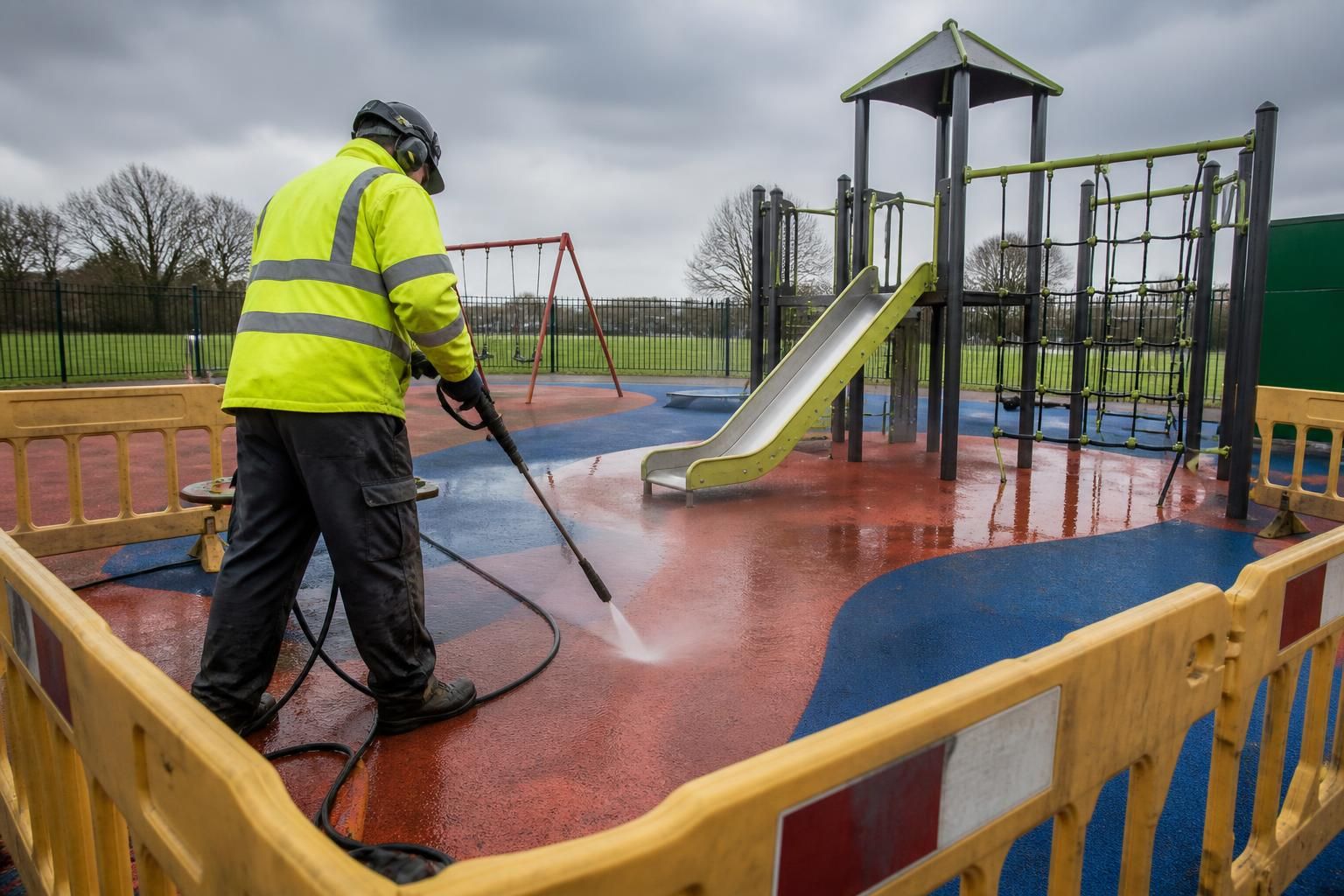
Isolate the playground during maintenance. The play area should be closed before equipment, chemicals or pressurised water are brought onto site. Use secure barriers and clear warning notices rather than relying only on cones or verbal instructions. Access points should be controlled, and nearby footpaths or vehicle routes should be managed where hoses, machinery or wash water could create a hazard.
Where the playground is next to a school, nursery, park or housing development, agree the closure arrangements with the site contact. Do not leave equipment, hoses, tools or chemicals unattended where children could reach them. If the work is being completed in stages, each completed section should remain segregated until it has passed its checks.
Use competent people and suitable equipment. Anyone carrying out inspections, cleaning or repairs should have the training, experience and instruction appropriate to the task. Operators should understand the equipment manufacturer’s guidance, the cleaning system, emergency shutdown procedures and the risks of working around children and the public. Specialist defects, structural concerns, damaged foundations or safety-critical repairs should be referred to a suitably competent playground inspector, installer or repair specialist.
Work equipment should be selected, maintained and checked in line with the Provision and Use of Work Equipment Regulations (PUWER), where applicable. Electrical equipment should be suitable for outdoor use and protected from water. Hoses and cables should be routed to prevent trips, and pressure-washing equipment should never be directed at people, electrical components, damaged surfaces or areas where water could enter unsafe locations.
Control cleaning chemicals and contaminated water. Cleaning products should be selected for the particular surface and used in accordance with the product safety information and manufacturer’s instructions. The Control of Substances Hazardous to Health Regulations (COSHH) may apply where substances could harm people through contact, inhalation or ingestion. COSHH assessments should cover storage, dilution, handling, personal protective equipment, spill response and disposal.
Do not mix cleaning products unless the manufacturer specifically permits it. Prevent children, members of the public and unprotected workers from entering areas where chemicals are being applied or residues remain. Rinse or recover residues as appropriate for the surface and product, and prevent dirty water or chemical run-off from entering drains, planted areas or watercourses unless it is safe and legally permitted to do so.
Protect workers during pressure washing and steam cleaning. Operators should wear task-appropriate personal protective equipment, which may include protective footwear, gloves, eye or face protection, hearing protection and waterproof clothing. PPE is an additional control, not a substitute for isolation, safe working distances and proper equipment handling.
Pressure should be kept appropriate to the material. Excessive pressure can damage wet-pour surfacing, synthetic grass, line markings, timber, coatings, fixings and drainage details. A small test area should be checked before full cleaning begins, particularly on older or repaired surfaces. Operators should control spray direction, avoid creating airborne contamination and take account of wind, visibility and nearby users.
Apply work-at-height and access controls where needed. If cleaning involves canopies, roofs, high façades or elevated play features, the Work at Height Regulations may apply. Work should be planned and supervised, with collective protection used where reasonably practicable. Ladders should only be used where suitable for the task and conditions. Powered access equipment must be operated by trained and authorised personnel, positioned on stable ground and kept away from children, overhead hazards and unsafe edges.
Where lifting equipment or accessories are used, the relevant lifting-equipment requirements, including LOLER where applicable, should be considered. Tools and materials should be secured so they cannot fall into the play area, and the exclusion zone should account for the potential reach of the equipment and falling objects.
Inspect equipment and surfacing as part of the work. Cleaning is not a substitute for a formal playground inspection. Before work, look for obvious defects that could affect the method or make the area unsafe, including:
- Loose, broken, cracked or missing components;
- Sharp edges, exposed fixings, splinters and damaged welds;
- Movement, corrosion or deterioration in posts, platforms, barriers and anchors;
- Blocked drainage, standing water and wash-out around foundations;
- Holes, gaps, raised edges, worn patches and failed joints in the surface;
- Insufficient or displaced loose-fill material in impact zones;
- Roots, stones, glass, animal fouling, litter and other foreign objects; and
- Graffiti or contamination that may require a specialist treatment.
Any defect that could cause immediate injury should result in the affected equipment or area being taken out of use. Cleaning teams should report defects rather than attempting unapproved repairs or concealing them through cleaning. Photographs, location details and a clear description of the action required help the responsible person arrange follow-up work.
Follow a documented inspection and maintenance system. A suitable system normally combines routine visual checks, operational checks and a more detailed periodic inspection, with the frequency determined by the equipment, intensity of use, exposure, vandalism risk and manufacturer’s instructions. A competent person should carry out the detailed inspection, and independent specialist input may be appropriate where there is doubt about structural integrity or compliance.
Records should identify the site, date, areas inspected, findings, cleaning or repair work completed, products used where relevant, defects reported, equipment taken out of use and the person responsible. Keep records with previous inspection information so recurring problems, drainage failures, surface wear or vandalism can be identified and addressed.
Reopen only after a final safety check. Before removing barriers, confirm that:
- Equipment and surfacing are free from debris, tools, loose components and hazardous contamination;
- Cleaning residues have been removed or have dried sufficiently;
- Surfaces are not unacceptably slippery and there is no standing water or uncontrolled run-off;
- Hoses, cables, barriers and machinery have been removed;
- Repairs or defects identified during the work have been completed, isolated or clearly recorded;
- Access routes, gates and impact areas are clear; and
- The person responsible for the site has received the completion information and understands any restrictions that remain.
If conditions are unsuitable, such as severe weather, poor visibility, unstable ground or a defect that cannot be controlled, postpone the work or keep the affected area closed. Following BS EN 1176 and BS EN 1177 alongside the Health and Safety at Work etc. Act, PUWER, COSHH and work-at-height requirements provides a robust framework, but safe playground maintenance ultimately depends on competent assessment, careful isolation, appropriate cleaning methods and accurate records.
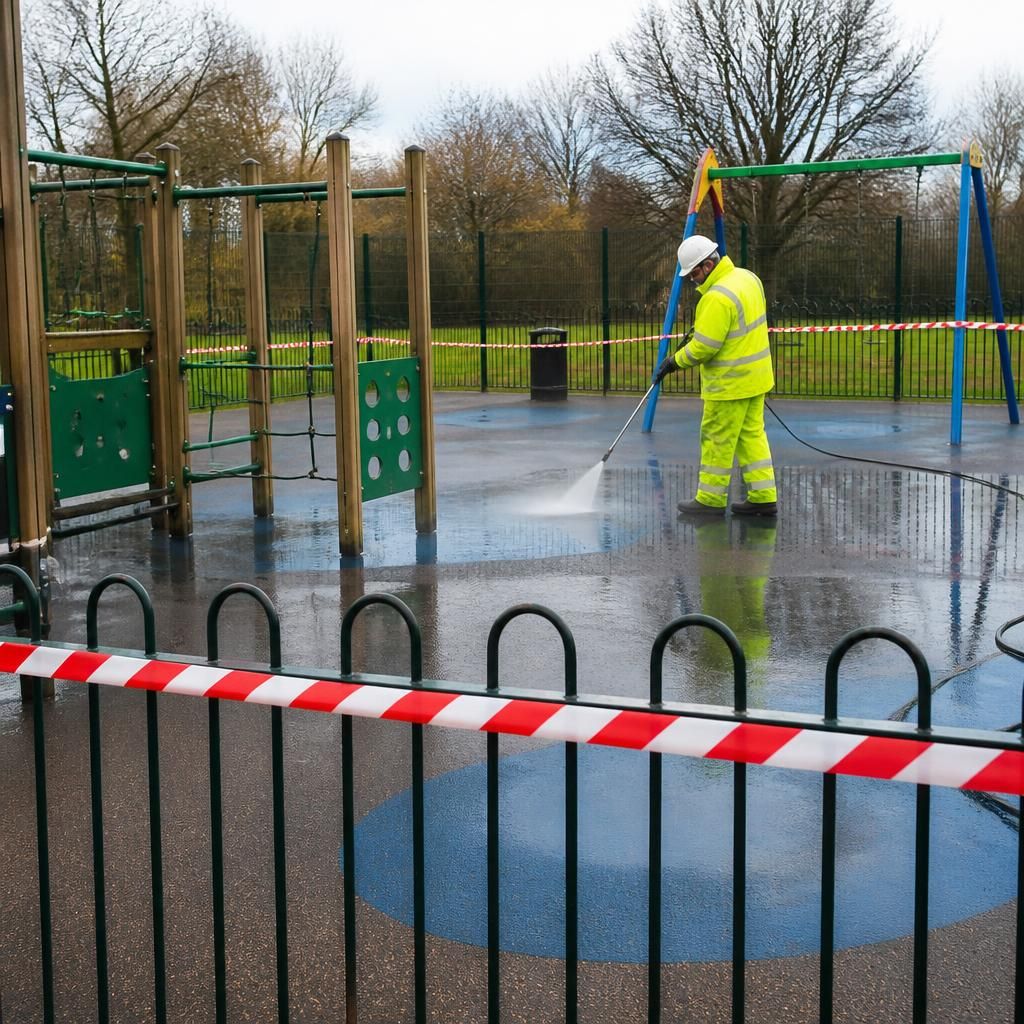
Isolating the playground throughout maintenance is a fundamental safety control. Close the area before bringing in pressure washers, hoses, chemicals, tools or access equipment, and use secure barriers with clear warning signs. Cones alone may not prevent children or members of the public from entering.
Keep each completed section segregated until it has been checked. Before reopening, confirm that equipment and surfacing are free from debris, cleaning residues, standing water, loose components and trip hazards. Hoses, cables, tools and barriers should be removed, while any unresolved defect must be repaired or the affected area kept out of use and clearly recorded.