
What safety standards and guidelines should playground maintenance adhere to in the UK?
UK playground maintenance should follow the relevant BS EN 1176 equipment and playground standard and BS EN 1177 impact-absorbing surfacing requirements, alongside the site operator’s duties under the Health and Safety at Work etc. Act and associated regulations. A suitable maintenance regime should include documented risk assessments, routine visual checks, operational inspections, periodic detailed inspections, prompt defect repairs and accurate records, with work carried out by competent personnel using appropriate safety controls.
UK playground maintenance should be planned and carried out in line with the relevant BS EN 1176 equipment and playground standard, BS EN 1177 impact-absorbing surfacing requirements, the manufacturer’s instructions and the operator’s legal health and safety duties. A compliant regime combines documented risk assessments, routine checks, competent inspections, safe cleaning methods, prompt defect control and clear maintenance records.
The main standards and legal duties
- BS EN 1176 covers playground equipment and its safe use, installation, inspection and maintenance. The relevant parts should be applied to the equipment present, including requirements relating to entrapment, falls, impact areas, structural integrity, moving parts, access and user safety.
- BS EN 1176-7 provides guidance on installation, inspection, maintenance and operation. It supports the use of routine visual checks, operational inspections and more detailed periodic inspections by suitably competent people.
- BS EN 1177 applies to impact-attenuating playground surfacing. It addresses the ability of surfaces to reduce injury risk from falls, including performance linked to critical fall height. Surface condition, depth, drainage and wear must be considered rather than treating the material as purely decorative.
- The Health and Safety at Work etc. Act 1974 places duties on those responsible for premises and activities to protect employees and members of the public who may be affected by their work.
- The Management of Health and Safety at Work Regulations 1999 require suitable and sufficient risk assessments, appropriate arrangements and competent assistance. Significant findings and control measures should be recorded where applicable.
- COSHH applies where cleaning products, disinfectants, algae treatments or other hazardous substances are used. Product assessments, safe handling instructions, storage controls and suitable personal protective equipment must be in place.
- PUWER may apply to pressure washers, powered cleaning equipment and other work equipment. Equipment must be suitable, maintained, inspected where necessary and used by people who have received appropriate information and instruction.
- LOLER may apply when lifting equipment or lifting accessories are used during maintenance. Any applicable examination, planning and safe-use requirements must be addressed.
These requirements do not mean that every playground has an identical inspection timetable. The operator should set frequencies according to the site’s design, age, usage, location, vandalism risk, weather exposure, surfacing type, manufacturer’s guidance and previous defects. Local authority procedures, lease conditions, insurers and contract specifications may also impose additional requirements.
Risk assessment and maintenance planning
Before work starts, the responsible organisation should assess the risks created by both the playground and the maintenance activity. The assessment should cover falls, sharp edges, loose or damaged components, entrapment points, unstable equipment, contaminated surfaces, trip hazards, vehicles, members of the public, weather conditions and any interaction between contractors and children.
Cleaning and repair tasks need their own controls. A work plan should identify the equipment and surfaces being treated, the products and machinery required, access arrangements, drainage routes, electrical risks, expected drying time and the method for reopening the area. Where the playground remains near a school, park, housing development or public route, the plan should also consider children, pedestrians, staff and other unauthorised people entering the work zone.
Inspection and defect control
A practical maintenance system normally includes the following levels of inspection:
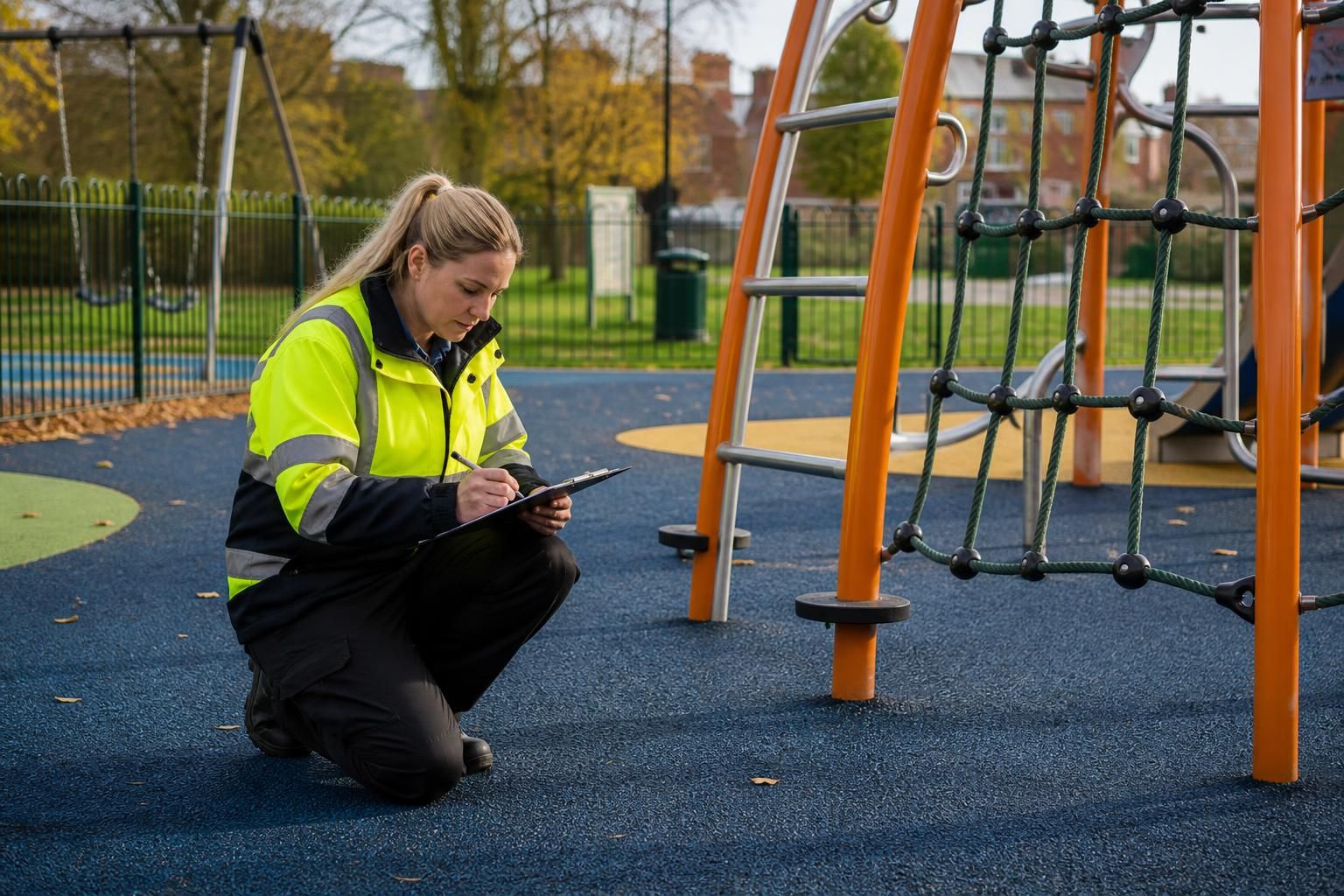
- Routine visual checks: look for obvious hazards such as broken components, exposed foundations, glass, litter, vandalism, animal fouling, damaged surfacing, standing water and contamination. These checks should be frequent enough for the site’s risk profile.
- Operational inspections: test the function and stability of equipment, including moving parts, gates, fasteners, chains, seats, bearings and access elements. Unusual movement, noise or resistance should be investigated.
- Detailed periodic inspections: examine wear, corrosion, structural condition, fixings, foundations, drainage, impact areas and surfacing performance. This should be completed by a person with suitable knowledge and experience of playground equipment and the applicable standards.
- Post-incident or post-event checks: inspect after serious vandalism, flooding, storms, fire, construction work, suspected contamination or any incident that could have affected safety.
Defects should be assessed by risk rather than left until a scheduled visit. An immediate danger should result in the affected equipment or playground being taken out of use, isolated and clearly marked. Less urgent defects should still receive a named owner, target completion date and follow-up check. Temporary repairs must not be treated as a permanent solution unless they are suitable, secure and authorised.
Safe maintenance and cleaning practices
Playgrounds should be closed or effectively segregated while pressure washing, steam cleaning, repairs or chemical treatment are taking place. Barriers and warning signs should prevent access to the work area, including access from the sides or through nearby gates. Operators should not rely solely on a sign where children could easily enter the zone.
Cleaning methods must be selected for the surface and equipment. Excessive pressure can dislodge rubber granules, damage wet-pour binders, remove protective coatings, force water into bearings or spread contamination. Steam and hot water can create burn risks and may affect adhesives, painted finishes or synthetic materials. Detergents and biocides should be used only where appropriate, in accordance with the product label and COSHH assessment.
Run-off should be controlled so that dirty water, chemicals, silt or biological contamination do not flow into adjacent play areas, drains or watercourses. The surface should be left clean, stable and sufficiently dry before reopening. Any remaining slip risk, loose aggregate, pooling or surface damage should be corrected rather than concealed by cleaning.
Those carrying out the work should use suitable personal protective equipment, which may include gloves, eye or face protection, hearing protection, safety footwear and waterproof clothing. PPE is the final layer of control and does not replace isolation, safe equipment, ventilation, training or good site management. Hoses, cables and machinery should be positioned to prevent trip hazards, and electrical equipment should be protected from water in accordance with the manufacturer’s instructions.
Competence and supervision
People undertaking routine cleaning must understand the equipment, surface materials, chemicals and risks involved. More complex inspections, structural repairs, surfacing assessments and work at height should be assigned to suitably competent personnel. Competence should be based on relevant training, practical experience, knowledge of the applicable standards and the ability to recognise when specialist advice is required.
Where access equipment, ladders, mobile platforms or lifting equipment are needed, the task should be planned separately. The equipment must be appropriate, inspected and used on stable ground by trained personnel. Work at height should be avoided where practicable and otherwise controlled through suitable access equipment, exclusion zones and fall prevention measures.
Records and evidence of compliance
Maintenance records should identify the site, date, inspector or contractor, weather or site conditions where relevant, equipment and surfaces checked, defects found, action taken, products or methods used, areas closed and the date of reopening. Photographs, repair invoices, inspection reports and certificates can provide useful supporting evidence.
Records should be retained in a form that allows the operator to demonstrate what was checked, who completed it and how defects were managed. They also help identify recurring problems, such as poor drainage, repeated vandalism, settlement or accelerated wear, so that the underlying cause can be addressed.
Before reopening the playground
- Remove tools, hoses, barriers and cleaning materials.
- Check that equipment is secure, complete and free from sharp edges, loose parts and hazardous residues.
- Confirm that surfacing is intact, sufficiently dry, evenly distributed where loose-fill material is used and free from trip hazards.
- Check that gates, access routes, drainage points and surrounding areas are safe.
- Verify that any repaired or treated component has been cleared for use in accordance with the manufacturer’s instructions or repair specification.
- Record the inspection and only remove the closure controls when the responsible person is satisfied that the area is safe to reopen.
Standards and guidance should be checked against the current edition and the specific equipment manufacturer’s instructions, as requirements can change and individual products may have additional limitations. A written maintenance system that links risk assessment, inspection, cleaning, repair and record keeping provides the clearest way to protect users and demonstrate that the playground is being managed responsibly.
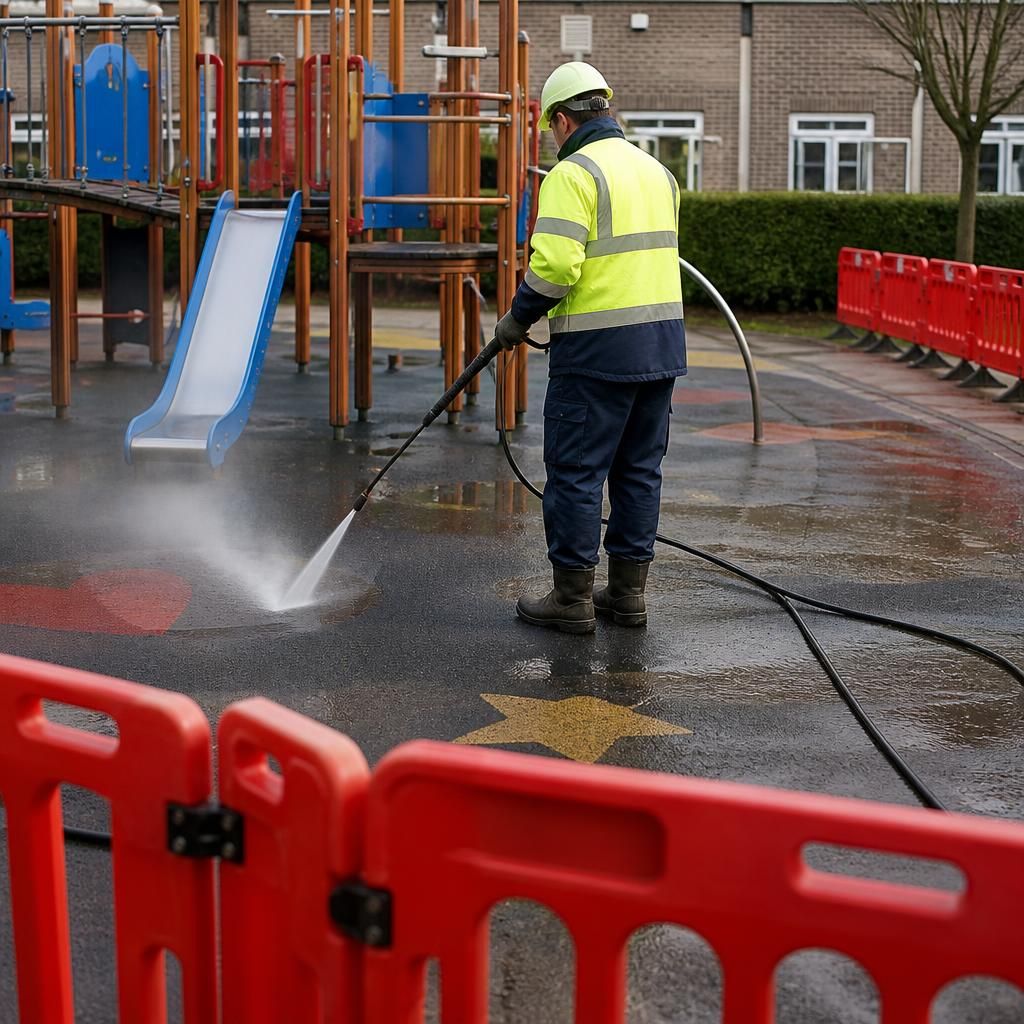
Playgrounds should remain closed or effectively segregated during pressure washing, steam cleaning, chemical treatment and repairs. Barriers must prevent children and members of the public entering the work area, including from nearby gates or surrounding paths. Warning signs support this control but should not be the only protection where unauthorised access is possible.
Before reopening, the responsible person should check that equipment is secure, surfaces are sufficiently dry, loose materials and residues have been removed, and no trip, slip or contamination hazards remain. Hoses, tools and cleaning materials must be cleared away, run-off controlled and the reopening check recorded.