
What considerations should be taken into account when selecting a playground maintenance service?
When selecting a playground maintenance service, assess the contractor’s experience with play areas, knowledge of relevant UK safety standards, cleaning methods, access equipment, insurance and risk controls. Choose a provider that can inspect surfaces and equipment, identify hazards, work around site users and provide clear recommendations for planned and reactive maintenance.
Select a playground maintenance service by assessing its experience with play areas, understanding of UK safety requirements, cleaning methods, inspection procedures, risk controls and ability to work around children and the public. The contractor should provide a clear scope of work, suitable insurance, documented method statements and useful maintenance reports rather than offering cleaning as an isolated task.
Experience with playground environments
Playgrounds require more careful planning than many other exterior surfaces. A suitable contractor should understand how surfacing, play equipment, fencing, seating, bins and surrounding paths are used, and how cleaning activities can affect safety. Ask whether the team has worked on similar sites, including schools, parks, housing developments, leisure facilities or public open spaces.
Experience should include working around vulnerable site users, managing restricted access and identifying conditions that may need to be reported to the site operator. Cleaning personnel should know when an issue is outside their role, such as damaged equipment, exposed foundations, loose fixings or a surface that may no longer provide adequate impact attenuation.
Knowledge of relevant standards and responsibilities
The service provider should be familiar with the standards and guidance relevant to the site, including the BS EN 1176 series for playground equipment and the BS EN 1177 standard relating to impact-attenuating playground surfacing, where applicable. They should also understand the importance of routine visual checks, operational inspections, recorded maintenance and appropriate post-installation or periodic inspections by competent personnel.
Cleaning does not replace a formal playground inspection or safety assessment. A responsible contractor will explain the limits of the service and report defects rather than implying that pressure washing or surface treatment makes equipment compliant. Where a site has specific local authority, school, landlord or insurer requirements, these should be included in the maintenance plan.
Ability to assess the work before starting
A site survey should consider the type and condition of each surface, drainage, access, water supply, nearby buildings, electrical equipment, planting, play equipment and the likely effect of cleaning on users. The contractor should ask about previous treatments, known defects, contamination, restricted areas and any requirements for working outside normal opening hours.
Pre-work checks are particularly important where surfaces are worn, loose, cracked, heavily soiled or poorly drained. A competent provider should identify areas requiring repair, isolation or specialist advice before cleaning begins. Photographs and condition notes can make the recommendations easier to review and provide a useful baseline for future maintenance.
Appropriate cleaning methods and equipment
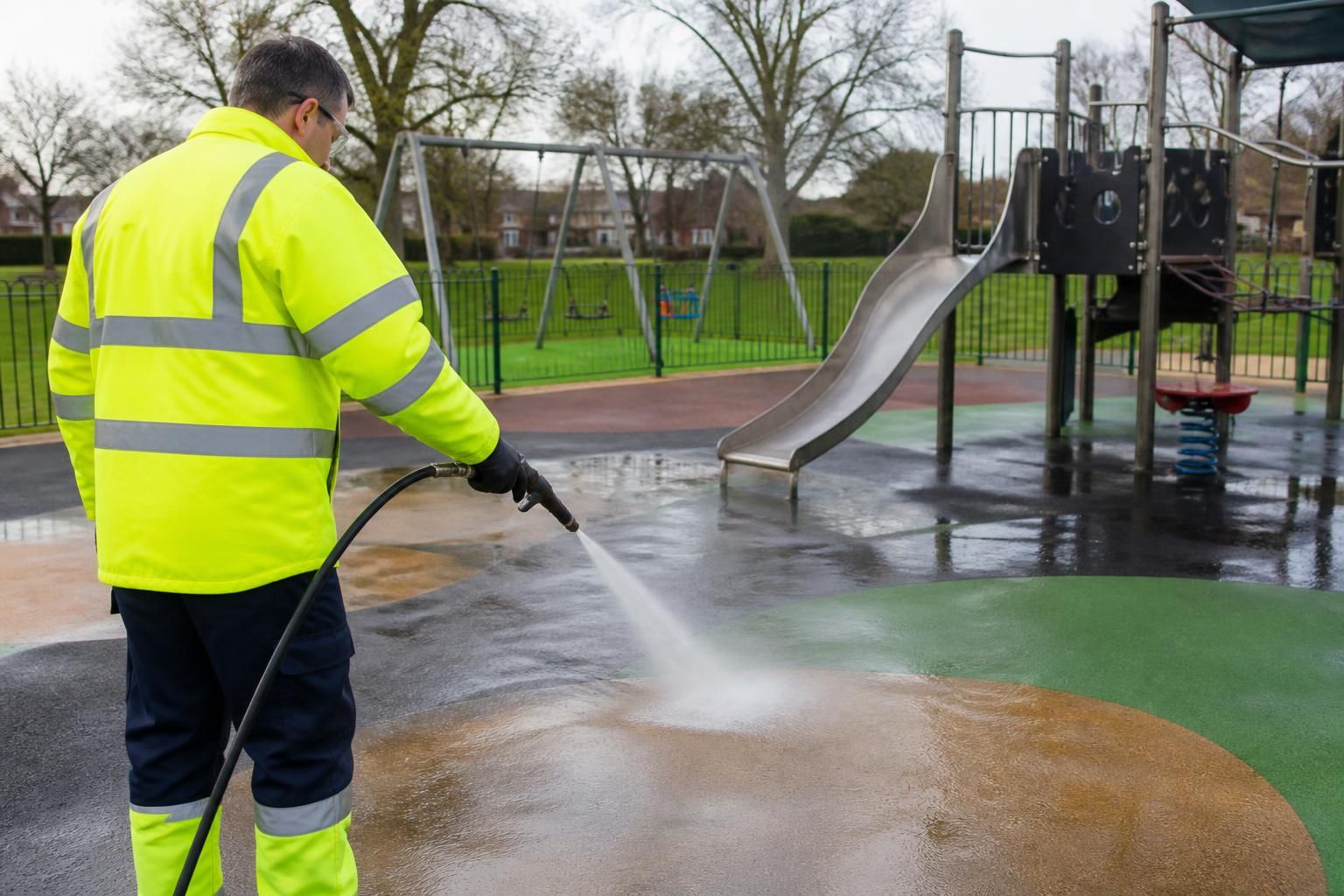
The contractor should select the method according to the material and condition of the surface, not simply use the highest available pressure. Rubber wet-pour, rubber tiles, artificial grass, tarmac, concrete, block paving, timber and metal components each require different treatment. Excessive pressure, unsuitable chemicals or aggressive agitation can damage the surface, remove jointing material, affect slip resistance or force water beneath play equipment.
Ask the provider to explain:
- Which cleaning method will be used on each material and why it is suitable.
- Whether pressure washing, steam cleaning, soft washing, rotary cleaning or manual treatment is required.
- How detergents will be selected, diluted, applied and rinsed away.
- How run-off, waste water and loosened contamination will be controlled.
- How sensitive items such as safety surfacing, labels, bearings, electrical fittings and drainage channels will be protected.
- How the surface will be left safe to use, including the removal of standing water and residues.
A small test area may be appropriate where the surface is unfamiliar, heavily weathered or previously treated. The provider should also have suitable access equipment for difficult areas without placing ladders, vehicles or hoses where they could create additional hazards.
Risk assessments, method statements and site controls
Before work begins, request task-specific risk assessments and method statements. These should cover public protection, equipment isolation, slips and trips, water and electrical hazards, chemical handling, pressure-washing risks, manual handling, weather conditions, access arrangements and emergency procedures.
Effective controls may include barriers, warning signs, a controlled work zone, a banksman where vehicles or equipment are moving, and a clear process for preventing access until the area is safe. If the playground is next to a school, nursery or public footpath, the timing and segregation arrangements should be agreed with the responsible person in advance.
Where chemicals are used, the contractor should follow COSHH requirements and provide suitable product information. Operatives should use appropriate personal protective equipment and prevent chemical or contaminated water from entering drains, planted areas or watercourses unless the discharge is properly controlled.
Insurance, competence and workforce arrangements
Check that the company carries appropriate public liability and employers’ liability insurance, with cover suitable for the type and scale of work. Depending on the site, additional cover or evidence of competence may be required for work at height, use of access equipment, traffic management or specialist treatments.
Ask how operatives are trained and supervised, whether subcontractors will be used and who will be responsible for the work on site. A reliable service should be able to explain its escalation process when operatives find a safety defect or encounter conditions that differ from the original survey.
Clear scope, frequency and response arrangements
Compare quotations by checking exactly what is included. The scope should identify the areas to be cleaned, preparation and rinsing requirements, treatment of algae or organic growth, removal of litter and debris, protection of adjacent surfaces, waste handling, reinstatement and final checks. It should also state what is excluded, such as repairs, graffiti removal, specialist equipment inspections or resurfacing.
For sites with regular use, a planned maintenance schedule is usually more useful than occasional reactive cleaning. The frequency should reflect usage, shade, drainage, nearby vegetation, weather exposure, contamination and the findings of inspections. The contractor should be able to provide a process for urgent attendance where contamination, vandalism, flooding or a newly identified hazard prevents safe use.
Reporting and follow-up
Good records should confirm the date and areas treated, methods used, products applied where relevant, defects observed, photographs, restrictions placed on the playground and any recommendations for follow-up work. Reports should distinguish between cleaning observations and findings that require assessment by an equipment inspector, surfacing specialist, grounds contractor or repair provider.
It is also worth checking how recommendations are prioritised. Issues that could affect immediate safety should be clearly separated from cosmetic defects and longer-term maintenance suggestions. This helps the site manager make informed decisions without treating every observation as the same level of risk.
Value, communication and contract terms
The lowest quotation may not provide the best value if it omits preparation, safe isolation, waste handling, reporting or suitable treatment for the surface. Compare the method, resources, insurance, response times, reporting standard and follow-up support as well as the price. Ask about cancellation arrangements, weather-related delays, access requirements and how additional work will be authorised.
The contractor should communicate clearly before, during and after the work. They should confirm the planned access arrangements, notify the responsible person of any change in scope and avoid leaving the site unavailable longer than necessary. After completion, the playground should be checked for residues, pooled water, displaced material, equipment damage and other conditions that could affect safe reopening.
For most commercial and public playgrounds, the strongest choice is a specialist exterior cleaning contractor that combines material-specific cleaning with disciplined site controls, accurate reporting and sensible escalation of defects. A pre-start survey and written scope will make it easier to confirm that the service is suitable for the playground, its users and the standards that apply to the site.
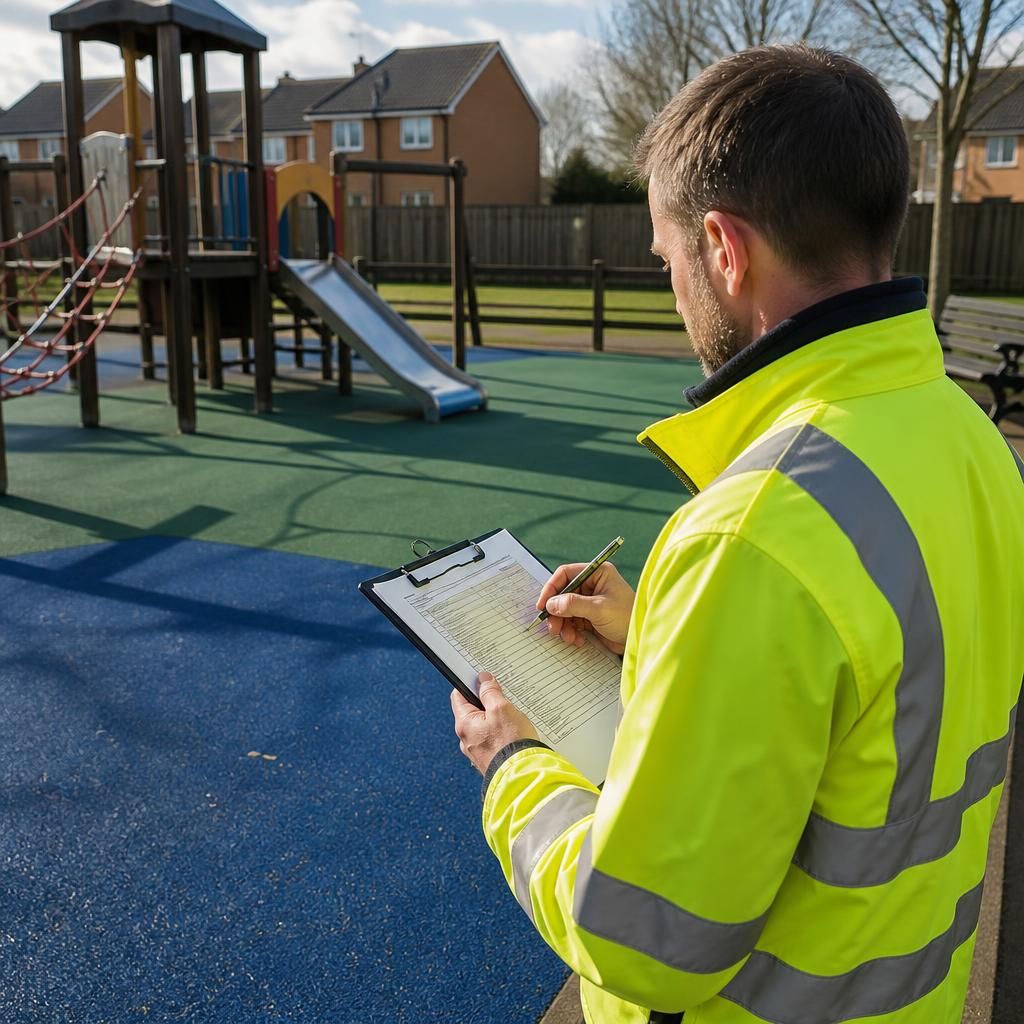
A pre-work site survey is a key sign that a playground maintenance service understands the risks involved. Before cleaning begins, the contractor should assess the surfacing, play equipment, drainage, access routes, nearby planting and areas used by the public. This helps determine suitable cleaning methods and identify conditions that may need repair, isolation or specialist inspection.
Ask for a written scope of work supported by a task-specific risk assessment and method statement. These documents should explain how the playground will be segregated, how run-off and chemicals will be controlled, how sensitive surfaces will be protected and what checks will be completed before reopening. A reliable contractor will also record defects with photographs and clearly distinguish cleaning observations from issues requiring attention by an equipment inspector or surfacing specialist.