
What are the safety protocols for cleaning playground surfaces?
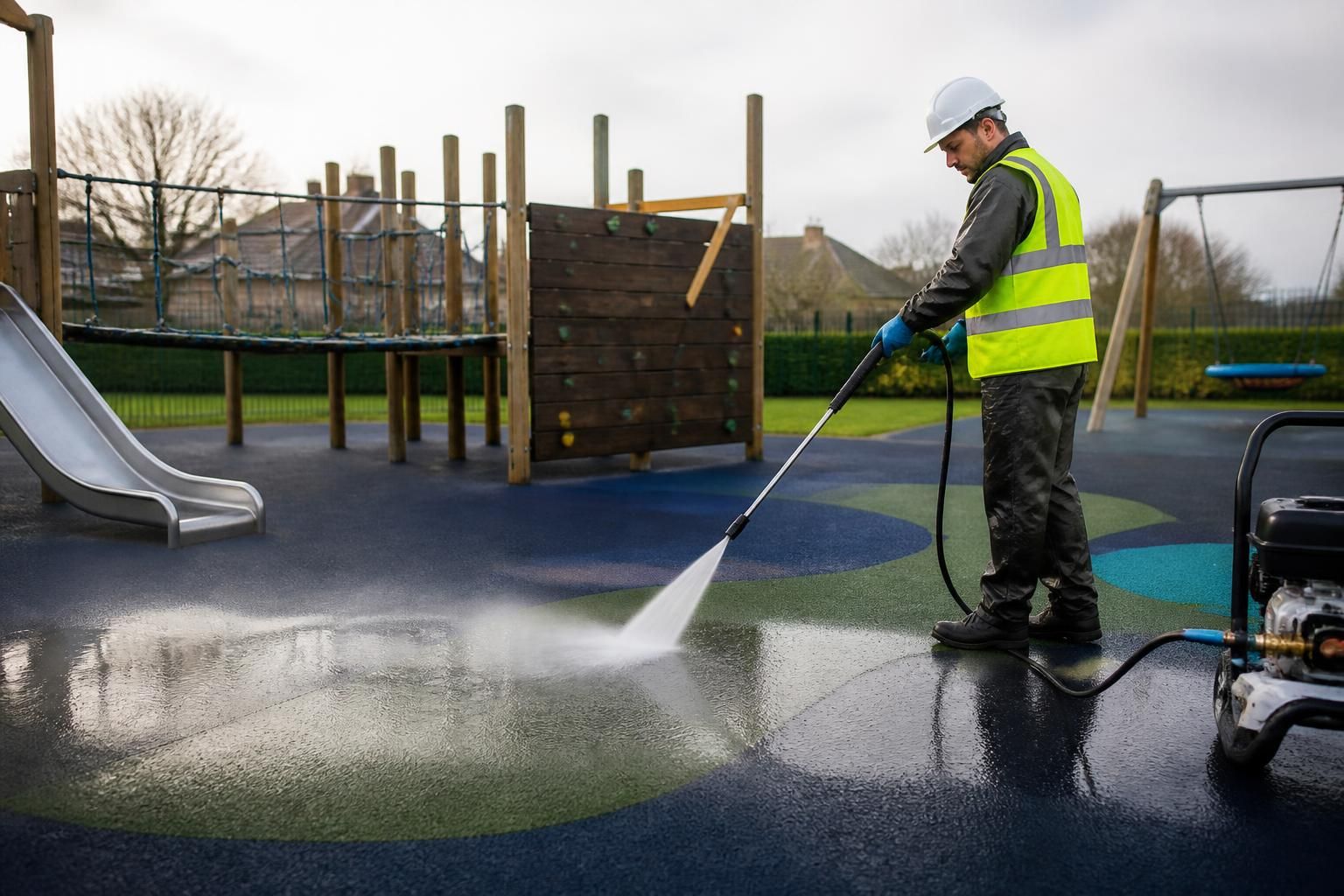
Safety protocols for cleaning playground surfaces include completing a site-specific risk assessment, isolating the play area, inspecting equipment and surfaces, and selecting cleaning methods, pressure levels and chemicals that will not cause damage or create slip hazards. Operatives should use appropriate personal protective equipment, control water and chemical run-off, check the area for defects after cleaning, and only reopen the playground when surfaces are clean, dry and safe for children.
Safe playground surface cleaning requires a documented risk assessment, effective isolation of the play area, suitable equipment and cleaning products, controlled water and chemical run-off, and a final inspection before the site is reopened. The cleaning method must remove contamination without damaging the surface, reducing impact-attenuation performance or leaving conditions that could cause slips, trips or skin irritation.
Cleaning is also only one part of playground safety. It does not replace routine visual checks, operational inspections or formal assessments of equipment and impact-absorbing surfaces. Where defects are identified, the area or affected item should remain out of use until it has been assessed and, where necessary, repaired by a competent person.
Complete a site-specific risk assessment
Before work begins, the operative should assess the playground, its access routes, surrounding land and the planned cleaning process. The assessment should consider:
- The type and condition of the surface, such as wet-pour rubber, rubber tiles, artificial grass, sand, bark, woodchip, bonded rubber, concrete or tarmac.
- Nearby play equipment, fencing, seating, lighting, drainage channels, planting and electrical installations.
- Potential contamination, including mud, algae, bird fouling, chewing gum, oils, litter, sharps or other hazardous materials.
- Slopes, uneven ground, trip hazards and areas where water could collect.
- Weather conditions, particularly rain, frost, strong wind and high temperatures that could affect drying or the use of cleaning products.
- Risks to operatives, members of the public, children, animals and other contractors working nearby.
The assessment should identify the controls required and be updated if the site conditions or cleaning method change. Any hazardous substance used should be covered by the appropriate COSHH assessment, with the product label and safety data sheet reviewed before application.
Close and segregate the play area
Children and members of the public must be kept away from the work area while cleaning is taking place. Use suitable barriers, cones, signs and controlled access points rather than relying on a temporary verbal warning. The exclusion zone should account for spray, hose movement, wet surfaces and any equipment being used outside the immediate cleaning area.
Where the playground forms part of a school, nursery, housing development or public space, the responsible site contact should be informed of the work schedule and the conditions for reopening. Operatives should not leave hoses, cables, tools, containers or pressure-washing equipment unattended where they could be accessed by children.
Inspect the surface and equipment before cleaning
A pre-clean inspection should record existing damage and identify areas that need separate attention. Look for lifting or loose edges, open joints, cracks, bubbling, worn patches, exposed sub-base, displaced loose-fill material and blocked drainage. Check that safety surfacing remains correctly positioned around equipment and that there are no obvious changes that could affect impact protection.
Play equipment should be checked for loose fixings, damaged coatings, trapped debris and components that could be affected by water or cleaning products. Electrical items, lighting and other sensitive installations should be protected or excluded from the cleaning operation. Photographs and written notes can help distinguish pre-existing defects from any issue discovered after cleaning.
Cleaning equipment should be inspected before use. Pressure washers, hoses, spray guns, lances, cables and electrical connections must be in suitable condition. Operatives should use equipment in line with the manufacturer’s instructions and relevant work equipment controls. Hoses and cables should be routed to minimise trip risks, and operators should maintain a stable stance when using pressurised equipment.
Select a method that suits the surface
Pressure, temperature, agitation and chemical choice should be adjusted to the material and its condition. Excessive pressure or heat can damage rubber surfaces, open joints, dislodge loose-fill material, disturb artificial grass or force water beneath bonded areas. A low-pressure test area in an inconspicuous location is a sensible control before wider cleaning begins.
- Wet-pour rubber and rubber tiles: use a controlled, surface-appropriate method that avoids lifting edges, damaging the binder or removing loose granules. Do not direct concentrated water at joints, cracks or damaged sections.
- Artificial grass: remove loose debris first and avoid methods that disturb the pile, seams or infill. Excess water must be able to drain away without carrying infill or contamination into surrounding areas.
- Sand, bark and woodchip: avoid washing these materials away or compacting them unevenly. Cleaning may need to focus on litter removal, local contamination and levelling, followed by replenishment or redistribution where required.
- Concrete and tarmac: these materials may tolerate more robust cleaning, but algae, detergents and residual water can still create slip hazards. Check edges, joints, drainage and adjacent impact-absorbing areas.
- Painted or coated surfaces: use a method that will not strip the coating or expose a rough, sharp or contaminated substrate.
Cleaning products should be selected for the contamination and surface, not simply for maximum strength. Avoid unapproved or unnecessarily aggressive chemicals, and never mix products unless the manufacturer specifically permits it. Product containers should remain labelled, and dilution and contact times should follow the instructions. A clean water rinse may be necessary where residue could irritate skin or make the surface slippery.
Use appropriate personal protective equipment
Personal protective equipment should be based on the risk assessment and product information. Depending on the task, this may include waterproof protective clothing, gloves, safety footwear with suitable slip resistance, eye protection, hearing protection and respiratory protection where a product or cleaning process creates an inhalation risk.
PPE does not replace safe working practices. Operatives should avoid directing spray towards people, keep hands away from pressurised jets, use safe handling procedures for chemicals and wash exposed skin after work. Contaminated PPE should be cleaned or disposed of in accordance with the relevant instructions.
Control water, run-off and contamination
Run-off should be managed so that dirty water, detergent, algae, oils and other contaminants do not enter play areas, neighbouring land, watercourses or surface-water drains without appropriate controls. Before cleaning, identify drainage points and determine where water can safely be collected, contained or discharged.
Use drain covers, temporary bunding, wet vacuums or other suitable controls where necessary. Remove solid debris rather than washing it into drains. If animal fouling, sharps, oil or another hazardous contaminant is present, follow the relevant handling and disposal procedure rather than treating it as ordinary dirt.
Maintain safe conditions during the work
Keep the exclusion zone in place throughout cleaning, rinsing and drying. Monitor changing conditions, particularly where water is pooling, wind is carrying spray or the cleaning process is affecting adjacent paths. Stop work if the controls are no longer effective or if hidden defects become apparent.
Do not use a cleaning method that causes excessive spray near occupied buildings, roads, electrical equipment or pedestrian routes. Where access equipment is required, it should be suitable for the ground conditions and operated by trained personnel. Equipment must not be positioned in a way that overloads, damages or contaminates safety surfacing.
Inspect and verify the area before reopening
After cleaning, complete a documented handover inspection. Confirm that:
- The surface is free from visible contamination, chemical residue, loose debris and cleaning equipment.
- The area is sufficiently dry and does not present an abnormal slip risk.
- Drainage is functioning and no standing water remains in play or circulation areas.
- Loose-fill materials have not been removed from critical zones or left unevenly distributed.
- No edges, joints, coatings, fixings, surfacing or equipment have been damaged during the work.
- Barriers and signs remain in place until the responsible person is satisfied that the area is safe to use.
The playground should only be reopened when surfaces are clean, dry, stable and free from hazards. If cleaning reveals damage or a possible loss of impact-attenuation performance, record it and refer it to the site owner or competent playground inspector. Cleaning operatives should not assume that a visually clean surface is compliant if its structure or protective performance is in doubt.
Keep suitable records
Good records should include the risk assessment, date and areas cleaned, surface types, products and methods used, equipment checks, run-off controls, defects found and the person who authorised reopening. These records support the site’s maintenance programme and provide useful evidence that safety controls were considered and applied.
For UK sites, maintenance and inspection arrangements should be considered alongside the relevant requirements of BS EN 1176 and BS EN 1177, the manufacturer’s instructions and applicable health and safety guidance. Where a playground has unusual surfacing, persistent contamination or significant defects, obtain advice from a suitably competent specialist before cleaning or reopening.
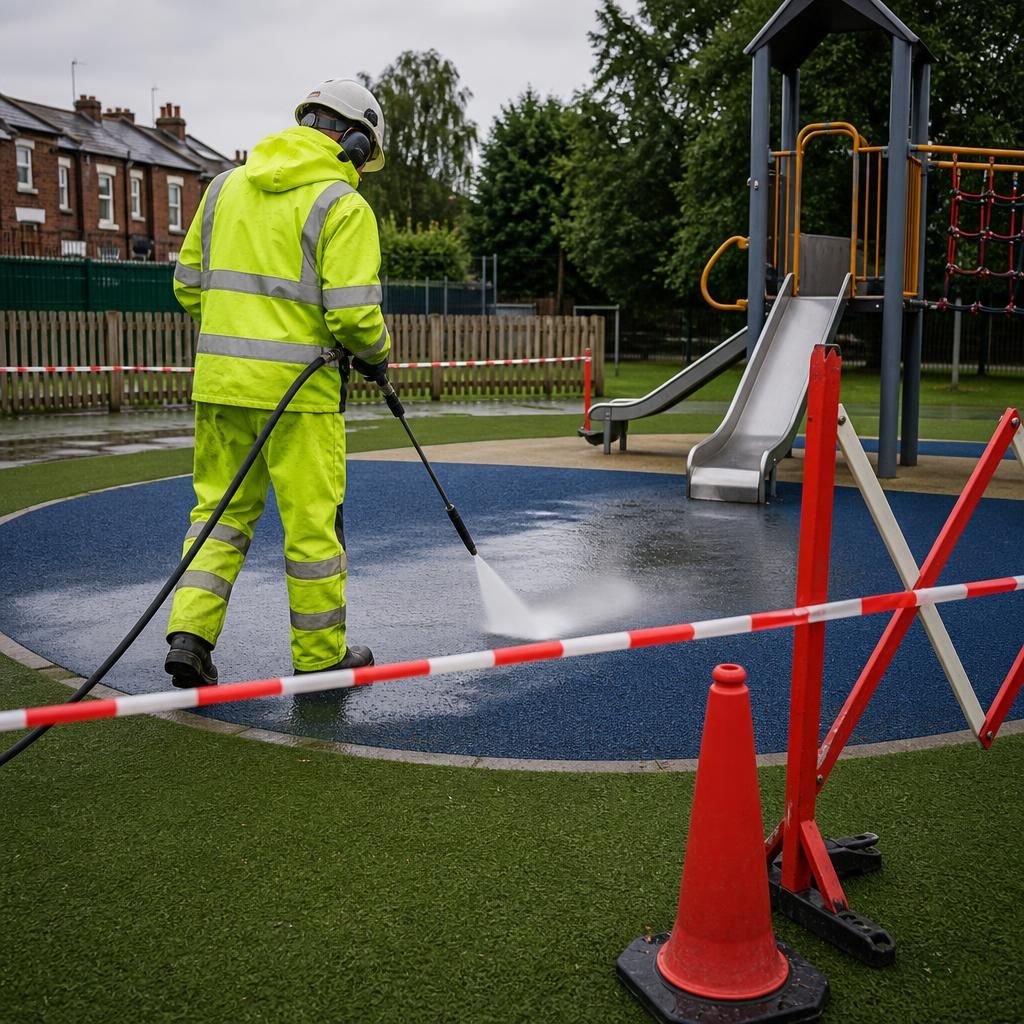
Keep the playground closed until the surface is safe to use. Cleaning areas must be isolated with suitable barriers and clear signs throughout washing, rinsing and drying. Before reopening, check that the surface is clean, dry, stable and free from chemical residue, standing water, loose debris and trip hazards. If cleaning exposes damaged surfacing, displaced loose-fill material or a possible loss of impact protection, keep the affected area closed and refer the issue to the site owner or a competent playground specialist.