
Are there specific safety standards and regulations to consider during playground surface cleaning?
Yes. Playground surface cleaning should account for COSHH controls for cleaning chemicals, PUWER requirements for pressure-washing equipment, Work at Height regulations where access equipment is used, and relevant playground safety standards such as BS EN 1177, while also controlling runoff, protecting users and inspecting the surface before reopening.
Yes. Playground surface cleaning must be planned around health and safety law, chemical controls, equipment requirements, work-at-height precautions and the safety performance of the surfacing itself. In the UK, the main considerations include the Control of Substances Hazardous to Health (COSHH) Regulations, Provision and Use of Work Equipment Regulations (PUWER), Work at Height Regulations, environmental controls for wastewater and relevant playground standards such as BS EN 1177 and BS EN 1176.
These requirements do not create one separate legal standard called playground cleaning. Instead, they apply to the way the work is assessed, carried out and signed off. The cleaning method must also follow the surface manufacturer’s maintenance instructions, the site’s risk assessment and any requirements set by the playground owner, local authority, school or facilities manager.
Risk assessment and method statement
Before work starts, the contractor should prepare a site-specific risk assessment and method statement. This should cover:
- the type and condition of the surface, including wet-pour rubber, rubber tiles, artificial grass, sand, bonded rubber, concrete, tarmac or resin-bound areas;
- pressure, temperature, chemical concentration and cleaning technique;
- slip hazards created by water, detergents, algae or loosened contamination;
- nearby play equipment, safety surfacing edges, soft landscaping, drainage channels and electrical installations;
- pedestrian, vehicle and public access controls;
- noise, spray, overspray and potential disturbance to nearby users;
- wastewater collection, filtration and disposal; and
- the inspection and approval process before the playground is reopened.
The assessment should be reviewed if the surface is unusually damaged, heavily contaminated, inaccessible, affected by flooding or likely to require stronger chemicals or additional equipment. Cleaning should not be treated as a routine process where site conditions have changed.
COSHH and chemical safety
Any detergent, disinfectant, biocide, degreaser or other hazardous product must be assessed under COSHH before use. The assessment should identify the risks to operatives, members of the public, the surface and the surrounding environment. Safety data sheets and product labels must be available, and operatives should understand the required dilution, contact time, ventilation, storage and first-aid arrangements.
Only products suitable for the particular playground surface should be used. Some solvents, strong alkalis, acids and aggressive biocides can damage rubber binders, colour coatings, artificial grass backing or jointing materials. Chemicals must never be mixed unless the manufacturer specifically permits it. Appropriate personal protective equipment may include gloves, eye protection, protective footwear and waterproof clothing, depending on the product and application method.
Where a disinfectant or biocidal product is used, the product must be authorised for its intended use in the UK and applied according to its label. A stronger concentration is not automatically safer or more effective. Residues should be rinsed or removed in accordance with the product instructions, with appropriate controls to prevent children or animals contacting the area before it is safe.
Pressure-washing and steam-cleaning equipment
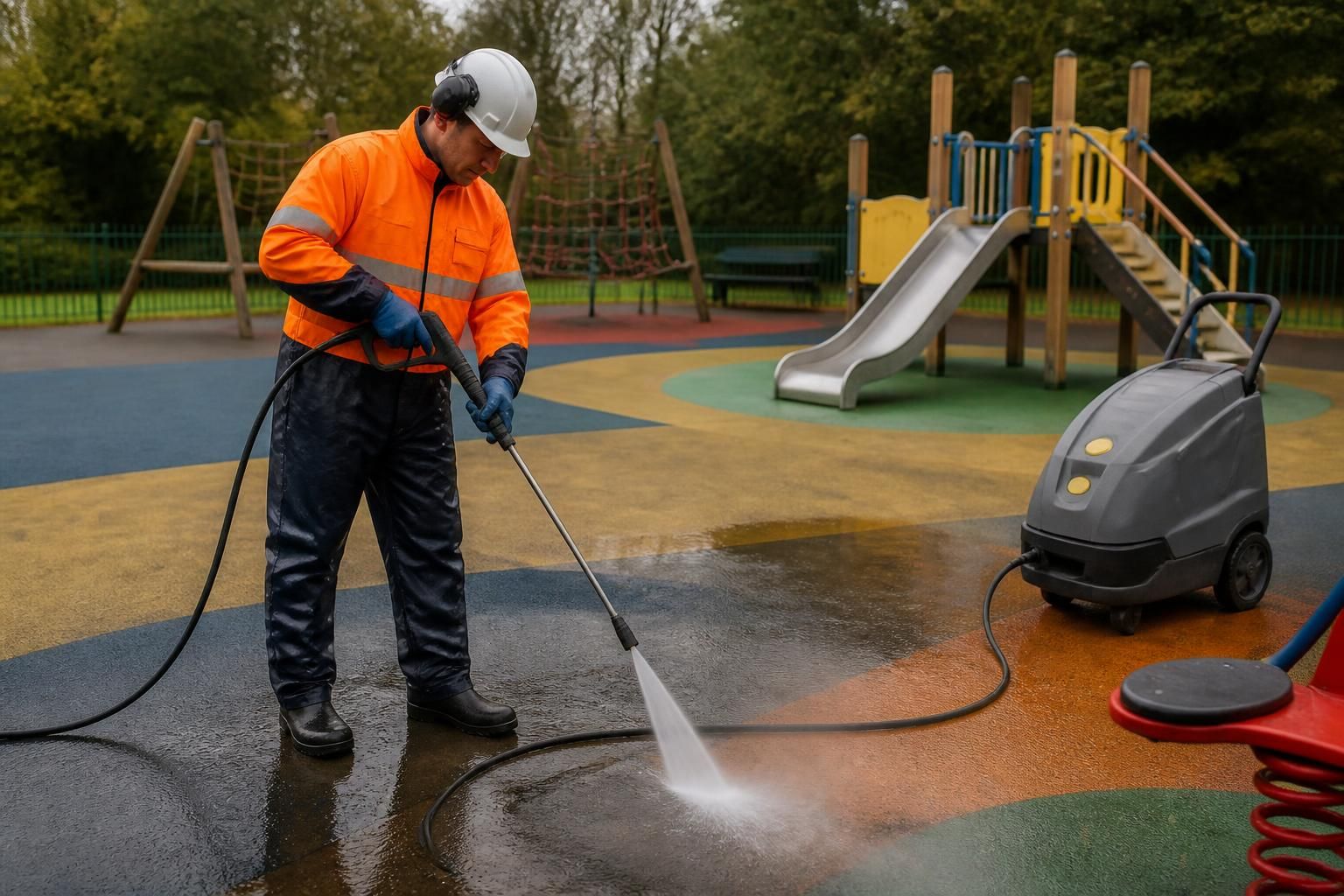
Pressure washers, steam cleaners, vacuum recovery systems and other work equipment are covered by PUWER. Equipment should be suitable for the task, maintained in safe working order and inspected by a competent person at appropriate intervals. Hoses, trigger guns, lances, electrical leads, plugs, guards and safety devices should be checked before use.
Operatives need training in safe operating pressure, nozzle selection, hot-water hazards, recoil forces and the risk of injecting water into the skin. Pressure should be kept low enough to avoid dislodging rubber granules, opening joints, damaging the impact-absorbing structure or driving contamination deeper into porous surfaces. Steam cleaning can also cause burns and surface damage if excessive heat is applied or if the equipment is held too close for too long.
Electrical equipment used outdoors must be appropriate for the conditions, with suitable supplies and residual-current protection where required. Fuel-powered equipment must be positioned and operated to control exhaust fumes, fire risk and carbon monoxide exposure. Cables and hoses should be routed to prevent trip hazards and kept away from standing water wherever possible.
Work at height and access equipment
If cleaning involves roofs, elevated play structures, canopies, high façades or other raised areas, the Work at Height Regulations apply. Work should be avoided at height where a safer ground-based method is reasonably practicable. Where access is necessary, the method should use suitable equipment, edge protection, fall prevention and rescue arrangements.
Mobile elevating work platforms, towers, ladders and other access equipment must be selected for the task and used by trained personnel. Equipment should be inspected and maintained, and any lifting equipment or accessories must also meet applicable inspection requirements. Public exclusion zones are particularly important because falling equipment, water or debris could affect people below.
Protecting children, staff and the public
The playground should be closed during cleaning, with clear signs and physical barriers rather than relying on verbal warnings. The exclusion area should account for spray, overspray, hoses, wet surfaces, chemical application and equipment movement. If the playground is in a public space, the arrangement should also control access by passers-by, pets and unauthorised vehicles.
Cleaning should be timed to minimise interaction with users, but a quiet period does not remove the need for barriers and supervision. Operatives should not leave equipment, containers or hoses unattended in an accessible area. Any chemical containers should remain labelled, sealed when not in use and stored securely.
Surface safety and BS EN standards
BS EN 1177 is concerned primarily with the impact-attenuating properties of playground surfacing and the critical fall height, rather than prescribing a cleaning method. Cleaning must therefore preserve the surface’s ability to reduce injury risk. Aggressive pressure, heat, solvents, scraping or the removal of loose material can alter the surface and should be avoided unless specifically approved.
BS EN 1176 covers playground equipment and related safety considerations, including inspection and maintenance principles. After cleaning, the responsible person should check for exposed aggregates, loose rubber, open seams, damaged edges, standing water, displaced infill, sharp objects and other defects. Cleaning does not replace a formal playground inspection or post-installation impact-attenuation assessment where one is required.
Particular care is needed around drainage channels, kerbs, transitions and the edges of wet-pour surfacing. These areas can lift or deteriorate if water is forced underneath them. Artificial grass may require controlled brushing and infill management, while loose-fill surfaces may need raking or levelling after cleaning rather than high-pressure washing.
Runoff, drainage and environmental controls
Dirty water, detergent, algae, oils, paint residues and other wash-off must not be allowed to enter surface-water drains, watercourses or neighbouring land without suitable controls. Surface-water systems commonly discharge to the environment without treatment. The cleaning plan should therefore identify drainage routes and specify whether water will be contained, filtered, collected or disposed of through an approved route.
Wastewater should be managed in line with the Environmental Protection Act, Water Resources Act, Environmental Permitting Regulations and any local water company or site requirements that apply. Trade effluent or contaminated water may require consent before discharge to a foul sewer. If contaminated material, used filters or chemical containers are removed from site, they must be handled and transferred in accordance with applicable waste requirements.
Where possible, use the least hazardous effective product, limit water and chemical use, and prevent runoff at the source. Eco-friendly wording on a product label does not by itself confirm that discharge is acceptable. The product’s safety and environmental information, together with the site drainage arrangements, must be considered.
Inspection before reopening
The playground should remain closed until the surface is clean, adequately dry and free from chemical residue, loose debris and slip hazards. A competent person should complete a post-clean inspection covering:
- surface condition and visible damage;
- slip risks and remaining standing water;
- drainage and the removal of captured wastewater;
- equipment bases, fixings, edges and impact areas;
- loose-fill levels or displaced infill where relevant;
- barriers, signs, gates and surrounding access routes; and
- any defects that need reporting before use.
Cleaning records should state the date, areas treated, equipment and products used, relevant COSHH controls, weather or drying conditions, defects found, wastewater arrangements and the name of the person who authorised reopening. Keeping this information supports the site’s maintenance records and provides evidence that the work was controlled properly.
Responsibilities of the client and contractor
The contractor is responsible for carrying out the cleaning safely, using competent operatives and suitable equipment, and following the agreed method statement. The playground owner or managing organisation remains responsible for providing relevant information about the site, coordinating access, arranging closure and ensuring that defects identified during cleaning are dealt with. Both parties should agree who will inspect and formally reopen the area.
For larger or higher-risk sites, the arrangements should be coordinated with the principal contractor, facilities team or local authority procedures. Where construction, refurbishment or other contractors are working nearby, the cleaning plan should also be integrated with the site’s wider health and safety arrangements.
In practical terms, compliant playground surface cleaning means using a surface-appropriate method, controlling chemicals and equipment, preventing public access, managing wastewater responsibly and recording a proper inspection before reopening. Where the surface is damaged, its manufacturer’s instructions are unavailable or the cleaning could affect impact performance, specialist advice should be obtained before work proceeds.
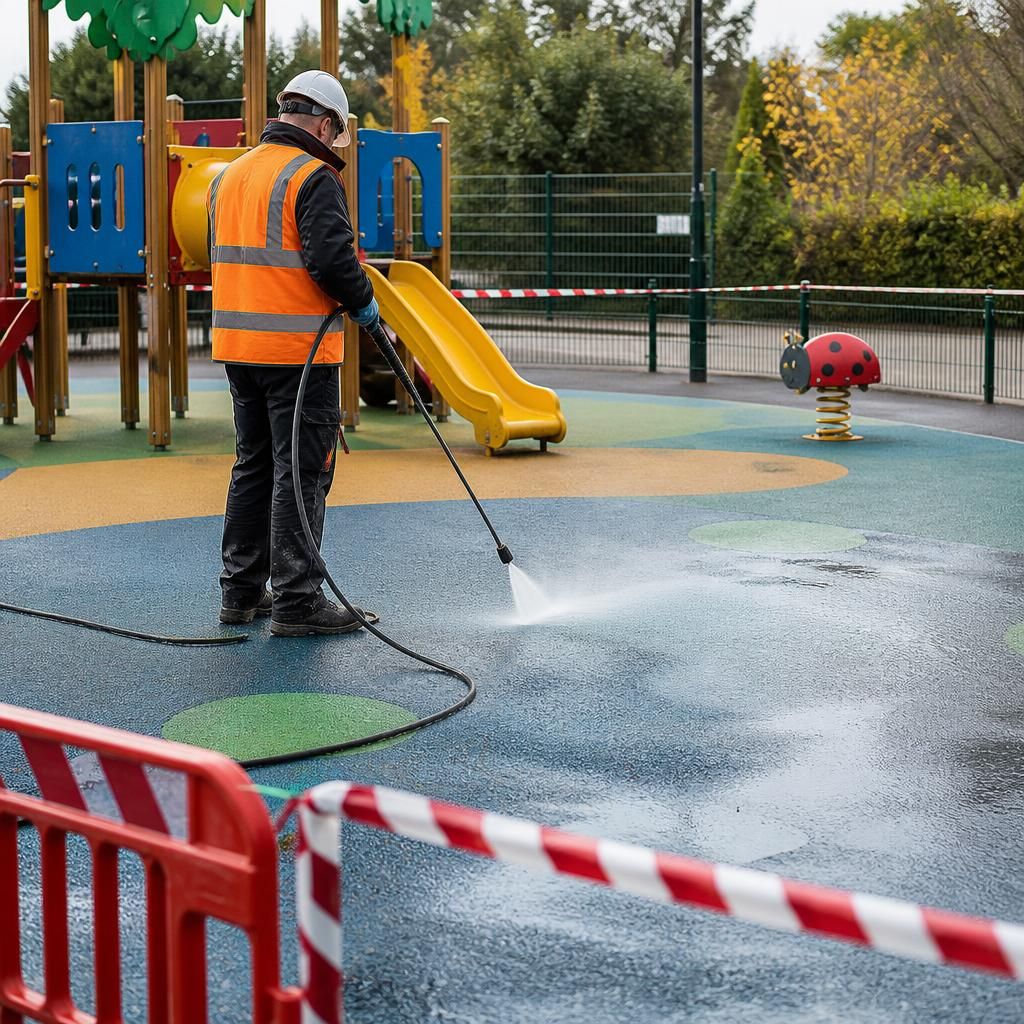
Playground surface cleaning must be controlled so that the finished surface remains safe for children, staff and visitors. Before reopening, the area should be dry, free from chemical residue and loose debris, and checked for damage that could affect slip resistance, drainage or impact protection.
A competent person should inspect the cleaned area for loosened rubber, open seams, damaged edges, displaced infill, standing water and exposed aggregates. Cleaning should not compromise the impact-attenuating performance covered by BS EN 1177, and it does not replace the site’s routine playground inspection requirements.
- Keep the playground closed with suitable barriers until the inspection is complete.
- Confirm that wastewater, hoses, equipment and cleaning materials have been removed.
- Check transitions, drainage channels, kerbs and equipment bases for water ingress or damage.
- Record the products, method, surface condition, defects and person who authorised reopening.