
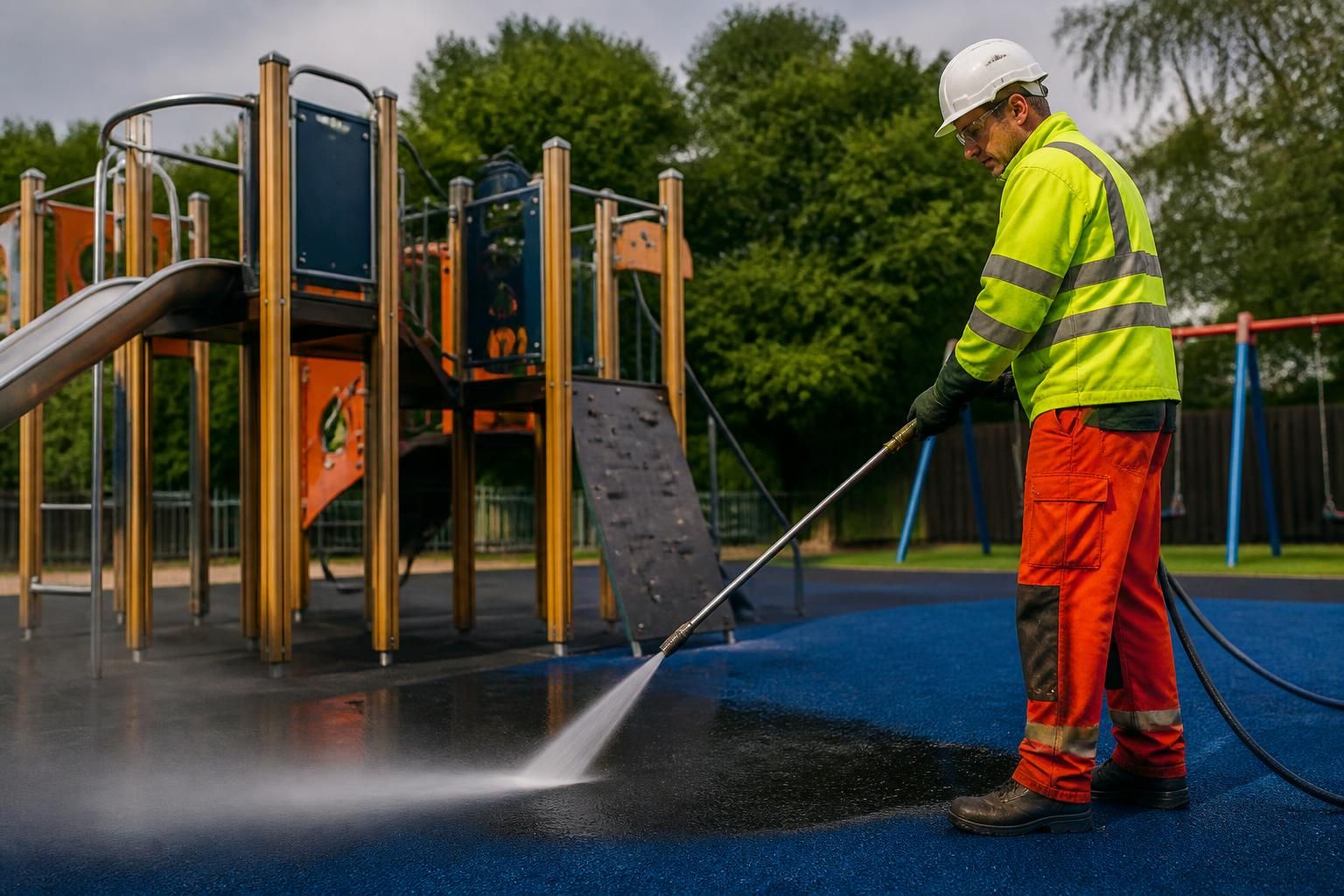
What safety standards should a playground maintenance service comply with?
A playground maintenance service should work in line with relevant UK requirements, including BS EN 1176 for playground equipment and BS EN 1177 for impact-attenuating surfacing, alongside Health and Safety Executive guidance and applicable risk-assessment duties. This includes competent inspections, safe cleaning and repairs, control of work equipment and access activities, documented maintenance records, and prompt isolation of unsafe equipment or surfaces.
A playground maintenance service should comply with the relevant British and European standards for play equipment and impact-attenuating surfacing, while also meeting UK health and safety law for inspections, cleaning, repairs, access work and the use of equipment. The principal references are BS EN 1176 for playground equipment and BS EN 1177 for impact-attenuating playground surfacing. A competent contractor should also apply suitable risk assessments, method statements, inspection records and control measures for every maintenance task.
British Standards are not automatically legal requirements in every situation, but they are widely recognised as the accepted technical benchmark for public playground safety. Contract specifications, site policies, insurers and local authority requirements may also require compliance. The maintenance provider should confirm which standards and specifications apply to the equipment, surfacing and site before work begins.
BS EN 1176 covers the safety of playground equipment and includes requirements relating to design, installation, use zones, entrapment risks, falls, moving parts, structural integrity and deterioration. A maintenance service should use the standard when checking equipment for:
- Loose, missing, damaged or excessively worn components
- Sharp edges, protrusions, splinters and exposed fixings
- Entrapment points affecting a child’s head, neck, fingers or clothing
- Unstable foundations, movement, corrosion or structural damage
- Damaged chains, ropes, bearings, platforms, steps, handrails and barriers
- Unsafe clearances, fall zones or changes to the surrounding area
- Damage caused by vandalism, weather, misuse, vegetation or unauthorised alterations
BS EN 1176-7 provides guidance on installation, inspection, maintenance and operation. It supports a planned inspection regime rather than relying only on occasional reactive repairs. This normally includes routine visual checks, more detailed operational inspections and a documented annual main inspection by a suitably competent person. The precise frequency should reflect the site’s use, location, equipment, age, exposure to vandalism and findings from previous inspections.
BS EN 1177 applies to impact-attenuating playground surfacing. It concerns the ability of a surface to reduce the severity of an impact from a fall and includes requirements for testing critical fall height. Maintenance activities should therefore protect the performance of the surface rather than simply improve its appearance. Checks should identify:
- Compaction, displacement, hollows or exposed sub-base
- Loose-fill material that has migrated away from high-use areas
- Cracks, lifting, trip hazards, worn patches or failed joints
- Standing water, poor drainage, moss, algae or contamination
- Damage around posts, slide exits, swings and other high-impact locations
- Changes in surface depth or condition that may reduce impact protection
Pressure washing, steam cleaning and other cleaning methods must be selected carefully. Excessive pressure, heat or aggressive chemicals can damage rubber, wet-pour, synthetic grass, resin-bound materials, timber, coatings and drainage systems. A suitable service should assess the surface first, use compatible cleaning products, control run-off and prevent loosened debris or contaminated water from entering play areas, drains or neighbouring property. The area should remain closed until it is clean, dry and safe to reopen.
Maintenance work should also be planned in accordance with the Health and Safety at Work etc. Act 1974 and the Management of Health and Safety at Work Regulations 1999. The contractor should complete a site-specific risk assessment and provide a method statement covering the work, hazards, controls and emergency arrangements. This should address children and members of the public, nearby roads, schools or housing, weather conditions, manual handling, slips and trips, noise, water and chemical exposure, and the safe movement of vehicles and equipment.
Where the work involves machinery or powered equipment, the requirements of the Provision and Use of Work Equipment Regulations 1998 (PUWER) should be considered. Equipment must be suitable, maintained, inspected where necessary and used by people who have received appropriate information, instruction and training. Electrical equipment should be maintained and checked in accordance with the risks and the manufacturer’s instructions.
Additional requirements may apply depending on the work involved. For example:
- Control of Substances Hazardous to Health Regulations 2002 (COSHH): cleaning chemicals, treatments and contaminated materials must be assessed, stored, handled and disposed of safely.
- Work at Height Regulations 2005: ladders, mobile towers, access platforms or other access equipment must be properly selected, inspected and used where work cannot be completed safely from ground level.
- Lifting Operations and Lifting Equipment Regulations 1998 (LOLER): lifting accessories or lifting equipment used to move heavy playground components may require planned examination and controlled use.
- Personal protective equipment requirements: workers should receive suitable PPE where risks cannot be adequately controlled by other means, such as gloves, eye protection, hearing protection or safety footwear.
- Waste and environmental controls: removed surfacing, contaminated wash water, chemical containers and other waste must be contained and disposed of through suitable channels.
Competence is an important part of compliance. A provider should be able to demonstrate relevant experience in playground equipment, safety surfacing and exterior cleaning, together with training appropriate to the work being undertaken. Competence may come from qualifications, manufacturer training, industry training, supervised experience and knowledge of BS EN 1176 and BS EN 1177. The person inspecting equipment should be capable of recognising defects and understanding when an item must be repaired, restricted or taken out of service.
Safe systems of work should include clear public protection measures. Before cleaning or repairs start, the playground should be assessed and isolated where there is a foreseeable risk to children, staff or passers-by. Barriers and warning signs should be suitable for the site, not merely placed where they can be easily moved. Equipment with a serious defect should be clearly tagged or otherwise identified, and access should remain restricted until the hazard has been controlled and the area has been checked.
Accurate records provide evidence that the maintenance system is being managed properly. Records should normally include the date and location of the work, equipment or surface inspected, defects found, photographs where useful, cleaning or repair methods used, products applied, responsible personnel, recommended follow-up action and the date of completion. Inspection records should distinguish between defects requiring monitoring, planned repair and immediate isolation. Repeated defects should be reviewed to identify whether replacement, redesign, drainage work or changes to the maintenance schedule are needed.
Before the playground is returned to use, the responsible person should verify that:
- Cleaning water, chemicals, tools and debris have been removed
- Surfaces are sufficiently dry, stable and free from slip hazards
- Repairs are secure and no sharp edges, exposed fixings or trip hazards remain
- Impact-attenuating surfacing has not been displaced or damaged by the work
- Barriers and temporary controls have been removed only when safe to do so
- Outstanding defects have been recorded and communicated to the site owner
In practice, a compliant playground maintenance service is not defined by cleaning alone. It combines standards-based inspection, suitable cleaning and repair methods, competent personnel, controlled access, documented risk management and prompt action when equipment or surfacing is unsafe. The site owner should retain the maintenance records and ensure that any recommendations requiring specialist inspection, testing or replacement are followed through.
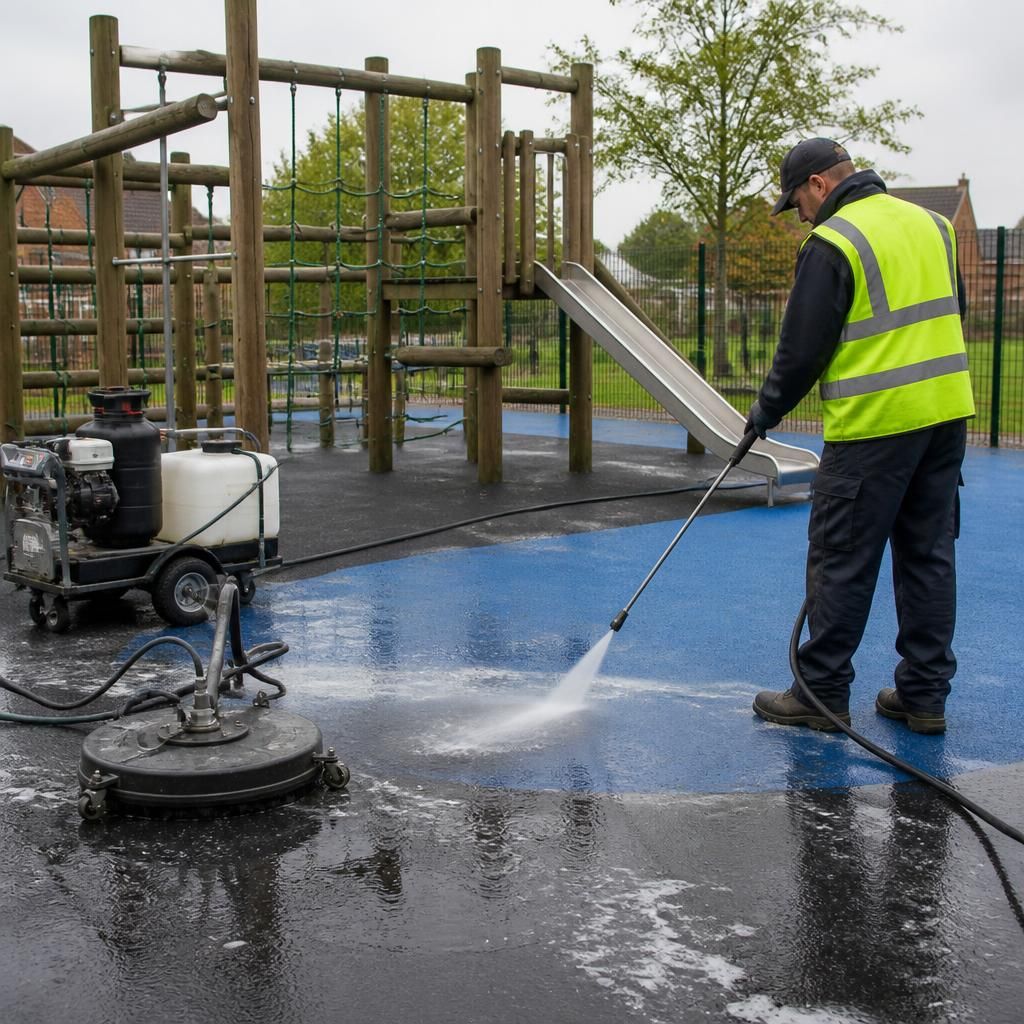
Safe playground cleaning must protect the performance of impact-attenuating surfacing, not just improve its appearance. Before work starts, the surface should be assessed for its material, condition, drainage and existing defects so the cleaning method does not cause displacement, lifting, cracking, excessive wear or loss of impact protection.
Pressure, heat and cleaning products should be selected to suit the surface, whether it is wet-pour rubber, rubber tiles, synthetic grass or loose-fill material. The playground should be isolated during cleaning, and wash water, loosened debris and chemicals must be controlled so they cannot create slip hazards or enter play areas and drainage systems.
After cleaning, the surface should be checked for standing water, contamination, exposed sub-base, trip hazards and changes in depth or coverage. The area should remain closed until it is clean, stable and sufficiently dry, with any defects recorded and referred for repair or further inspection before reopening.
Arrange a playground safety assessment
Arrange a playground safety assessment with Encanto Exterior Cleaning to review equipment, impact-attenuating surfacing, drainage and maintenance risks. We can identify defects requiring immediate action and recommend suitable cleaning, repairs or follow-up inspections.