
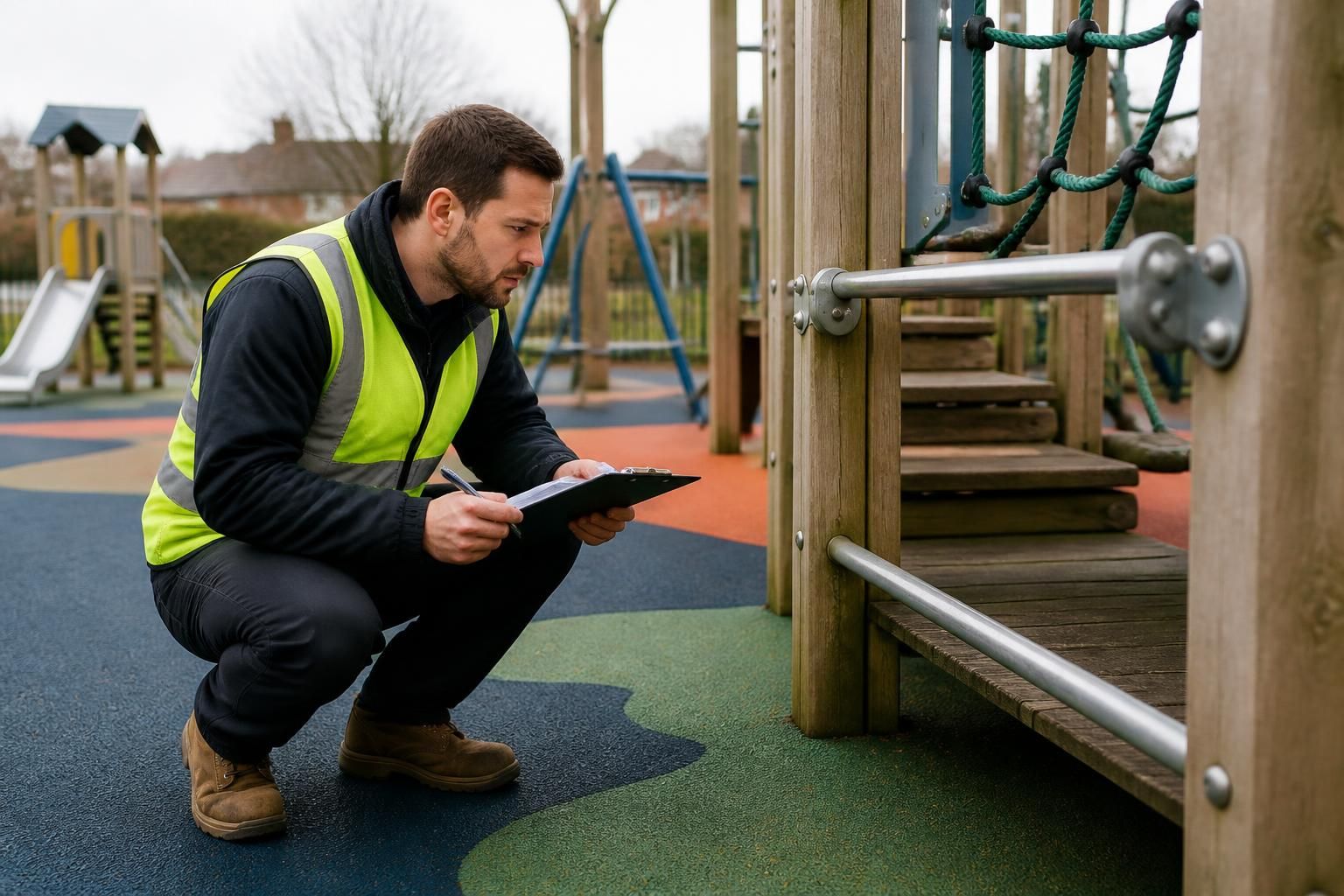
What qualifications and certifications should a playground maintenance provider have to ensure safety and quality?
A competent playground maintenance provider should use staff trained in BS EN 1176 playground safety and BS EN 1177 impact-attenuating surfacing, with inspection personnel holding relevant Register of Play Inspectors International (RPII) qualifications where formal inspections are required. For wider assurance, check suitable health and safety accreditation, documented risk-assessment procedures, and IPAF or PASMA training where powered access or towers are used; certifications should support, not replace, demonstrable practical experience.
A suitable playground maintenance provider should be able to demonstrate competent staff trained in the relevant British and European standards, particularly BS EN 1176 for playground equipment and BS EN 1177 for impact-attenuating surfacing. Where formal safety inspections are included, the inspector should hold an appropriate Register of Play Inspectors International (RPII) qualification. These should be supported by documented risk assessments, effective quality-control procedures, suitable insurance and practical experience with the types of equipment and surfaces being maintained.
There is no single licence that covers every playground maintenance task. The qualifications required depend on the work being carried out. A provider completing routine cleaning and minor maintenance will need different competencies from one undertaking post-installation inspections, repairing structural components, maintaining wet-pour surfacing or using powered access equipment. A responsible contractor should therefore explain which personnel are qualified for each part of the service rather than relying on one general accreditation.
Key technical knowledge should include:
- BS EN 1176: this standard covers playground equipment and its relevant safety requirements, including issues such as entrapment, impact areas, protrusions, structural integrity and equipment-specific risks. Maintenance staff should understand how defects against these requirements can arise and how they should be recorded and addressed.
- BS EN 1177: this relates to the impact attenuation of playground surfacing. Competent personnel should understand the purpose of critical fall height, the maintenance needs of loose-fill and synthetic surfaces, and when a surface may require more detailed assessment or testing.
- Manufacturer instructions: equipment manufacturers’ maintenance schedules, torque settings, replacement components and repair methods must be followed. A provider should not substitute unsuitable fixings, coatings, cleaning chemicals or surfacing materials simply because they are readily available.
- Inspection and defect assessment: staff should be able to identify wear, corrosion, loosened fixings, damaged welds, timber deterioration, trip hazards, inadequate impact areas, contamination and changes to the surrounding environment.
RPII competence is particularly important for formal inspections. RPII offers qualifications and registration routes for people carrying out different types of playground inspection. The relevant level should match the service being provided, whether that involves routine operational checks, more detailed inspections or an annual main inspection. Ask to see the named inspector’s current qualification or registration and confirm that it covers the equipment and inspection type required. An inspection report should identify defects clearly, assess their significance and state the recommended action; a certificate or logo alone is not evidence that an inspection has been carried out properly.
It is also important to distinguish between a standard and a qualification. BS EN 1176 and BS EN 1177 are technical standards, not certificates awarded to every maintenance company. A provider should be able to explain how its employees apply those standards in inspections, repairs and surfacing work. Training records, inspection templates, sample anonymised reports and evidence of continuing professional development can provide more useful assurance than an unsupported claim of compliance.
Health and safety training should cover the risks created by the work itself. Depending on the site and contract, this may include:
- documented risk assessments and method statements for maintenance activities;
- safe use of cleaning chemicals, pressure-washing equipment and steam-cleaning equipment;
- manual handling, hand-tool safety and control of stored energy;
- working at height and exclusion-zone management;
- emergency procedures and suitable first-aid arrangements;
- asbestos awareness where older structures or adjacent buildings may present a risk; and
- site-specific safeguarding and communication procedures where work takes place around children, schools or public facilities.
Where access equipment is used, operators should hold the appropriate recognised training for the equipment involved. For example, IPAF training may be relevant to powered access platforms, while PASMA training may be relevant to mobile access towers. These qualifications do not replace a site-specific risk assessment, correct equipment selection, pre-use checks or supervision. The provider should also be able to show that its access equipment is inspected and maintained in accordance with applicable requirements.
Additional competence may be needed for specialist repairs. Electrical work should be undertaken by suitably qualified personnel, while structural repairs, welding, fabricated components and major ground or foundation work may require appropriately experienced tradespeople or specialist contractors. If lifting equipment is used, the business should have suitable procedures for inspection and safe operation, including compliance with relevant lifting-equipment requirements. Chemical treatments, coatings and repairs to synthetic surfacing should be carried out in accordance with product data sheets and manufacturer recommendations.
Business accreditations can provide useful supporting evidence, but they are not a substitute for playground competence. Health and safety schemes, quality-management systems and contractor pre-qualification memberships may indicate that a company has documented processes, insurance and administrative controls. However, they do not automatically prove that an individual can inspect playground equipment or repair a particular surface. Check what the accreditation actually assesses, whether it is current and whether the named playground personnel are covered by it.
A provider should also maintain appropriate documentation, including:
- staff training, qualification and refresher-training records;
- risk assessments and method statements for the planned work;
- inspection reports with photographs or clear defect descriptions where appropriate;
- maintenance schedules and completed service records;
- evidence of replacement-part suitability and traceability;
- equipment servicing and access-equipment inspection records;
- public liability and employers’ liability insurance details; and
- a process for escalating urgent hazards and confirming when corrective work is complete.
When selecting or reviewing a provider, ask who will carry out the work, which standards and manufacturer instructions they will use, what qualifications apply to each task, and how defects will be prioritised. Check that certificates are in the individual’s name where appropriate, remain in date and relate to the work being commissioned. You should also ask for evidence of comparable experience with the relevant equipment, surfacing system and site environment.
In practice, the strongest assurance comes from combining RPII-qualified inspection expertise where required, BS EN 1176 and BS EN 1177 knowledge, task-specific health and safety training, suitable access-equipment competence and a clear documented maintenance process. Qualifications support safe and consistent work, but they should always be assessed alongside practical experience, quality of reporting and the provider’s ability to act promptly when a serious playground defect is found.
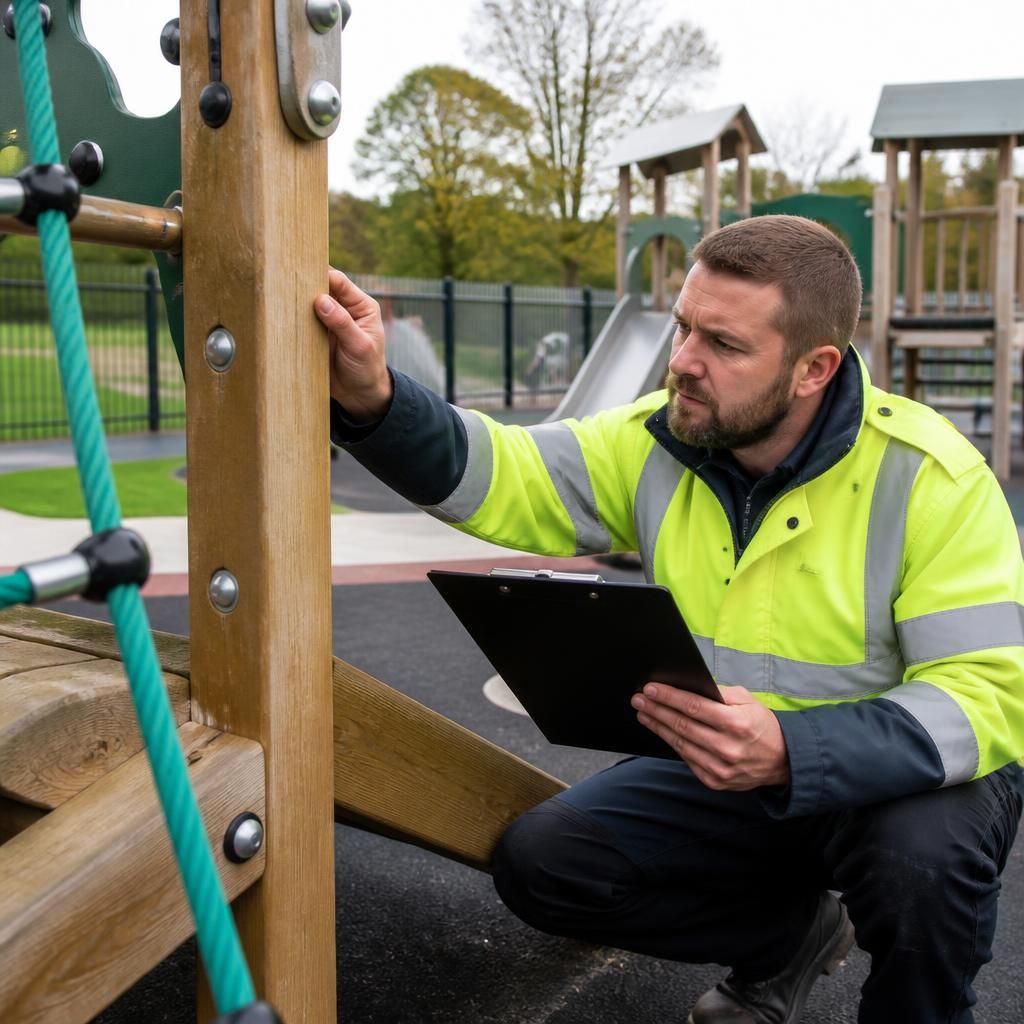
The most important qualification to verify for formal playground safety inspections is relevant Register of Play Inspectors International (RPII) competence. The inspector’s qualification or registration should match the type of inspection required, while maintenance staff should understand BS EN 1176 for playground equipment and BS EN 1177 for impact-attenuating surfacing.
Ask for the named inspector’s current credentials and an anonymised example of their reporting. A suitable report should describe defects clearly, explain their safety significance and identify the corrective action required. Qualifications provide useful assurance, but they should be supported by practical experience, manufacturer-specific maintenance knowledge, documented risk assessments and records showing that defects have been resolved.
Discuss Your Playground Maintenance Requirements
Discuss your playground maintenance requirements with our team, including the equipment, surfacing, inspection type and site-specific risks involved. We can help confirm the appropriate competencies, documentation and maintenance approach for your premises.