
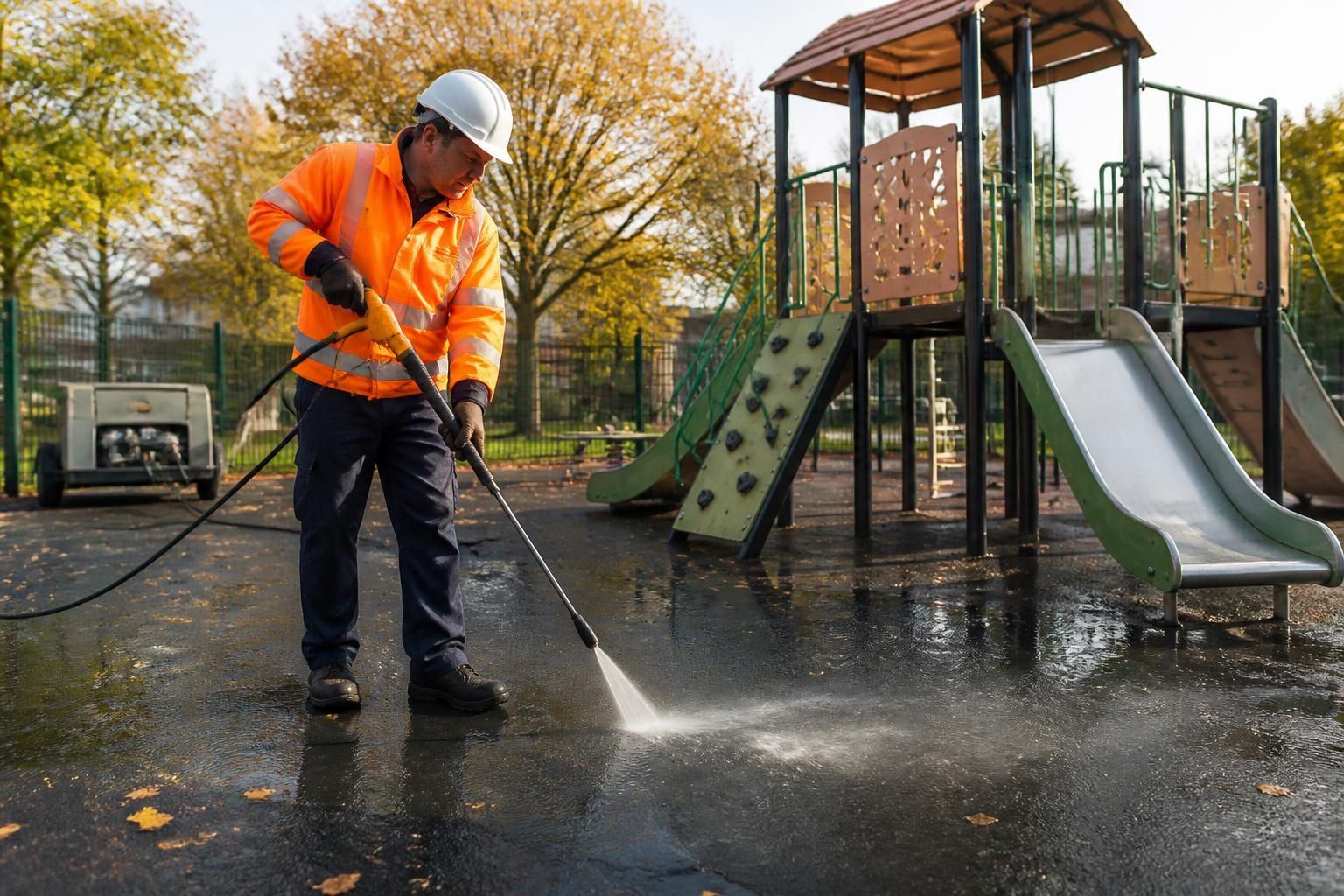
How often should playground surfaces be cleaned to maintain safety and compliance?
Playground surfaces should receive routine visual checks and spot cleaning before use, with a scheduled clean based on footfall, weather, contamination and the type of surface; busy public play areas may need cleaning daily or several times a week. Carry out a more thorough clean whenever there is mud, algae, mould, food, bodily fluids, litter or other contamination, and record the work alongside inspections and repairs to support safe operation and compliance with the site’s risk assessment and maintenance plan.
Playground surfaces should be visually checked before use, spot-cleaned whenever contamination is found and cleaned on a planned schedule based on use, weather, surface type and site-specific risk. Busy public playgrounds may require daily or several-times-weekly cleaning, while less frequently used areas may follow a weekly or fortnightly routine, provided inspections confirm that the surface remains safe and hygienic. A more thorough clean is needed immediately after mud, algae, mould, food, litter, animal fouling, bodily fluids or other contamination is identified.
There is no single cleaning interval that suits every playground. The frequency should be set out in the site’s risk assessment and maintenance plan, taking account of:
- the volume and pattern of use, including school holidays and periods of increased visitor numbers;
- the playground’s location, such as an urban area, woodland setting, coastal site or position beneath trees;
- rainfall, standing water, frost, heat and other weather conditions that can encourage biological growth or move dirt across the surface;
- the type and age of the surface, including wet-pour rubber, rubber tiles, artificial grass, sand, bark, woodchip, grass and bonded or loose-fill materials;
- nearby sources of contamination, including roads, building work, food outlets, trees, birds and animals;
- the condition of drainage, edging, joints, impact-absorbing areas and surrounding hard surfaces; and
- the cleaning instructions and limitations issued by the surface or equipment manufacturer.
Routine checks and spot cleaning
A responsible member of staff should carry out a visual check before the playground opens and at suitable intervals during busy operating periods. The check should look for glass, sharp objects, litter, animal fouling, discarded food, spillages, mud, standing water, excessive sand migration, algae, moss, mould and other slip or trip hazards. Contamination should be removed promptly rather than left until the next scheduled clean.
Spot cleaning is appropriate for small, localised problems. Use a method that is suitable for the material, remove the waste safely and leave the area clean and dry before reopening it. Bodily fluids, animal fouling and potentially hazardous materials should be isolated and dealt with under the site’s hygiene and waste procedures. Staff should not improvise with strong chemicals or equipment that could damage the surface or leave harmful residues.
Planned cleaning intervals
A planned clean should be scheduled even where routine inspections find no obvious contamination. As a practical starting point, high-use playgrounds and sites exposed to trees, mud or heavy weathering often need cleaning several times a week. Lower-use sites may be cleaned weekly or at another interval justified by the risk assessment. The schedule should be reviewed after periods of wet weather, seasonal leaf fall, building work, local events or any reported incident.
Planned cleaning should remove embedded dirt from the surface and surrounding areas, rather than simply moving debris from one part of the playground to another. It should include play surfacing, edges, drainage channels, kerbs, access routes and adjoining hardstanding where dirt can be carried back onto the play area. Where algae, moss or mould is present, cleaning should address both the visible growth and the conditions allowing it to return, such as poor drainage, persistent shade or accumulated organic matter.
Deep cleaning and seasonal work
Some playgrounds benefit from a more intensive clean at intervals determined by their condition and exposure. This may be needed after winter, before the busiest summer period, following prolonged damp weather or when routine cleaning no longer restores the surface adequately. Deep cleaning can help remove ingrained soil and organic deposits, but it must be planned carefully so that pressure, heat, water and cleaning agents do not loosen bonded materials, damage rubber, wash out loose-fill surfacing or affect impact-attenuation performance.
Loose-fill surfaces require particular attention because litter and organic matter can become buried below the top layer. The material may need raking, levelling, topping up or partial replacement in line with the manufacturer’s instructions and the site’s inspection requirements. Cleaning alone cannot correct insufficient depth, compaction, displacement or poor drainage.
Cleaning is separate from inspection and repair
Cleaning does not replace a formal playground inspection. During and after each clean, staff should report defects such as damaged wet-pour areas, exposed sub-base, lifted tiles, open joints, worn edges, broken drainage covers, trip points, damaged equipment or inadequate loose-fill depth. Repairs should be prioritised according to the risk they present, and equipment or areas should be taken out of use where a hazard cannot be controlled immediately.
Playground operators should maintain an inspection and maintenance record showing the date, areas treated, condition found, cleaning method, products used, defects identified, corrective action and person responsible. Records help demonstrate that the cleaning frequency is based on actual site conditions and support the wider management arrangements required for a safe play area. They should be retained alongside the risk assessment, manufacturer information and inspection records.
Reopening the playground after cleaning
Before the area is reopened, confirm that the surface is free from residue, loose debris and standing water, and that it is sufficiently dry for safe use. Check that access routes, drainage points and impact areas have not been obstructed or displaced. Any temporary barriers or warning signs should remain in place until the cleaning work and any associated repair or drying period are complete.
For UK sites, the cleaning plan should form part of the operator’s broader playground management system and be consistent with the relevant risk assessment, manufacturer guidance and applicable British and European playground safety standards, including the BS EN 1176 series where relevant. Cleaning frequency should be increased when inspections, complaints, incidents or changing site conditions show that the existing schedule is not controlling the risk adequately.
In practice, the most reliable approach is a three-level routine: check the playground before use, remove contamination as soon as it appears, and complete documented scheduled cleaning at an interval matched to the site. Reviewing the records regularly allows the frequency to be adjusted before dirt, biological growth or contamination becomes a safety or compliance issue.
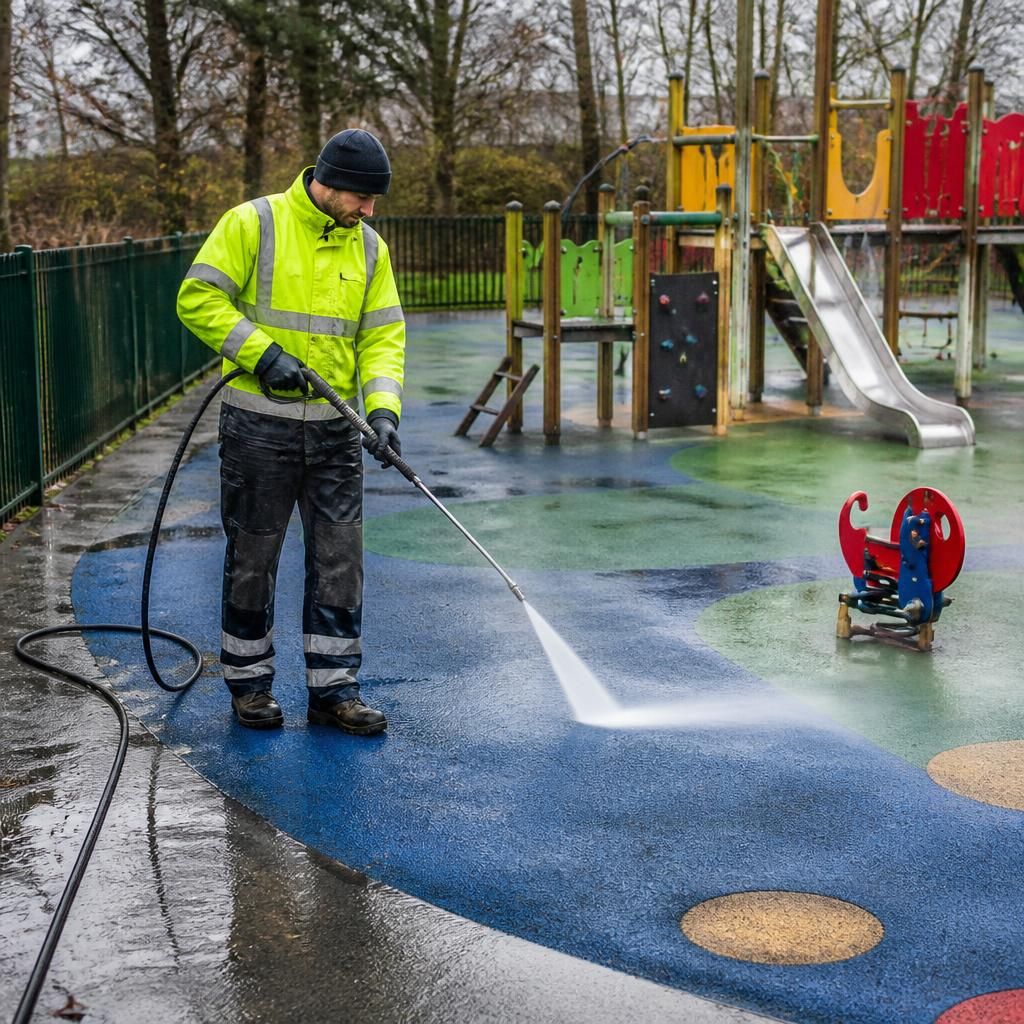
Playground surfaces should be cleaned at an interval based on use, weather, contamination and surface type rather than a fixed timetable. Busy or exposed play areas may need cleaning several times a week, while lower-use sites may follow a weekly or fortnightly schedule if inspections confirm that the surface remains safe.
Any visible contamination, including animal fouling, food, mud, algae, mould, litter or bodily fluids, should be removed promptly. Review the cleaning schedule after heavy rain, seasonal leaf fall, building work, local events or a reported incident, and record the work alongside inspections and any repairs.
Arrange your playground surface cleaning
Arrange a playground surface cleaning with Encanto Exterior Cleaning to remove ingrained dirt, organic growth and contamination using a method suited to the surface. We can help align the cleaning visit with your inspection records, risk assessment and maintenance schedule.