
What safety measures and certifications should a service provider possess to ensure compliance with industry standards for car park and play area cleaning?
A compliant provider should supply site-specific risk assessments and method statements, COSHH assessments, suitable insurance, trained operatives and controls for traffic, slip hazards, chemicals, pressure equipment and work at height. For play areas, they should understand BS EN 1176 and BS EN 1177 requirements, while recognised accreditations such as CHAS, SafeContractor or another SSIP scheme, plus relevant IPAF or PASMA training and ISO management standards, can provide additional evidence of competent systems.
A compliant car park and play area cleaning provider should be able to demonstrate competent staff, documented risk controls, suitable insurance, properly maintained equipment and an understanding of the standards that apply to each site. There is no single certificate that covers every cleaning project. Compliance is normally evidenced through site-specific risk assessments and method statements, COSHH assessments, training records, equipment inspections and recognised health and safety management systems.
Site documentation should be provided before work starts. A suitable risk assessment and method statement (RAMS) should describe the hazards, controls, equipment, chemicals, access arrangements and emergency procedures for the particular car park or play area. Generic documents are not sufficient where the site has unusual features such as steep gradients, underground parking, pedestrian routes, children’s equipment, nearby watercourses or restricted vehicle access.
The provider should also identify who is responsible for isolating areas, controlling access and checking the site after cleaning. Any changes in weather, site layout, traffic flow or equipment condition should trigger a review of the RAMS rather than relying on an outdated document.
Key safety measures for car park cleaning include:
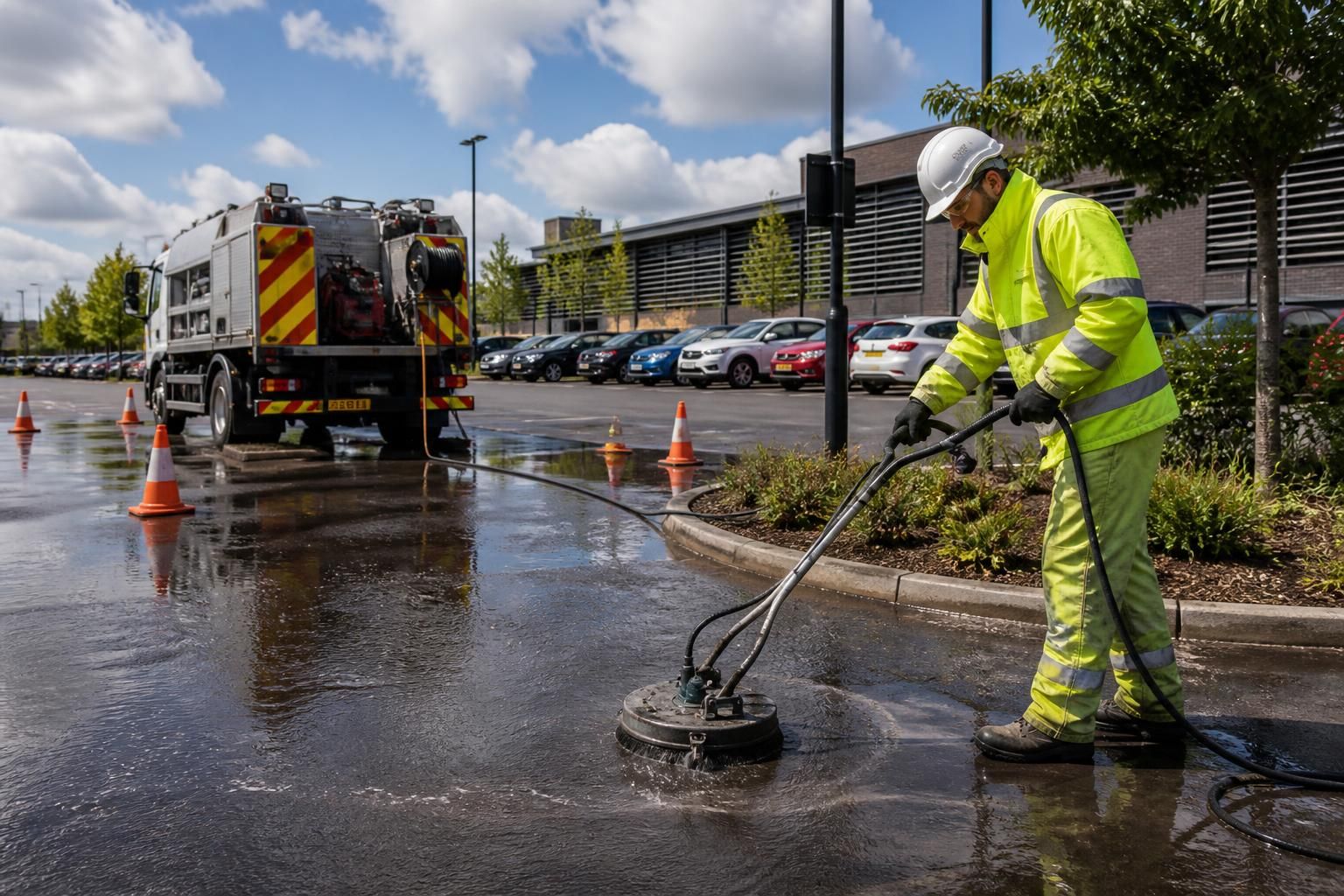
- Segregating operatives from vehicles and pedestrians with suitable barriers, cones, signage and, where necessary, a planned traffic management system.
- Closing or isolating sections of the car park while pressure washing, steam cleaning or using machinery, particularly around ramps, entrances and pedestrian crossings.
- Controlling slip risks from water, oil, detergents, algae and contaminated surfaces, with appropriate drying, drainage and reopening checks.
- Preventing contaminated wash water, oils and cleaning chemicals from entering surface-water drains or nearby watercourses without suitable controls.
- Using low-pressure or controlled cleaning methods where high pressure could damage coatings, line markings, cladding, electrical equipment or drainage infrastructure.
- Providing personal protective equipment appropriate to the task, such as eye and face protection, gloves, waterproof clothing, hearing protection and slip-resistant footwear.
- Maintaining safe cable, hose and fuel arrangements to prevent trips, vehicle contact, leaks and unauthorised access.
Where detergents, biocides, degreasers or other hazardous substances are used, the contractor should complete a COSHH assessment for each relevant product. Operatives should understand dilution, application, storage, ventilation, required personal protective equipment, spill response and first-aid measures. Safety data sheets should be available, and chemicals should be stored and transported in a way that prevents leaks or accidental access.
Play areas require additional controls because cleaning takes place in spaces used by children. The work area should be fully closed before cleaning begins, with clear barriers that children cannot easily move or climb through. Equipment, hoses, chemicals and vehicles should not be left unattended. The provider should agree how the area will be inspected, dried and formally released for use, rather than removing barriers as soon as the visible cleaning is complete.
Cleaning methods should not leave harmful residues, standing water, sharp debris or slippery surfaces. Operatives should take care around impact-attenuating surfaces, joints, fixings, drainage points and moving components. Pressure or steam should be selected carefully because excessive force, heat or chemical use may damage rubber surfacing, timber, plastics, coatings or safety-critical components.
The relevant reference standards for play areas are BS EN 1176, which covers playground equipment and related safety requirements, and BS EN 1177, which covers impact-attenuating playground surfacing. These standards are primarily concerned with the design, installation, inspection and safety performance of equipment and surfacing; a cleaning contractor does not automatically become a certified playground inspector by referring to them. However, the contractor should understand how its methods may affect those requirements and should report visible damage, loose components, exposed foundations, trip hazards or failing surfacing to the responsible site manager.
Cleaning operatives should have documented training appropriate to the work. This may include pressure-washing and steam-cleaning procedures, chemical handling, manual handling, first aid, safeguarding site users, safe vehicle movements and the use of relevant machinery. Anyone working at height should be trained in the selected access method, and anyone operating powered access equipment or working from a temporary access tower should hold the appropriate recognised training for that equipment. Training should be supported by supervision and periodic refresher instruction, not just an attendance certificate.
For work at height, the provider should demonstrate compliance with the Work at Height Regulations. Access equipment must be suitable, inspected and used on stable ground, with controls for falling objects and exclusion zones below. Pressure washing from ladders is generally unsuitable where it creates instability or prevents safe control of the equipment. Where lifting equipment is used, the contractor should retain the required inspection and examination records under the applicable lifting-equipment regulations.
Powered cleaning equipment should be selected, maintained and operated in accordance with the Provision and Use of Work Equipment Regulations. Electrical equipment must be suitable for wet conditions and protected against electric shock. Hoses, triggers, nozzles, guards, fuel systems and emergency shut-offs should be checked before use, with defects taken out of service. Records of maintenance and inspection provide useful evidence that equipment is being managed rather than simply used until it fails.
Insurance and contractor competence should also be checked. A suitable provider will normally hold employers’ liability insurance where it employs staff, public liability insurance for damage or injury claims, and cover appropriate to its vehicles, equipment and the scale of the work. The limits should be suitable for the contract and any requirements set by the property owner, managing agent or local authority. Insurance is not a substitute for safe systems of work, but a current certificate is an important part of supplier due diligence.
Recognised health and safety accreditation can provide additional assurance, particularly for commercial procurement. Examples include membership of an accredited contractor assessment scheme or certification under a recognised SSIP health and safety assessment scheme. These schemes assess aspects of a contractor’s documented systems, but they do not remove the need for a site-specific RAMS or prove that every operative is competent for every task.
Management-system certification can also be relevant. ISO 45001 indicates a structured approach to occupational health and safety, ISO 14001 relates to environmental management, and ISO 9001 relates to quality management. Such certification is useful evidence of formal processes, but clients should still ask how those processes are applied to water recovery, chemical selection, waste handling, incident reporting and play area handover on the actual project.
Environmental compliance forms part of safe cleaning. The contractor should explain how it will contain or recover dirty water, deal with oil or chemical contamination, store waste and prevent pollution. Where waste is removed from site, the business should use the appropriate waste documentation and authorised disposal arrangements. A pollution incident procedure and spill kit should be available when the work presents a credible spill risk.
Before appointing a provider, request the following evidence:
- A site-specific RAMS, including traffic, slip, chemical, pressure-equipment, work-at-height and public-access controls.
- Relevant COSHH assessments and product safety information.
- Training and competency records for the operatives assigned to the work.
- Insurance certificates and, where requested, health and safety accreditation details.
- Equipment maintenance, inspection and access-equipment examination records.
- A plan for managing wastewater, chemicals, waste and pollution risks.
- A play area closure, inspection and handover procedure that identifies when the area is safe to reopen.
- A process for reporting defects or damage discovered during cleaning, with photographs or written records where appropriate.
After completion, the site should be checked for residual water, chemical residues, loose debris, damaged surfaces and remaining trip or slip hazards. The contractor should record any defects outside the cleaning scope and confirm that barriers have only been removed once the area is safe for normal use. This combination of competent personnel, verifiable documentation and practical site controls is more meaningful than relying on a certificate alone.
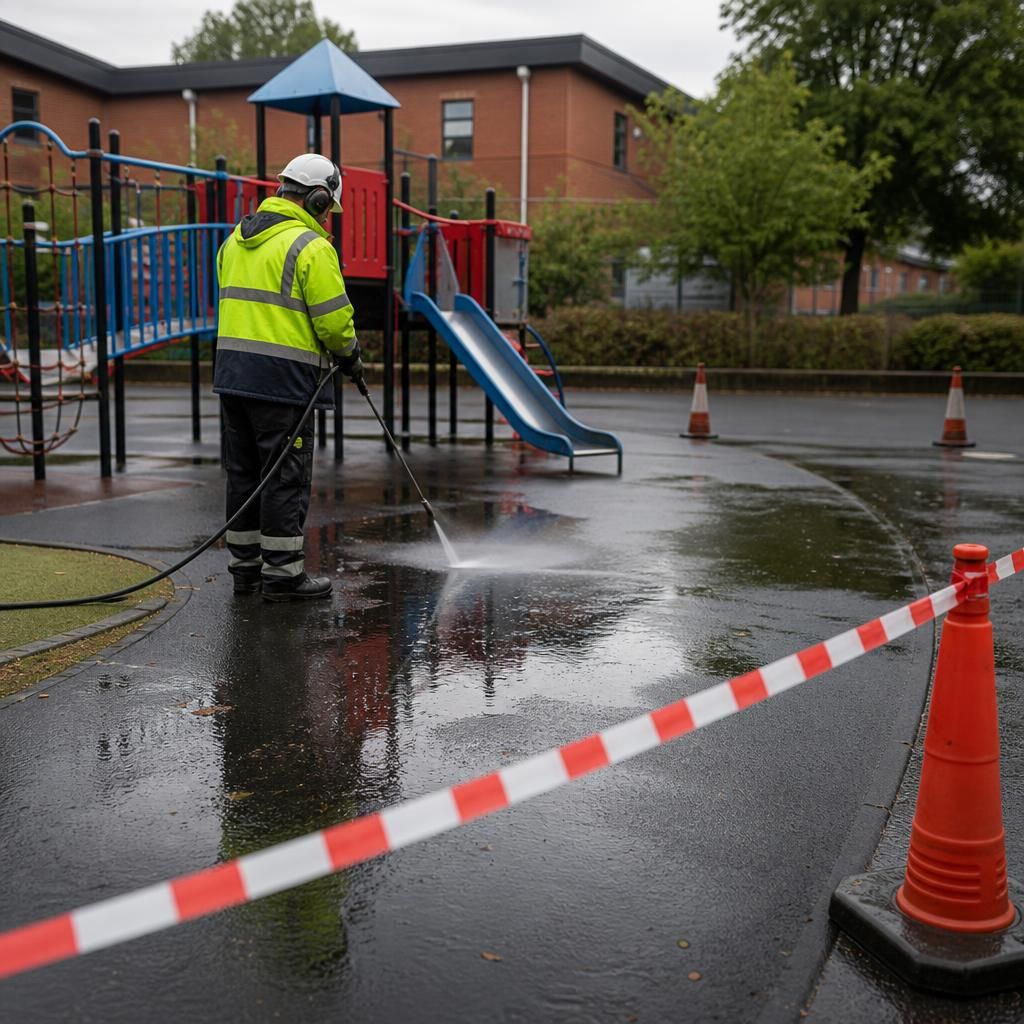
A safe play area handover means the space remains closed until cleaning is complete, surfaces are dry, residues and debris have been removed, and the equipment and surfacing have been checked for visible hazards. Cleaning should not be treated as finished simply because dirt has been washed away.
- Keep children and other users outside a clearly marked exclusion zone throughout the work.
- Remove hoses, equipment, chemicals and loose debris before inspection.
- Check rubber surfacing, joints, drainage points, fixings and moving components for damage or trip hazards.
- Confirm that no slippery residue or standing water remains.
- Record and report defects that fall outside the cleaning scope before reopening.
The responsible site representative should agree the release procedure with the cleaning team. Barriers should only be removed once the area is safe for normal use, with any outstanding maintenance issues clearly documented.
Request compliant car park and play area cleaning
Request compliant car park and play area cleaning, including site-specific RAMS, COSHH assessments, trained operatives and safe handover procedures. Contact Encanto Exterior Cleaning to discuss your site requirements and arrange a suitable cleaning plan.