
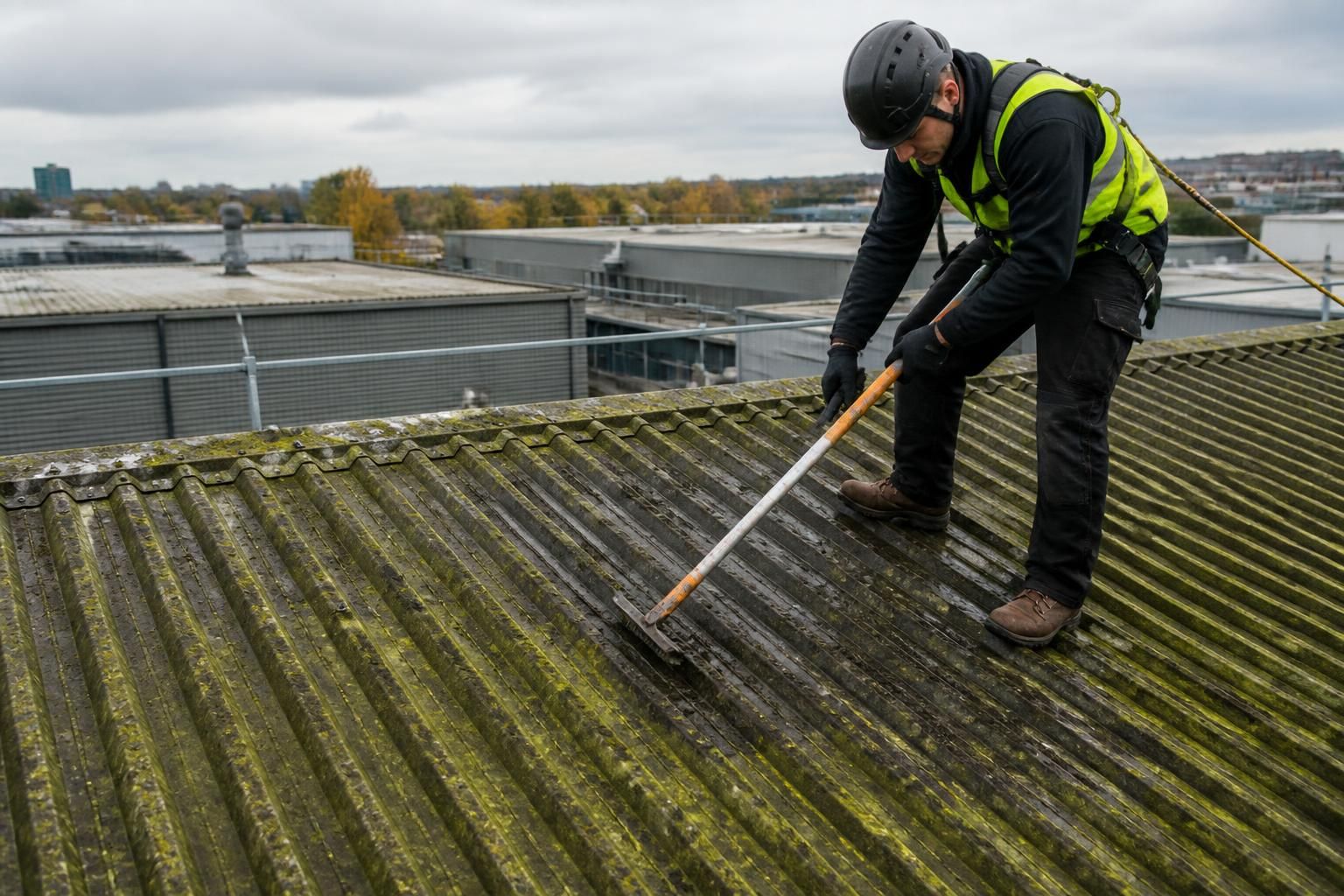
What specific precautions should be taken based on my roof type to safely and effectively remove moss without causing damage?
Roof-specific moss removal precautions depend on the material, condition and pitch: use gentle manual or low-pressure methods for clay and concrete tiles, avoid aggressive pressure washing on slate, protect metal coatings from abrasion and unsuitable chemicals, and take particular care around seams and membranes on flat roofs. Before cleaning, inspect for cracked, loose or deteriorated materials, select a compatible treatment, control runoff and use suitable access equipment rather than walking directly on vulnerable roof surfaces.
Roof-specific moss removal precautions depend on the roof covering, its condition, the roof pitch and how water is managed. Clay and concrete tiles generally require gentle manual removal and a compatible biocidal treatment; slate is more vulnerable to cracking and delamination; coated metal can be scratched or chemically damaged; and flat roofs require particular care around seams, outlets, membranes and insulation. Before any method is selected, the roof should be inspected for defects and the cleaning plan adapted to its weakest components.
Precautions that apply to every roof type
- Inspect the covering, flashings, ridge and verge details, valleys, gutters and rainwater outlets before starting. Cracked, loose, slipped, porous or deteriorated materials should be recorded and dealt with before moss is removed.
- Identify the roof material and any surface coating. Do not assume that a method suitable for concrete tiles is suitable for slate, metal or a membrane roof.
- Use suitable access equipment, edge protection and fall-arrest measures. Operatives should avoid walking directly on vulnerable coverings wherever possible, particularly where tiles are brittle, the roof is steep or the surface is wet and slippery.
- Test any cleaning solution on an inconspicuous area first. Check that it will not bleach the covering, attack fixings, affect paint or coatings, or harm nearby plants, glazing and drainage components.
- Control loosened moss, dirty water and treatment residue. Protect walls, paving, vehicles, planted areas and watercourses, and prevent blocked gutters by using suitable collection and screening measures.
- Do not clean during high winds, frost, heavy rain or conditions that make access or runoff difficult. A dry, settled period is normally easier to control, although treatment products must always be used in accordance with their instructions.
Clay roof tiles
Older clay tiles can be hard, brittle and easily displaced, while handmade or weathered tiles may have an uneven surface that catches tools and footwear. Moss should normally be lifted or scraped away carefully by hand using tools that do not gouge the tile. Work down the slope rather than forcing material underneath overlapping tiles, and avoid levering against tile edges, nibs and fixing points.
Pressure washing is not usually the first choice for clay tiles. High-pressure water can remove the weathered surface, drive water beneath overlaps and loosen tiles or pointing. If controlled rinsing is required, it should be carried out at a pressure and angle appropriate to the tile condition, with the flow directed away from laps, flashings and roof penetrations. A compatible post-clean treatment can help control regrowth, but it should not be allowed to pool on porous tiles or run unchecked onto sensitive surfaces.
Concrete roof tiles
Concrete tiles are often more robust than clay tiles, but age, surface wear and previous frost damage can make them vulnerable. Moss may hide cracking, spalling or weakened edges, so removing it aggressively can expose defects or cause further loss of the surface.
Use gentle scraping or brushing first, followed where appropriate by controlled low-pressure rinsing. Avoid directing water into joints, under the tile courses or towards damaged mortar. Particular care is needed with older tiles that have lost their original finish. Abrasive cleaning can leave the surface more receptive to water and future biological growth, so the objective should be to remove moss without stripping sound protective material.
Slate roofs
Slate should be treated as a fragile, layered material. It can crack under concentrated foot pressure, and some slates may delaminate or become thin after prolonged weathering. Moss must not be pulled forcefully from slate edges, and operatives should use roof ladders, platforms or other suitable access systems rather than walking across the slates.
Aggressive pressure washing, rotary surface cleaning and hard scraping are generally unsuitable for slate. They can break slates, disturb fixings and force water beneath the courses. Carefully controlled manual removal is usually safer, followed by a slate-compatible treatment where required. The treatment must not corrode copper, lead or galvanised fixings, and runoff should be controlled because slate roofs commonly discharge directly into gutters and downpipes.
Metal roofs
Metal roofing may be galvanised, plastisol-coated, painted, aluminium, zinc or another specialist system. The correct precaution depends on both the metal and its finish. Abrasive pads, wire brushes and harsh pressure can scratch or remove the coating, exposing the substrate to corrosion. Strong acidic or alkaline products may also discolour the finish or attack fixings.
Remove moss with soft tools and a non-abrasive process approved for the particular coating. Do not allow chemicals to dry on the surface, and rinse in a controlled manner where the coating manufacturer permits it. Check laps, seams, penetrations, gutters and fasteners for corrosion or failed seals before cleaning. Standing water must not be created around fixings or seams, and care is needed not to bend panels by placing access equipment on unsupported areas.
Where the roof forms part of an industrial building, confirm whether there are fragile rooflights or asbestos-containing cement sheets nearby. These require separate controls and should never be treated as ordinary metal roofing.
Flat roofs
Flat roofs are not one material: they may have built-up felt, single-ply membranes, liquid-applied systems, asphalt, rubber or another waterproofing layer. Moss is often concentrated where drainage is poor, so removing it without addressing blocked outlets or persistent ponding will not resolve the underlying problem.
Do not drag tools, scrape aggressively or use equipment that can puncture the membrane. Avoid walking on areas that are soft, blistered, poorly supported or close to unprotected edges. Use designated walkways or load-spreading boards where appropriate, while ensuring they do not damage the membrane or obstruct drainage.
Clean around outlets and upstands by hand, keeping debris out of the drainage system. Do not direct pressure into laps, joints, edge trims, rooflight seals or penetrations. Any chemical treatment must be specifically compatible with the waterproofing system; a product suitable for mineral tiles may soften, stain or destabilise a flat-roof membrane.
Roofs with coatings, solar equipment or specialist details
Painted, encapsulated or otherwise coated roofs need a method that preserves the coating rather than simply producing a visually clean surface. Check manufacturer or installer guidance where it is available. Solar panels should not be used as footholds, and cleaning solution or dirty runoff should not be allowed to collect beneath frames, around cable entries or at mounting points.
Take extra care around leadwork, copper features, roof vents, skylights, conservatory connections and rendered abutments. Some treatments can stain adjacent materials or accelerate corrosion when different metals are exposed to the same runoff. Masking, temporary sheeting and controlled collection may be required, but coverings must not trap moisture against the roof.
When the roof should not be cleaned immediately
Postpone moss removal if the covering is extensively cracked, unstable, heavily saturated, badly sagging or affected by significant water ingress. Cleaning can reveal the scale of the damage, but it will not repair failed tiles, membranes, flashings or structural defects. An inspection by an appropriately qualified roofing professional may be necessary before work proceeds.
For commercial and industrial premises, the method should also account for people below, adjacent buildings, plant, vehicles, access routes and drainage systems. A written risk assessment and method statement should identify the roof material, fragile areas, access arrangements, treatment products, weather limits, runoff controls and post-clean inspection requirements. The safest effective approach is the least aggressive method that removes the moss, protects the roof covering and leaves drainage and surrounding property in a controlled condition.
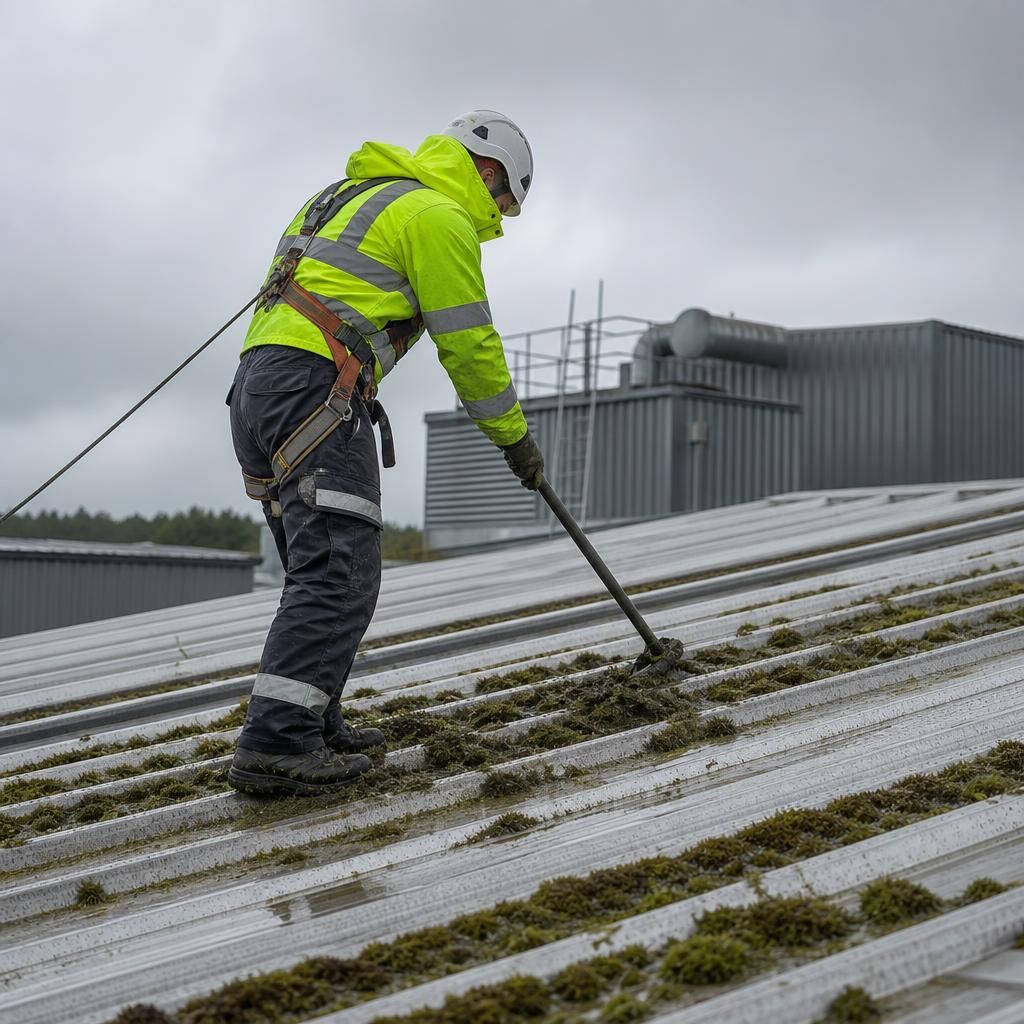
Roof-type moss removal means matching the cleaning method, tools and treatment to the roof covering, rather than using the same process on every surface. Clay and concrete tiles usually need gentle manual removal and controlled rinsing, while slate, coated metal and flat-roof membranes require more careful access and lower-impact techniques.
Before work begins, check for cracked or loose materials, fragile rooflights, damaged coatings, seams, flashings and blocked outlets. Avoid aggressive scraping, abrasive tools and uncontrolled pressure washing, as these can displace tiles, strip finishes, puncture membranes or force water beneath overlaps. Use only treatments confirmed as compatible with the roof material, and control moss, chemical residue and dirty runoff so gutters, walls, vehicles and planted areas are protected.
Arrange a Roof-Specific Moss Removal Assessment
Arrange a roof-specific moss removal assessment so the covering, access requirements, moss removal method and treatment compatibility can be checked before work begins. We will identify vulnerable areas and recommend precautions that protect the roof, drainage system and surrounding property.