
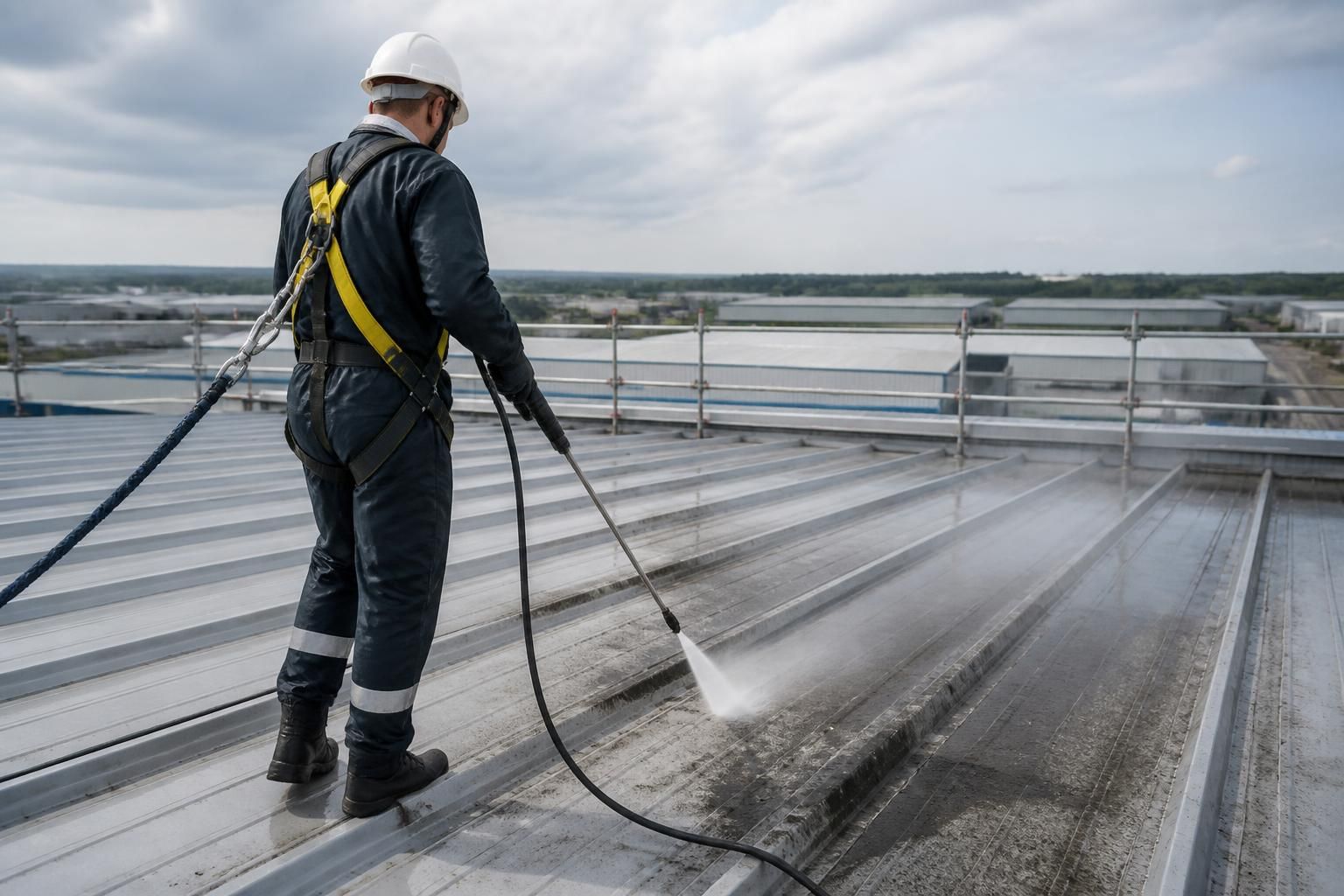
What safety measures should be taken during industrial roof cleaning?
Industrial roof cleaning should be planned and carried out by trained professionals using a site-specific risk assessment, suitable access equipment, fall protection, and controlled work areas. Key measures include checking the roof structure and weather conditions, preventing falls and falling objects, managing water and cleaning chemicals safely, and following relevant UK health and safety requirements.
Industrial roof cleaning should be planned as a controlled work-at-height operation, not treated as ordinary pressure washing. The essential safety measures are a site-specific risk assessment and method statement, a structural inspection, competent operatives, suitable access and fall-protection systems, controlled water and chemical use, exclusion zones, and a documented emergency plan. The controls must reflect the roof design, surface condition, access arrangements, cleaning method, weather, surrounding operations and the potential for people or property to be affected below.
Assess the roof and work area before starting
A competent person should inspect the roof and its surroundings before equipment or operatives are positioned. The assessment should identify the roof type, load-bearing capacity, pitch, fragile areas, rooflights, skylights, exposed edges, parapets, gutters, drainage outlets, plant, cables, vents and other obstructions. Older industrial roofs may have corrosion, damaged fixings, deterioration beneath coatings or concealed fragile panels that are not obvious from ground level.
Roof plans, maintenance records and information from the building owner should be reviewed where available. A roof should never be assumed to be safe to walk on simply because it appears intact. Fragile surfaces, rooflights and areas affected by corrosion must be clearly identified, protected or avoided. Where the roof cannot safely support operatives, cleaning should be carried out from suitable access equipment or another system that prevents loading of the surface.
Use a site-specific risk assessment and method statement
The risk assessment should cover the complete operation, including delivery of equipment, access to the roof, movement across the work area, use of hoses and electrical equipment, application of cleaning products, collection of debris, cleaning of gutters, work near the public and removal of equipment. It should set out who is responsible for each control and how the work will be stopped if conditions change.
The method statement should describe the proposed cleaning technique, equipment, access route, exclusion arrangements, fall-protection measures, communications, inspection requirements and emergency procedures. It should also account for other contractors and normal site activities. A permit-to-work or roof-access permit may be required by the site operator, particularly where the work is near production areas, vehicle routes, live electrical systems or other high-risk activities.
Ensure operatives are trained and competent
Industrial roof cleaning should be carried out by operatives who are trained for the specific tasks and equipment involved. This includes work-at-height procedures, safe use of access equipment, roof and fragile-surface awareness, manual handling, pressure-washing techniques, chemical handling and emergency response. Training must be supported by practical experience and appropriate supervision rather than relying solely on a general induction.
Operatives should be briefed on the risk assessment and method statement before work begins. They should understand the limits of the roof, the location of safe access points, the position of fragile areas, the agreed exclusion zone and the arrangements for raising an alarm or obtaining assistance.
Choose and inspect access equipment
Access equipment must be selected according to the height, roof layout, ground conditions, reach required and duration of the work. Depending on the site, this may include properly erected scaffolding, edge-protection systems, mobile elevating work platforms, tower systems, roof access ladders or a specialist rope-access arrangement. Access equipment should be suitable for the task and used in accordance with the manufacturer’s instructions.
Equipment must be checked before use and after it has been moved, altered or exposed to conditions that could affect its stability. Mobile equipment should be positioned on a firm, level surface with adequate clearance from edges, excavations, overhead obstructions and vehicle movements. Equipment inspections, thorough examinations and operator authorisations should be current where required. Lifting accessories and powered equipment must also be properly maintained and inspected.
Prevent falls from edges and through fragile surfaces
Collective protection, such as guardrails, scaffold edge protection or a suitable barrier system, should be used wherever reasonably practicable. Personal fall-arrest or work-restraint equipment may be required where collective protection cannot fully control the risk. Harnesses, lanyards, anchor points and lifelines must be compatible, correctly fitted, inspected and attached to an approved system.
A fall-arrest system is not a complete control by itself. There must be sufficient clearance below the operative, a suitable rescue plan and people trained to carry out the rescue. Operatives should not work alone where a fall or other emergency could leave them unable to summon help. Improvised anchor points, unsecured ladders and unprotected rooflights are not acceptable substitutes for a designed fall-protection system.
Control movement on the roof
Safe walkways, crawling boards or designated access routes should be provided where the roof design requires them. Hoses, cables and tools must be routed to prevent trip hazards, snagging and damage to the roof surface. Equipment should be kept away from roof edges and fragile panels, and loads should not be concentrated in one area unless the roof has been confirmed as capable of supporting them.
Operatives should use footwear with suitable slip resistance and should keep both hands available when climbing or moving through access points. Pressure-washing reaction forces can affect balance, particularly when working on sloping or wet surfaces, so the operator’s position and the restraint system must be suitable for the equipment being used.
Manage weather and changing conditions
Rain, frost, high winds, poor visibility, ice and extreme temperatures can make roof cleaning unsafe. Water, algae and cleaning residues can significantly reduce grip, even on surfaces that are normally walkable. The site supervisor should monitor conditions throughout the work and stop the operation if the roof, access equipment or fall-protection arrangements can no longer be used safely.
Weather conditions also affect spray drift, chemical application, electrical safety and the stability of mobile access equipment. A forecast should be checked before mobilisation, but the decision to continue must be based on actual conditions at the workplace.
Control pressure, steam and cleaning equipment
Pressure-washing and steam-cleaning equipment should be selected for the roof material and used at a pressure and temperature that will not damage membranes, coatings, seals, joints, fixings or insulation. Operators should be trained to control the lance and avoid directing spray at people, open vents, electrical installations, vulnerable glazing or areas where water could enter the building.
Hoses and connections should be checked for wear, leaks and secure couplings. Machinery must have suitable guards and emergency controls, and fuel-powered equipment must not be used in enclosed or poorly ventilated areas where exhaust fumes could accumulate. Electrical equipment should be appropriate for wet conditions, protected by suitable residual-current protection where required and kept away from standing water and damaged cables.
Handle chemicals and contaminated residues safely
Where detergents, biocides, degreasers or other treatments are used, the product assessment should cover exposure through skin contact, inhalation, splashes and accidental release. Operatives should follow the product safety information, use the specified dilution and wear the required personal protective equipment, such as gloves, eye protection, protective footwear or suitable respiratory protection.
Chemicals must be labelled, securely stored and transported in a way that prevents leaks. They should not be mixed unless the manufacturer specifically permits it. Spill kits and an agreed response procedure should be available. Residues, sludge, moss and contaminated water must be managed so they do not enter surface-water drains, watercourses, neighbouring land or areas used by the public.
Protect people, vehicles and property below
A clearly defined exclusion zone should be established beneath and around the work area to control falling tools, debris, spray, runoff and displaced roof material. Barriers and warning signs should be used, with a banksman or other traffic-management arrangement where pedestrians or vehicles could enter the zone. Doors, entrances, loading bays and fire exits must not be obstructed without an agreed alternative arrangement.
Windows, vents, sensitive machinery, stock, vehicles and building openings should be protected from water, chemicals and debris. Cleaning should be coordinated with the building’s occupants so that vulnerable activities, deliveries and pedestrian routes are controlled while work is under way.
Maintain communication and emergency arrangements
The team should have a reliable means of communication between the roof, ground-level personnel and the site contact. The emergency plan should cover falls, suspension in a harness, medical incidents, chemical exposure, equipment failure, fire, sudden weather changes and damage to the building. It should state how emergency services will access the site and how an injured person will be recovered without creating further risk.
First-aid arrangements, site address details, access gates and emergency contact information should be confirmed before starting. A rescue plan must be practical for the actual roof and access system; simply relying on emergency services is not sufficient where a suspended operative could deteriorate before rescue.
Follow legal and site requirements
Work should be organised in line with relevant UK health and safety requirements, including the rules governing work at height, construction and maintenance activities, safe use of work equipment, lifting equipment, hazardous substances, personal protective equipment and workplace transport. The principal contractor, building owner or facilities manager may also impose additional procedures. Compliance should be demonstrated through competent planning, inspections, training records, equipment examinations and clear site documentation.
Check the work as it progresses
Supervision should continue throughout the cleaning rather than ending after the initial briefing. The responsible person should check barriers, access equipment, anchor systems, weather, roof condition, chemical use, runoff controls and housekeeping. Any change to the roof, equipment, method or surrounding site activity should trigger a review of the controls.
On completion, hoses, tools, debris and barriers should be removed safely, gutters and drainage routes checked, and the area inspected for standing water, residues or damage. Any defects identified during cleaning should be recorded and reported to the client rather than concealed by the finished appearance. This approach leaves a clear maintenance record and helps ensure that future roof-cleaning work can be planned on accurate information.
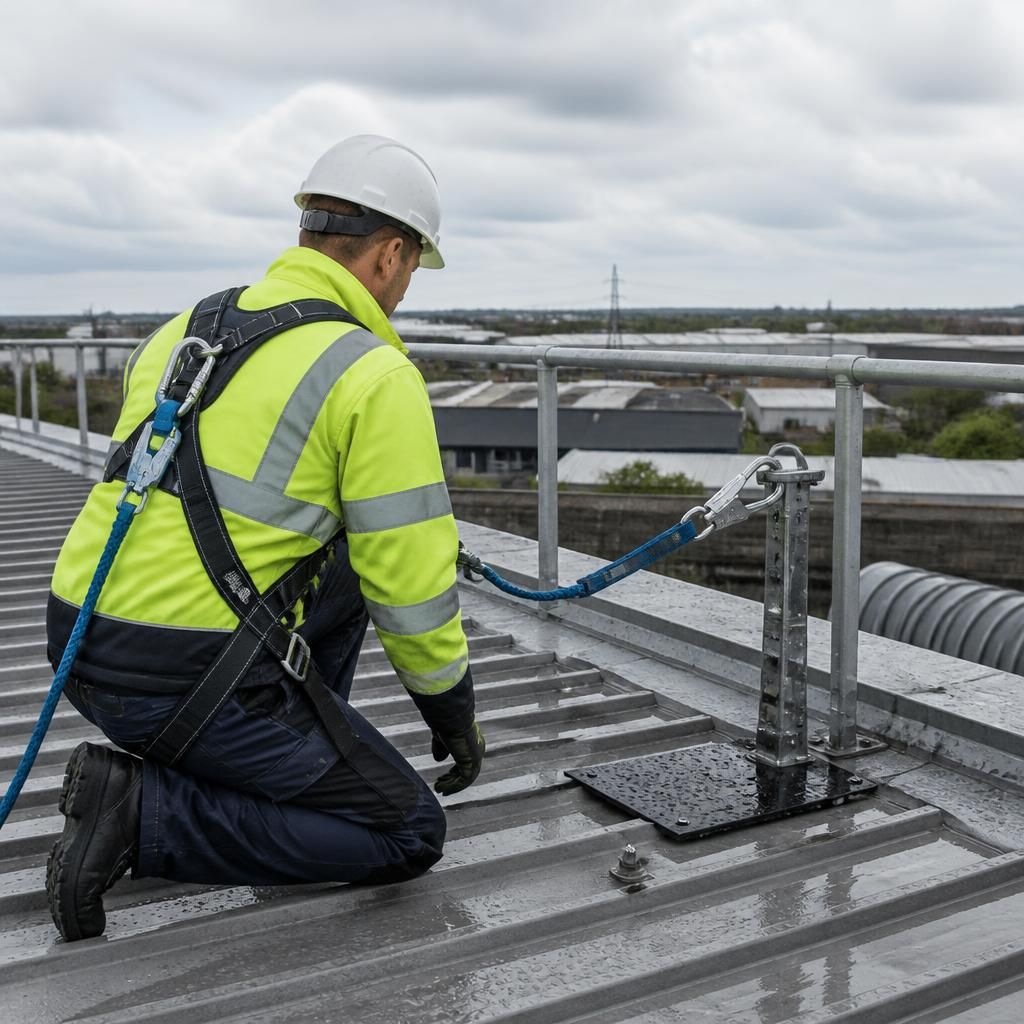
Fall protection is a central safety measure during industrial roof cleaning because wet surfaces, roof edges and fragile rooflights can create serious risks. Before work begins, the access arrangement should be selected for the roof layout and condition, with collective protection such as guardrails or edge protection used wherever practicable.
Where additional protection is needed, a suitable work-restraint or fall-arrest system must be connected to approved anchor points and checked before use. The equipment should be compatible, correctly fitted and appropriate for the task. A fall-arrest system also requires a practical rescue plan, as a suspended operative may need prompt recovery. Roof cleaning should stop if weather, surface contamination or changing site conditions make the agreed controls ineffective.
Arrange a Safe Industrial Roof Cleaning Assessment
Arrange a site-specific industrial roof cleaning assessment with Encanto Exterior Cleaning to review roof condition, access requirements, fall protection and environmental controls before work begins. Contact us to agree a safe, compliant cleaning plan for your premises.