
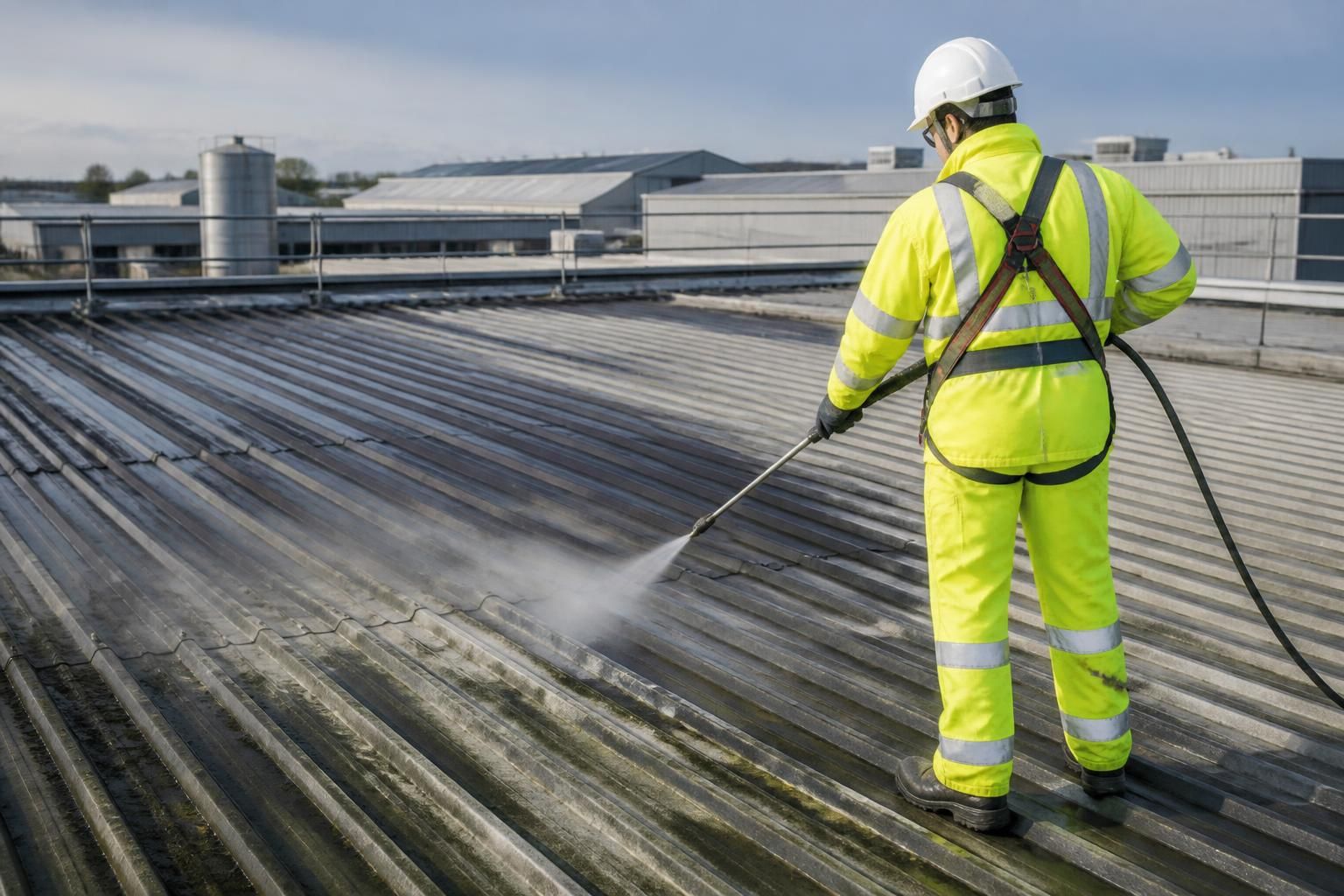
What qualifications and certifications should an industrial roof cleaning company possess to ensure professional and compliant service delivery?
An industrial roof cleaning company should hold appropriate health and safety training, public and employers’ liability insurance, and demonstrable competence in working at height, using access equipment and handling cleaning chemicals. Depending on the project, look for relevant contractor accreditation, equipment inspection records, environmental controls and documented risk assessments and method statements (RAMS) before work begins.
An industrial roof cleaning company should be able to demonstrate formal health and safety training, competence in working at height, suitable insurance, properly maintained access and cleaning equipment, and a documented system for controlling environmental and operational risks. There is no single UK certificate that automatically qualifies a contractor to clean every industrial roof. Professional compliance is established by matching the company’s training, experience, equipment and procedures to the roof, access arrangements, cleaning method and site conditions.
Working-at-height competence is the most important qualification area. Roof cleaning commonly involves fragile surfaces, rooflights, roof edges, plant areas, access ladders and mobile elevated work platforms. The contractor should be able to show that the people carrying out the work have suitable training and practical experience in:
- recognising fragile roofing materials and rooflights;
- using edge protection, guardrails, safety lines and personal fall-arrest equipment where specified;
- setting up and using ladders, towers and other access systems correctly;
- working safely around roof edges, openings, skylights, services and obstructions; and
- responding to a fall, injury, equipment failure or changing weather conditions.
Training should be appropriate to the equipment and work method rather than presented as a generic certificate. The company should also explain how it verifies ongoing competence through supervision, refresher training and site-specific briefings.
Access equipment training should be checked where the project requires powered access or specialist systems. Operators of mobile elevating work platforms should hold recognised training suitable for the type of machine being used. Where towers or modular access systems are required, the installers and users should have relevant training. Rope-access work needs a suitably trained and medically fit rope-access team, together with a documented rescue plan; it should not be treated as a substitute for general roof safety controls.
Training schemes and cards can help demonstrate competence, but they do not remove the contractor’s responsibility to assess the particular site. Ask for evidence that the operator is trained on the relevant equipment category and that the machine will be used in accordance with its manufacturer’s instructions and the site’s ground conditions.
Health and safety training should cover more than working at height. Depending on the proposed cleaning process, relevant training may include:
- risk assessment and method statement preparation;
- manual handling and safe use of hand tools;
- first aid and emergency response;
- chemical awareness and safe storage;
- control of exposure to dust, aerosols and contaminated run-off;
- use, inspection and maintenance of personal protective equipment; and
- traffic management when work takes place near vehicles, loading areas or public routes.
A supervisor should be capable of stopping the work when conditions change. Wind, rain, frost, poor visibility, contaminated surfaces or unexpected roof defects may make the planned method unsafe.
Chemical and cleaning-process competence is necessary when detergents, biocides, degreasers or other treatments are used. The contractor should provide current safety data sheets, COSHH assessments and clear instructions for dilution, application, storage, spill response and disposal. Operatives should understand the risks of mixing products, applying chemicals near people or vehicles, and allowing contaminated water to enter drains or watercourses.
The company should also understand the limits of pressure washing and steam cleaning. Excessive pressure, heat or chemical strength can damage coatings, seals, membranes, insulation, flashings and roof drainage components. A competent contractor will select a method after identifying the roof covering and its condition, and will carry out a controlled test area where appropriate.
Inspection and equipment records are an important part of compliance. The contractor should maintain records for access equipment, lifting accessories, pressure washers, steam equipment, hoses, electrical tools and personal protective equipment. Depending on the equipment, records may include pre-use checks, planned maintenance, examination certificates and inspection reports under relevant legal requirements.
Powered access equipment and lifting accessories require particular attention. The company should be able to confirm that statutory examinations and inspections are current, that defects are recorded and that unsafe equipment is removed from use. Electrical equipment should be maintained and checked in a manner appropriate to the site and its working environment.
Asbestos awareness may be relevant to older industrial buildings, particularly where roof sheets, panels, soffits or associated materials could contain asbestos. Awareness training helps operatives recognise when work must stop and specialist advice is needed. It does not authorise a general roof cleaning company to disturb, remove or dispose of asbestos-containing materials. If asbestos is suspected, the material should be assessed by a competent asbestos professional and any required work carried out under the appropriate legal controls.
Insurance should be verified before work starts. A professional contractor will normally hold:
- public liability insurance for injury to third parties and damage to property;
- employers’ liability insurance where it employs staff; and
- appropriate cover for vehicles, plant and specialist operations where relevant.
The level and scope of cover should reflect the size and risk of the project. Check that the policy covers work at height, pressure washing, chemical use, work on industrial premises and accidental damage to roofing systems or building fabric. Insurance is not a qualification, but it is an essential indicator of responsible business management and financial protection.
RAMS and site documentation should be prepared before the cleaning begins. A suitable risk assessment and method statement should address the actual building rather than rely on a generic template. It should cover roof construction and condition, access and exclusion zones, fragile areas, weather limits, equipment positioning, water and chemical controls, electrical or mechanical hazards, emergency arrangements, rescue procedures and protection of building occupants, vehicles and equipment.
The contractor should also be willing to coordinate with the building manager, principal contractor or facilities team. On construction sites, the client may require specific site induction, construction-safety cards, supervisor qualifications or approved-contractor documentation. These requirements are separate from the company’s underlying competence and should be confirmed during planning.
Environmental and waste-management competence is increasingly important for industrial roof cleaning. The company should explain how it will prevent detergents, biological treatments, oil residues, paint particles and dirty run-off from entering surface-water drainage or nearby land. Controls may include drain protection, collection and filtration, temporary containment, controlled discharge and lawful disposal by an authorised waste carrier where required.
Environmental accreditations or a recognised environmental management system can provide useful evidence of structured processes, but certification alone does not prove that the proposed roof-cleaning method is suitable. The contractor should still provide a project-specific plan for water use, run-off, chemical selection, waste and protection of surrounding areas.
Accreditations and management standards can support the assessment of a contractor, particularly for procurement teams and larger sites. Schemes covering health and safety, quality, environmental management or contractor pre-qualification may indicate that policies and documentation have been independently reviewed. Quality, environmental and occupational health and safety management standards can also demonstrate a formal management system.
However, these accreditations should be treated as supporting evidence rather than a replacement for practical checks. Confirm who will carry out the work, what training they hold, whether the accreditation applies to the relevant services, and whether certificates are current. A company can possess general accreditation while still needing additional training or controls for a particular roof, access system or cleaning chemical.
Before appointing an industrial roof cleaning company, request copies or confirmation of its relevant qualifications, insurance, equipment examinations, COSHH assessments, RAMS and environmental controls. Ask for method-specific experience with the roof covering and cleaning technique proposed. The strongest evidence is a consistent combination of competent operatives, appropriate supervision, maintained equipment, clear documentation and a willingness to adapt the plan when the roof inspection identifies additional risks.
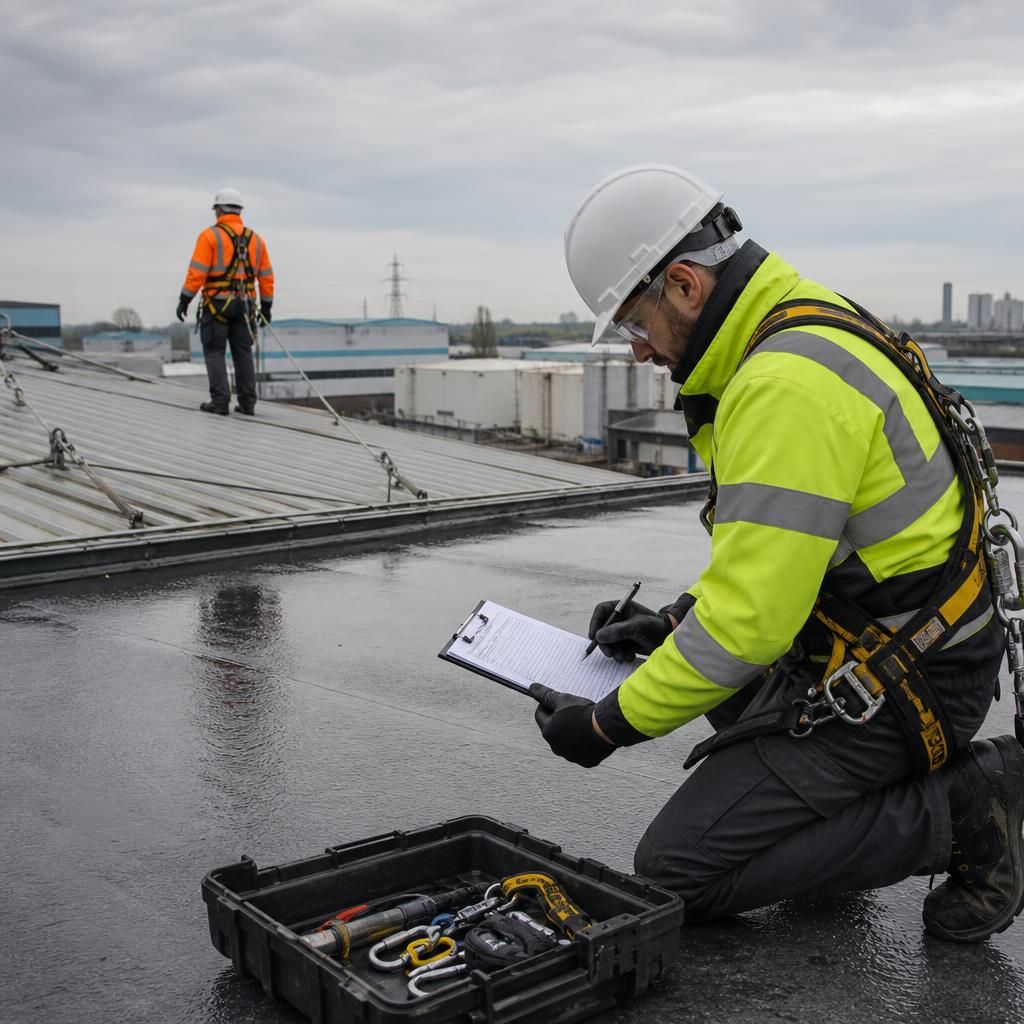
A competent industrial roof cleaning company should provide project-specific evidence that its operatives, equipment and working methods are suitable for the site. Relevant qualifications may include working-at-height and access-equipment training, supported by current equipment inspection records, public liability insurance and employers’ liability insurance where applicable.
Before work starts, ask to review the risk assessment and method statement (RAMS), COSHH assessments for any cleaning products, emergency arrangements and controls for contaminated run-off. These documents should address the actual roof construction, fragile areas, access points, weather limits and surrounding operations rather than rely on a generic template. Accreditations can support this assessment, but they should complement—rather than replace—evidence of practical experience and competent supervision.