
What criteria should be used to evaluate the long-term effectiveness and sustainability of industrial roof cleaning solutions?
Evaluate industrial roof cleaning solutions by their ability to remove contamination without damaging the roofing system, preserve the roof’s service life, and deliver consistent results through planned maintenance. Also assess contractor competence, health and safety controls, environmental impact, wastewater management, compliance, clear reporting and whole-life cost rather than relying on the lowest initial price.
The long-term effectiveness and sustainability of an industrial roof cleaning solution should be judged by more than the immediate visual result. A suitable solution removes contamination without damaging the roof, supports the roof system’s service life, controls health, safety and environmental risks, and provides repeatable results through planned maintenance. The assessment should cover technical performance, contractor competence, compliance, environmental controls, reporting and whole-life cost.
Assess the cleaning result and its effect on the roof
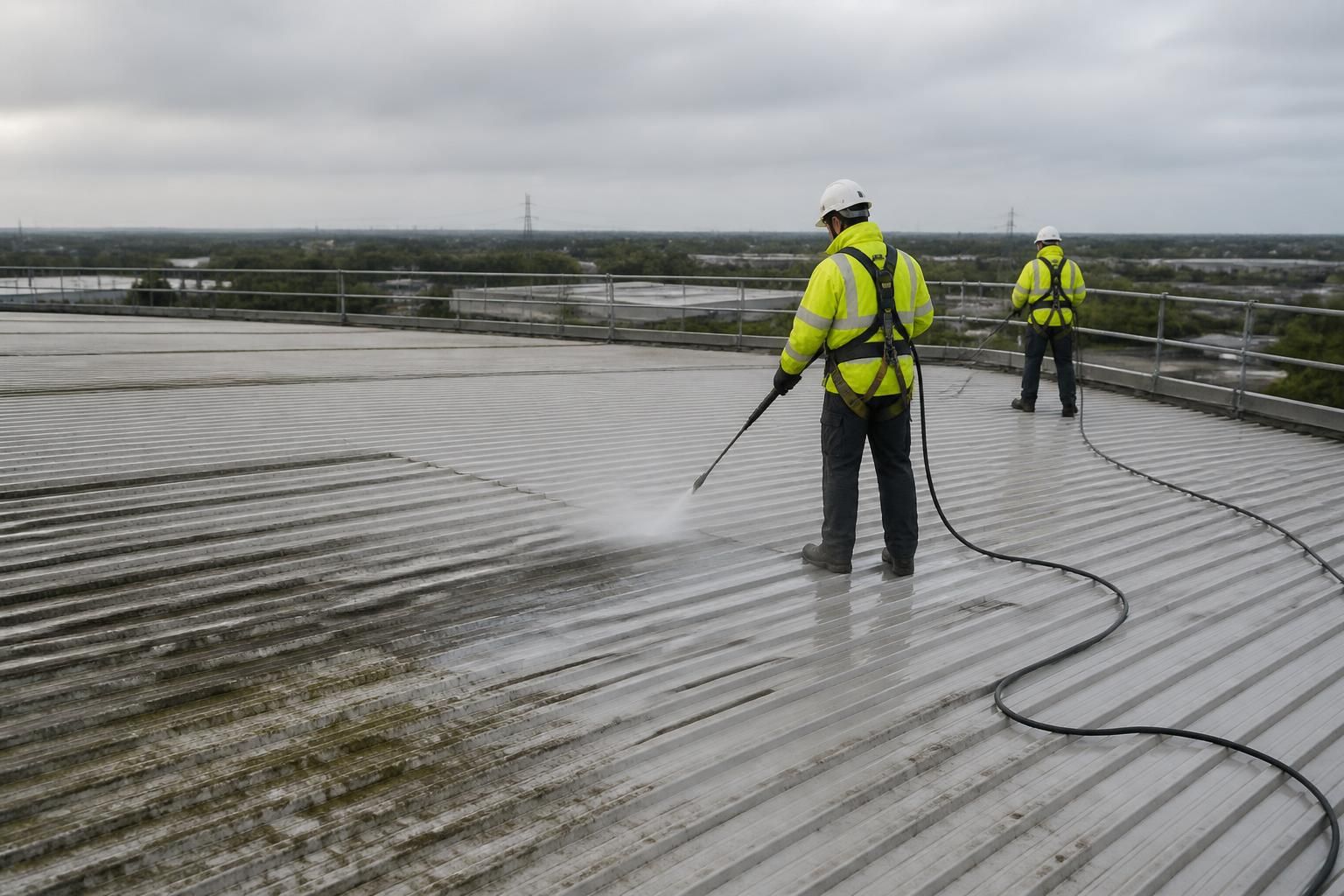
The cleaning method should be matched to the roof covering, its age, condition, coatings and known defects. Industrial roofs may include profiled metal, coated steel, asbestos cement, concrete panels, EPDM, PVC, TPO, fibreglass or other specialist systems. Pressure, temperature, agitation, steam and cleaning products must be selected according to the manufacturer’s requirements and the condition of the surface.
- Contamination such as moss, algae, lichen, dirt, bird fouling, atmospheric deposits, oil and construction residue should be removed to the agreed standard.
- The method should avoid lifting laps, forcing water beneath sheets or membranes, damaging protective coatings, opening joints or disturbing fixings and sealants.
- There should be no unnecessary abrasion, etching, discolouration or chemical attack on the roof surface.
- Drainage outlets, gutters, valleys and rainwater systems should be cleared without allowing loosened debris to create blockages.
- The roof should be inspected for defects revealed by cleaning, including corrosion, failed sealant, cracked panels, loose fixings, damaged membranes and areas of standing water.
A clean appearance alone is not proof of effectiveness. The contractor should explain how the method protects the roof and how the finished work will be checked. Where appropriate, photographic records, inspection notes and agreed completion criteria should be provided.
Consider whether the result will last
Long-term performance depends on the cause and type of contamination, not simply the strength of the cleaning process. A solution is more sustainable when it removes the source of deterioration or allows it to be managed through planned maintenance. The evaluation should consider:
- Whether contamination is likely to return because of nearby trees, industrial emissions, persistent dampness, bird activity or defective drainage.
- Whether remedial work is needed to address blocked outlets, leaking joints, damaged coatings or areas where water remains on the roof.
- Whether a compatible treatment or protective coating is appropriate and can be maintained without creating future inspection or repair problems.
- Whether the proposed maintenance interval is based on the roof’s exposure, materials, condition and use rather than an arbitrary schedule.
- Whether future cleaning can be carried out using a similar low-impact method without progressively weakening the roof system.
Cleaning should be integrated with roof inspections and planned maintenance. This makes it easier to identify changes in condition, compare results over time and address minor defects before they require more disruptive work.
Evaluate roof compatibility and technical competence
The contractor should demonstrate experience with the specific roof construction and contamination present on the site. This includes understanding the difference between cleaning a roof membrane, a coated metal surface, a fragile cement-based sheet and a fibreglass system. A method that is suitable for one material may cause permanent damage to another.
Ask for a clear method statement explaining the proposed equipment, water pressure, temperature, chemicals, dwell times, rinsing process and protection of vulnerable details. The contractor should also explain how they will test the method, where necessary, before proceeding across the full roof area. Product information and safety data should be available for any detergents, biocides, treatments or coatings used.
Technical quality also depends on access and work sequencing. Equipment, hoses and foot traffic should be positioned so that they do not overload vulnerable areas or damage roof coverings. Walkways, crawl boards, edge protection and designated access routes should be used where required by the roof design and risk assessment.
Check health and safety controls
Industrial roof cleaning is high-risk work because it can involve fragile surfaces, roof edges, open skylights, electrical equipment, water, chemicals, plant and public or vehicle movements below. A sustainable solution is not acceptable if it transfers unacceptable risk to workers, building occupants or visitors.
The contractor should provide a site-specific risk assessment and method statement covering:
- Work at height, fragile roofing and the risk of falls through rooflights or deteriorated panels.
- Safe access, edge protection, fall restraint or fall arrest arrangements where required.
- Weather conditions, wind, rain, frost, heat and poor visibility that could make the work unsafe.
- Electrical services, rooftop plant, ventilation systems, smoke vents and other building installations.
- Manual handling, hose management, slips, trips and the movement of cleaning equipment.
- Exposure to cleaning chemicals, aerosols, biological contamination and contaminated water.
- Segregation from employees, members of the public, vehicles and operations at ground level.
- Emergency arrangements, rescue procedures, first aid and communication with the site contact.
Competent operatives should have suitable training and supervision for the equipment and access systems being used. The contractor’s insurance, training records, equipment inspections and relevant qualifications should be available for review where required by the site’s procurement or compliance procedures.
Assess environmental sustainability
Environmental performance should be assessed across the whole cleaning process rather than by looking only at the chemical label. Important considerations include water use, energy use, chemical selection, transport, waste and the handling of runoff.
- Use the least aggressive method that can achieve the required result, avoiding unnecessary pressure, heat and chemical consumption.
- Select products that are appropriate for the roof and contamination while limiting avoidable harm to drainage systems, soil, plants, watercourses and site users.
- Prevent dirty water, oils, biocides, detergents and loosened contaminants from entering surface-water drains or the wider environment.
- Identify drainage routes before work begins and use containment, collection, filtration or controlled disposal measures where necessary.
- Dispose of sludge, debris, containers and contaminated materials through appropriate waste arrangements.
- Protect rainwater harvesting systems, cooling equipment, planting, vehicles, stored goods and sensitive areas from overspray and runoff.
Claims such as environmentally friendly or chemical free should be supported by a clear explanation of the method and its controls. A low-chemical process is not automatically sustainable if it uses excessive water, causes repeated cleaning or produces uncontrolled runoff.
Review legal, regulatory and site compliance
The service should comply with applicable health and safety, environmental, waste and work-at-height requirements, together with the site’s own permit and contractor management procedures. Requirements may vary according to the roof material, the presence of hazardous substances, the type of discharge and the operational setting.
Particular care is required where asbestos-containing materials, lead residues, industrial contaminants or other hazardous substances may be present. The roof should not be cleaned until relevant surveys, controls and specialist arrangements have been confirmed. If cleaning could disturb hazardous material, the work should be reassessed and undertaken only by appropriately competent personnel under the correct controls.
Where discharge consent, trade effluent approval or specific waste documentation is required, responsibilities should be agreed before work begins. Records should show what was removed, how wastewater and waste were managed, and whether any restrictions applied to the site.
Examine the contractor’s process and documentation
A reliable contractor should provide more than a price and a proposed start date. The quotation and supporting documents should define:
- The roof areas, surfaces and contamination included in the scope.
- The cleaning method, products and equipment to be used.
- Pre-cleaning inspections, testing and protection of adjacent assets.
- Access arrangements, safety controls and working restrictions.
- Runoff, wastewater, waste and chemical management procedures.
- The expected finish and how the completed work will be inspected.
- Any exclusions, limitations or repairs that are outside the cleaning scope.
- Recommendations for follow-up inspections and future maintenance.
Completion records should include photographs where useful, details of areas treated, products used, defects observed and any recommendations. This information supports future maintenance planning and provides an auditable record for property managers, landlords, insurers and facilities teams.
Compare whole-life value rather than the initial price
The cheapest quotation may not provide the lowest cost over the roof’s service life. A meaningful comparison should include preparation, access, cleaning, wastewater management, repairs identified during the work, protective treatments, follow-up inspections and future cleaning requirements.
Consider whether the method could shorten the life of the roof, invalidate a manufacturer’s warranty, increase the risk of leaks or create a need for more frequent intervention. Conversely, a carefully controlled method that costs more initially may offer better value if it reduces damage, avoids repeated remedial work and supports predictable maintenance.
Ask contractors to identify assumptions and potential additional charges before work starts. Clear scope, transparent exclusions and consistent reporting make competing proposals easier to compare and reduce the risk of choosing a process that appears inexpensive only because important controls have been omitted.
Use measurable review criteria
For an ongoing programme, effectiveness should be reviewed against agreed criteria rather than judged informally. These may include the condition of the roof after cleaning, the absence of avoidable damage, the cleanliness of drainage systems, the control of runoff, the completion of safety records and the recurrence of contamination during subsequent inspections.
The evaluation should be repeated after each significant clean or inspection. If contamination returns quickly, the solution may need to be adjusted, but the answer is not necessarily a stronger chemical or higher pressure. The underlying cause, roof condition, drainage, surrounding environment and maintenance frequency should be reviewed first.
In practice, the most sustainable industrial roof cleaning solution is one that is compatible with the roof, proportionate to the contamination, safe to deliver, compliant with environmental requirements and supported by dependable records. Selecting against these criteria helps protect the building, control future maintenance costs and maintain a professional standard across the site’s operational life.
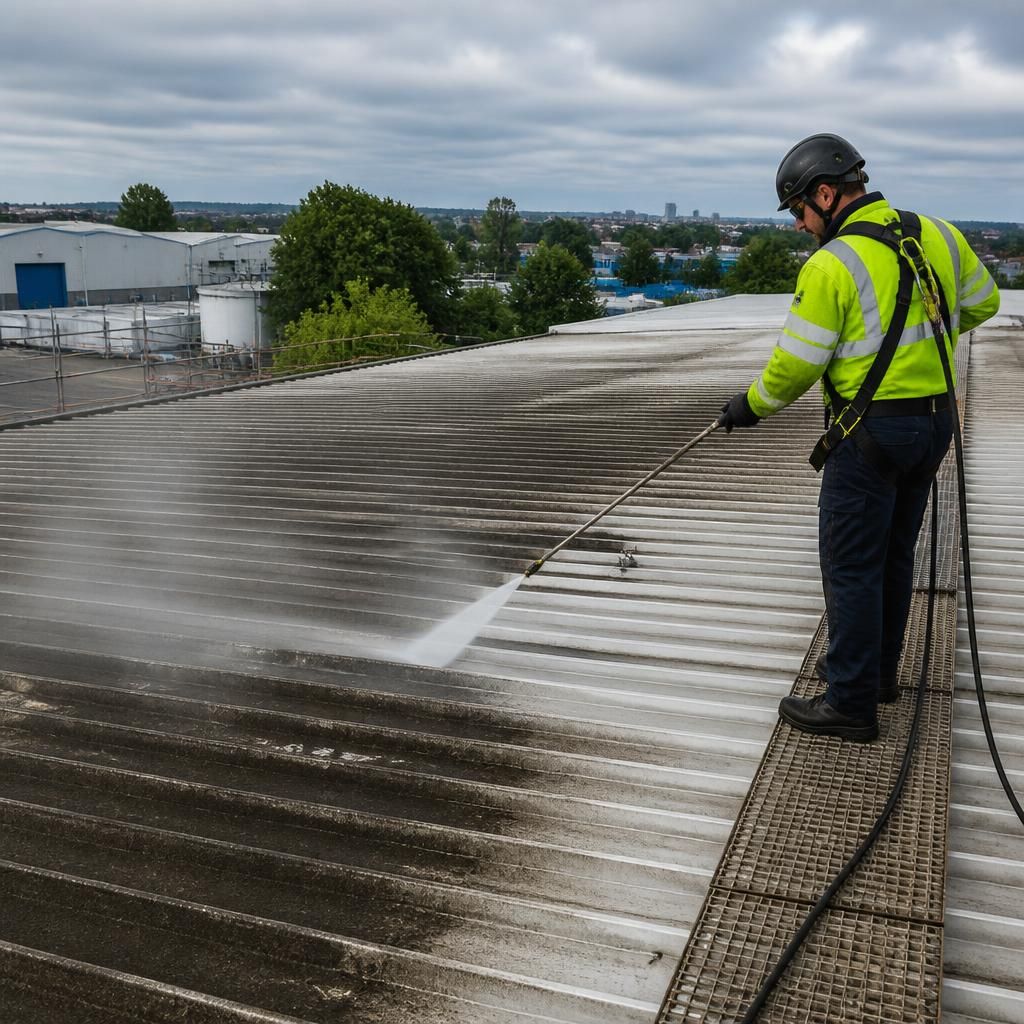
Long-term sustainability in industrial roof cleaning is best assessed by whether the method protects the roof, controls environmental risks and produces results that can be maintained without unnecessary repeat treatment. The immediate appearance should be considered alongside roof condition, drainage performance, contamination recurrence and the quality of the contractor’s records.
For each cleaning project, retain photographs and inspection notes showing the roof before and after treatment. Record the surfaces cleaned, products used, defects identified, drainage areas cleared and any restrictions on future maintenance. During subsequent inspections, compare these records to check whether contamination is returning quickly, whether coatings or membranes remain intact and whether defects have worsened.
- Confirm that the cleaning method caused no avoidable damage to sheets, membranes, sealants, fixings or protective coatings.
- Check that gutters, outlets and valleys remain clear and that dirty water or debris has not created a new maintenance issue.
- Review whether runoff, waste and chemical use were controlled in accordance with the site’s environmental requirements.
- Assess whether the recommended maintenance interval reflects the roof’s material, exposure, drainage and surrounding contamination sources.
- Compare the whole-life cost, including access, repairs, follow-up inspections and future cleaning, rather than comparing the initial quotation alone.
This evidence-based review helps identify whether the solution is genuinely effective or merely produces a short-lived visual improvement. If contamination returns, investigate drainage, dampness, nearby vegetation, emissions or bird activity before increasing pressure or chemical strength.
Discuss Your Industrial Roof Cleaning Requirements
Discuss your industrial roof cleaning requirements with our team to review the roof type, contamination, access arrangements and long-term maintenance needs. We can help identify a suitable cleaning approach and provide clear recommendations for your site.