
What are the safety measures involved in industrial roof cleaning?
Industrial roof cleaning safety measures include a documented risk assessment, competent operatives, controlled access using suitable scaffolding, edge protection or access equipment, and appropriate fall-arrest systems where required. Teams should also establish exclusion zones, manage water and electrical hazards, use suitable personal protective equipment, follow chemical and equipment controls, and stop work during unsafe weather or roof conditions.
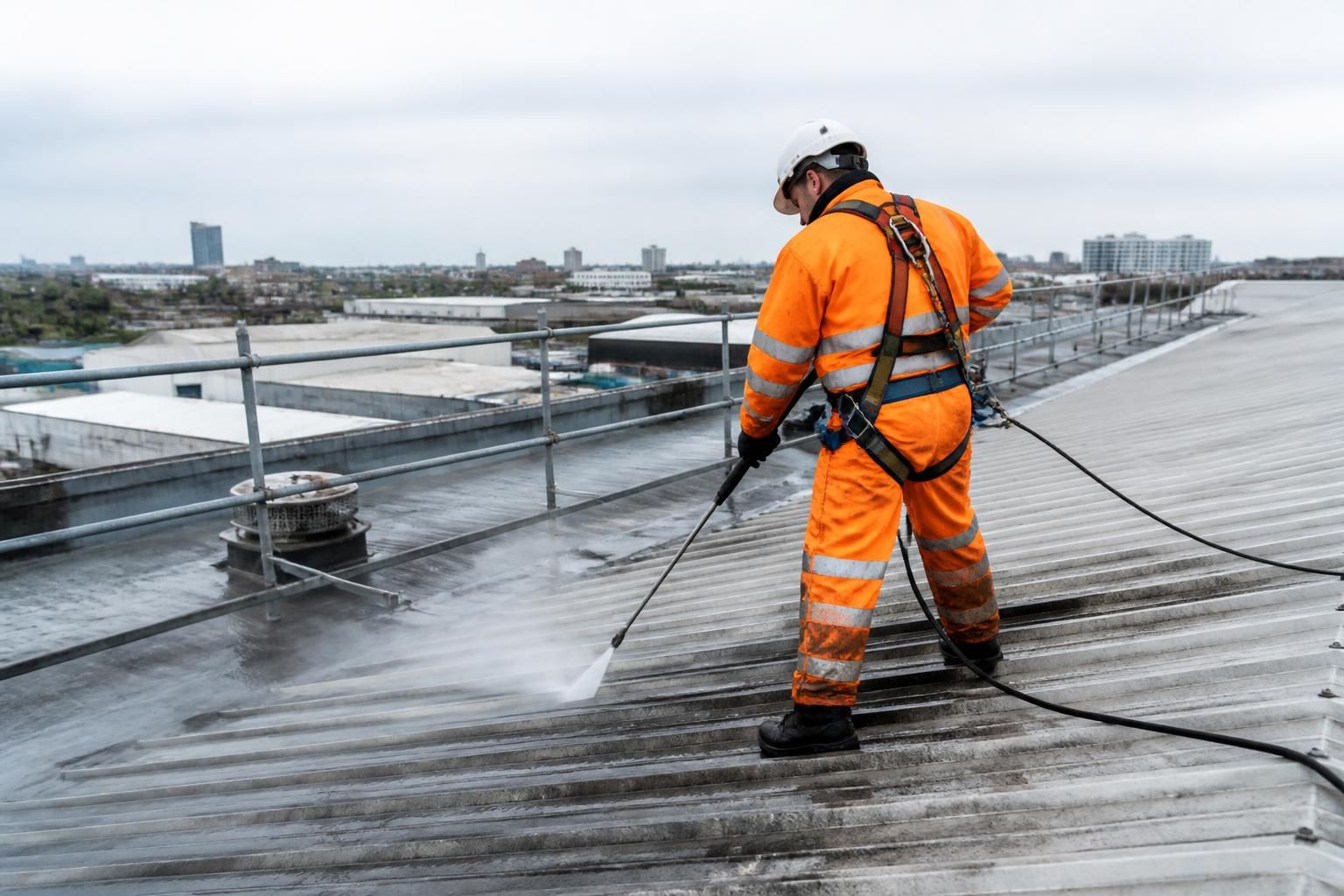
Industrial roof cleaning safety measures begin with a documented risk assessment, competent operatives and a planned system of work. The cleaning team must identify the roof’s construction, access points, fragile areas, edge hazards, weather exposure, electrical risks, chemical requirements and the potential impact on people below before work starts. Suitable access equipment, fall protection, personal protective equipment, exclusion zones and emergency arrangements should then be selected for the specific building and cleaning method.
Roof cleaning is not a routine maintenance task that can be carried out safely from the roof surface without preparation. Industrial buildings may contain fragile roof sheets, rooflights, asbestos-containing materials, unprotected edges, steep pitches, vulnerable coatings and concealed voids. Pressure washing and steam cleaning also introduce water, hoses, wet surfaces and equipment movement, which can increase the risk of slips, falls and damage to the building.
Risk assessment and method statement
Before mobilisation, the contractor should prepare a suitable risk assessment and method statement covering the work sequence and site-specific hazards. This should be reviewed with the client or site representative, particularly where the premises remain operational during cleaning.
- Survey the roof type, condition, pitch, load-bearing capacity and areas that must not be walked on.
- Identify rooflights, fragile sheets, openings, vents, plant, cables, pipework and other obstructions.
- Assess access and egress, including how operatives, hoses, tools and equipment will reach the work area.
- Consider nearby roads, footways, loading areas, employees, visitors, vehicles and members of the public.
- Define the cleaning method, water pressure, steam temperature, chemicals and containment arrangements.
- Set out stop-work conditions for high winds, rain, ice, lightning, poor visibility or deteriorating roof conditions.
- Provide arrangements for communication, first aid, rescue and reporting defects or incidents.
The plan should reflect the principles of the Work at Height Regulations and other relevant UK health and safety requirements. A generic document is not sufficient where roof design, access arrangements or cleaning risks differ between sites.
Competent people and supervision
Industrial roof cleaning should be undertaken by trained, experienced operatives who understand work at height, roof hazards, access equipment, pressure or steam equipment, chemical controls and emergency procedures. Competence includes knowing when not to walk on a roof, how to recognise unsafe materials and how to use fall-protection systems correctly.
Operatives should receive a site induction and understand the agreed method statement before work begins. Appropriate supervision is needed to confirm that controls remain effective, particularly where the work involves complex access, fragile roofing, live industrial operations or changing weather conditions.
Safe access and fall prevention
Collective protection should be considered before personal fall protection. Depending on the building and task, this may include properly designed scaffolding, guarded platforms, access towers, mobile elevating work platforms, temporary edge protection, roof walkways or designated access routes. Equipment must be suitable for the ground conditions, roof height, reach required and surrounding obstructions.
- Access points should be stable, secured and kept clear of hoses, tools and standing water.
- Guardrails, toe boards and other edge protection should be installed where required and checked before use.
- Fragile roof areas should be excluded, clearly marked and protected with suitable staging or barriers where access is unavoidable.
- Operatives should not use rooflights, roof sheets, gutters or roof plant as footholds unless the system has been specifically designed for that purpose.
- Ladders should only be used where justified by the risk assessment and for suitable short-duration access tasks, not as a substitute for safer work platforms.
- Mobile elevating work platforms and similar equipment should be operated by trained personnel on suitable ground, with controls for overhead and collision hazards.
Where personal fall protection is necessary, the harness, lanyard, lifeline or restraint system must be compatible with the task and correctly anchored. A fall-arrest system does not prevent a fall; it limits the consequences after one occurs. It therefore requires adequate clearance, suitable equipment inspection and a practicable rescue plan. Operatives must not be left suspended after a fall while waiting for routine assistance.
Fragile roofs, rooflights and asbestos
Many industrial roofs contain materials that can fail under a person’s weight, including older fibre cement sheets, rooflights and deteriorated panels. A roof should never be assumed to be load-bearing simply because it appears intact. Rooflights may be difficult to distinguish from roof sheets when wet, dirty or viewed from above.
If asbestos-containing materials may be present, the relevant asbestos information and survey should be checked before work starts. The cleaning method must not damage or release fibres from asbestos materials. Work involving asbestos should only be undertaken under the appropriate controls by suitably trained and authorised personnel; ordinary pressure washing should not be used where it could disturb the material or spread contamination.
Equipment inspection and control
Pressure washers, steam cleaners, pumps, hoses, access equipment, lifting accessories and electrical tools should be selected for the conditions and inspected before use. Defective or damaged equipment must be removed from service.
- Hoses should be routed to reduce trip, snagging and entanglement risks and secured where necessary.
- Connections should be checked before pressurising the system, with the operator standing clear of joints and fittings.
- Pressure and temperature should be controlled to suit the roof covering, coating, sealants and adjacent fixtures.
- Equipment should be isolated before maintenance, nozzle changes, clearing blockages or repositioning.
- Fuel-powered equipment must be kept away from enclosed or poorly ventilated areas unless adequate ventilation and controls are in place.
- Electrical equipment and temporary supplies should be suitable for wet conditions, protected by appropriate residual-current protection and kept away from pooled water.
Under the Provision and Use of Work Equipment Regulations, work equipment must be appropriate, maintained and used by people with suitable information, instruction and training. Lifting accessories and lifting operations should also be controlled and inspected where equipment or materials are raised to roof level.
Water, electricity and slip hazards
Water from cleaning can make roof surfaces, access routes, scaffolding and ground areas slippery. It may also enter the building through defects, vents, rooflights or unsealed penetrations. The work plan should identify drainage points and protect sensitive internal areas, stock, machinery and electrical installations.
Run-off should be controlled so that contaminated water, detergents, oil, moss, paint residue or biological growth does not enter watercourses, neighbouring property or areas used by the public. Drains may need to be protected or temporarily isolated, with collected water disposed of in accordance with site and environmental requirements. Hoses and cables should be routed safely, and electrical services near the work area should be identified and isolated where necessary.
Chemical and biological controls
Any biocide, detergent, treatment product or roof coating must be suitable for the roof material and used in accordance with its safety data sheet and the Control of Substances Hazardous to Health requirements. The assessment should cover storage, dilution, application, contact with skin or eyes, inhalation, wind drift, run-off and accidental release.
- Use the least hazardous effective product and avoid unnecessary chemical application.
- Keep containers labelled, closed and secured against unauthorised access or tipping.
- Prevent spray drift towards people, air intakes, vehicles, neighbouring premises and sensitive vegetation.
- Use suitable gloves, eye protection, footwear, protective clothing and respiratory protection where the assessment requires it.
- Provide clean water and suitable arrangements for dealing with splashes or contamination.
Moss, bird fouling and other deposits may present biological risks. Operatives should avoid creating airborne contamination, maintain good hygiene and use appropriate protective equipment and waste controls.
Personal protective equipment
PPE supports, but does not replace, safe access and collective protection. Depending on the assessment, it may include a safety helmet with a secure chin strap, slip-resistant safety footwear, gloves suited to the equipment and chemicals, eye or face protection, hearing protection, waterproof or chemical-resistant clothing and a suitable harness system. PPE must fit the wearer, be compatible with other equipment and be inspected before use.
Exclusion zones and protection of people below
A clearly controlled exclusion zone should be established beneath and around the work area. Barriers and warning signs should prevent unauthorised access, while a banksman or site representative may be needed to manage vehicle and pedestrian movement. Tools, hoses, debris and cleaning equipment must be prevented from falling or being blown from the roof or access platform.
Where work takes place above entrances, walkways, loading bays or occupied areas, the client may need to provide temporary closures, alternative routes or coordinated working times. Cleaning should not begin until everyone affected understands the restrictions.
Weather monitoring and emergency arrangements
Wind can affect operatives, ladders, MEWPs, scaffolding, sheeting and unsecured equipment. Rain, frost and cleaning solution can create very slippery surfaces, while poor visibility can conceal fragile areas and obstacles. Weather conditions should be checked before and during the work, with clear authority to stop the operation when controls are no longer adequate.
The rescue plan should describe how an injured or suspended operative will be reached without exposing another person to the same hazard. It should include emergency contacts, access details, first-aid arrangements, the location of rescue equipment and communication with the site team. Emergency arrangements must be practical for the actual roof and access system, not simply copied into the paperwork.
For the client, the most useful checks are that the contractor has surveyed the roof, confirmed any asbestos information, provided a site-specific method statement, selected suitable access and fall-protection measures, controlled water and chemicals, and explained how people and property will be protected. Safe industrial roof cleaning depends on coordinating these controls before work starts and monitoring them throughout the project.
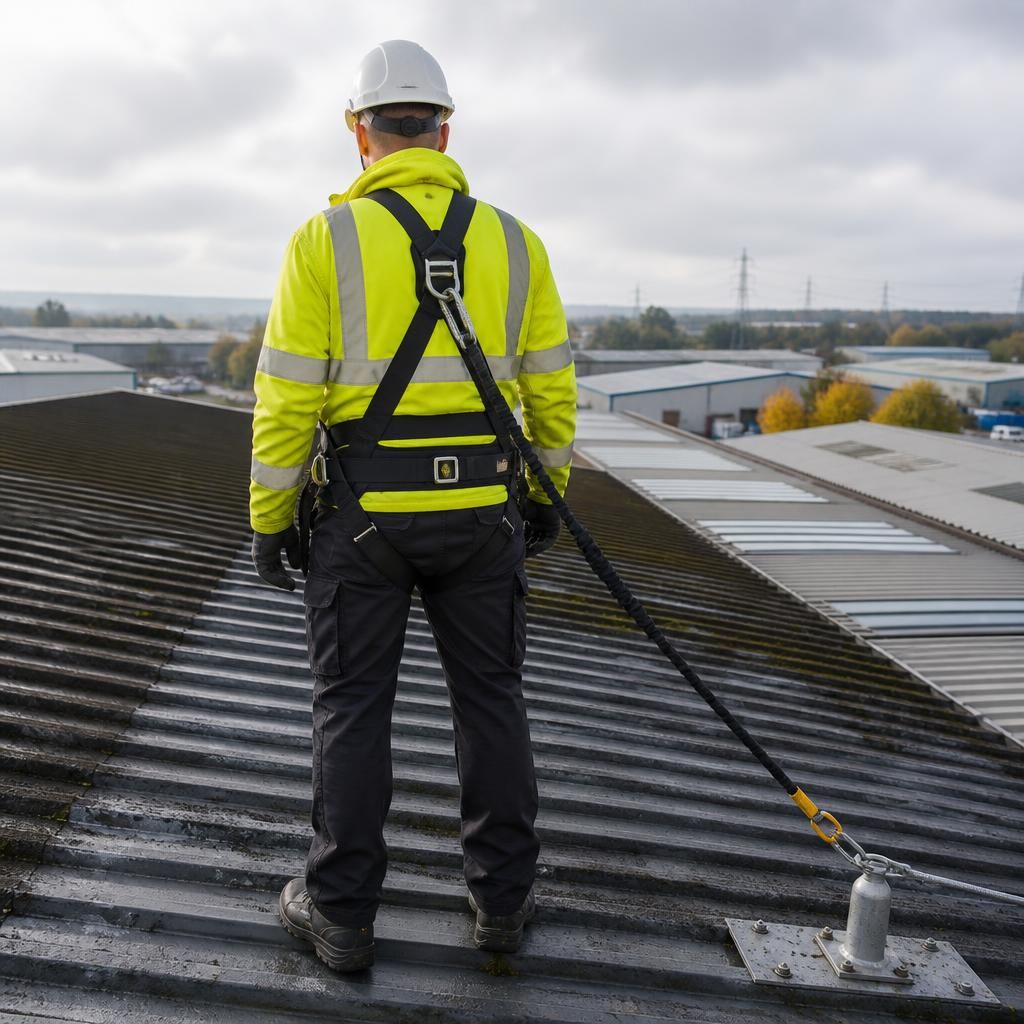
Fall protection is a central safety measure in industrial roof cleaning because wet surfaces, fragile roof coverings and unprotected edges can make even routine movement hazardous. The safest approach is to prevent a fall wherever possible using suitable scaffolding, guarded platforms, edge protection, roof walkways or a properly positioned access platform.
Where personal fall protection is required, the harness, restraint or fall-arrest system must be compatible with the roof and correctly anchored. A fall-arrest arrangement also requires sufficient clearance below the operative and a practical rescue plan, so nobody is left suspended after a fall. Access equipment and protective systems should be inspected before use and monitored throughout the cleaning work.