
What types of access equipment are essential for safe and efficient roof cleaning on commercial buildings?
Essential access equipment for commercial roof cleaning includes suitable mobile elevating work platforms (MEWPs), scaffolding, roof ladders or crawling boards, edge protection and certified fall-arrest systems. The correct combination depends on the roof design, height, access points and surface condition, and must allow operatives to work securely without damaging the building or disrupting site operations.
The essential access equipment for commercial roof cleaning is determined by the roof height, pitch, surface condition, fragile areas, access points and cleaning method. In most cases, a safe arrangement combines a suitable mobile elevating work platform (MEWP) or scaffold with roof ladders or crawling boards, edge protection and a correctly selected fall-protection system. Equipment must allow operatives to reach the work area without overreaching, loading vulnerable roofing materials or creating uncontrolled fall and dropped-object risks.
MEWPs for external access and perimeter work
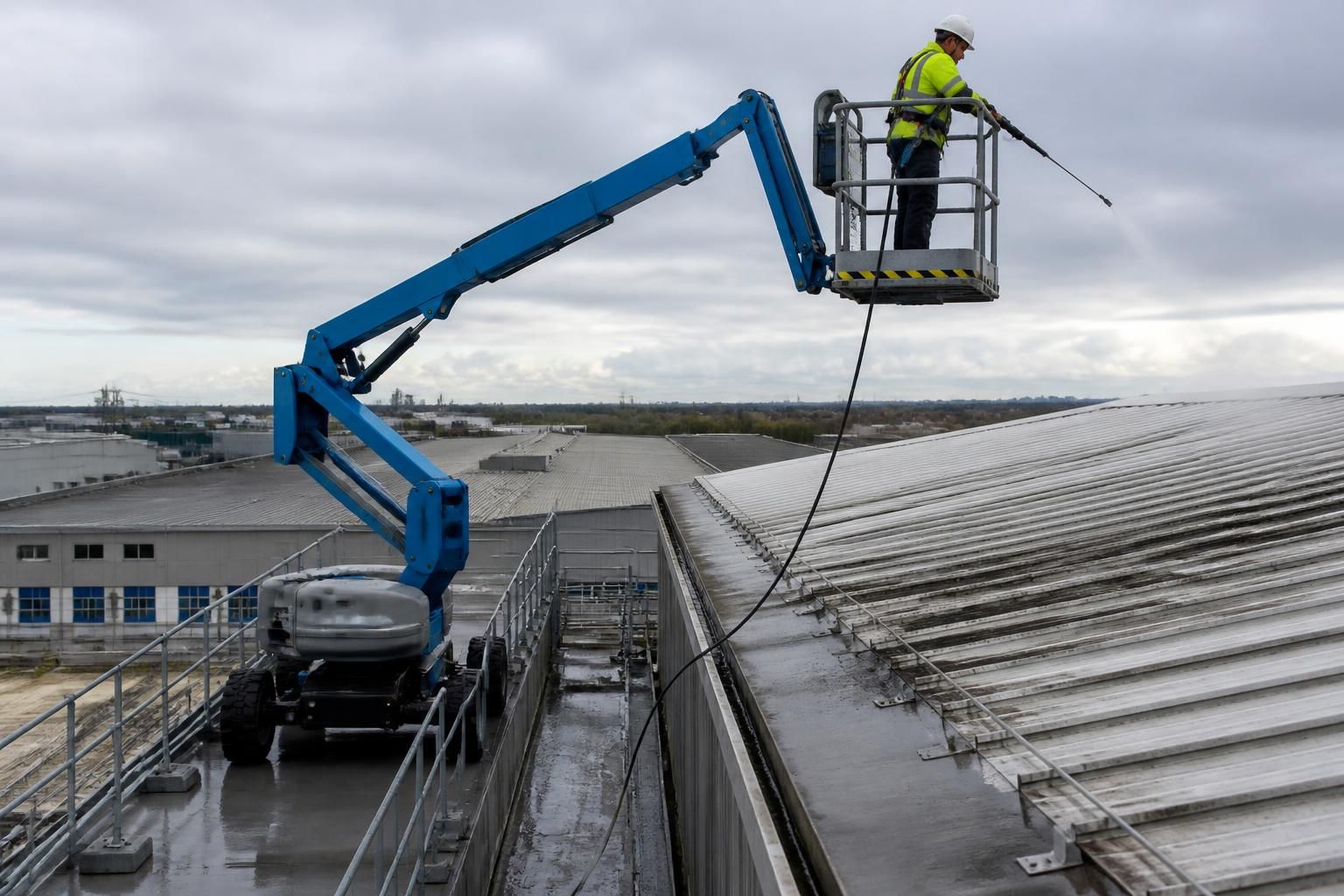
MEWPs are often the most efficient option for reaching roof edges, façades, canopies and areas that cannot be approached safely from the roof itself. Depending on the site, this may include a mobile boom lift, scissor lift or tracked access platform. Selection should consider working height, sideways reach, platform capacity, ground conditions, overhead obstructions, restricted entrances and the need to position cleaning hoses without snagging them.
The platform should be set up on a firm, level surface with adequate clearance from excavations, edges, traffic routes and overhead electrical services. Outriggers, spreader mats and stabilisers must be used as specified by the manufacturer. Operatives should be trained and authorised for the particular MEWP, carry out pre-use checks and wear the restraint or harness equipment required for that platform. A MEWP is not a substitute for planning: the work area still needs segregation, communication arrangements and a recovery plan in case the machine becomes immobilised.
Scaffolding and temporary access platforms
Scaffolding can provide a stable working platform for larger or longer-duration roof-cleaning projects, particularly where operatives need to work along an elevation or repeatedly handle hoses and cleaning equipment. A properly designed scaffold may include boarded platforms, guardrails, toe boards, access ladders, loading bays and sheeting where appropriate.
Scaffold must be erected, altered and inspected by competent persons, with its design taking account of the building, anticipated loads, wind exposure and the cleaning operation. It should not be used to store pressure-washing equipment or materials beyond its designed capacity. Access points must remain clear, and the scaffold should be protected from vehicle impact and unauthorised access where it stands in a busy commercial area.
Roof ladders and crawling boards
Roof ladders, roof hooks and crawling boards distribute an operative’s weight and provide a controlled route across sloping or potentially fragile surfaces. They are particularly useful on pitched roofs, but only when the roof construction has been assessed and the equipment is suitable for the pitch, covering and planned work.
These items must be secured against slipping, movement and sideways displacement. They should never be placed over unsupported sheets, rooflights or other fragile sections without confirming that the load will be transferred safely. Operatives should avoid stepping directly onto surfaces known or suspected to be fragile. Where a roof cannot safely support access equipment, an alternative method such as a MEWP, scaffold or temporary platform is required.
Edge protection and temporary guardrails
Edge protection prevents people, hoses, tools and loose debris from leaving an unprotected roof edge. Systems may include guardrails, intermediate rails and toe boards, with protection adapted to parapets, roof openings, skylights and changes in level. Temporary edge protection must be securely installed and checked before work starts and after any event that could affect its stability, such as impact or severe weather.
Guardrails should not be treated as a convenient place to tie equipment unless the system is specifically designed for that purpose. Hoses should be routed and managed so that they cannot pull against the protection or create a trip hazard. Toe boards and exclusion measures are also important where cleaning takes place above entrances, pavements, vehicles or occupied areas.
Personal fall-restraint and fall-arrest systems
Where collective protection cannot fully control the risk, a personal system may be required. Fall restraint limits an operative’s movement so they cannot reach an exposed edge. Fall arrest allows a fall to occur but limits its consequences using compatible anchors, connectors and energy-absorbing equipment. Restraint should normally be preferred where a suitable arrangement can be achieved.
Harnesses, lanyards, inertia reels, lifelines and anchors must be selected as a compatible system and used in accordance with the manufacturer’s instructions. Anchor position, clearance distance, swing-fall risk and the possibility of striking a lower roof or structure all need to be considered. An anchor is not suitable simply because it is present: it must be verified as appropriate for the system and the building. Harness users also require training, pre-use inspections and a rescue plan that does not rely solely on emergency services.
Access towers, ladders and stair units
Mobile access towers and stair units can provide controlled access to lower roofs, plant areas and scaffold platforms. Stair units are generally preferable to leaning ladders where equipment or frequent movement is involved, because they provide more stable footing and safer handling. Ladders should be used only where the task, duration and conditions make them appropriate, and they must be secured with a stable landing and three points of contact where practicable.
Mobile towers must be assembled and used on suitable ground, with wheels locked and stabilisers fitted where required. They must not be moved while occupied, raised or modified outside the manufacturer’s instructions. A ladder or tower should provide access rather than encourage operatives to work sideways from an unstable position.
Equipment for hose, tool and material management
Commercial roof cleaning often involves long pressure-washing or steam-cleaning hoses, electrical leads, recovery hoses and hand tools. Hose ramps, cable covers, lifting lines, tool lanyards and designated storage points help prevent trips, snagging and dropped objects. Hoses should be supported or routed away from fragile rooflights, unprotected edges, walkways and plant that could be damaged by water.
Tools should be raised and lowered using suitable lifting arrangements rather than carried while climbing. Equipment must not be left where it can block escape routes, overload a roof section or fall into areas below. Water management is also part of access planning: runoff should be controlled so that it does not make platforms, ladders or walkways slippery or affect occupants, electrical installations and drainage systems.
How the access arrangement should be selected
- Survey the building and roof. Confirm height, pitch, roof covering, fragile areas, rooflights, parapets, plant, drainage, access points and nearby hazards. Check whether the roof can support people and temporary equipment.
- Choose the safest work position. Work from ground level or a MEWP where this removes the need to walk on the roof. If roof access is necessary, use a designed route with suitable boards, edge protection and fall protection.
- Check the site conditions. Assess ground bearing capacity, slopes, traffic, pedestrians, overhead services, weather exposure and space for vehicle or scaffold setup. Use barriers and exclusion zones below elevated work.
- Plan the cleaning process. Consider hose lengths, equipment weight, water supply, runoff, chemical handling, pressure reaction and the position of operatives while using the lance. Avoid methods that require overreaching or working beyond the platform rails.
- Confirm inspection and emergency arrangements. Access equipment, harnesses, lifting accessories and temporary systems need the relevant inspections and pre-use checks. Everyone involved should understand communication, first aid, evacuation and rescue procedures.
UK work-at-height planning should follow the hierarchy of avoiding work at height where possible, preventing falls where it cannot be avoided and reducing the consequences of a fall where prevention is not sufficient. The arrangements should reflect the Work at Height Regulations, applicable equipment inspection requirements and the responsibilities of the site operator and contractor. For construction-related projects, the wider duties under the Construction (Design and Management) Regulations may also apply.
For commercial roof cleaning, the safest solution is rarely a single item of equipment. A planned combination—such as a MEWP for the perimeter, secured roof ladders for controlled movement, edge protection at exposed sides and a restraint system for specific tasks—can protect operatives while allowing pressure-washing or steam-cleaning equipment to be used efficiently. The final selection should be made after a site-specific assessment by competent personnel and reviewed if the roof, weather, cleaning method or site activities change.
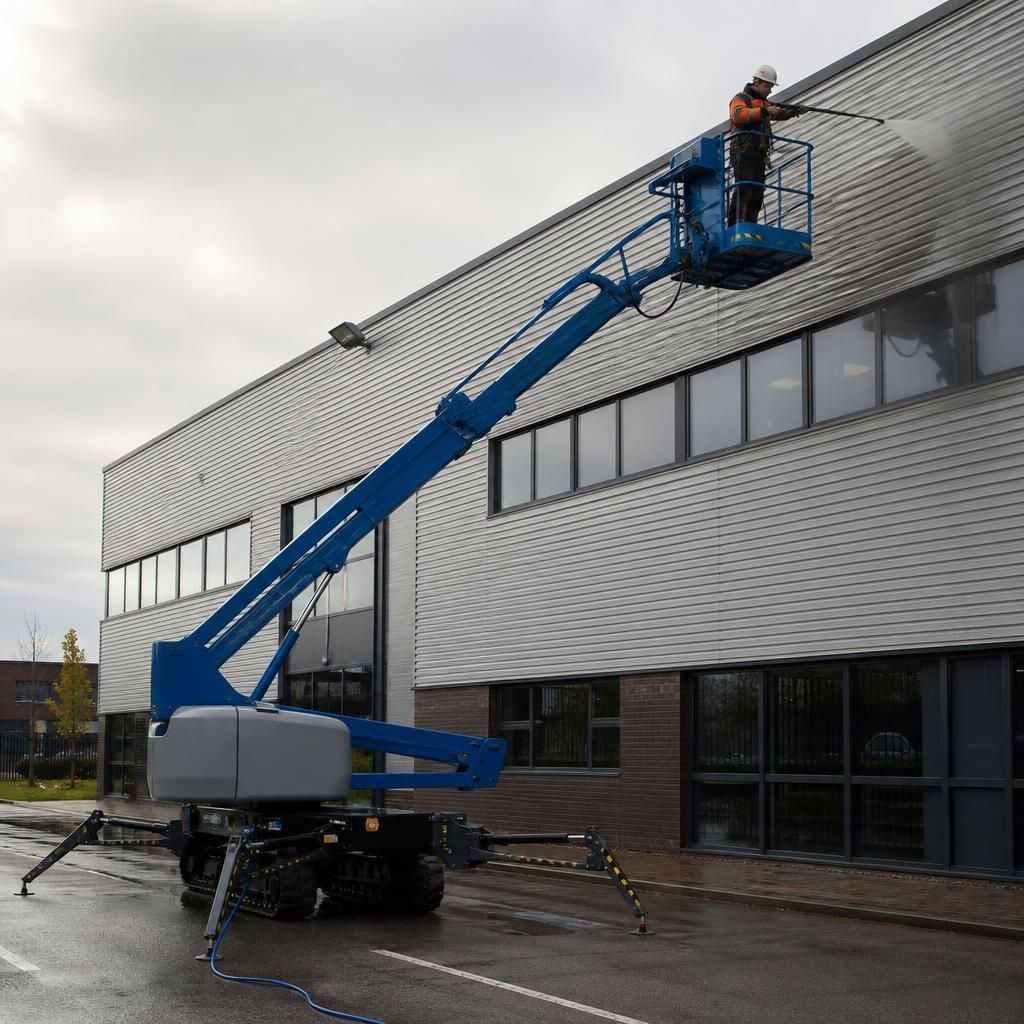
A mobile elevating work platform (MEWP) can provide the safest access for cleaning roof edges, façades and canopies without requiring operatives to walk across the roof. The correct platform depends on working height, sideways reach, ground conditions, overhead obstructions, access restrictions and the weight of people and equipment.
Before use, the MEWP must be positioned on suitable ground, with stabilisers and spreader mats fitted where required. Operatives should complete the relevant pre-use checks, wear the specified restraint equipment and remain within the platform’s safe working limits. The surrounding area should also be segregated to protect people from moving machinery, falling debris and cleaning hoses.