
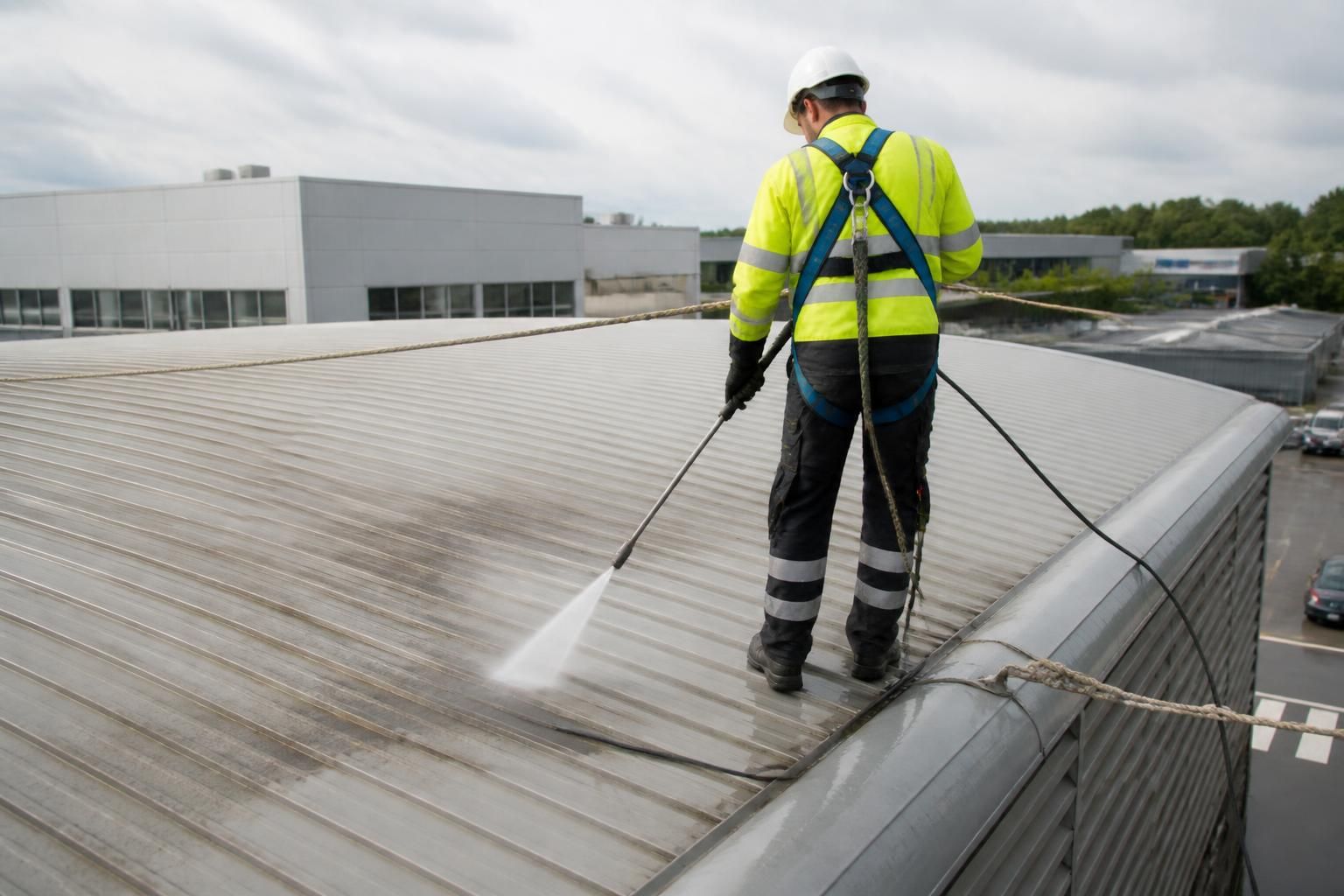
What safety measures should be considered when using roof cleaning equipment on commercial canopies?
Safe commercial canopy roof cleaning requires a documented risk assessment, suitable access and fall protection, equipment inspections, controlled water and chemical use, and trained operatives wearing appropriate PPE. Protect people and property by isolating the work area, managing runoff and electrical hazards, checking weather and roof condition, and following the equipment manufacturer’s instructions.
Safe commercial canopy roof cleaning depends on planning the work as a controlled work-at-height activity, rather than simply selecting a pressure washer or surface cleaner. Before work starts, the team should assess the canopy’s construction, access points, roof condition, surrounding hazards, equipment, chemicals, weather conditions, runoff and the protection of employees, occupants and the public.
Complete a site-specific risk assessment and method statement. The assessment should identify fragile or deteriorated roofing, unsupported sheets, skylights, rooflights, concealed edges, overhead services, nearby traffic, customer access routes and areas where falling objects or contaminated water could cause harm. The method statement should explain the planned access system, cleaning process, exclusion zones, equipment positioning, water management, emergency arrangements and inspection requirements. It should be available to the operatives carrying out the work and amended if site conditions change.
Use a suitable access system. Commercial canopies may be reached from ladders, mobile elevated work platforms, towers, scaffolding or temporary roof-access systems, but the correct option depends on the canopy height, structure, reach required and surrounding ground conditions. Ladders should not be treated as a default working platform for prolonged pressure washing. Access equipment must be positioned on stable ground, set up by trained personnel and used in accordance with the manufacturer’s instructions. Where a mobile elevated work platform is required, check ground bearing capacity, overhead obstructions, wind limits and the need for harnesses or restraint systems.
Work at height should be avoided where a safer ground-based method is reasonably practicable. If it cannot be avoided, use collective protection such as guardrails or properly designed platforms wherever possible. Personal fall protection should be selected for the task and connected only to suitable, inspected anchor points. Never attach a lanyard to handrails, pipework, roof sheets or other components that have not been designed for this purpose.
Confirm that the canopy can safely support the planned work. Many canopies contain fragile roof sheets, translucent rooflights or areas weakened by corrosion, impact or age. A visual inspection from a safe position should take place before anyone steps onto the roof. Operatives should not walk directly on fragile surfaces unless a competent person has confirmed the arrangement is safe and suitable crawling boards, staging or other load-spreading equipment has been installed. Rooflights must be treated as fragile unless their strength has been established. Cleaning should normally be carried out from a platform, MEWP or other controlled position rather than by standing on the canopy itself.
Inspect all equipment before use. Pressure washers, steam cleaners, hoses, lances, nozzles, surface cleaners, pumps, generators, access equipment, harnesses and connectors should be checked for damage, leaks, loose fittings and signs of wear. Pay particular attention to high-pressure hose couplings, trigger controls, electrical leads, guards and emergency shut-off functions. Defective equipment should be removed from service until repaired by an appropriately competent person. Keep inspection and maintenance records where required by the equipment manufacturer, the site rules or the company’s safety management system.
Use the cleaning equipment within its rated pressure, temperature, flow and chemical limits. A high-pressure jet can injure skin, damage roof coatings, force water beneath laps and seals, loosen fixings or break glazing. Fit the correct nozzle and surface-cleaning attachment, maintain a controlled distance from the surface and begin with the least aggressive effective setting. Never point a lance at another person, use a damaged hose or leave a pressurised system unattended. Release pressure before changing nozzles, disconnecting hoses or clearing blockages.
Control electrical risks. Water and electricity create a serious hazard around illuminated signs, canopy lighting, power outlets, distribution equipment, charging points and external cabling. Identify electrical installations before cleaning and arrange isolation or suitable protection with the responsible facilities or electrical team. Keep electrical connections, generators and extension leads away from standing water and route cables to prevent trip hazards and contact with the cleaning area. Electrical equipment used outdoors should be appropriate for the conditions and protected by suitable residual current protection where required. Operatives should never assume that a fitting is safe simply because it is weatherproof.
Manage water, chemicals and runoff. Establish where water will drain before starting. Prevent contaminated runoff, detergent, oil, algae, paint residue and other debris from entering surface-water drains, neighbouring property, pedestrian routes or watercourses. Use drain covers, bunding, wet vacuums, collection systems or controlled discharge arrangements where appropriate, and confirm any disposal requirements with the site manager or relevant authority. Do not block emergency exits, drainage channels or fire routes with hoses or containment equipment.
Read the safety data sheet for every cleaning product and complete a COSHH assessment where hazardous substances are used. Store chemicals in labelled containers, dilute them as instructed and never mix products unless the manufacturer specifically permits it. Choose a treatment compatible with the canopy’s roof coating, sealants, cladding, glazing and drainage materials. Provide suitable ventilation when cleaning near enclosed areas, and prevent spray mist from reaching workers, building occupants, food preparation areas, vehicles or air-intake systems.
Wear task-appropriate PPE. The exact selection should follow the risk assessment, but may include safety footwear with suitable slip resistance, protective gloves, eye or face protection, waterproof or chemical-resistant clothing, hearing protection and head protection. Where there is a fall risk, a correctly selected and fitted harness may form part of the system, but it does not replace safe access or collective protection. High-pressure water can penetrate ordinary clothing and cause serious injury, so PPE should be maintained and replaced when damaged or contaminated.
Isolate the work area. Use barriers, warning signs and, where necessary, a banksman or dedicated marshal to prevent people walking beneath the canopy or entering the area affected by spray, falling debris, hoses and access equipment. Plan the exclusion zone around the potential reach of the jet and the possible fall path of tools or loosened material. Coordinate the work with the building occupier, security team, delivery schedule and traffic management arrangements. Do not rely on warning signs alone in busy public or operational areas.
Check weather and environmental conditions. Wind can affect access equipment, spray direction, overspray and the stability of lightweight debris. Rain, frost, ice, poor visibility and wet surfaces can increase slipping and access risks. Stop or postpone work when conditions exceed the limits for the access equipment or create uncontrolled spray, fall or electrical hazards. Consider nearby doors, ventilation intakes and sensitive operations when wind could carry mist or cleaning chemicals.
Provide competent supervision and training. Operatives should understand the cleaning equipment, access system, fall-protection arrangements, chemical controls and emergency procedures. They should be able to recognise fragile roofing, unsafe weather, damaged equipment and unexpected changes in the structure. Training should include safe hose handling, pressure release, nozzle changes, manual handling and first-aid arrangements for high-pressure injection injuries. A high-pressure injection injury requires urgent medical assessment even if the wound appears minor.
Before beginning, brief the team on communication signals, equipment shut-down, rescue arrangements and the location of first-aid equipment. A fall-arrest system is incomplete without a realistic rescue plan, because a suspended worker may deteriorate quickly. Ensure someone on site can summon emergency assistance and that access routes remain available throughout the work.
On completion, depressurise and isolate the equipment, remove hoses and barriers safely, inspect the cleaned area for damage or displaced components, and confirm that drains, walkways and entrances are clear. Report defects such as cracked rooflights, loose fixings, failed sealant, corrosion or damaged coatings rather than attempting unauthorised repairs. These controls help ensure that commercial canopy cleaning protects the workforce, the building and the public while producing a consistent, compliant result.
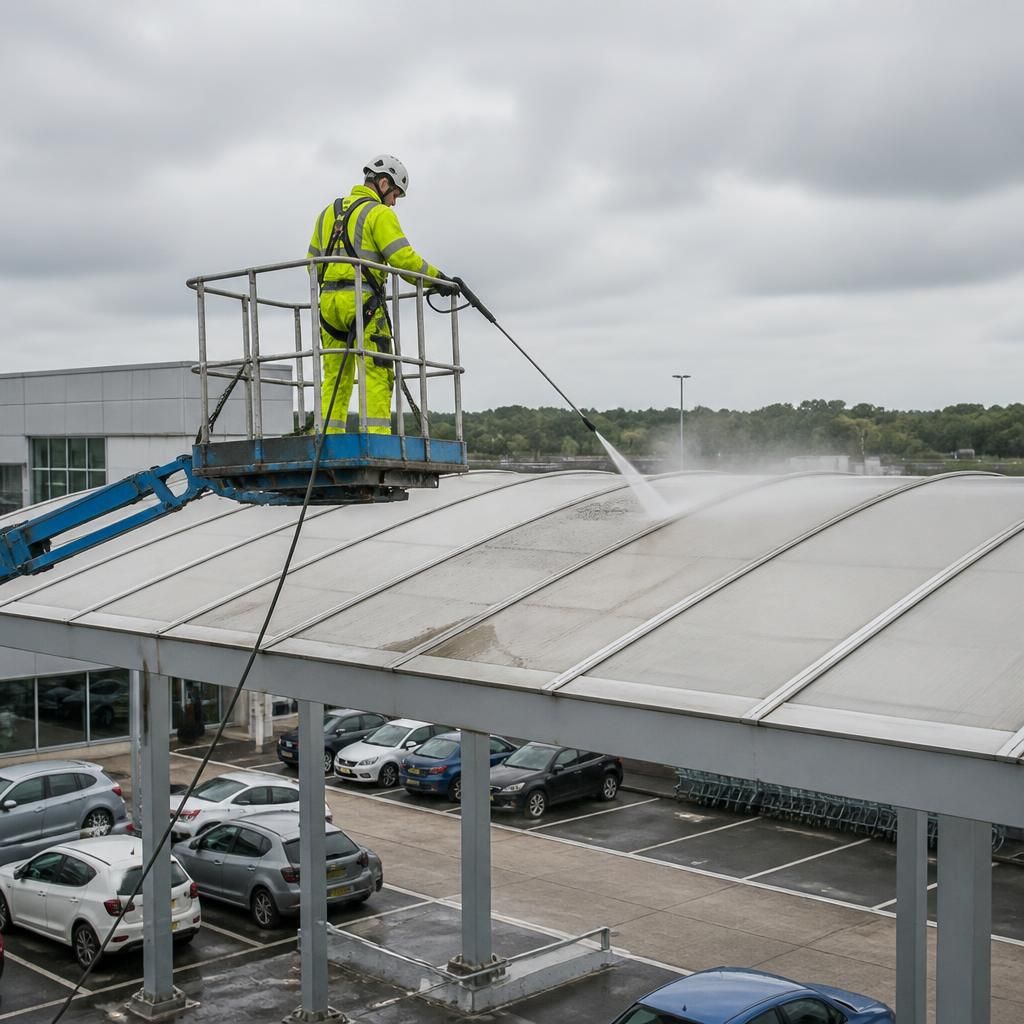
Safe roof cleaning on a commercial canopy starts with preventing falls, not relying on personal protective equipment alone. A competent person should assess the canopy from a safe position, identify fragile roof sheets and rooflights, and select a suitable access system such as a guarded platform, scaffold or MEWP. Operatives should not walk directly on the canopy unless its strength and the planned load have been confirmed.
Use collective protection wherever practicable, with harnesses and restraint or fall-arrest equipment only connected to approved, inspected anchor points. The method statement should also include exclusion zones below, equipment checks and a realistic rescue plan. Ladders are generally unsuitable for prolonged pressure-washing work because hose movement, spray and recoil can reduce stability.