
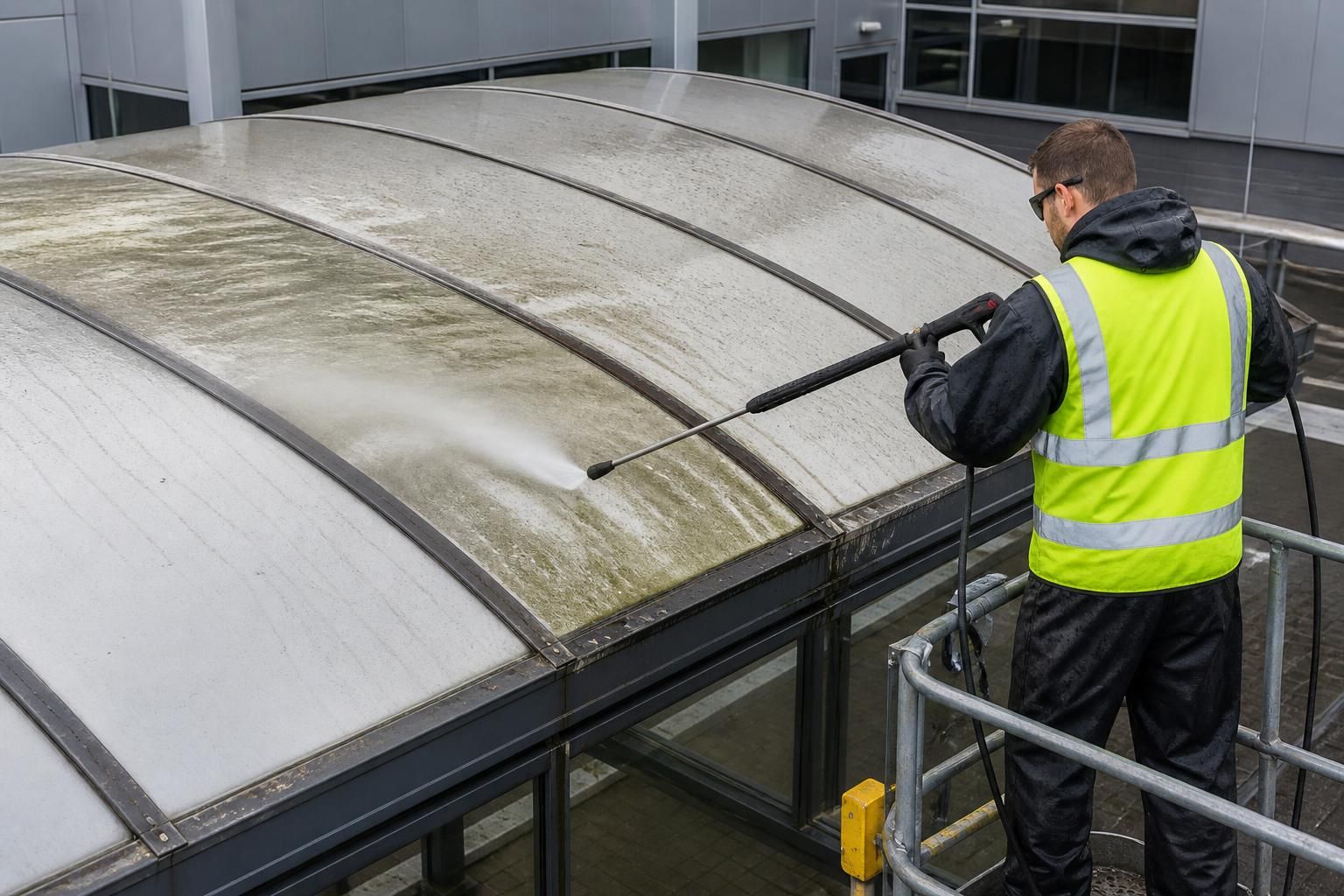
What are the key features of Nilfisk roof cleaners that make them suitable for commercial canopy cleaning?
Nilfisk roof cleaners are suitable for commercial canopy cleaning because they combine controllable pressure, dependable cleaning performance, robust construction and practical mobility for demanding exterior work. Their adjustable settings, compatible attachments and hot- or cold-water options—depending on the model—help cleaning contractors remove dirt, algae and staining while reducing the risk of damaging canopy materials.
Nilfisk roof cleaners are suitable for commercial canopy cleaning because they combine controllable pressure, consistent water flow, robust construction and practical handling. Depending on the model, they can provide cold- or hot-water cleaning, detergent application and compatibility with surface-cleaning or extension accessories. These features help contractors remove dirt, algae, traffic film, atmospheric staining and residues from canopies while keeping the cleaning process controlled.
Commercial canopies are often made from materials such as coated metal, polycarbonate, fabric, glass or composite panels. They may also incorporate joints, seals, drainage channels, lighting and signage. A suitable machine must therefore deliver enough cleaning power to remove contamination without forcing water beneath laps, damaging coatings or marking sensitive surfaces. The main Nilfisk features that support this work include the following:
- Adjustable pressure and controlled application: Pressure can be selected to match the canopy material and the type of contamination. Lower settings are generally more appropriate for fabric, painted finishes, glazing, seals and weathered coatings, while more robust metal surfaces may tolerate a stronger setting. Control is more important than maximum pressure, as excessive force can strip coatings, open seams or drive water into the building structure.
- Reliable water flow: Consistent flow helps maintain an even cleaning pattern across large canopy sections. It supports the removal of loosened dirt and reduces the need to repeatedly pass over the same area. Flow should still be managed carefully around drainage points, electrical fittings and vulnerable edges.
- Hot- and cold-water options: The appropriate Nilfisk model may provide cold-water cleaning or heated water. Cold water is often sufficient for loose dirt, algae and general soiling. Heated water can assist with greasy deposits, traffic film, biological residue and other contamination that is difficult to dissolve with cold water alone. Temperature must be selected according to the manufacturer’s guidance for the canopy material, coatings and sealants.
- Detergent compatibility: Where a cleaning chemical is appropriate, detergent application can help soften organic growth, grease and ingrained deposits before rinsing. Correct dilution, dwell time and thorough rinsing are essential. Cleaning chemicals should be checked for compatibility with the canopy surface, surrounding landscaping, drainage systems and any nearby vehicles or public areas.
- Suitable nozzles and accessories: Different spray patterns allow the operator to control the concentration and coverage of the water. Fan-pattern nozzles are commonly useful for broad areas, while a more focused spray may be reserved for stubborn deposits on durable surfaces. Surface-cleaning attachments can help produce a more uniform result on suitable rigid areas and may reduce overspray, but they are not automatically suitable for fabric, flexible sheets or uneven canopy profiles.
- Extension and access options: Lance extensions and compatible accessories can help clean from a safer position, reducing the need to work directly at the edge of a canopy. They can also improve reach around awkward structures. They do not replace suitable access equipment, edge protection or fall-prevention measures where work at height is involved.
- Robust construction: Commercial cleaning machines are designed for regular use and demanding working conditions. Durable frames, wheels, hose connections and controls are valuable when equipment must be moved around large sites or used for planned maintenance work. Robust equipment still requires correct storage, inspection and servicing to remain dependable.
- Mobility and handling: Wheels, handles and manageable hose arrangements make it easier to position the machine around loading bays, forecourts, service areas and large commercial buildings. Good hose management is particularly important because hoses can create trip hazards and may catch on railings, signage or access equipment.
- Operational control: Clear controls allow the operator to adjust pressure, temperature, flow or detergent use without interrupting the work unnecessarily. This is useful when a single canopy includes several materials, such as painted framework alongside glazing or flexible panels.
For canopy cleaning, machine selection should begin with a survey rather than the highest available specification. Identify the canopy material, condition, coating, age, drainage arrangement and any areas of previous damage. A small test area should then be cleaned using the least aggressive practical setting. Check for colour transfer, coating loss, water penetration, surface marking and changes to seals before proceeding across the full area.
The cleaning method is also important. Loose debris should be removed first so that it does not become abrasive during washing. Organic growth and adhered deposits may need pre-treatment and dwell time before rinsing. The operator should work in manageable sections, keep the lance at a consistent distance and avoid directing concentrated spray at joints, vents, flashing, seals, electrical components or open drainage channels. Rinsing should remove loosened contamination and chemical residue without pushing debris into gutters or internal areas.
Nilfisk equipment can improve productivity, but it does not remove the need for competent operation. Operators should follow the machine instructions, use appropriate personal protective equipment and control overspray around pedestrians, vehicles and neighbouring properties. Where the canopy cannot be reached safely from ground level, the work should be planned with suitable mobile elevating work platforms, scaffolding, towers or other access arrangements. The access method must account for ground conditions, overhead obstructions, wind and the possibility of wet surfaces.
Regular inspection is particularly important when machines are used on commercial sites. Hoses, couplings, spray guns, lances, electrical leads, wheels and safety controls should be checked before use. Filters and water supplies should be kept clean, and heated machines should be maintained in line with the manufacturer’s servicing requirements. Damaged accessories or unstable connections can affect both cleaning results and operator safety.
In practice, the most suitable Nilfisk roof cleaner is the model and configuration that provides sufficient performance with precise control, rather than simply the greatest pressure or temperature. When matched with the correct nozzle, detergent, access equipment and working procedure, it can provide an efficient approach to maintaining commercial canopies while protecting their surfaces and associated building components.
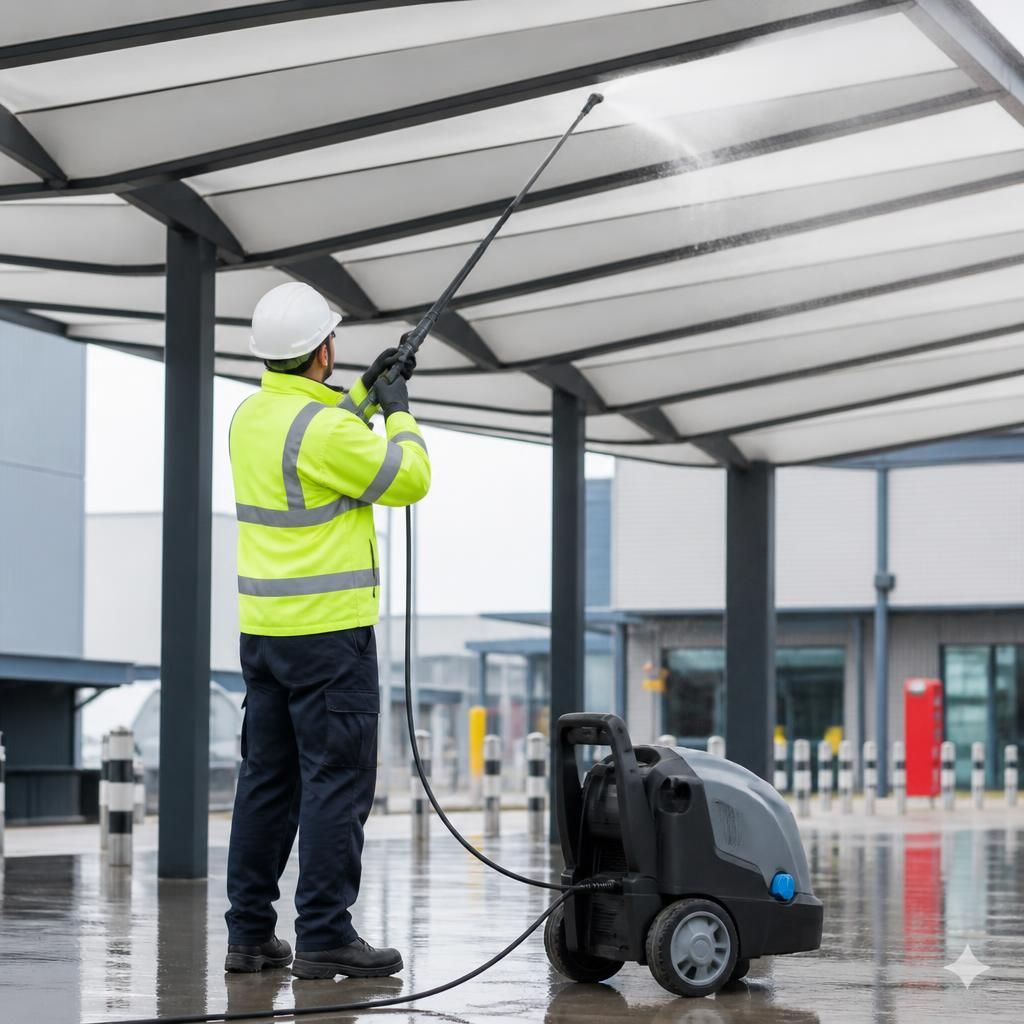
Adjustable pressure is one of the most important Nilfisk features for commercial canopy cleaning because it allows the operator to match cleaning force to the material and its condition. A lower-pressure setting is generally preferable for fabric, polycarbonate, glazing, painted finishes and weathered coatings, while more durable metal surfaces may accept a stronger setting.
Controlled pressure helps remove dirt, algae, traffic film and atmospheric staining without unnecessarily forcing water beneath joints, seals or panel edges. The operator should still use the correct nozzle, maintain a consistent lance distance and test a discreet area first. This confirms that the selected pressure and water temperature will not cause marking, coating loss, surface distortion or water penetration before cleaning proceeds across the canopy.