What types of access equipment should industrial roof cleaning companies utilise to ensure comprehensive coverage and safety on complex structures?
Industrial roof cleaning companies should use appropriately selected mobile elevating work platforms (MEWPs), scaffold towers, fixed scaffolding, roof ladders, crawl boards and temporary edge-protection systems to reach complex areas without placing workers or the roof at unnecessary risk. Equipment should be chosen following a site-specific risk assessment, with suitable harness and restraint systems, trained operators, secure access routes and additional methods such as telescopic cleaning poles where they improve coverage from a safe position.
Industrial roof cleaning companies should use a combination of access equipment rather than rely on one method for every structure. The appropriate solution may include mobile elevating work platforms (MEWPs), scaffold towers, fixed scaffolding, roof ladders, crawl boards, temporary edge protection, safety nets and telescopic cleaning systems. Selection should follow a site-specific risk assessment that considers the roof design, access points, fragile areas, height, ground conditions, nearby services, weather, cleaning method and the distance workers must reach.
The purpose of access equipment is not simply to get operatives onto a roof. It must provide a stable working position, prevent falls, protect the roof covering from avoidable damage and allow the cleaning team to reach roof surfaces, edges, valleys, plant areas and drainage details without overreaching. On complex industrial premises, access arrangements should also support controlled movement of hoses, pressure-washing equipment, steam-cleaning systems and recovered debris.
Mobile elevating work platforms
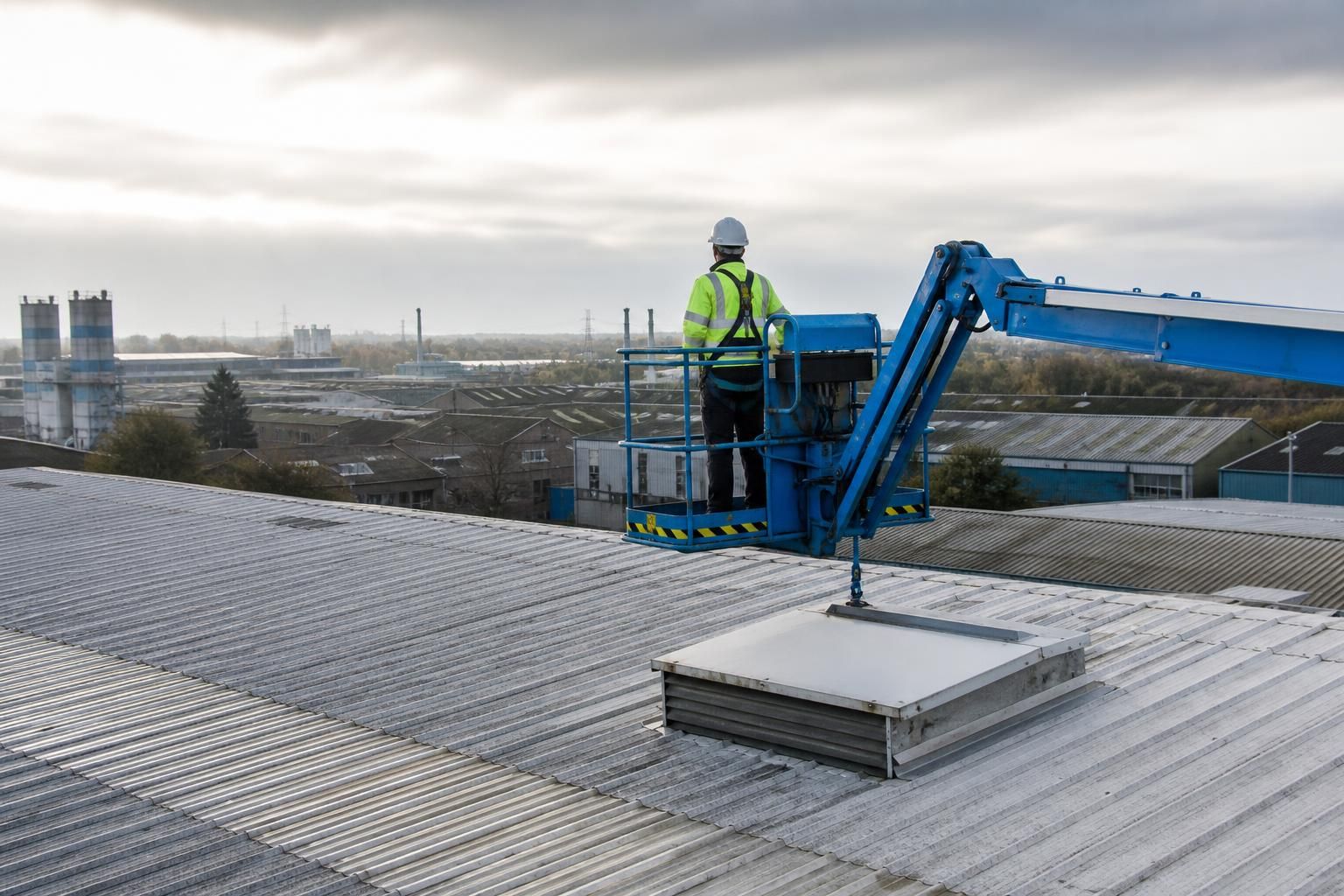
MEWPs are often suitable for accessing roof edges, façades, canopies, gutters and areas that cannot be reached safely from ground level. Depending on the site, a contractor may use a scissor lift, articulated boom or telescopic boom. Scissor lifts provide a broad, stable platform for work close to a vertical elevation, while boom-type machines can reach over obstacles or across setbacks where a straight vertical approach is not possible.
- The platform must have sufficient working height, outreach and safe working load for the task.
- Ground conditions must be checked for gradients, soft surfaces, voids, drainage channels and underground obstructions.
- Outriggers, spreader plates or other stabilising measures may be needed to prevent ground damage or instability.
- Operators must be trained and authorised for the relevant category of MEWP.
- Emergency lowering arrangements, exclusion zones and a rescue plan must be established before work starts.
MEWPs can allow cleaning to be carried out from a protected platform, reducing the need for workers to walk across fragile or contaminated roof areas. They are less suitable where access is restricted, the ground cannot support the machine or the required outreach would encourage unsafe leaning from the platform.
Scaffold towers and fixed scaffolding
Scaffold towers can provide a practical working platform for smaller roof sections, loading bays, plant rooms and elevations where a MEWP cannot be positioned. They should be erected on a firm, level surface by competent personnel and fitted with appropriate guardrails, toe boards, access ladders and stabilisers. Towers must not be moved while occupied, and they should not be used outside the conditions specified by the manufacturer or site assessment.
Fixed scaffolding may be preferable for extensive or prolonged cleaning projects. It can provide continuous access along a roof edge and a secure platform for cleaning façades, parapets, gutters and roof-mounted details. The design should account for the building layout, loading from equipment and materials, the need for sheeting or debris control, and the risk of contact with fragile roof surfaces. Scaffolding must be inspected at appropriate stages and after events that could affect its stability.
Roof ladders, crawling boards and staging
Roof ladders and crawling boards distribute a worker’s weight across a wider area and can reduce the risk of breaking fragile sheets or damaging roof membranes. They are particularly useful on pitched roofs, profiled sheeting and surfaces where direct foot traffic is unsuitable. They must be correctly positioned, secured against slipping and used with suitable fall protection. They are not a substitute for edge protection or a complete fall-prevention system.
On low-pitched or fragile roofs, staging or purpose-designed walkways may create a defined route between access points and work areas. These systems help keep operatives away from unsupported rooflights, deteriorated sheets, concealed gaps and areas with limited load-bearing capacity. The cleaning plan should identify these hazards before equipment is brought onto the roof.
Edge protection, safety nets and fall-arrest systems
Temporary guardrails and edge-protection systems are used where workers could fall from roof perimeters, openings, rooflights or changes in level. They should be designed and installed for the specific roof arrangement, including parapets, raised sections and areas around plant. Where collective protection cannot fully control the risk, operatives may require a harness connected to a suitable restraint or fall-arrest system.
Restraint systems are intended to prevent a worker reaching a fall hazard, whereas fall-arrest systems are designed to limit the consequences if a fall occurs. The anchor points, lifelines and connectors must be suitable for the structure and used in accordance with their design. A harness is not effective on its own. There must also be a documented inspection regime, compatible equipment, adequate clearance below and a practical rescue procedure that does not rely solely on emergency services.
Safety nets may be appropriate beneath certain roof areas during construction or specialist access work, but their suitability depends on the structure, installation method and available clearance. They should not be treated as a universal solution for roof cleaning.
Telescopic poles and remote cleaning equipment
Water-fed telescopic poles, rotary cleaning heads and other extended-reach systems can improve coverage from ground level or from a secure platform. They are useful for façades, roof edges, gutters and accessible roof sections where placing a person directly on the roof would create unnecessary risk. Remote methods can also reduce disturbance to roof coatings and limit the movement of hoses across the surface.
However, extended-reach equipment must be selected carefully. Long poles can become difficult to control in wind, may create fatigue and can bring workers close to overhead electrical services. The operator must retain a stable stance, maintain a safe distance from hazards and avoid excessive force that could damage cladding, membranes, coatings or rooflights. Telescopic systems complement physical access equipment; they do not remove the need to inspect inaccessible or hazardous areas properly.
Equipment for difficult roof features
Complex industrial roofs often contain valleys, north-facing slopes, rooflights, smoke vents, skylights, parapets, solar panels, extraction plant, ductwork and drainage channels. Access equipment should allow each feature to be approached without using it as a foothold or placing loads on components that are not designed to support people.
- Rooflights should be treated as fragile unless their load-bearing capability has been confirmed.
- Solar panels and associated cabling should be protected from impact, contamination and inappropriate cleaning pressure.
- Plant and ductwork may require segregated walkways or a MEWP rather than direct access across the roof covering.
- Valleys and gutters should be reached using stable platforms or secured boards, with precautions against slips caused by accumulated moss, silt or water.
- Parapets and roof edges require suitable collective protection where operatives could fall while cleaning or handling hoses.
How equipment should be selected and used
Before work begins, the cleaning contractor should review available drawings, previous maintenance information and the condition of the roof, then complete a site inspection. The assessment should identify fragile materials, weak areas, access restrictions, overhead and underground services, traffic routes, public interfaces, water run-off routes and areas where cleaning residues could enter drainage systems.
The equipment plan should then match each work zone with a safe access method. A MEWP may be used for external edges, a scaffold platform for a long elevation, secured roof ladders for a pitched section and telescopic equipment for areas that can be cleaned without direct contact. This zoned approach is generally safer and more efficient than moving one type of equipment around the entire site.
All equipment must be suitable, maintained and inspected. MEWPs, lifting accessories, scaffolds, harnesses and temporary systems require checks appropriate to their type and use, with records retained where required. Work should be carried out by trained, competent personnel in accordance with the Work at Height Regulations and other applicable health and safety requirements. Operators should also understand the limitations of low-pressure washing, steam cleaning and chemical treatments so that access equipment is not exposed to inappropriate loads, spray or contamination.
Weather, housekeeping and emergency arrangements
Wind, rain, frost, poor visibility and extreme temperatures can affect the safe use of access equipment and the stability of workers on roof surfaces. The site supervisor should monitor conditions and stop work when the equipment manufacturer’s limits or the risk assessment no longer permit safe operation. Hoses, cables and removed debris must be routed or secured to prevent trips, entanglement and uncontrolled movement from the roof.
A suitable rescue plan should cover falls from a roof, entrapment in a MEWP, illness, equipment failure and sudden weather deterioration. It should identify who raises the alarm, how the casualty is reached, which access route is used and how the area is isolated. Planning this before cleaning starts is particularly important on large sites where the roof may be remote from normal occupied areas.
In practice, comprehensive coverage is achieved by combining collective protection, stable platforms and remote cleaning methods, with roof ladders or crawl boards used only where appropriate. The safest industrial roof cleaning companies do not select access equipment solely by height or convenience. They match each system to the structure and the cleaning task, verify that it is properly installed and inspected, and maintain a controlled route for workers, tools, hoses and waste throughout the project.
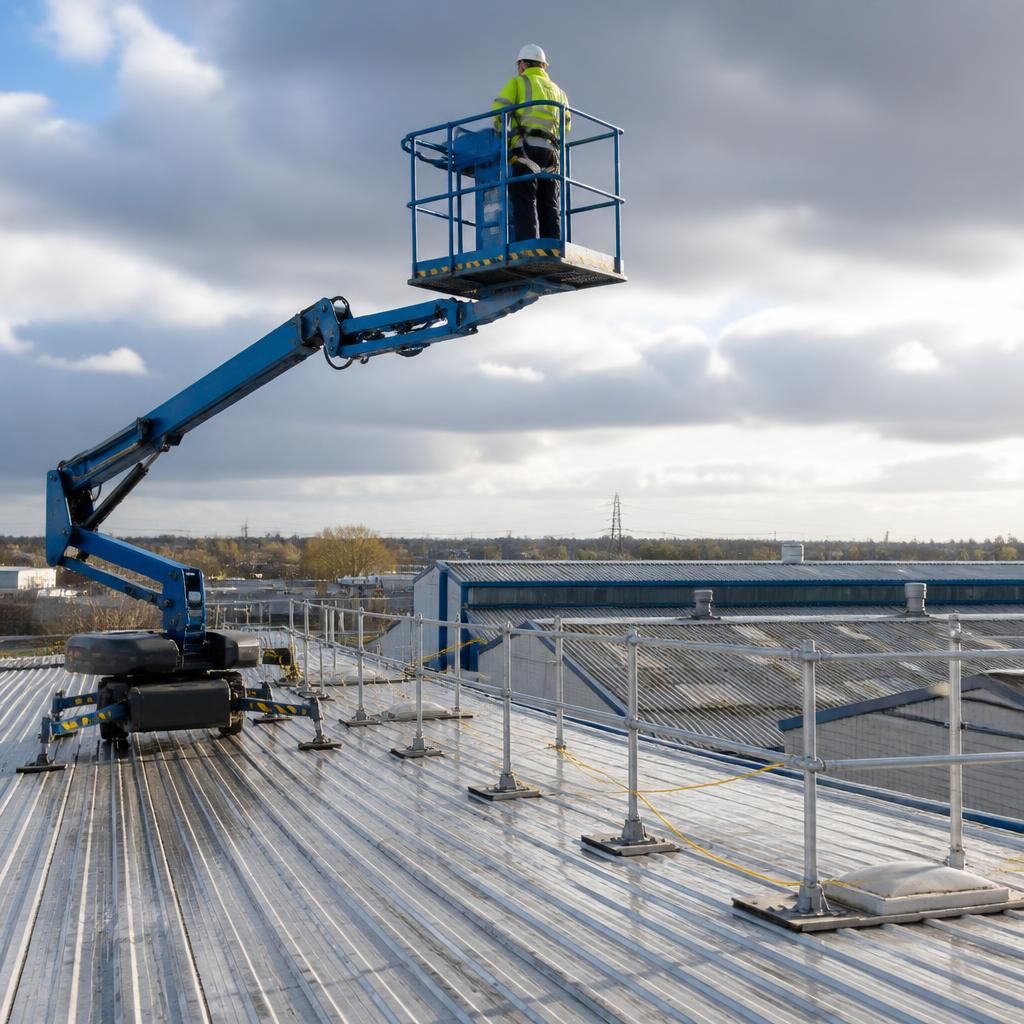
Access equipment for industrial roof cleaning should be selected by work zone, roof condition and cleaning method rather than by height alone. A mobile elevating work platform may provide the safest access to roof edges, façades and plant areas, while scaffold platforms, secured roof ladders or crawl boards may be more appropriate for other sections.
This zoned approach helps operatives maintain stable footing and avoid fragile rooflights, unsupported sheets, solar panels and roof-mounted equipment. Temporary edge protection, guardrails or suitable restraint systems should be added wherever there is a fall risk. Telescopic cleaning poles can extend coverage from ground level or a secure platform, reducing unnecessary traffic across the roof.
Before work begins, the contractor should confirm ground conditions, equipment capacity, access routes, weather limits, overhead services and rescue arrangements. Every system must be suitable, inspected and used by trained personnel in line with the site-specific risk assessment.