
What safety protocols do industrial roof cleaning companies have in place to protect workers and maintain compliance with health and safety regulations?
Industrial roof cleaning companies protect workers through documented risk assessments and method statements, planned work-at-height procedures, suitable access equipment, edge protection, fall-arrest systems, PPE, exclusion zones and emergency rescue plans. They also manage chemical and water risks under relevant UK health and safety requirements, brief trained operatives, inspect equipment and maintain records to demonstrate compliance.
Industrial roof cleaning companies protect workers and maintain compliance through a documented, project-specific system covering risk assessment, work-at-height planning, suitable access equipment, fall prevention, chemical and water controls, competent supervision, emergency rescue and inspection records. The controls must reflect the roof’s condition, construction, height, access arrangements, surrounding activities and chosen cleaning method; a generic checklist is not sufficient.
Pre-start surveys and risk assessments
Before work begins, the contractor should survey the building and surrounding area. This normally includes identifying roof materials, fragile or deteriorated sections, roof lights, openings, parapets, valleys, plant, electrical services, drainage routes, skylights, access points and areas affected by falling debris or overspray. The survey should also consider nearby roads, public areas, occupied premises, other contractors and weather exposure.
The findings are recorded in a suitable risk assessment and method statement (RAMS). These documents explain the proposed cleaning sequence, access arrangements, equipment, substances, exclusion zones, controls for fragile surfaces and emergency procedures. They should be reviewed when site conditions change, rather than treated as permanent paperwork prepared for every project.
Work-at-height planning
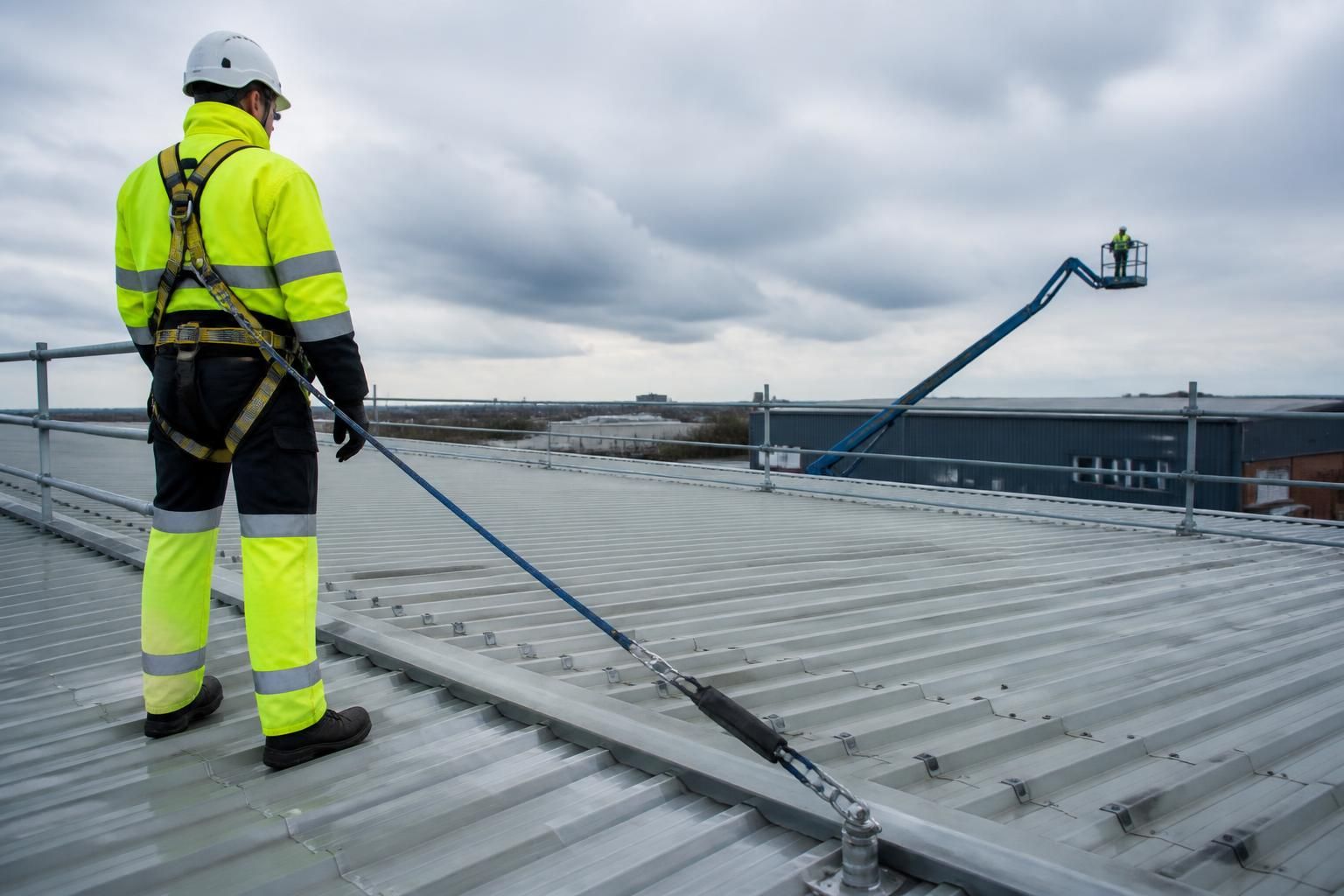
Roof cleaning is work at height where a person could fall and suffer injury. Under the Work at Height Regulations, the planning process should prioritise avoiding work at height where reasonably practicable, then preventing falls and, where a fall cannot be fully prevented, reducing the consequences. Roof teams should not rely solely on personal protective equipment when collective protection or ground-based methods can provide safer control.
Depending on the building, controls may include mobile elevating work platforms, scaffold towers, fixed scaffolding, temporary edge protection, guardrails, safety nets, roof access systems, crawl boards or designated walkways. The equipment must be appropriate for the surface, reach, loading, ground conditions and cleaning activity. Ladders are generally used for access or short-duration, low-risk tasks rather than as a primary work platform for extensive roof cleaning.
Fragile roofs and fall protection
Operatives should assume that roof lights, asbestos-containing sheets, aged fibre cement, corroded metal panels and other suspect areas may be fragile until their condition has been assessed. They should avoid stepping directly on unsupported or unverified surfaces. Physical barriers, crawling boards, staging or alternative access may be required to distribute weight and define safe routes.
Where harnesses and fall-arrest systems are used, the system must be correctly selected, anchored and adjusted for the task. A fall-arrest arrangement needs sufficient clearance below the user and must not create an unmanageable swing-fall risk. Harnesses, lanyards, lifelines and anchor points should be inspected before use and at the required intervals. A rescue plan is essential because a person suspended after a fall may need prompt recovery; calling the emergency services alone is not a complete rescue procedure.
Access equipment controls
Access equipment is selected and operated by people with suitable training and experience. Mobile elevating work platforms require appropriate operator competence, pre-use checks, safe positioning and consideration of overhead obstructions, uneven ground, wind and nearby traffic. Scaffolding and temporary edge protection must be properly designed, erected, altered and inspected by competent people. Lifting accessories and lifting equipment are managed under the relevant requirements of LOLER where they are used for lifting.
Equipment is checked before use and removed from service if it is damaged, defective or outside its inspection requirements. The contractor should retain inspection and maintenance records, including details of scaffold or access-system inspections where applicable. The site team should also confirm that access equipment can withstand the effects of hoses, water, cleaning tools and any chemicals used.
Competence, supervision and communication
Operatives should have training relevant to the work they are carrying out, such as work-at-height procedures, use of access equipment, harness systems, safe pressure-washing techniques, manual handling, COSHH controls and emergency arrangements. Training should be supported by practical experience and competent supervision, particularly where the roof is complex, fragile or occupied.
Before starting, the team should receive a site induction and briefing on the RAMS, roof layout, safe routes, exclusion zones, weather limits, communication arrangements and stop-work conditions. The principal contractor or site manager should coordinate activities where other contractors, vehicles, tenants or members of the public could be affected. Any change in method, equipment or site condition should be communicated and recorded.
Exclusion zones and falling-object protection
Cleaning can dislodge moss, scale, coatings, fixings and other debris. Ground-level exclusion zones, barriers and warning signs help prevent people entering areas beneath or beside the work. The size and position of the zone should reflect the building height, cleaning method, wind conditions and likely fall path.
Where work is near entrances, walkways, roads or neighbouring property, the contractor may need protected routes, temporary closures, banksmen, debris containment or planned work outside occupied periods. Hoses and cables should be routed to reduce trip hazards and should not obstruct fire exits, access routes or vehicle movements.
Pressure, steam, chemical and electrical safety
The cleaning method should be matched to the roof material and condition. Excessive pressure can damage coatings, seals, laps, membranes and delicate roof details, while steam and heated water can introduce burn, vapour and surface-damage risks. Operators should use controlled pressure, suitable nozzles and safe working distances, with test areas used where the surface response is uncertain.
Where biocides, detergents, degreasers or other substances are used, the company should complete a COSHH assessment. This covers the product hazards, safe dilution and application, storage, labelling, ventilation, incompatible substances, required PPE, spill response and disposal. Safety data and product instructions should be available to the team, and operatives should understand the controls rather than simply being given protective clothing.
Water and electrical risks also require planning. Electrical installations, rooftop plant and temporary supplies should be protected from spray and standing water, with isolation agreed where necessary. Operators should use equipment suitable for wet conditions and avoid creating routes through which water can enter the building. Drainage should be monitored to prevent flooding, blocked outlets or uncontrolled discharge.
Personal protective equipment
PPE is selected from the risks identified in the assessment and may include safety footwear with suitable slip resistance, protective clothing, gloves, eye or face protection, hearing protection, head protection, respiratory protection and a harness system. PPE should fit the user, be compatible with other equipment and be inspected, maintained and replaced when damaged or contaminated. It is an additional control and does not replace safe access, edge protection or sound work planning.
Weather, site conditions and stop-work rules
Rain, frost, ice, strong or gusting wind, poor visibility and extreme temperatures can affect footing, access equipment, chemical performance, overspray and fall-protection systems. RAMS should define conditions in which work is postponed or stopped. The supervisor should reassess the roof after significant weather changes and before operatives resume work.
Work should also stop if the roof becomes unexpectedly unstable, a control measure fails, unauthorised people enter the exclusion zone, equipment develops a fault, contamination cannot be contained or the cleaning result requires a method outside the agreed assessment. Restarting should follow a review rather than an informal decision on the roof.
Emergency and incident arrangements
A suitable plan covers falls, suspension in a harness, medical emergencies, chemical exposure, burns, electric shock, fire, equipment failure, flooding and uncontrolled runoff. It should identify how to raise an alarm, who provides first aid, how emergency services reach the site, how a casualty is recovered and how the area is isolated. Rescue equipment and trained personnel should be available where the risk assessment requires them.
Near misses, incidents, defects and changes to the method should be reported and reviewed. This provides evidence that controls are being actively managed and allows the contractor to improve future work. Any reportable event must be dealt with under the applicable reporting requirements.
Records and legal compliance
Depending on the project, the compliance framework may include the Health and Safety at Work etc. Act, the Work at Height Regulations, the Provision and Use of Work Equipment Regulations (PUWER), the Lifting Operations and Lifting Equipment Regulations (LOLER), the Control of Substances Hazardous to Health (COSHH) Regulations, the Personal Protective Equipment at Work Regulations and, where construction work is involved, the Construction (Design and Management) Regulations.
Responsible contractors keep proportionate records such as site surveys, RAMS, training and competence evidence, equipment inspections, COSHH assessments, product information, briefings, permits, weather checks, incident reports and waste or discharge documentation. These records help demonstrate that the work was planned, supervised and carried out using appropriate controls, while also giving the client a clear maintenance history.
For a commercial or industrial roof, the client should expect the cleaning company to explain the proposed access system, how fragile areas will be controlled, what happens to wastewater and debris, which substances will be used, how the public and other site users are protected, and how a casualty would be rescued. Reviewing these points before mobilisation helps confirm that the method is suitable for the particular building and that health and safety responsibilities are properly coordinated.
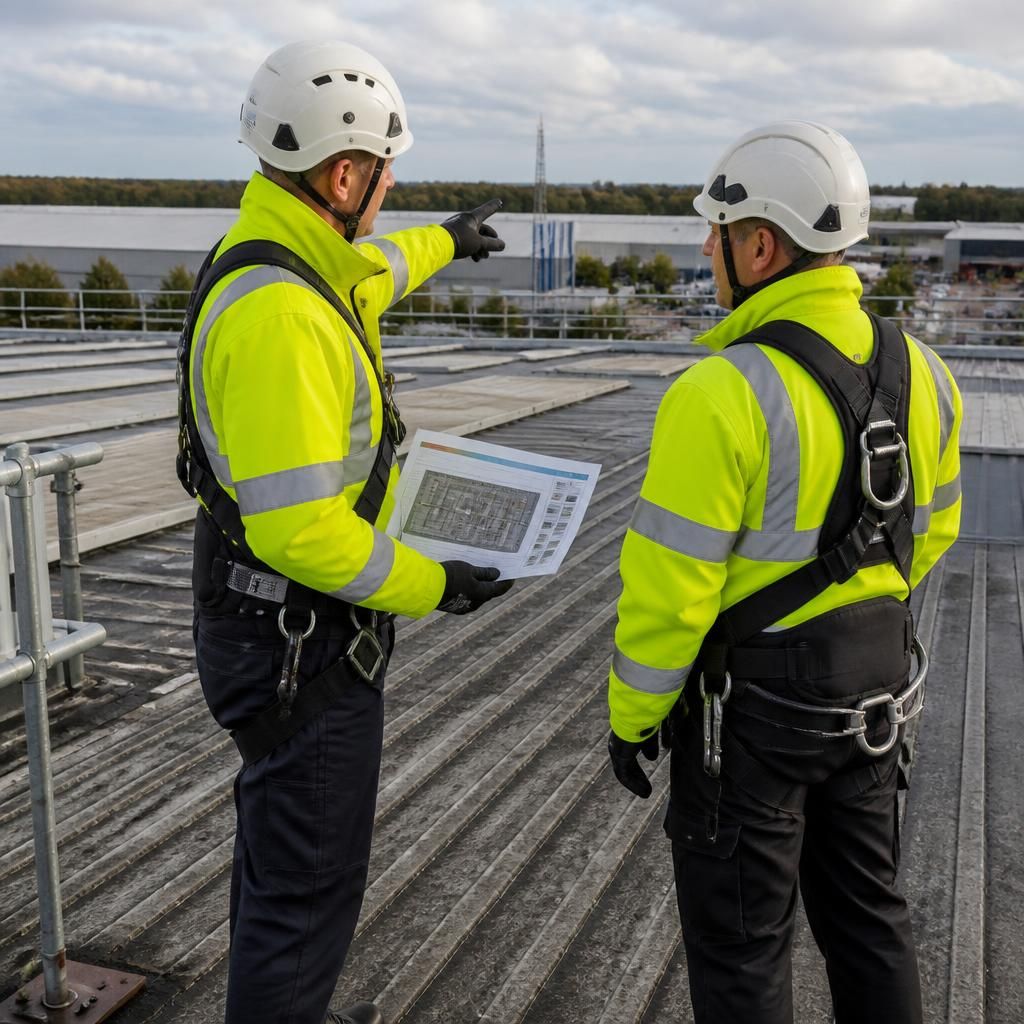
Industrial roof cleaning safety starts with a site-specific risk assessment and method statement (RAMS). Before work begins, the team identifies fragile roof areas, roof lights, access points, plant, electrical services, falling-object risks and nearby public or site activities. The RAMS then sets out the safe access method, edge protection, exclusion zones, cleaning controls and emergency arrangements.
These controls are reviewed if weather, equipment, roof conditions or the agreed cleaning method changes. This ensures the work-at-height plan remains relevant throughout the project, rather than relying on generic paperwork.