
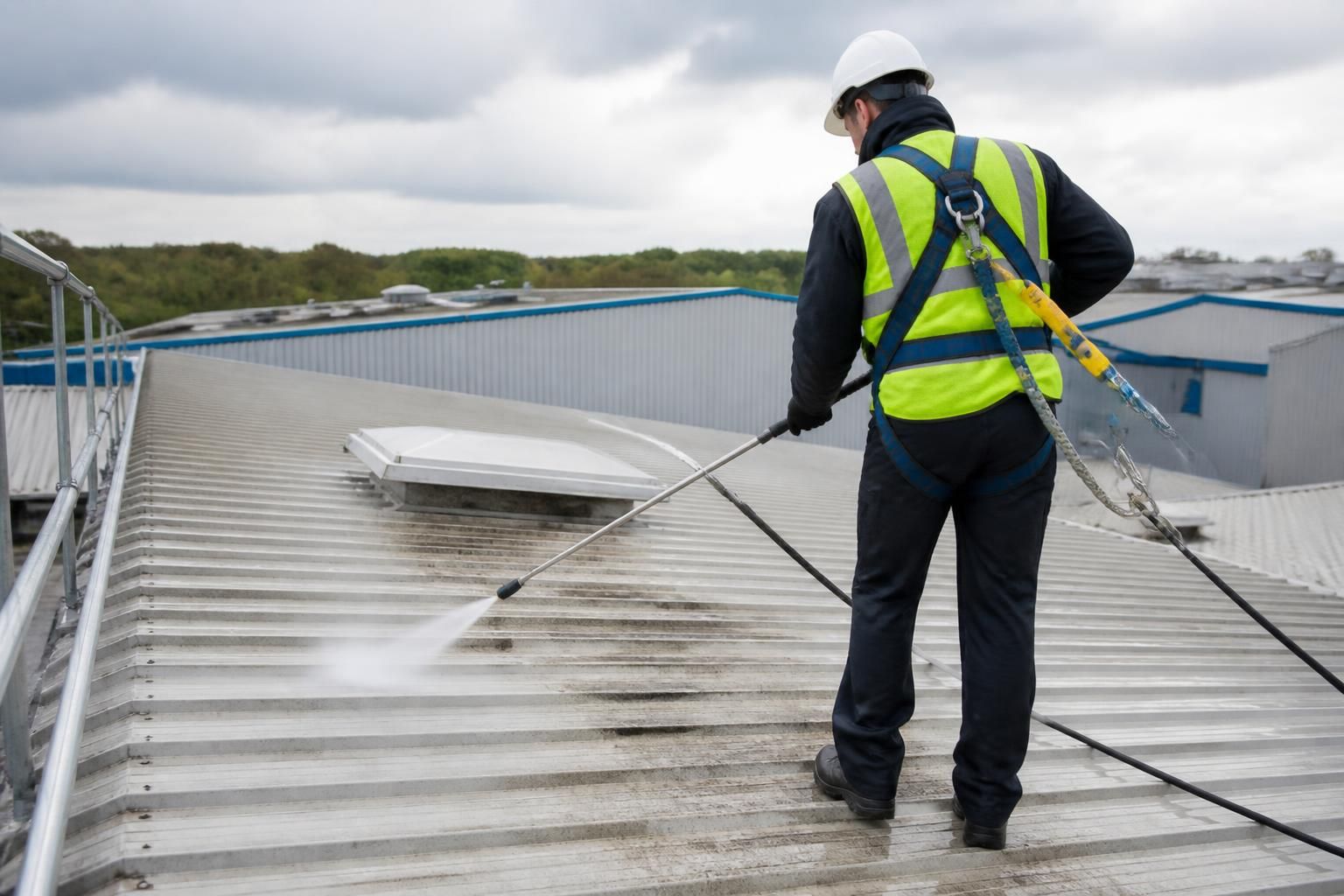
How do you ensure safety during industrial roof cleaning?
We ensure safety during industrial roof cleaning through site-specific risk assessments, trained operatives, suitable access equipment and controlled work areas. Our teams use appropriate fall-protection systems, follow established method statements and monitor conditions throughout the project to protect people, property and the roof itself.
Safety during industrial roof cleaning is managed through a documented, site-specific system of risk assessment, competent operatives, suitable access equipment, controlled work areas and continuous supervision. Before work starts, we identify the roof’s construction, fragile areas, access points, nearby hazards and the cleaning methods required. The findings are recorded in a risk assessment and method statement, which the team reviews before work begins and updates if site conditions change.
Planning and risk assessment
Industrial roofs differ considerably in their condition, materials, pitch and load-bearing capacity. A safe plan therefore considers the roof covering, rooflights, hatches, skylights, exposed edges, drainage outlets, plant, cables, ductwork and any areas weakened by corrosion, leaks or previous damage. We also assess hazards at ground level, including vehicle movements, pedestrians, loading bays, public areas and adjacent buildings.
The assessment covers the proposed cleaning technique, water and chemical use, access arrangements, fall protection, equipment positioning, weather conditions and emergency procedures. Where information about the roof structure or its load capacity is unavailable, we do not assume that the surface is safe to walk on. Access may need to be restricted to designated routes, completed from suitable platforms or carried out using equipment that avoids placing operatives on vulnerable sections.
Competent operatives and clear procedures
Roof cleaning is carried out by trained operatives who understand work-at-height controls, the limitations of access equipment and the risks associated with industrial roofing systems. Before starting, the team receives a site briefing covering the method statement, exclusion zones, communication arrangements, equipment checks, rescue arrangements and any client-specific requirements.
Operatives are expected to use the agreed method rather than improvise when conditions become difficult. If they identify damage, unexpected contamination, unstable surfaces, unsafe weather or a change in the surrounding work area, they stop and report it so that the controls can be reviewed before work resumes.
Safe access and fall prevention
Suitable access equipment is selected according to the building, roof layout and cleaning requirements. This can include mobile elevating work platforms, scaffold systems, towers, roof access systems and other purpose-designed equipment. The choice depends on the working height, ground conditions, reach, obstruction levels and whether the roof can safely support access.
Where there is a risk of falling from an edge or through a fragile surface, controls are planned in a hierarchy: avoid working at height where practicable, use collective protection such as suitable platforms or edge protection where possible, and use personal fall-restraint or fall-arrest systems where required. Harnesses, lanyards, anchor points and other protective equipment must be compatible, inspected and used in accordance with the manufacturer’s instructions and the site method statement. Fall-arrest equipment is not treated as a substitute for a proper rescue plan.
Access equipment is positioned on suitable ground and kept clear of unstable surfaces, excavations, overhead obstructions and moving vehicles. Equipment is inspected before use and operated only by people with the appropriate training and authorisation. Relevant lifting and work equipment requirements are considered, including the inspection and examination arrangements associated with equipment used on the project.
Control of fragile roofs and roof features
Fragile rooflights, asbestos-containing materials, deteriorated sheets and areas of corrosion require particular care. These features may not be obvious from ground level and may not safely support a person’s weight. They are identified during the planning process and marked or protected where appropriate. Operatives do not use rooflights, translucent sheets, unsupported panels or service components as footholds.
Cleaning pressure is selected to avoid damaging the roof covering, seals, flashings and fixings. Low-pressure or soft-washing techniques may be more appropriate than aggressive pressure, particularly where the roof has aged, where coatings are failing or where water could enter through laps and penetrations. The method is adjusted to the material and condition of the roof rather than applying the same approach to every building.
Exclusion zones and protection of people below
Work areas are segregated to protect employees, visitors, contractors and members of the public from falling objects, overspray, displaced debris, hoses and moving plant. Barriers, warning signs and controlled access points are used where necessary. The size and position of the exclusion zone reflect the height of the work, the equipment being used, wind conditions and the surrounding layout.
Where cleaning takes place above entrances, walkways, roads, car parks or active work areas, we coordinate with the site contact to divert pedestrians or vehicles, schedule activities during quieter periods or provide suitable protection. Tools and equipment are managed to reduce the risk of dropped objects, while hoses and cables are routed to minimise trip and vehicle hazards.
Weather and changing site conditions
Wind, rain, ice, poor visibility and extreme temperatures can affect both access equipment and the stability of operatives on a roof. Weather conditions are checked before and during the work, with particular attention to wind limits specified for mobile elevating work platforms and other equipment. Wet surfaces can also reduce grip and make contamination harder to control.
Work is paused when conditions exceed the limits set in the risk assessment, equipment guidance or site rules. This is especially important when using elevated platforms, fall-protection systems, hoses or cleaning solutions near electrical equipment.
Water, chemicals and electrical safety
Cleaning products are selected and handled in line with their safety data sheets and the control measures identified under COSHH requirements. Operatives use the required protective clothing and equipment, prevent contact with skin and eyes, and keep products securely stored and labelled. Chemicals are not mixed unless the manufacturer’s instructions specifically permit it.
Water is controlled to reduce slip hazards, uncontrolled discharge and the risk of entering electrical installations, roof voids or occupied areas. Drainage routes and vulnerable openings are considered before work begins. Electrical equipment, roof-mounted plant and temporary power supplies are protected from water, and appropriate isolation arrangements are agreed with the responsible site contact where necessary.
Inspections, communication and emergency arrangements
Access systems, harnesses, barriers, hoses, tools and cleaning equipment are checked before use and monitored throughout the project. The supervisor maintains communication with the team and the site contact, particularly where work is carried out across several roof areas or around other contractors.
The method statement includes arrangements for foreseeable emergencies, such as a fall, equipment failure, sudden weather change, chemical exposure, fire or a person becoming trapped at height. Rescue arrangements are specific to the access system being used; calling the emergency services alone is not considered a complete work-at-height rescue plan. Site personnel are also made aware of how to report hazards and how to keep clear of the work area.
These controls are applied alongside the client’s site rules and relevant UK health and safety requirements, including the Work at Height Regulations, PUWER and COSHH where applicable. The aim is to prevent falls, protect people on and below the roof, avoid damage to the building and ensure that cleaning is stopped or redesigned whenever the planned controls are no longer adequate.
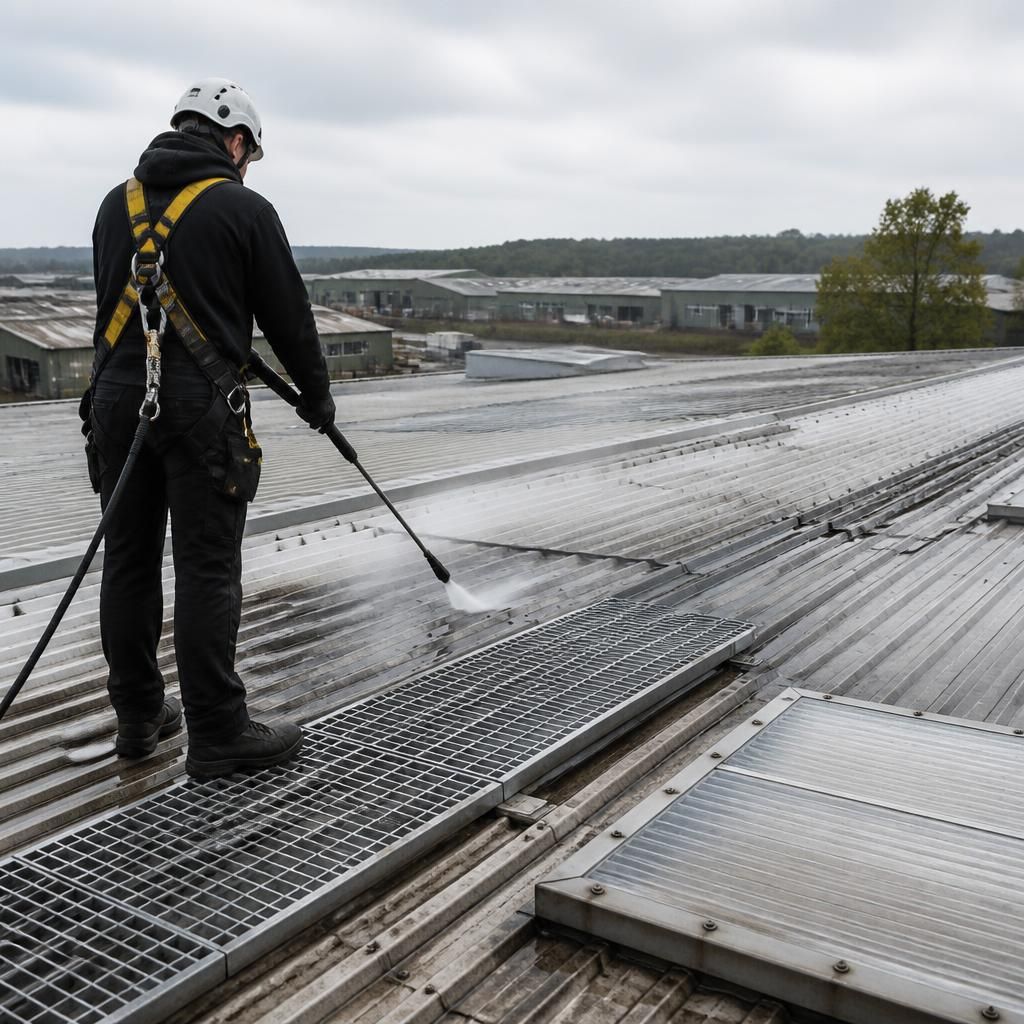
Safe industrial roof cleaning begins with preventing falls, particularly through fragile rooflights, deteriorated sheets and areas weakened by corrosion. These hazards are identified during the site assessment and clearly marked or protected before cleaning starts.
Operatives use designated access routes and suitable platforms rather than stepping on rooflights, translucent panels, unsupported sections or roof-mounted services. Where work at height cannot be avoided, the planned controls may include edge protection, collective protection or compatible fall-restraint equipment. The method is also adjusted to the roof’s condition, using controlled pressure to avoid damaging coverings, seals, flashings and fixings.