
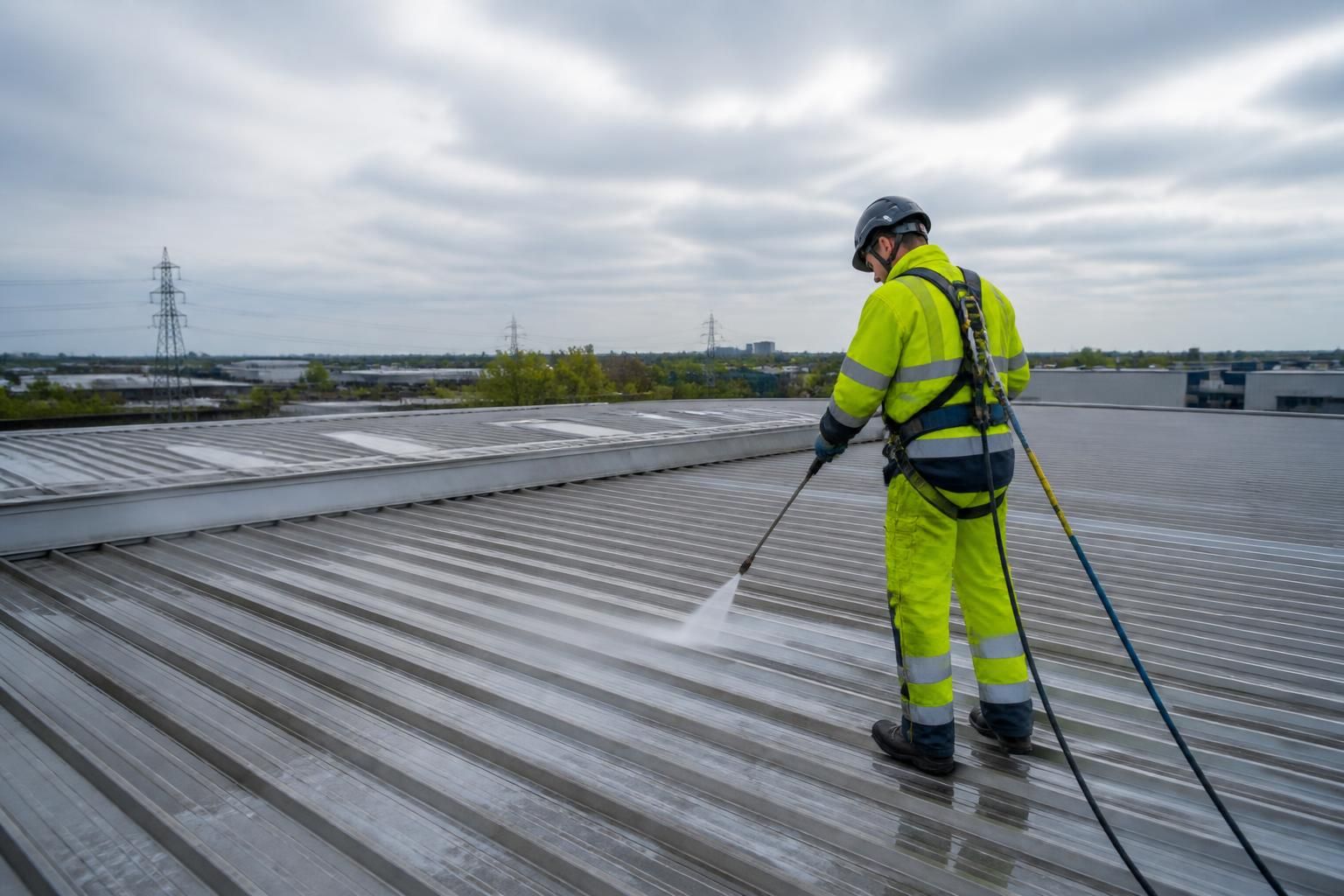
How do industrial roof cleaning companies ensure safety measures are in place during the cleaning process?
Industrial roof cleaning companies ensure safety by completing a site-specific risk assessment and method statement, inspecting the roof and access points, and selecting trained operatives, suitable equipment and appropriate fall-protection systems. They also control work areas, monitor weather and roof conditions, manage cleaning chemicals and wastewater, and maintain clear communication and emergency procedures throughout the project.
Industrial roof cleaning companies ensure safety by planning the work before anyone accesses the roof, assessing the building and cleaning risks, and applying controls throughout the project. This normally includes a site-specific risk assessment and method statement (RAMS), a roof and access inspection, competent operatives, suitable fall-protection equipment, controlled work areas, weather monitoring, safe chemical handling and a documented emergency procedure.
Site assessment and risk planning
The process begins with information about the building, the roof construction, previous maintenance work and any known hazards. A competent person should inspect the roof, access routes and surrounding ground conditions before the cleaning method is confirmed. The assessment considers:
- roof type, age, condition and load-bearing capacity;
- fragile sheets, rooflights, asbestos-containing materials or deteriorated coverings;
- roof edges, openings, skylights, valleys, gutters and changes in level;
- safe access for people, hoses, pressure-washing equipment and waste containers;
- overhead services, plant, vehicle movements and nearby public areas;
- water, electricity and drainage arrangements; and
- weather, wind exposure and any restrictions imposed by the building’s operations.
The findings are recorded in the RAMS. This document explains the proposed sequence of work, equipment, control measures, responsibilities and emergency arrangements. It should be communicated to the team before work starts and reviewed if site conditions or the cleaning method change.
Checking the roof before cleaning
Industrial roofs cannot be treated as ordinary walkways. A visual inspection, supported by information from the client and safe access equipment, helps identify weak areas and surfaces that could be damaged by foot traffic, pressure or heat. Operatives should never step on rooflights, fragile panels or areas that have not been confirmed as suitable for access.
Where a roof is fragile or its condition cannot be verified, the company should use a system that avoids unsupported access, such as suitable access platforms, crawling boards, temporary walkways or equipment operated from a safe position. If asbestos is suspected, the material must be identified and managed in accordance with the applicable asbestos requirements before cleaning begins. Cleaning should not proceed simply because a surface appears stable from ground level.
Using competent people and suitable supervision
Safe roof cleaning depends on more than experience with pressure washers. Operatives need training relevant to the work, including work at height, roof access, equipment operation, manual handling, chemical use and site-specific emergency procedures. They should understand the limitations of the roof, the fall-protection system and the selected cleaning pressure or temperature.
Where access equipment, lifting equipment or specialist systems are used, the people planning, operating and inspecting that equipment must have appropriate competence. A supervisor should check that the RAMS is being followed, that controls remain effective and that operatives are not exposed to avoidable risks. Site inductions and toolbox talks are useful for highlighting hazards unique to the premises.
Preventing falls from height
Fall prevention is normally prioritised over relying on personal protective equipment. Depending on the roof and task, controls may include permanent edge protection, temporary guardrails, a properly designed scaffold, mobile access equipment, designated walkways or a fall-restraint system. A fall-arrest system is only suitable when it has been properly designed, attached to an adequate anchor point and supported by a rescue plan.
Harnesses, lanyards, lifelines and anchors should be inspected before use and used in line with the manufacturer’s instructions. Equipment must not be clipped to an unsuitable point or arranged in a way that permits a person to reach an unprotected edge. The team also needs to consider clearance beneath the worker and the possibility of suspension after a fall. Rescue arrangements should be practical for the site rather than relying solely on the emergency services.
Controlling access and falling objects
Ground-level controls prevent unauthorised people from entering the work area and protect employees, visitors and members of the public from falling tools, debris, spray and contaminated water. Barriers, warning signs and a defined exclusion zone are selected according to the building layout and the equipment being used.
Tools and hoses should be positioned so they cannot create trip hazards or fall from the roof. Small equipment may need securing, while larger items should be raised and lowered using an appropriate method rather than carried up ladders. Vehicle routes, loading areas, entrances and fire exits must remain controlled and available to the required standard throughout the work.
Choosing and checking cleaning equipment
The cleaning system is selected for the roof material and its condition. Excessive pressure, heat or aggressive agitation can damage membranes, coatings, seals, flashings and drainage components. Low-pressure or steam cleaning may be more appropriate where the roof finish is vulnerable, but the method still requires controlled operation and a test area where appropriate.
Hoses, pumps, pressure washers, steam equipment, generators, access platforms and lifting equipment should be checked before use. Guards, electrical protection, fuel systems and connections must be in good condition, and equipment should be operated only within its intended limits. Inspection and maintenance records help demonstrate that work equipment has been kept suitable for use. Noise, vibration, hot surfaces, fuel and electrical risks should also be included in the assessment.
Managing weather and changing conditions
Rain, ice, high winds, poor visibility and extreme temperatures can make roof cleaning unsafe. Water and cleaning solutions can reduce grip, while wind can affect hoses, access platforms, sheets, debris and spray control. The supervisor should monitor conditions during the work and stop or alter the operation when the planned controls are no longer effective.
A safe project plan includes clear stop-work criteria. These may relate to wind, roof slipperiness, lightning, visibility, equipment failure, unexpected roof damage or the presence of people within the exclusion zone. Rescheduling is safer than pressuring operatives to continue when conditions have changed.
Handling chemicals and contaminated water
Any detergent, biocide, treatment product or disinfectant should be assessed under the Control of Substances Hazardous to Health requirements. Operatives need access to the relevant safety information, correct dilution instructions, suitable gloves and eye or face protection, and washing facilities or arrangements for dealing with accidental contact. Chemicals should be labelled, stored securely and kept away from incompatible substances.
Run-off must be controlled so that cleaning residues, coatings, oil, moss or other contaminants do not enter surface-water drains, watercourses or neighbouring property. Drainage points may need protection or temporary isolation, and recovered water may require collection and appropriate disposal. The method should account for the condition of gutters and downpipes, particularly where accumulated debris could cause blockages or uncontrolled discharge.
Maintaining communication and emergency arrangements
Before work starts, the cleaning team and the client should agree access arrangements, contact details, restricted areas, isolation requirements and the procedure for reporting defects. Communication is particularly important where the building remains occupied or vehicles and other contractors are operating nearby.
The emergency plan should cover falls, injury, chemical exposure, electrical incidents, fire, sudden weather deterioration, equipment failure and discovery of an unsafe roof. It should identify how to raise the alarm, contact first aid and emergency services, isolate equipment, reach the casualty and carry out a rescue from height. First-aid provision and rescue equipment must be appropriate to the task and available without creating further risk.
Monitoring, inspection and handover
Safety controls are checked throughout the project rather than only at the initial briefing. Supervisors should confirm that barriers remain in place, access equipment is stable, harness systems are correctly used, hoses are managed and the roof has not become unsafe through water or chemical application. Any near miss, defect or change to the method should be recorded and addressed.
At completion, the team should leave the roof, access routes and surrounding areas safe, remove equipment and waste, and confirm that drainage has been checked where this forms part of the agreed work. The client should be informed of defects found during cleaning, areas that could not be safely accessed and any recommended follow-up maintenance. This combination of planning, competent operation, active supervision and clear handover is how industrial roof cleaning companies maintain safe and compliant working practices from survey through to completion.
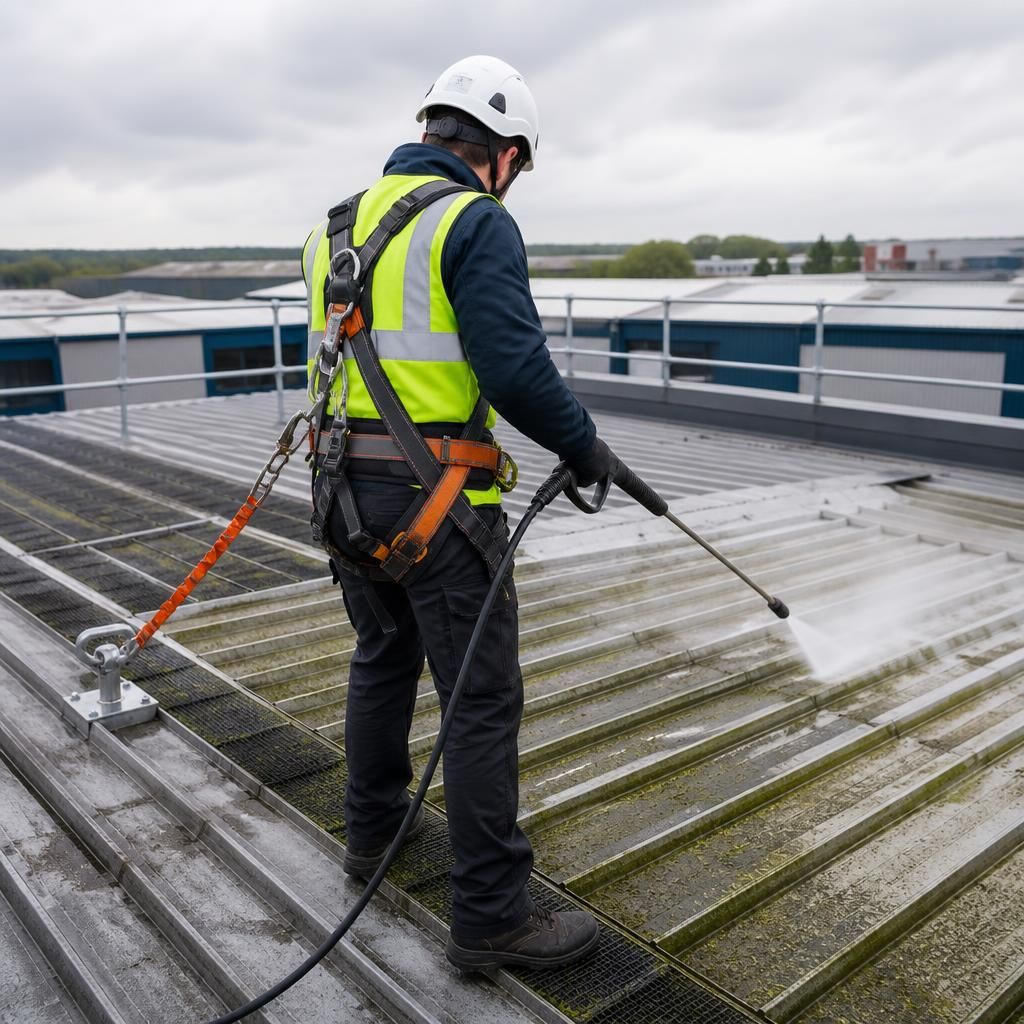
Industrial roof cleaning companies protect workers from falls by planning access before cleaning begins and using controls suited to the roof’s condition. This may include edge protection, temporary guardrails, designated walkways, access platforms or a properly designed fall-restraint system.
Harnesses and lanyards are not a substitute for safe planning. They must be inspected, connected to suitable anchor points and used with enough clearance beneath the worker. Where fall arrest is required, the cleaning team should have a practical rescue plan covering how a suspended or injured operative will be reached without exposing others to further risk.
Supervision continues throughout the work. Barriers, access equipment, hoses and roof surfaces are checked regularly, with work stopped if wind, rain, poor visibility, roof damage or changing site activity makes the agreed controls ineffective.