
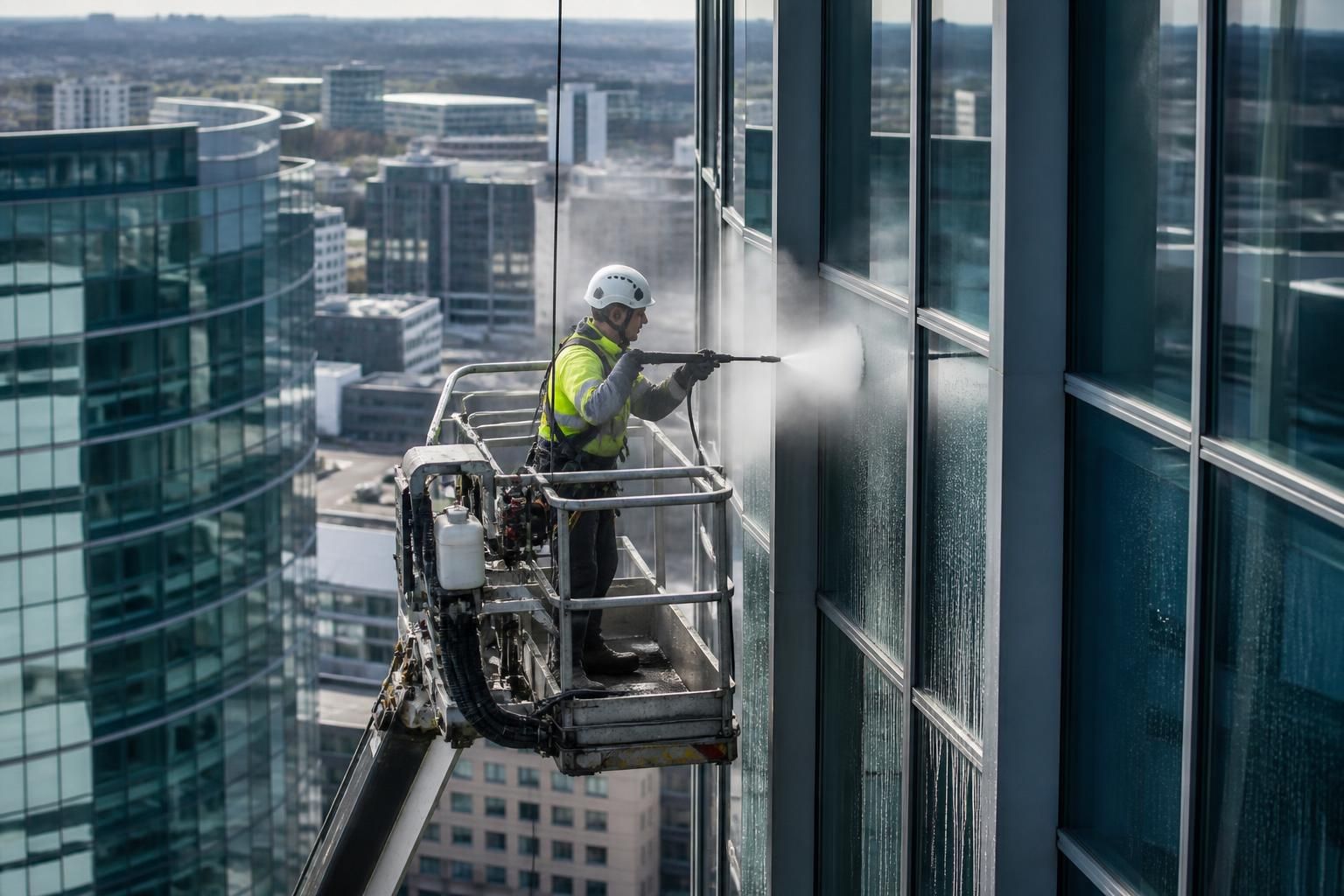
What safety precautions should be taken when conducting exterior steam cleaning on high-rise buildings or structures with complex architecture?
High-rise exterior steam cleaning requires a documented risk assessment, competent operatives, secure access equipment, controlled water and steam discharge, suitable PPE, and measures to protect people, property and the public below. Work should be planned around the building’s architecture, weather conditions, fragile materials, electrical services and emergency procedures before cleaning begins.
High-rise exterior steam cleaning must be controlled through a site-specific risk assessment and method statement, competent operatives, suitable work-at-height equipment, secure exclusion zones, and careful management of heat, water, access and falling objects. Complex façades require additional planning because projecting features, recesses, fragile materials, glazing, plant, roof edges and restricted drainage can create hazards that are not present on a simple elevation.
Complete a detailed survey and risk assessment
Before work starts, the contractor should inspect the building, surrounding ground and proposed access routes. The assessment should identify:
- the height, geometry and condition of the façade;
- ledges, balconies, canopies, parapets, fins, architectural projections and concealed recesses;
- fragile or loose materials, deteriorated joints, failing render, cracked masonry and unsecured fixtures;
- windows, vents, doors, roof coverings, sealants and other areas that could be damaged by heat, moisture or pressure;
- overhead and concealed electrical services, lighting, communications equipment and building plant;
- pedestrian routes, roads, neighbouring properties and areas below the work face;
- drainage capacity, runoff routes and any environmentally sensitive discharge points; and
- weather exposure, wind loading, visibility and the effect of conditions on access equipment.
The findings should be recorded in suitable risk assessments and method statements. Where the building is occupied, the plan should also account for residents, workers, visitors, deliveries, fire exits and the activities of other contractors. A pre-cleaning test on an inconspicuous area is important for confirming that the selected steam temperature, dwell time and technique are compatible with the surface.
Use competent people and properly selected access equipment
High-level cleaning should only be carried out by operatives who are trained and competent for the cleaning method and the access system being used. The equipment may include scaffold, a mobile elevating work platform, suspended access, cradle systems or rope access, depending on the building and the cleaning areas. The choice should be based on the structure, reach, ground conditions, wind exposure, rescue requirements and the need to keep the operator stable while handling a steam hose.
Access equipment must be installed, operated, inspected and maintained in accordance with the relevant manufacturer’s instructions and UK work-at-height requirements. Platforms should have suitable guardrails, toe boards and gates, while harnesses and lanyards should be used where the risk assessment requires them. Anchor points must be suitable for the intended system; they should never be assumed to be safe without verification. Hoses and cables should be routed and secured so that they cannot snag, create trip hazards or pull an operator off balance.
Rope access requires a planned system, suitable anchors, independent safety arrangements, trained technicians and a practicable rescue plan. A rescue procedure should be specific to the building and access method, rather than relying solely on the emergency services. It should explain how an incapacitated operative would be recovered and how equipment, communications and first-aid support would be provided.
Control steam, heat and pressure hazards
Steam equipment can expose operatives and nearby people to hot water, hot surfaces and pressurised hoses. Operators should follow the equipment manufacturer’s instructions, check hoses, couplings, guns and safety controls before use, and isolate the system before making adjustments or clearing blockages. Steam should never be directed towards people, unprotected electrical equipment, open vents or areas where water could become trapped.
Suitable protective equipment normally includes waterproof, heat-resistant gloves, protective footwear with slip-resistant soles, eye or face protection and appropriate protective clothing. Additional respiratory protection may be needed where the assessment identifies airborne contaminants, biological growth or cleaning chemicals. PPE is a final layer of protection and does not replace safe access, exclusion zones or control of the steam source.
Where detergents, biocides or other cleaning products are used with the steam process, the contractor should assess the product-specific hazards, provide the relevant safety data and follow COSHH controls. Products should not be mixed unless the manufacturer expressly permits it, and overspray must be prevented from reaching occupants, neighbouring premises, vegetation or watercourses.
Prevent falling objects and protect people below
Tools, hoses, fittings, fragments of masonry and dislodged deposits can fall from a high-rise façade. The work area below should therefore be controlled with suitable barriers, signage and, where necessary, a supervised exclusion zone or temporary closure of pedestrian and vehicle routes. The size and position of the zone should reflect the building height, wind conditions, access arrangement and the potential for materials or water to travel beyond the immediate work face.
Tools and loose equipment should be secured using suitable tool lanyards or storage systems. Items should not be left on platforms, parapets, window ledges or scaffold boards where vibration or hose movement could displace them. The façade should be checked for unstable material before cleaning, and any discovery of loose stone, render, brickwork or cladding should be reported and dealt with through the agreed procedure rather than simply being blasted away.
Manage water, runoff and overspray
Steam cleaning uses less water than many conventional pressure-washing methods, but it still produces condensate, runoff and wet surfaces. The plan should identify where water will collect and how it will be contained, diverted or removed. This is particularly important around entrances, public pavements, balconies, roof areas, loading bays and façades with limited drainage.
Runoff should not be allowed to enter electrical installations, occupied areas, neighbouring premises or surface-water drains without suitable controls. Where the existing drainage system cannot safely accept the discharge, the contractor may need collection, temporary bunding, wet vacuum recovery or an agreed disposal arrangement. The surrounding ground should be checked for slip hazards throughout the work, not only at the end of the shift.
Windows, vents, doors, expansion joints, service penetrations and damaged sealants should be protected or treated with an appropriate technique. Water ingress can damage internal finishes, insulation, equipment and tenant property even when the external cleaning itself appears controlled. Building management should be informed of vulnerable areas and any rooms or systems that need temporary isolation.
Check weather and stop work when conditions change
Wind is a major consideration for high-rise work because it can affect suspended platforms, mobile elevating work platforms, hoses, spray direction and the stability of loose materials. Rain, ice, poor visibility, lightning and extreme temperatures can also affect access equipment, footing, electrical safety and surface drying. The site supervisor should monitor conditions against the limits set for the equipment and method statement.
Work should be paused if wind causes the hose or access platform to move unpredictably, if visibility prevents safe communication, if surfaces become dangerously slippery, or if water begins entering the building or spreading into public areas. Conditions should be reassessed before operations resume, particularly after a weather change or interruption.
Protect the building and adjacent services
Steam settings and cleaning techniques should be selected according to the material, condition and detailing of the façade. Excessive heat or prolonged application can affect coatings, paint, sealants, timber, certain plastics, historic finishes and weathered masonry. Glazing, pointing and cladding joints may also require reduced exposure or physical protection.
Electrical and mechanical services should be identified before cleaning. External sockets, lighting, sensors, cameras, control panels, ventilation openings and roof plant may need isolation, shielding or avoidance. Any isolation should be agreed with the responsible building manager and completed by an appropriately authorised person. Operatives should never assume that a sealed-looking fitting is waterproof or that a service is de-energised.
Maintain communication and emergency controls
A named supervisor should coordinate the work, control access and confirm that the agreed method is being followed. Reliable communication is needed between the operative at the façade, the access-equipment operator, the ground team and the building contact. The team should know how to stop the steam system quickly, raise an alarm, summon first aid and report an incident or near miss.
The emergency plan should cover burns, falls, suspension or access-equipment failure, falling material, electrical contact, water ingress, fire and sudden weather deterioration. First-aid arrangements, emergency access, building evacuation procedures and the location of isolation points should be confirmed before starting. A post-work inspection should check the façade, access equipment, ground area, drainage points and any protected services before the site is handed back.
For high-rise or architecturally complex buildings, exterior steam cleaning should be treated as a coordinated work-at-height operation rather than as ordinary washing. A competent contractor will combine a documented survey, tested cleaning method, appropriate access system, controlled exclusion zone, water-management plan and building-specific rescue arrangements, with supervision throughout the work.
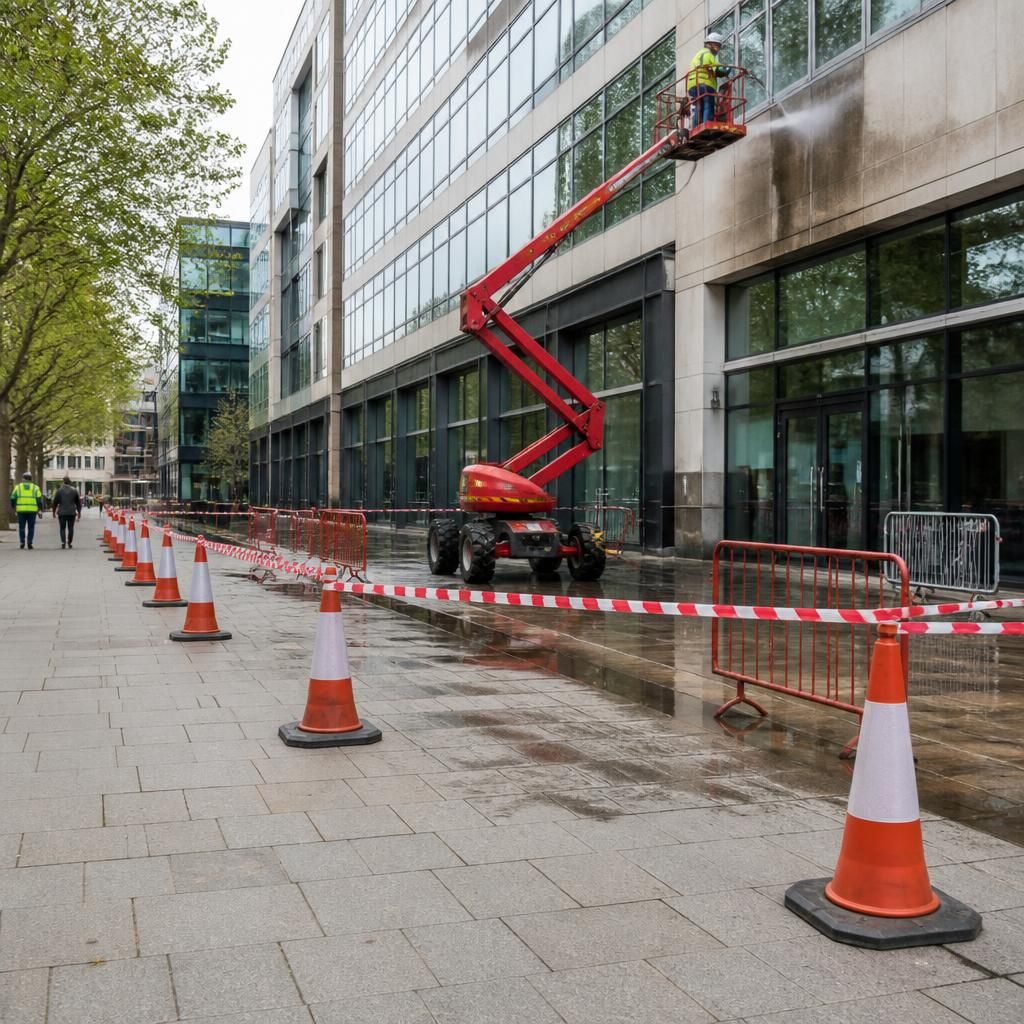
Exclusion zones are essential during high-rise exterior steam cleaning because tools, hose fittings, loose façade material and hot water can fall or travel beyond the area directly below the operative. The controlled zone should cover the likely drop area and be adjusted for building height, wind, access equipment and the condition of the façade.
- Use barriers and clear warning signs to keep pedestrians, vehicles and unauthorised workers away.
- Secure hoses, tools and attachments to prevent displacement from platforms, ledges or parapets.
- Use a trained ground person to monitor the zone where public routes or entrances cannot be fully closed.
- Inspect the area throughout the work and pause cleaning if loose masonry, unstable materials or uncontrolled runoff is identified.
Arrange a High-Rise Exterior Steam Cleaning Assessment
Contact Encanto Exterior Cleaning to arrange a site-specific assessment for high-rise or architecturally complex exterior steam cleaning. We will review access, surface condition, water control, exclusion zones and emergency arrangements before preparing a suitable cleaning plan.