
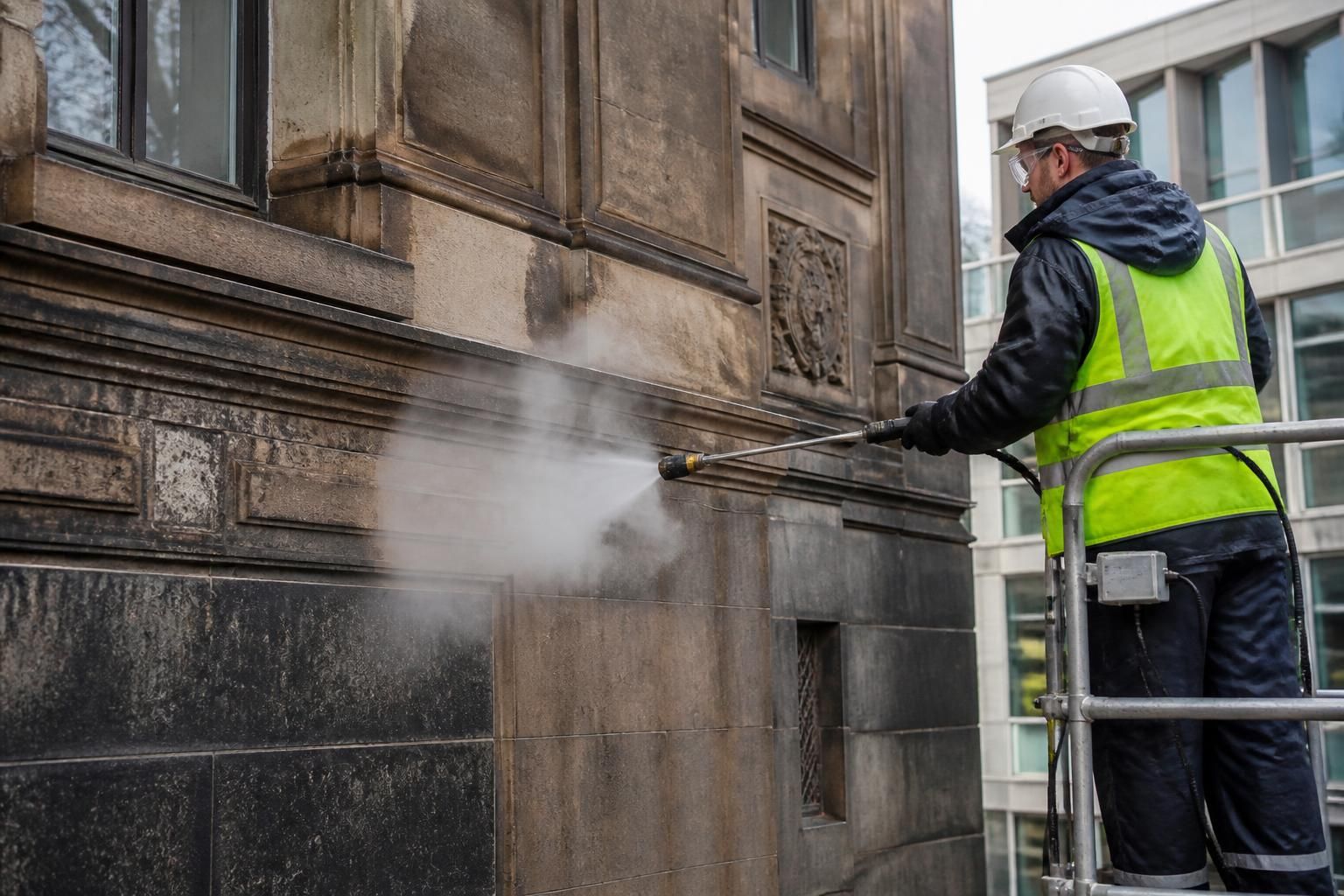
What key factors should be considered when choosing exterior steam cleaning services for sensitive building materials?
When choosing exterior steam cleaning services for sensitive building materials, check that the contractor can identify the substrate, adjust steam temperature and pressure, control moisture, and carry out a small test patch before full cleaning. They should also have suitable access equipment, insurance, trained operatives and experience with façades, cladding, render, masonry and heritage surfaces.
Choosing exterior steam cleaning services for sensitive building materials depends on the contractor’s ability to identify the substrate, assess its condition and control heat, pressure, moisture and dwell time throughout the work. The service should be based on a documented method statement and a test patch, rather than a standard setting applied to every surface. This is particularly important for historic masonry, delicate brickwork, natural stone, painted façades, render, timber, glazed surfaces and certain cladding systems.
A suitable contractor should inspect the building before recommending a cleaning method. The assessment should consider the material itself, previous repairs, coatings, joints, sealants, areas of deterioration and the type of soiling present. Organic growth, atmospheric deposits, carbon staining, oil, old paint and graffiti may require different treatment. A surface that appears sound from ground level may contain open joints, cracked render, friable mortar or loose coatings that could be affected by heat or water.
Key factors to check before appointing an exterior steam cleaning contractor include:
- Substrate knowledge: The operatives should be able to distinguish between materials such as brick, terracotta, limestone, sandstone, concrete, render, powder-coated metal and composite cladding. They should understand how each material reacts to heat, moisture and mechanical action.
- Condition assessment: Existing cracks, spalling, failed pointing, delamination, corrosion, loose paint and damaged sealants should be recorded. Cleaning should not be used as a substitute for repairs, and vulnerable areas may need to be protected or excluded.
- Controlled steam application: Steam cleaning is not simply a matter of applying the highest available temperature. The contractor should regulate temperature, pressure, flow rate, nozzle selection, working distance and cleaning speed to suit the surface.
- Test patching: A discreet test area should be cleaned and inspected before the main work begins. The test should confirm that the selected process removes the deposit without etching, bleaching, softening, discolouring or loosening the underlying material or coating.
- Moisture management: Sensitive façades can be affected by water entering joints, cavities or porous materials. The method should limit unnecessary saturation, provide a plan for run-off and include time for surfaces to dry safely where required.
- Experience with similar projects: Ask for evidence of relevant work on comparable façades, cladding systems, masonry or heritage structures. Experience with one surface does not automatically demonstrate competence with another.
Steam cleaning uses heated water and comparatively low mechanical impact, which can make it suitable where conventional pressure washing would be too aggressive. However, low pressure does not mean risk-free. Heat can soften certain coatings, alter sealants, affect plastics or damage poorly bonded finishes. Water can also penetrate porous masonry, vulnerable joints and concealed construction details. A competent operative will adjust the process continuously rather than treating steam cleaning as a fixed, one-setting system.
The proposed method should explain how the contractor will protect the building during cleaning. This can include masking or covering windows, vents, electrical fittings, sensors, door hardware, signage, vegetation and adjacent finishes. Particular care may be required around movement joints, expansion seals, leadwork, timber elements and areas where water could enter the building. Any sensitive fixtures or finishes that cannot tolerate heat or moisture should be identified during the survey.
For listed buildings, conservation areas and older structures, confirm whether the work requires consultation with a conservation officer, building owner, managing agent or other responsible party. Cleaning can expose historic repairs, change the appearance of weathered materials or remove surface treatments that form part of the building’s character. The contractor should use the least aggressive effective method and retain records of the agreed approach, test results and any areas deliberately left untreated.
Cleaning chemicals should also be considered. Steam may remove some deposits without detergents, reducing the risk of chemical damage and residues. Where a pre-treatment or biocide is proposed, the contractor should explain why it is needed, confirm its compatibility with the substrate and provide information on application, dwell time, rinsing and run-off control. Chemicals should not be introduced merely to compensate for unsuitable temperature, pressure or technique.
Access arrangements are an important part of protecting sensitive materials. The contractor should select suitable towers, mobile elevating work platforms, cradles, rope access or other equipment according to the building and the cleaning area. Access equipment must not bear against fragile façades, parapets, roofs, cladding panels or decorative features. The plan should also address exclusion zones, falling debris, pedestrian management, traffic, nearby businesses and protection of occupied premises.
For larger commercial or industrial sites, request a written quotation that separates survey work, preparation, test patching, cleaning, access, protection, waste-water management and any remedial recommendations. The scope should state which surfaces are included, the expected visual outcome and how difficult or permanent staining will be handled. Some staining may be embedded in the substrate or linked to corrosion, failed coatings or biological growth, so complete removal may not be technically appropriate without increasing the risk of damage.
Competence and compliance should be verified before work starts. Check that the contractor has appropriate public and employers’ liability insurance, trained operatives, safe systems of work and suitable equipment maintenance records. For work at height, the risk assessment and method statement should cover access, rescue arrangements, weather conditions, hose management, hot-water hazards and the protection of people below. The team should also understand site rules and any permit requirements.
Environmental controls are relevant where cleaning produces contaminated run-off. The method should explain how dirty water, removed coatings, oil, graffiti residue or cleaning chemicals will be contained and disposed of in accordance with site and legal requirements. Gullies, watercourses, planted areas and neighbouring properties may need protection. Steam cleaning can reduce water and chemical use in some applications, but its environmental performance still depends on how run-off, waste and equipment are managed.
Timing can affect the result and the condition of the building. Cleaning should take account of weather, surface temperature, frost risk, drying conditions and the operating requirements of the premises. Avoiding unsuitable conditions helps prevent rapid drying, streaking, trapped moisture and ineffective treatment. On occupied buildings, the programme should also account for public access, deliveries, ventilation and the risk of water or debris entering internal areas.
Before approving the work, ask the contractor to provide:
- a site survey identifying all relevant materials and defects;
- a proposed cleaning method with temperature, pressure, flow and access controls;
- details of the test patch and the person responsible for approving it;
- a risk assessment and method statement, including work-at-height controls;
- information on chemicals, water use, run-off containment and waste disposal;
- evidence of insurance, operator competence and experience with comparable surfaces;
- a clear scope, programme, exclusions and arrangements for reporting unexpected defects.
After cleaning, the building should be inspected while the surface is dry enough to assess properly. The review should check for missed deposits, colour variation, disturbed joints, damaged coatings, water ingress and any newly exposed defects. Photographs and written records provide a useful baseline for future maintenance. If the building has recurring staining or biological growth, the contractor should identify the likely cause and advise whether repairs, drainage improvements, coating maintenance or scheduled cleaning would be more appropriate than repeated intensive cleaning.
The safest choice is therefore a contractor that treats steam cleaning as a controlled conservation and maintenance process, not as a generic pressure-washing service. Material identification, condition assessment, a supervised test patch, adjustable equipment, careful access planning and responsible water management are the principal safeguards. These checks help protect sensitive façades and other exterior surfaces while achieving a cleanable, realistic and maintainable result.
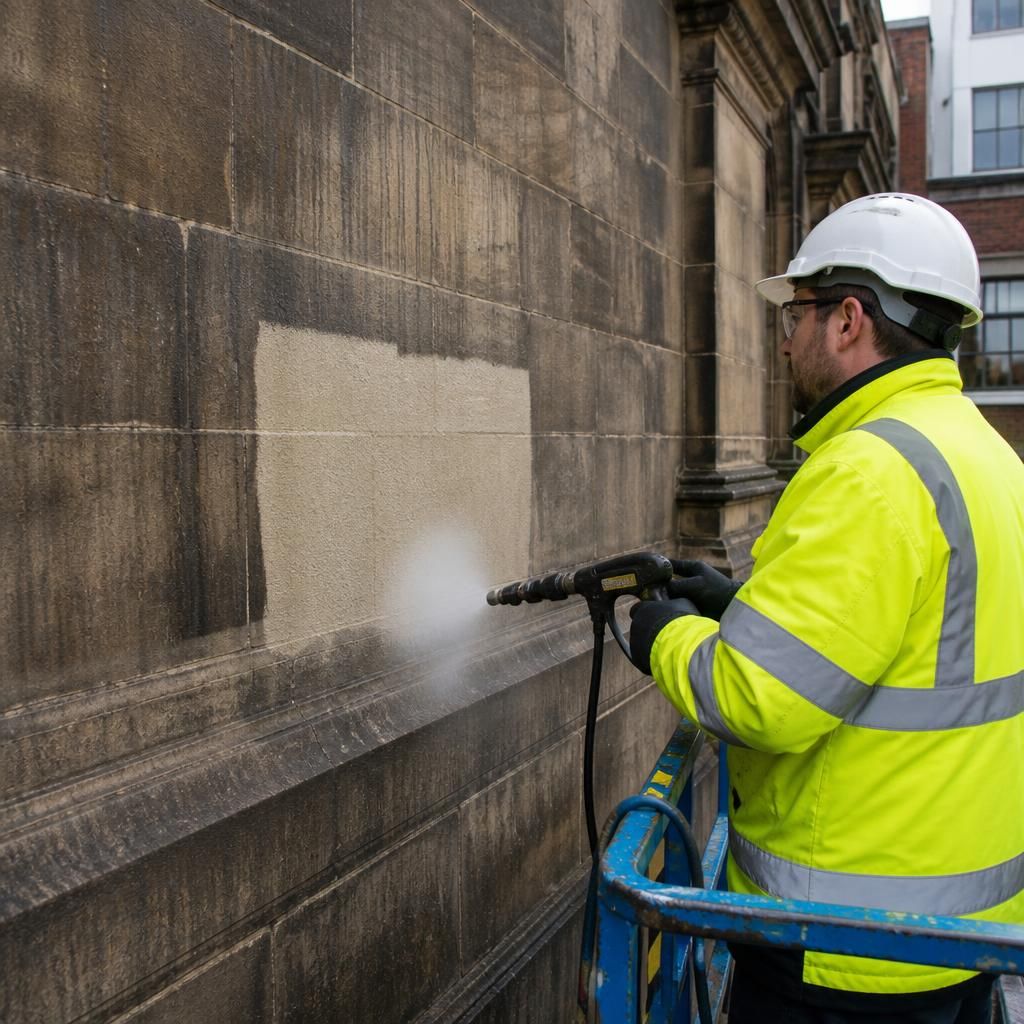
When exterior steam cleaning is used on sensitive building materials, a supervised test patch is the main safeguard against avoidable damage. It allows the contractor to confirm that the chosen temperature, pressure, flow rate, nozzle and working distance remove the soiling without affecting the substrate, coating, joints or sealants.
The test area should be representative of the wider façade and inspected after drying. Check for changes such as colour variation, softened paint, surface marking, loosened mortar, disturbed pointing or water penetration before approving the full clean. If the result is unsuitable, the method can be adjusted or the affected area excluded.