
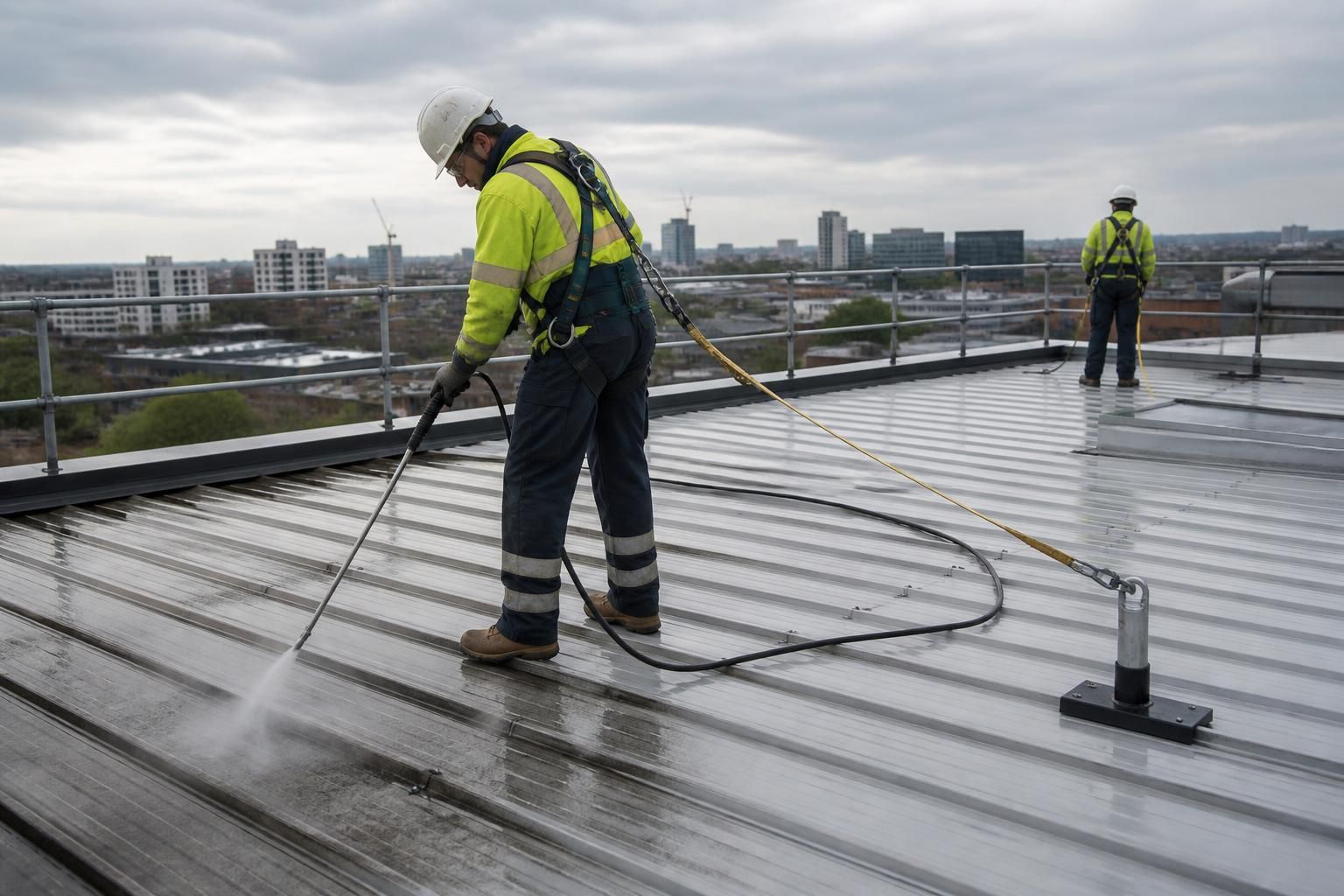
What safety measures are involved in commercial roof cleaning?
Commercial roof cleaning safety measures include a site-specific risk assessment, controlled access, suitable edge protection and fall-arrest systems, and trained operatives using appropriate access equipment. Contractors should also manage fragile surfaces, weather conditions, equipment, cleaning chemicals, water run-off and ground-level risks to protect people, property and the building.
Commercial roof cleaning must be planned as controlled work at height, not treated as routine pressure washing. The main safety measures are a site-specific risk assessment, a documented method statement, competent operatives, controlled roof access, suitable edge protection or fall-arrest systems, precautions for fragile surfaces, safe management of water and chemicals, and an emergency rescue plan.
Site assessment and planning
Before work starts, the contractor should inspect the building and its surroundings to identify hazards and select an appropriate cleaning method. The assessment should consider the roof construction, access points, roof pitch, condition of coverings, skylights, rooflights, fragile areas, plant, vents, drainage outlets, overhead services, neighbouring buildings and ground-level activity.
The findings should be recorded in a risk assessment and method statement. These documents should explain how operatives will reach the roof, move around it, clean each surface, control falling objects, manage water run-off and respond to foreseeable emergencies. Where the building is occupied, the plan should also address staff, visitors, tenants, vehicles and deliveries.
Competent operatives and supervision
Roof cleaning should be carried out by operatives who are trained and competent for the work and equipment involved. This includes working at height, safe use of access equipment, manual handling, equipment inspection, chemical handling and emergency procedures. Supervisors should check that the agreed controls remain effective throughout the project, particularly when the roof condition or weather changes.
Personal protective equipment supports these controls but does not replace them. Depending on the task, operatives may require safety footwear with suitable grip, hard hats, gloves, eye protection, protective clothing, hearing protection and respiratory protection. PPE must be compatible with the cleaning chemicals and maintained in a serviceable condition.
Safe access and fall prevention
The safest practical access method should be selected after considering the height, building layout, roof condition and duration of the work. This may involve a scaffold, scaffold tower, mobile elevating work platform, roof ladder, temporary walkway or another suitable access system. Ladders should generally provide access rather than serve as the main working position unless a specific assessment confirms that this is appropriate.
Where there is a risk of falling, collective protection such as guardrails, edge protection and properly secured platforms should be used wherever reasonably practicable. If a personal fall-protection system is required, it must be attached to a suitable, verified anchor arrangement and used by operatives trained in its operation. A harness on its own is not a complete safety system.
Fall-arrest equipment also requires a rescue plan. The plan should explain how a suspended operative would be recovered promptly, using suitable equipment and trained personnel. Relying solely on the emergency services is not an adequate substitute for planning an on-site response.
Fragile roofs and rooflights
Many commercial roofs contain fragile sheets, rooflights or concealed weak areas that may not be obvious from ground level. These surfaces must be identified before access is permitted and clearly marked or protected. Operatives should use designated walkways, crawling boards or platforms where necessary and should never assume that a roof can support their weight because it appears intact.
Rooflights can be particularly difficult to distinguish from surrounding roof materials, especially when covered by dirt, moss or coatings. They should be treated as fragile unless their strength and condition have been confirmed. Cleaning equipment, hoses and materials should be positioned so that they do not create trip hazards or impose damaging loads on the roof.
Equipment, hoses and falling-object controls
Pressure washers, steam systems, pumps, access equipment, harnesses and lifting accessories should be inspected before use and operated in accordance with the manufacturer’s instructions. Damaged electrical leads, hoses, couplings or safety equipment should be removed from service. Equipment should be positioned securely, with hoses routed to reduce trip, snagging and abrasion risks.
Tools, scraper blades, containers and other materials should not be left where they could fall from the roof. Ground-level exclusion zones, barriers and warning signs help protect pedestrians, vehicles and building users. Where work takes place above entrances, walkways or operational areas, the contractor should agree whether temporary diversion, controlled access or additional overhead protection is needed.
Weather and roof conditions
Rain, frost, high winds, poor visibility and extreme temperatures can make roof cleaning unsafe. Water and cleaning solutions can reduce grip, while wind can affect access platforms, hoses, spray patterns and lightweight materials. Work should be paused when conditions exceed the safe limits identified in the risk assessment or equipment instructions.
The roof should also be checked during the work for unexpected deterioration, pooling water, loose coverings, blocked outlets or areas made slippery by moss and deposits. Operatives should not continue simply to meet a programme if conditions have changed and the original controls are no longer adequate.
Safe use of cleaning chemicals
Any detergent, biocide, treatment or other chemical should be selected for the roof material and used in line with its safety data sheet and the control measures required under COSHH. Operatives should understand the risks of contact, inhalation, splashes and incompatible substances, and should have access to suitable PPE, secure storage and spill-response materials.
Chemicals should be mixed and applied in controlled areas, away from unprotected people, air intakes and sensitive surfaces. The contractor should prevent spray drift and protect windows, vehicles, landscaping, cladding, ventilation systems and other nearby assets where necessary. Chemicals must never be allowed to enter watercourses or drainage systems without appropriate controls.
Water run-off and environmental protection
Cleaning water can carry moss, dirt, coatings, oils and treatment residues from the roof. Before work begins, drainage routes and discharge points should be identified. Outlets may need temporary protection, filtration, collection or controlled diversion, subject to the site’s drainage arrangements and applicable environmental requirements.
Run-off should not be allowed to flood entrances, affect neighbouring property, contaminate soil or enter surface-water drains uncontrolled. Slurry and waste should be collected and disposed of through suitable channels. These controls also reduce slip hazards around the building.
Electrical and building-services precautions
Operatives should identify electrical intake points, rooftop plant, solar installations, lighting, air-conditioning equipment and other services before cleaning. Water and electrical systems must be kept safely separated, and vulnerable equipment should be isolated or protected by an authorised person where required. Cleaning around plant should follow the building owner’s instructions and should not obstruct ventilation, fire systems or maintenance access.
Protecting people and business operations
A commercial site should have agreed arrangements for isolating the work area, maintaining emergency routes and communicating with staff, tenants and visitors. Deliveries, vehicle movements and public access may need temporary changes while equipment is set up or cleaning takes place above ground-level areas. Noise, spray and access restrictions should be considered when scheduling the work.
The site contact should know who is in charge of the cleaning operation, where the exclusion zones are located and how to report a concern. Good coordination is particularly important on premises with public access, vulnerable occupants, multiple contractors or ongoing construction activities.
Monitoring and completion checks
Safety controls should be reviewed throughout the project rather than treated as a one-off pre-start exercise. Supervisors should monitor access equipment, weather, roof condition, chemical use, run-off, exclusion zones and changes to the surrounding site. Any incident, near miss or significant change should be recorded and the method revised where necessary.
At completion, the contractor should remove equipment and barriers safely, check that walkways and entrances are free from residue, clear agreed waste, confirm that drainage points are unobstructed and report any defects discovered on the roof. A clear handover gives the property manager a record of the work and highlights issues that may require separate repair or maintenance.
For a commercial roof, the correct cleaning method and safety controls depend on the roof material, building design, access conditions and surrounding operations. A professional contractor should explain these controls before work starts and should be prepared to stop or change the method if the site cannot be cleaned safely under the original plan.
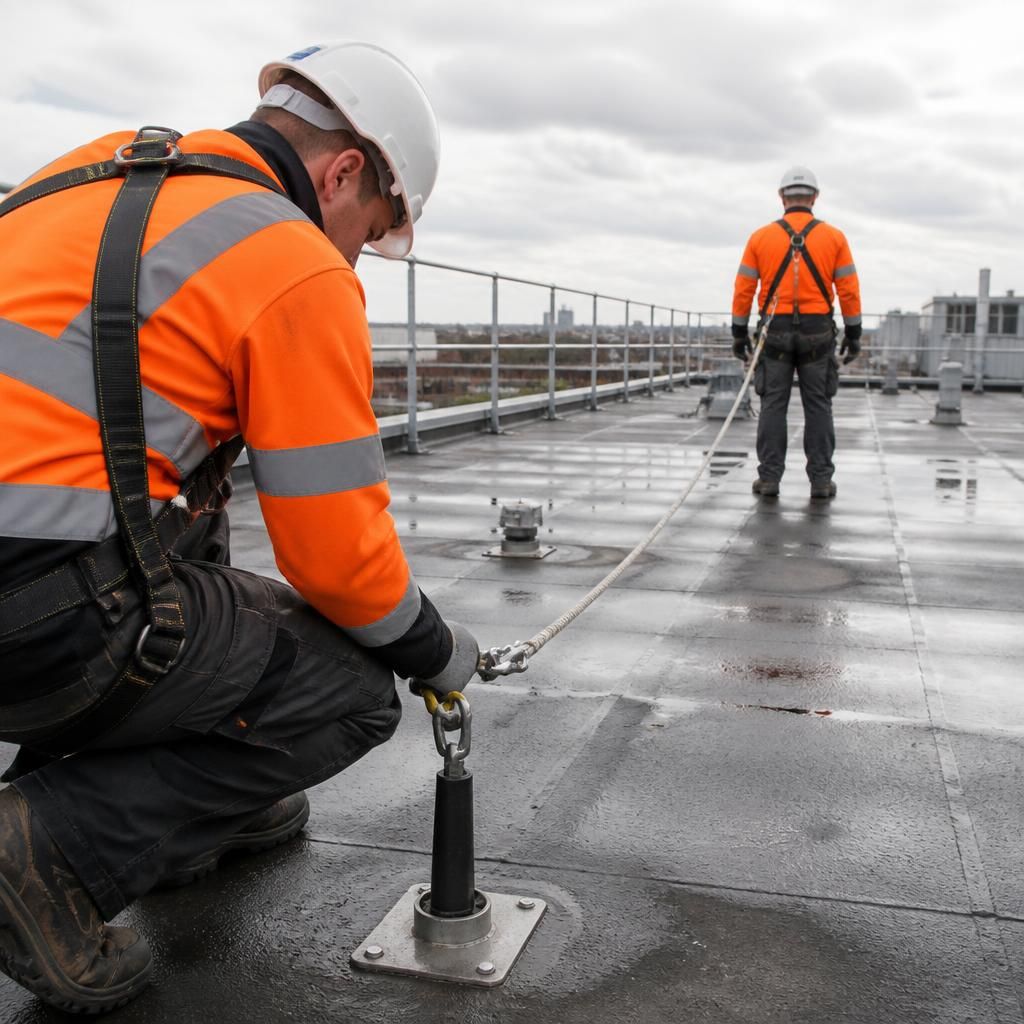
Fall protection is a core safety measure in commercial roof cleaning, but a harness alone is not sufficient. The contractor should first use collective protection, such as guardrails, edge protection or secure working platforms, wherever reasonably practicable. Where a personal fall-arrest system is necessary, it must be connected to a suitable, verified anchor arrangement and used by trained operatives.
A documented rescue plan should also be in place before work starts. It must explain how a suspended operative would be recovered promptly using suitable equipment and trained personnel, rather than relying solely on the emergency services. Access routes, fragile roof areas, exclusion zones and changing weather conditions should be checked throughout the work.
Request a Commercial Roof Cleaning Safety Assessment
Request a commercial roof cleaning safety assessment to review access requirements, fall protection, fragile surfaces, weather risks and run-off controls before work begins. Contact Encanto Exterior Cleaning to arrange a site-specific assessment for your premises.