
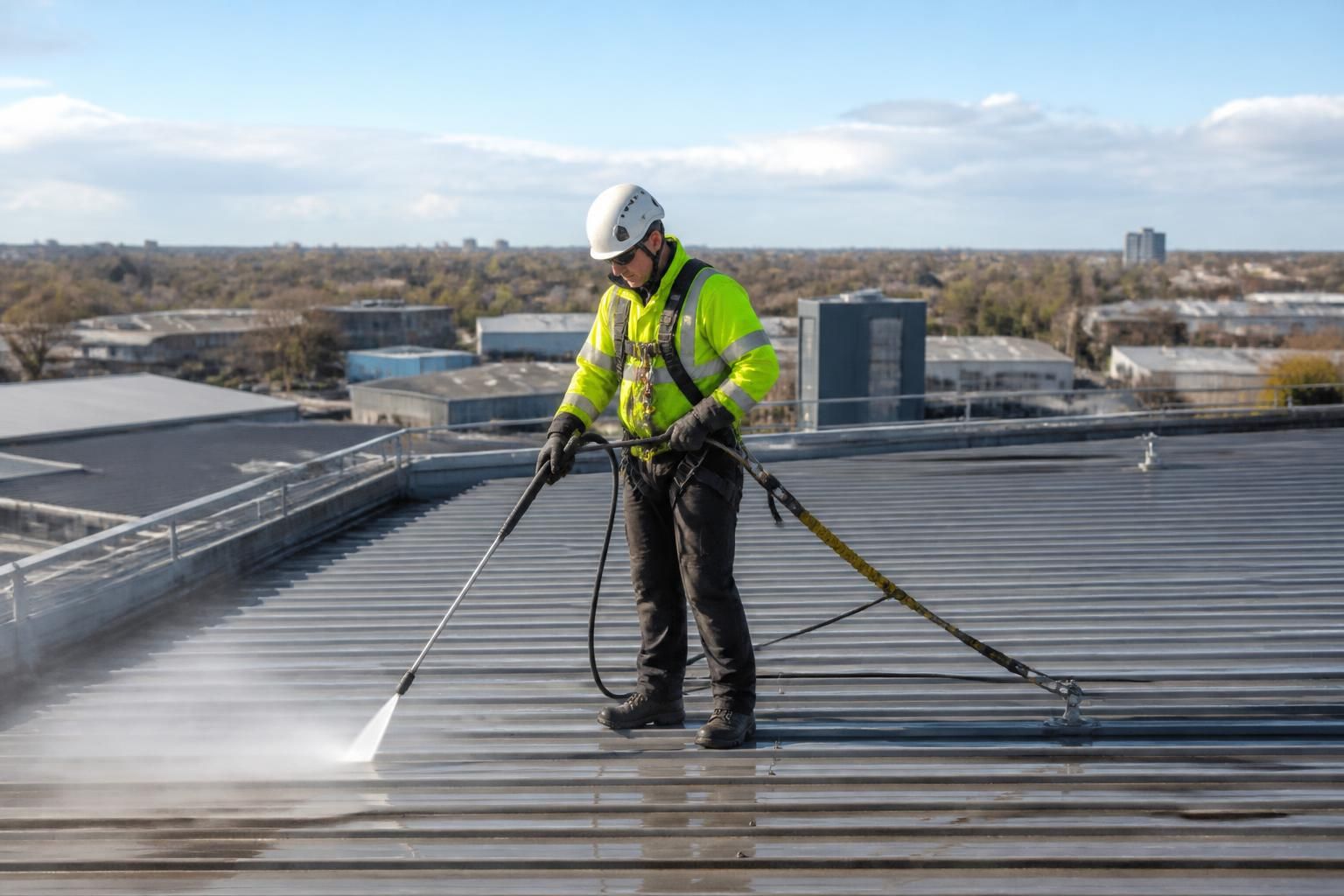
What qualifications and certifications should a commercial roof cleaning service possess to ensure reliability and safety?
A reliable commercial roof cleaning service should provide evidence of relevant work-at-height, access-equipment, pressure-washing and chemical-handling training, together with appropriate public liability and employers’ liability insurance. Where applicable, look for recognised contractor accreditation such as SSIP membership, IPAF or PASMA training, documented RAMS, COSHH controls and competent waste-water management.
A reliable commercial roof cleaning service should be able to demonstrate competent work-at-height training, appropriate access-equipment competence, safe use of pressure-washing and cleaning chemicals, suitable insurance, and a documented system for planning and controlling the work. In the UK, there is not one universal “commercial roof cleaning licence”. Reliability is assessed through the combination of relevant qualifications, practical experience, risk controls, insurance and evidence that the contractor can manage the specific roof and site conditions safely.
Work-at-height competence is the most important requirement for roof cleaning. Operatives should understand the Work at Height Regulations, including how to avoid working at height where possible, select suitable access methods, prevent falls and protect people below. Training should cover safe use of ladders, towers, roof access systems, edge protection and fall-arrest or restraint equipment where these are required. A certificate alone is not enough: the contractor should also be able to explain how the roof will be accessed and how fragile areas, rooflights, openings and changing weather conditions will be controlled.
Where powered access equipment is used, the relevant operators should hold current training for the type of machine involved. This may include mobile elevating work platforms, such as scissor lifts or boom lifts. Training for mobile access towers and other temporary access systems should also be appropriate to the equipment being erected and used. The contractor should retain inspection and maintenance records for access equipment, along with any required pre-use checks and thorough examination reports.
Roof-specific knowledge is equally important. Commercial roofs can include concrete or clay tiles, slate, metal sheeting, profiled cladding, single-ply membranes, asphalt, built-up felt systems and liquid-applied coatings. The cleaning method, pressure level, chemical selection and access arrangements must be suitable for the material. A competent contractor should be able to identify fragile or deteriorated surfaces, protect roof coverings and flashings, and recognise when cleaning could cause damage or invalidate a manufacturer’s warranty.
Useful evidence may include manufacturer or industry training, documented experience with similar roof systems and a clear inspection process before work starts. The contractor should check drainage routes, outlets, roof condition, access points and areas of suspected weakness rather than treating every roof as suitable for the same pressure-washing or soft-washing process.
Pressure-washing and equipment training should cover safe operation of pumps, hoses, lances, heated systems and surface-cleaning equipment. Operatives need to understand pressure, flow, temperature and spray distance, as well as the risk of forcing water beneath tiles, cladding joints, membranes, seals or flashings. Equipment should be maintained, electrically safe and appropriate for the working environment. If temporary electrical supplies are used, they should be protected and managed to prevent shock, trip and water-ingress hazards.
Chemical and biocide competence is required when detergents, fungicidal treatments, algae removers or other substances are used. Operatives should receive suitable COSHH training and be able to follow the product label and safety data sheet. The service should assess exposure risks, provide appropriate gloves, eye protection, respiratory protection or protective clothing, and control chemical storage, mixing, application and spill response. Any respiratory protective equipment must be suitable for the substance and properly maintained; where tight-fitting masks are used, face-fit testing is relevant.
The contractor should also explain how chemicals will be prevented from entering drains, watercourses, neighbouring premises or sensitive landscaping. The use of a biocidal product must comply with the applicable product authorisation and label requirements. COSHH documentation should be available for the substances used on the project, not just held as a generic company file.
Asbestos awareness is an important consideration for older commercial buildings. Roof sheets, cement products, soffits and associated materials may contain asbestos. Operatives should know how to recognise potential asbestos-containing materials and what to do if they encounter them. A roof should not be disturbed or cleaned until the relevant survey and legal controls have been considered. Suspected asbestos should be referred to a suitably competent asbestos professional rather than treated as an ordinary roof-cleaning surface.
Health and safety management should be demonstrated through project-specific documentation. Before work begins, the contractor should provide a suitable risk assessment and method statement, often referred to as RAMS. These should address roof access, fragile surfaces, falls, falling objects, public protection, weather, chemicals, electricity, traffic, emergency arrangements and cleaning run-off. RAMS are not a qualification, but they show whether the contractor has converted its training and experience into a workable plan for the particular site.
The site team should also have suitable emergency arrangements. These may include a rescue plan for a fall-arrest system, arrangements for recovering an incapacitated operative, first-aid provision, communication procedures and controls for evacuating or protecting people below. A rescue plan should not rely solely on the emergency services where the site layout or equipment requires a quicker response.
Accreditation and contractor assessment can provide additional reassurance, particularly for property managers and facilities teams. Membership of a recognised Safety Schemes in Procurement scheme may indicate that a contractor has undergone a structured review of health and safety arrangements. It does not, by itself, prove that the company has specialist roof-cleaning expertise, so it should be considered alongside technical training, references, RAMS and insurance.
Membership of trade organisations, audited management systems and relevant environmental or quality certifications may also be useful. However, certificates should be current, issued to the contracting business rather than an unrelated company, and relevant to the work being undertaken. Check whether the people attending site are directly employed, trained subcontractors or agency workers, and confirm that the same standards apply to everyone involved.
Insurance and financial responsibility should be confirmed before work starts. Employers’ liability insurance is generally required when a business employs staff, subject to limited legal exceptions. Public liability insurance is not a universal legal requirement, but it is an important protection for commercial roof cleaning because the work can affect buildings, vehicles, stock, visitors and members of the public. The level of cover should be appropriate to the contract and any requirements in the client’s procurement documents. If advice, inspection or design work forms part of the service, professional indemnity cover may also be relevant.
Ask for current insurance schedules, not just an assurance that cover exists. The policy should cover roof cleaning, work at height, chemical use and any subcontracted activities where applicable. Insurance does not replace competent working practices, but it is an essential part of responsible contractor selection.
Waste and wastewater controls should be included in the contractor’s competence assessment. The service should explain how moss, silt, sludge, chemical residues and contaminated wash-water will be contained, collected and disposed of. If the business transports controlled waste, it may need the appropriate waste-carrier registration, and waste transfer documentation should be retained where required. Wash-water must not be discharged into surface-water drains or watercourses without confirming that the discharge is permitted and suitably controlled.
Before appointing a service, request copies or confirmation of the following:
- Relevant work-at-height training and evidence of competence for the proposed access method.
- Access-equipment training, inspection records and thorough examination reports where applicable.
- COSHH assessments, product safety data and chemical-handling training for the substances to be used.
- Roof-specific experience and details of the proposed cleaning method for the roof covering.
- Project-specific RAMS, including fall prevention, rescue and public-protection arrangements.
- Current employers’ liability and public liability insurance schedules.
- Waste, run-off and environmental control procedures.
- Details of relevant SSIP assessment, trade membership or management-system certification, while recognising that these do not replace technical checks.
In practice, the strongest evidence is a consistent package: trained operatives, appropriate equipment, a competent supervisor, clear RAMS, suitable insurance, controlled chemical use and a documented plan for waste and run-off. If a contractor cannot explain how its qualifications relate to the specific roof, access arrangements and cleaning method, the certificates alone should not be treated as proof of reliability or safety.
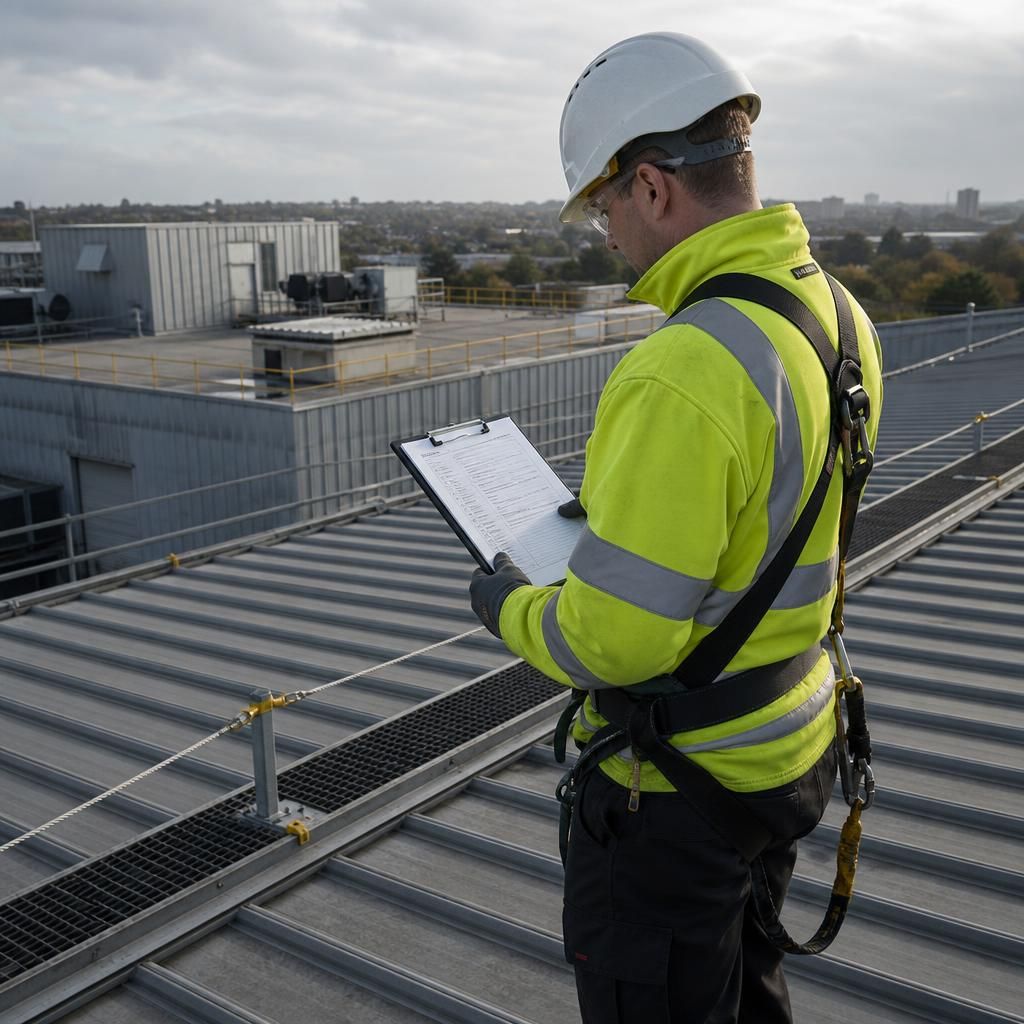
Qualifications and certificates are reliable only when they relate to the roof, access equipment and cleaning method being used. Before work starts, the contractor should provide project-specific RAMS explaining how falls, fragile surfaces, falling objects, chemicals, run-off and people below will be controlled.
Ask to see evidence that the proposed operatives are trained for the access equipment and substances involved, supported by current insurance and suitable equipment inspection records. This practical evidence is more meaningful than a general accreditation alone because it shows how the team will manage the actual risks on your premises.