
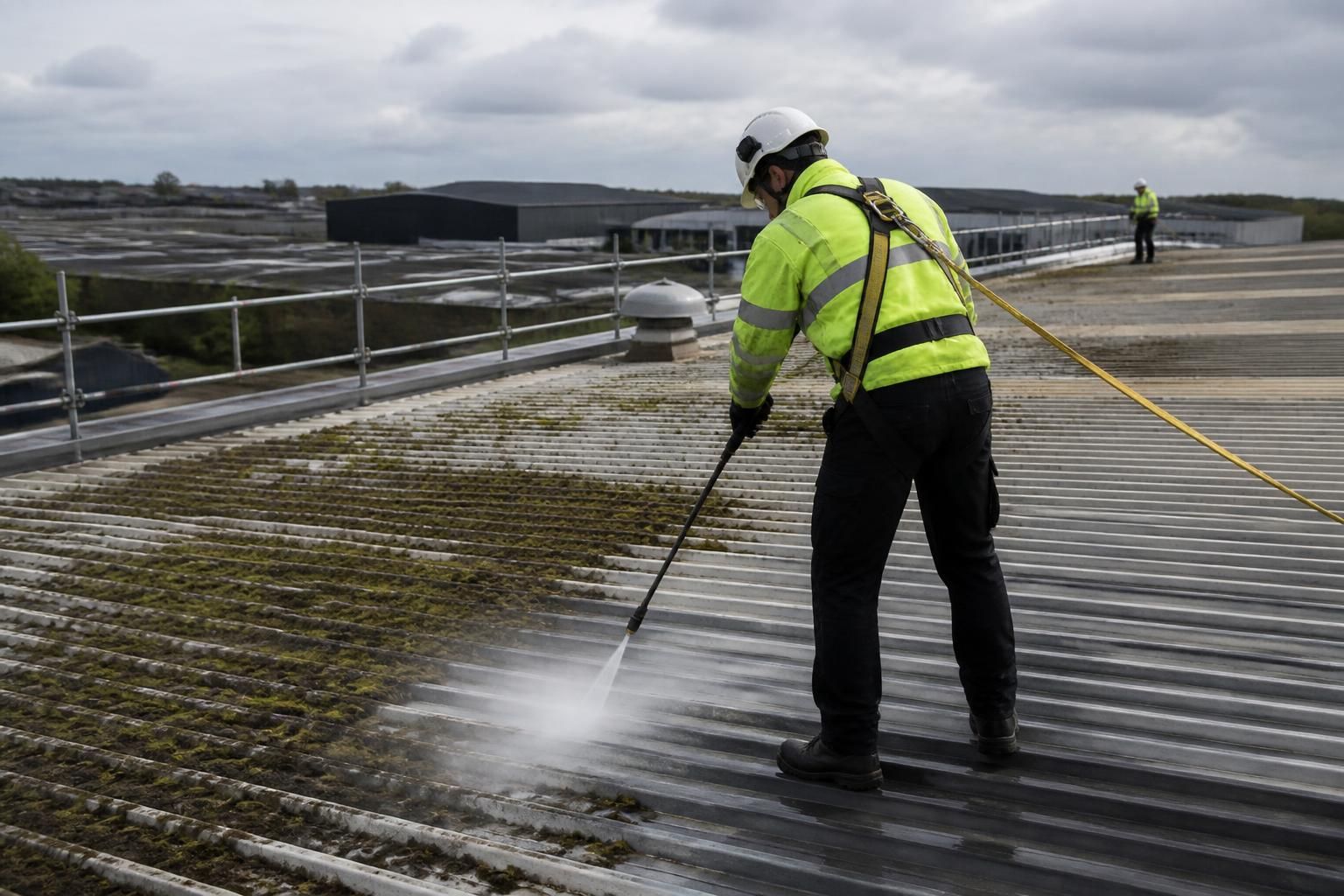
What safety measures should be taken during roof moss removal on commercial buildings?
Commercial roof moss removal should be carried out under a documented risk assessment and method statement, with suitable access equipment, edge protection, fall-arrest systems and trained personnel used to control work-at-height risks. The team should also protect occupants and the public below, isolate work areas, manage water and debris, use appropriate PPE and cleaning methods, and prevent damage to roofing materials, drainage systems and surrounding property.
Safe commercial roof moss removal requires a documented risk assessment and method statement, competent workers, suitable access equipment, effective fall protection and controlled handling of water, moss, debris and cleaning products. The precautions must address everyone affected by the work, including operatives, building occupants, visitors, members of the public and other contractors on site.
Assess the roof before work begins. A competent person should inspect the roof, access points and surrounding area before selecting the removal method. The assessment should identify roof pitch, fragile or damaged areas, skylights, rooflights, weak coverings, loose tiles, ageing membranes, parapets, plant, overhead services and any obstructions. It should also consider the condition of gutters, downpipes and drainage outlets, because moss removal can release a substantial amount of wet material.
Where the roof covering may contain asbestos or another hazardous material, it should not be disturbed until its composition and condition have been properly assessed. Suspected asbestos-containing materials require the appropriate specialist controls and must not be treated as ordinary roofing.
Plan the work through a risk assessment and method statement. The documentation should set out the proposed access system, fall-prevention measures, cleaning process, equipment, chemicals, exclusion zones, waste arrangements, emergency procedures and responsibilities on site. It should be reviewed if conditions change, such as deteriorating weather, unexpected roof damage or a change to the agreed cleaning method. Site-specific requirements from the property manager or principal contractor should also be incorporated.
Use suitable access and fall-protection equipment. Ladders should generally be limited to suitable short-duration access tasks and should not be relied on as the main working platform for extensive roof cleaning. Depending on the building, safer options may include properly installed scaffolding, guarded access towers, mobile elevated work platforms, roof-access systems, temporary edge protection or other engineered solutions.
Where a fall risk remains, suitable personal fall-arrest or restraint equipment should be used with compatible, inspected anchor points and a properly planned rescue procedure. Harnesses are not a substitute for a safe access system. Equipment must be checked before use, operated by trained personnel and positioned on stable ground or suitable supporting surfaces.
Protect fragile and vulnerable roof areas. Operatives should never assume that a roof can support their weight simply because it appears sound. Rooflights, fibre-cement sheets, aged coverings and concealed defects may fail without warning. Designated walkways, crawling boards, staging or other load-distribution measures may be required, with access kept away from unsupported or unprotected areas.
Control the area below and around the building. Moss, loosened deposits, tools and water can fall or be blown from the roof. The work area should therefore be segregated using barriers and clear signage, with pedestrians diverted where necessary. Entrances, delivery routes, pavements, roads, neighbouring property and occupied areas may require additional protection or temporary restriction. The site team should coordinate with the building manager so occupants know when access may be limited.
Tools and equipment should be secured against falling, hoses should be routed to prevent trip hazards, and materials should not be stored near roof edges. A banksman or ground operative may be needed when equipment is being moved, when a MEWP is operating near public areas or when the work affects vehicle routes.
Choose a cleaning method that matches the roofing material. Excessive pressure, aggressive scraping or unsuitable tools can dislodge tiles, damage protective coatings, force water beneath laps and seals, or shorten the life of membranes and flashings. The method should be agreed after inspecting the roof and, where appropriate, tested on a discreet area. Low-pressure washing, controlled scraping, steam cleaning or manual removal may each be suitable in different circumstances; the safest option is the one that removes the growth without imposing unnecessary mechanical, thermal or water pressure on the roof.
Operatives should avoid directing water towards roof joints, vents, electrical equipment, wall openings or areas where it could enter the building. Internal leaks, staining or dampness should be reported immediately rather than concealed by continuing the work.
Manage chemicals under appropriate controls. If a biocidal or moss-treatment product is used, its label and safety data should be followed, including requirements for dilution, application, storage, PPE, re-entry and disposal. Only products suitable for the roof and the intended setting should be selected. Chemicals must be kept away from occupants, food areas, watercourses, planted areas and drainage systems unless the discharge has been properly controlled.
Operatives should wear task-appropriate PPE, which may include protective footwear with suitable grip, gloves, eye protection, protective clothing and respiratory protection where the assessment requires it. PPE should complement, rather than replace, safer methods such as edge protection, controlled access and dust or spray reduction.
Take account of weather and visibility. Wet moss, frost, rain, wind and algae can make roof surfaces and access equipment especially slippery. Wind can also carry spray, debris or chemicals beyond the work area. Work should be paused when weather conditions make access, fall protection, visibility, equipment stability or chemical application unsafe. Roof surfaces should be checked throughout the task, not only at the start.
Protect drainage systems and the environment. Moss and silt should be collected where practicable rather than allowed to enter gutters or surface-water systems. Gutters, outlets and downpipes should be protected or cleared in a controlled manner, and any temporary covers should not create an additional flooding risk. Run-off containing cleaning residues must be managed in accordance with the product requirements, site drainage arrangements and applicable environmental controls. Waste should be contained, removed and disposed of through appropriate channels.
Control electrical and other site hazards. The team should identify overhead cables, rooftop electrical installations, photovoltaic panels, ventilation equipment, plant and other services before setting up access equipment or using water. Electrical risks may require isolation by an authorised person, physical separation or a different cleaning approach. Cables, hoses, pressure-washing equipment and generators should be positioned so they cannot create trip, contact or vehicle hazards.
Use trained and supervised personnel. Anyone involved should be competent for the tasks assigned, including work at height, access equipment, harness use, manual handling, pressure-washing equipment and chemical handling where relevant. They should understand the site rules, exclusion arrangements, communication method and emergency plan. Equipment inspections and any required records should be completed before work starts.
Prepare for emergencies. A rescue plan should be in place before anyone works at height, particularly where a person could be suspended in a harness or become stranded on an inaccessible roof. The plan should identify how assistance will be summoned, how the person will be reached safely and who is responsible for coordinating the response. First-aid arrangements, emergency access, contact details and procedures for leaks, chemical exposure, equipment failure and falling materials should be clear to the team.
At the end of the work, the roof and surrounding areas should be checked for loose materials, blocked outlets, damaged coverings, unsecured equipment and residual treatment products. Any defect discovered during cleaning should be recorded and reported to the responsible building contact. These controls help ensure that moss removal improves the condition and appearance of a commercial roof without creating avoidable risks to people, property or the environment.
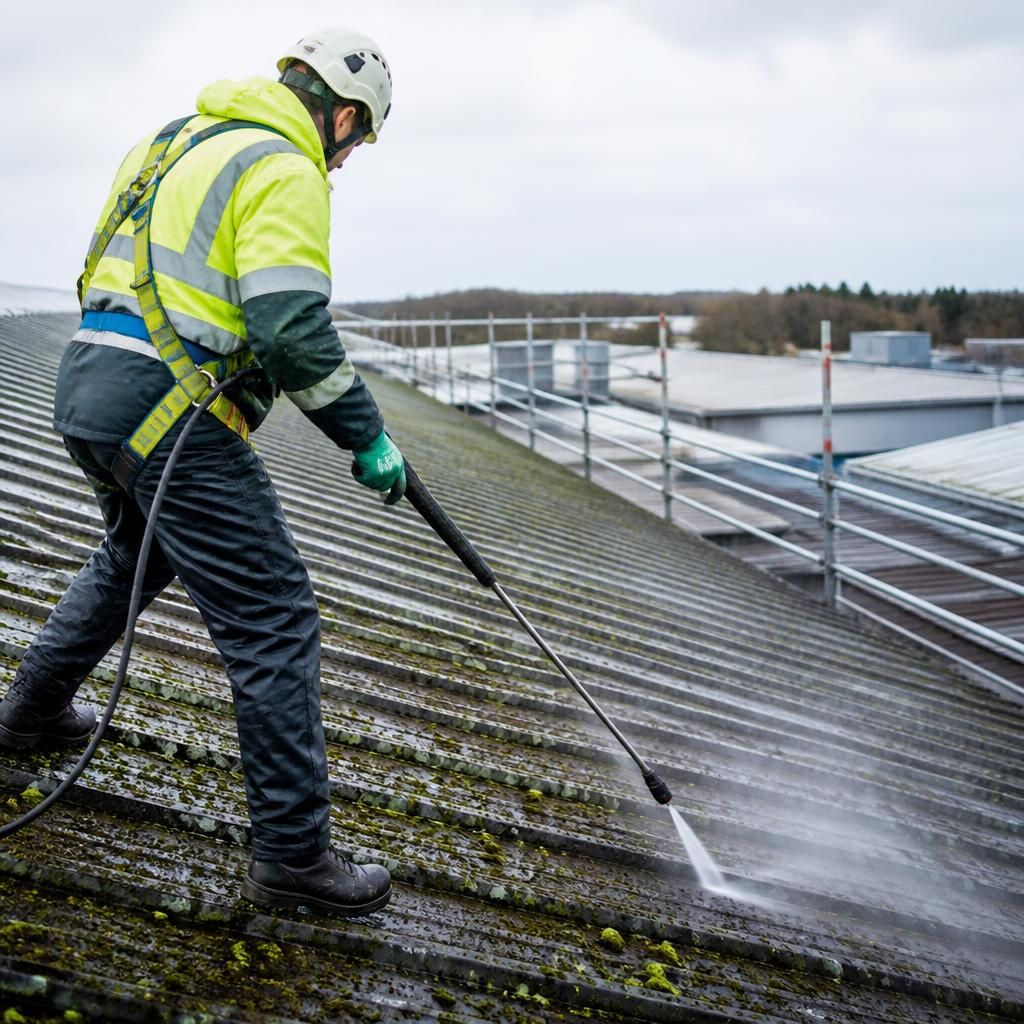
Fall protection is the primary safety control during commercial roof moss removal because wet moss, sloping surfaces and fragile roof coverings can make a fall more likely. Before work begins, the team should select suitable access equipment, such as guarded scaffolding, an access tower, a mobile elevated work platform or an engineered roof-access system. Where a fall risk remains, compatible edge protection, restraint or fall-arrest equipment should be used with inspected anchor points and a planned rescue procedure.
Protection is also required at ground level. Barriers and clear signage should keep people away from falling moss, tools, water and debris, while entrances, delivery routes and pavements may need temporary controls. Equipment must be secured, hoses routed safely and a ground operative used where access equipment or public areas require additional supervision.