
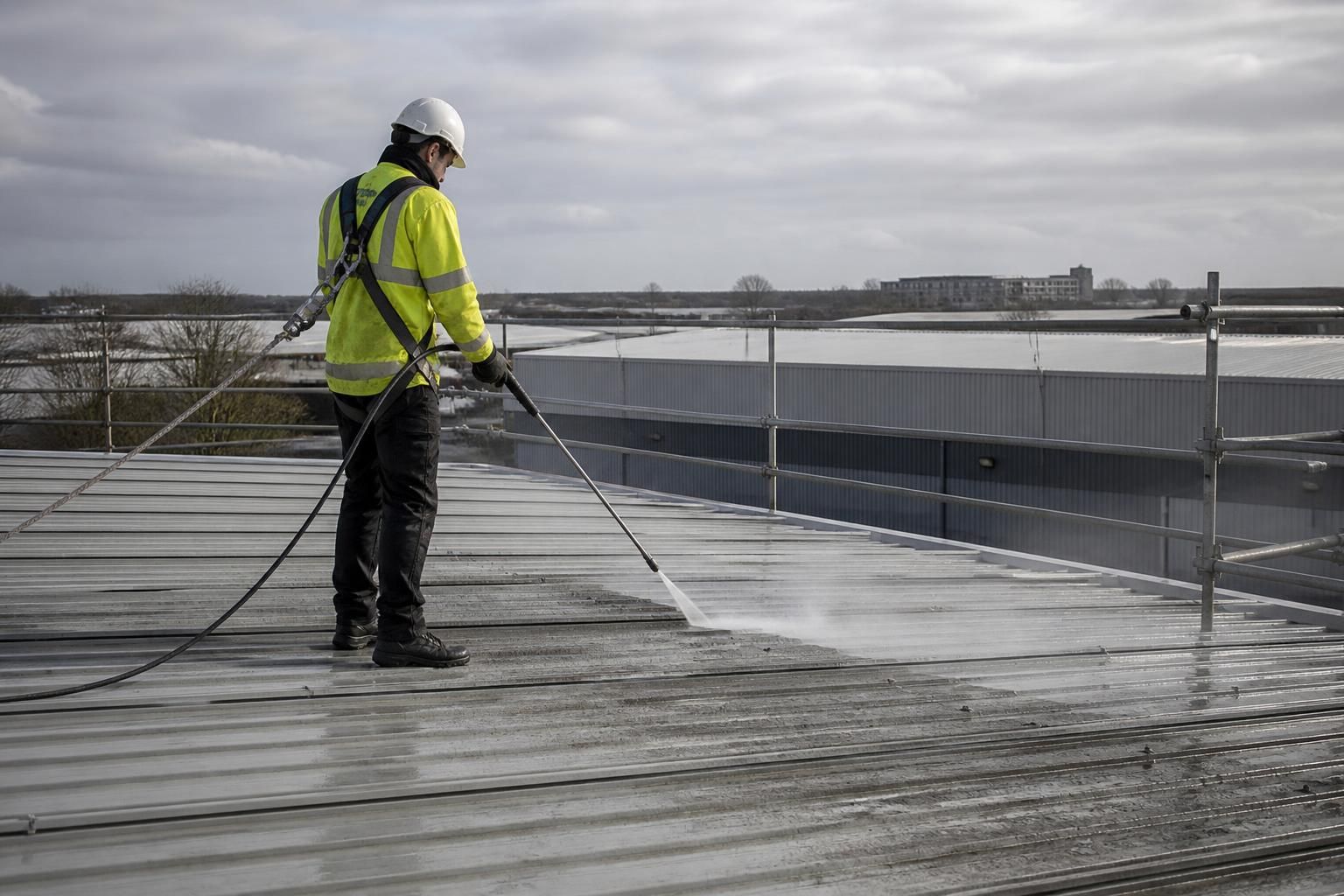
What safety measures should be in place during the commercial roof washing process?
Commercial roof washing should be carried out under a documented risk assessment and method statement, with suitable access equipment, edge protection, fall-arrest systems and trained operators in place. Professional teams should also control water, chemicals and run-off, protect occupants and building assets, establish exclusion zones, and monitor weather and roof conditions throughout the work.
Commercial roof washing should be completed under a documented risk assessment and method statement, with competent operatives, suitable access equipment, fall protection, controlled cleaning methods and a clear emergency plan. The measures required will depend on the roof construction, height, access arrangements, surface condition, cleaning system and risks to people or property below.
Pre-work planning and risk assessment
Before work begins, the cleaning team should inspect the site and identify hazards such as fragile roof sections, rooflights, unprotected edges, steep slopes, standing water, exposed services, overhead obstructions, nearby roads and areas used by staff or the public. The assessment should cover the proposed equipment, chemicals, water supply, run-off, weather conditions and the measures needed to prevent falls or exposure to hazardous substances.
A method statement should then set out the work sequence, access arrangements, control measures, responsibilities and emergency procedures. Where other contractors or building occupants are present, the plan should be coordinated with the site manager. For construction-related work, the requirements of the Construction (Design and Management) Regulations may also apply.
Safe access and fall protection
- Access should be provided using suitable equipment, such as properly positioned mobile elevating work platforms, scaffolding, access towers or other systems selected for the site conditions.
- Equipment should be inspected before use and operated only by people with appropriate training and competence. Lifting equipment and work equipment should be selected, maintained and examined in line with applicable UK requirements, including LOLER and PUWER where relevant.
- Guardrails, edge protection, barriers or other collective measures should be used wherever practicable. Personal fall-restraint or fall-arrest systems should be used where collective protection cannot adequately control the risk.
- Harnesses, lanyards and anchor points must be compatible, correctly fitted and suitable for the proposed system. A rescue plan is essential because remaining suspended after a fall can create a serious secondary risk.
- Operatives should use designated access routes and never step onto areas that have not been confirmed as capable of supporting their weight.
Fragile roof sheets, rooflights and concealed voids require particular care. They should be identified before cleaning and protected with suitable covers, platforms or barriers. A rooflight should never be treated as a safe foothold simply because it appears intact.
Personal protective equipment and equipment controls
Personal protective equipment should be selected from the risk assessment rather than used as a substitute for safer access controls. Depending on the work, this may include safety footwear with suitable grip, a safety helmet, gloves, eye protection, hearing protection, protective clothing and respiratory protection. Where chemical products are used, the team should follow the product safety data sheet and COSHH assessment, including requirements for storage, dilution, handling and disposal.
Pressure washers, steam equipment, hoses and electrical supplies should be checked before use. Hoses should be routed to reduce trip hazards and should not obstruct access routes, emergency exits or vehicle movements. Electrical equipment and connections must be protected from water, with appropriate residual-current protection and suitable equipment for the working environment.
Control of water, chemicals and run-off
Cleaning pressure and temperature should be matched to the roof material and its condition. Excessive pressure can dislodge coverings, damage sealants, force water beneath panels or enter the building through defects. Operatives should monitor the roof and surrounding structure during the clean and stop if damage, unexpected water ingress or unsafe movement is observed.
Run-off should be contained or directed to an approved drainage route wherever necessary. The team should prevent dirty water, detergents, oils, biological growth and other contaminants from entering surface-water drains, neighbouring premises, landscaped areas or watercourses. Drainage points may need to be protected, isolated or checked before cleaning, and waste should be handled in accordance with site and environmental requirements.
Exclusion zones and protection of people below
An exclusion zone should be established beneath and around the work area to protect occupants, visitors, vehicles and passers-by from falling tools, equipment, debris, water and displaced material. Cones, barriers, warning signs and a banksman may be required, particularly near entrances, loading bays, car parks, public footpaths or roads.
Building occupants should be informed about the work, restricted areas, temporary access changes and any relevant precautions. Doors, air intakes, ventilation systems, plant, stock and sensitive equipment should be protected from spray, dust, fumes and water. Where the work could affect normal operations, the cleaning schedule should be coordinated with the premises manager.
Weather and changing site conditions
Roof washing should be postponed or suspended when wind, rain, ice, poor visibility, lightning or other conditions make access, equipment operation or fall protection unreliable. Wet surfaces can reduce footing, while wind can affect elevated platforms, hoses, sheeting and spray control. Conditions should be monitored throughout the work rather than assessed only at the start of the day.
Roof condition can also change during cleaning. Moss, algae, loose coatings and accumulated debris may conceal defects or make surfaces slippery. Operatives should keep access routes clear, reassess conditions when the surface becomes wet and stop work if the roof no longer provides a safe working platform.
Supervision, communication and emergency arrangements
A responsible supervisor should monitor the work, confirm that controls remain effective and coordinate with the client’s site contact. The team should have reliable communication, first-aid arrangements, clear access for emergency services and a specific rescue procedure for falls, equipment failure, chemical exposure, electrical incidents and water ingress.
On completion, the work area should be checked for loose materials, pooled water, contaminated run-off, damaged surfaces and equipment left behind. Barriers should remain in place until the area is safe for normal use, and any defects or limitations identified during washing should be reported to the client rather than concealed by the cleaning process.
For a commercial roof, the safest approach is therefore a planned, supervised operation that combines suitable access, fall prevention, controlled washing, protection of people and property, environmental management and continual monitoring. A professional cleaning team should be able to explain these controls before work starts and adapt them when the roof or site conditions differ from the original assessment.
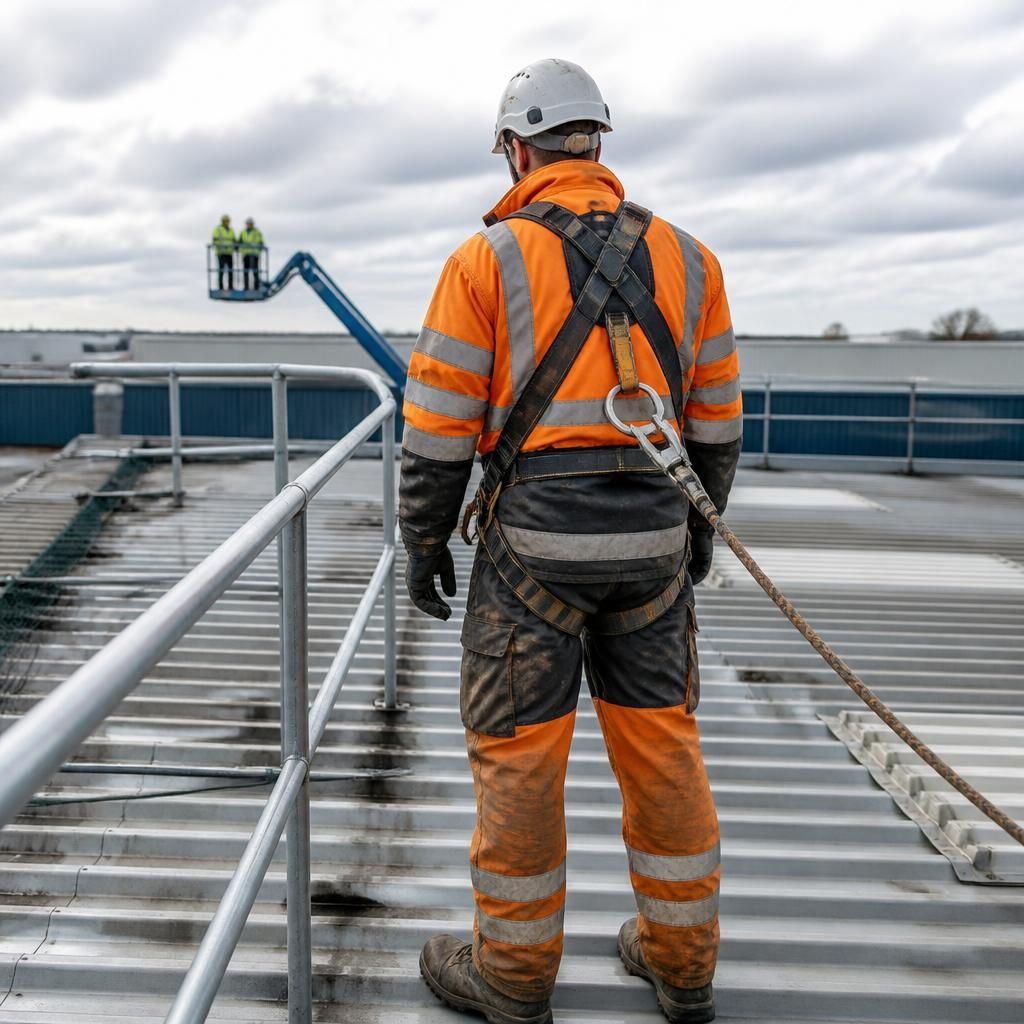
Fall prevention is the most important safety control during commercial roof washing. The team should use suitable access equipment, edge protection and designated working routes, with fragile rooflights, roof sheets and concealed voids identified before anyone accesses the roof.
Where collective protection cannot control the risk, correctly fitted harnesses, compatible lanyards and suitable anchor points may be required. These systems must be supported by a clear rescue plan, because a fallen operative cannot safely remain suspended while waiting for assistance. Exclusion zones below the work area also protect occupants, vehicles and passers-by from falling tools, debris and wash water.