
What are the environmental impacts of using biocide treatments on roofs, and how can I minimise them?
Biocide treatments can harm aquatic life, soil organisms and nearby plants if contaminated runoff, spray drift or residue enters drains, watercourses or planted areas. Minimise the impact by selecting the least-harmful suitable product, following its label and COSHH guidance, avoiding rain and windy conditions, protecting drains and vegetation, and containing or collecting contaminated wash water.
Biocide treatments used on roofs can affect aquatic life, soil organisms, plants and wildlife if product, contaminated runoff or spray drift reaches surface-water drains, watercourses, ponds, planted areas or neighbouring land. The environmental risk depends on the active substance, concentration, application method, weather, roof location and how runoff is managed. It can be minimised by selecting the least-harmful suitable product, following the product label and safety data sheet, preventing uncontrolled discharge and carrying out the work in suitable weather.
Why biocide treatments can affect the environment
Biocides are designed to control living organisms such as algae, moss, lichen, fungi or bacteria. That effectiveness means they may also harm non-target organisms if they are released beyond the roof area. The principal routes of environmental contamination are:
- Runoff: rain or washing can carry active residues from the roof into gutters, downpipes, surface-water drains, soil or watercourses.
- Spray drift: wind can move fine droplets onto vegetation, gardens, ponds, neighbouring properties or areas used by people and animals.
- Spillage: undiluted product or mixing water can contaminate hard surfaces, ground and drainage systems.
- Residue and waste: empty containers, absorbent materials, used filters and contaminated protective equipment require appropriate handling and disposal.
Aquatic organisms are a particular concern because some biocidal substances can be harmful to fish, invertebrates, amphibians and aquatic plants even when the source of contamination is some distance away. A connection to a surface-water drain may therefore present a risk that is not obvious from the roof itself. Soil organisms and nearby plants can also be affected by direct overspray or contaminated discharge.
Choose the product and method carefully
Use only a product authorised for the intended purpose and roof application in the UK. The label must be followed for dilution, application rate, personal protection, environmental precautions, storage, disposal and any restrictions concerning drains or watercourses. The product safety data sheet and the relevant Control of Substances Hazardous to Health (COSHH) assessment should be reviewed before work starts.
Product selection should consider the roof material, the target growth, the proximity of drains and water, and whether a lower-impact treatment or non-chemical cleaning method could achieve the required result. A treatment should not be applied simply because it is available: using more product than necessary increases environmental loading without necessarily improving performance. Avoid mixing products unless the manufacturer specifically permits it, as mixtures may change the hazard profile or create incompatible residues.
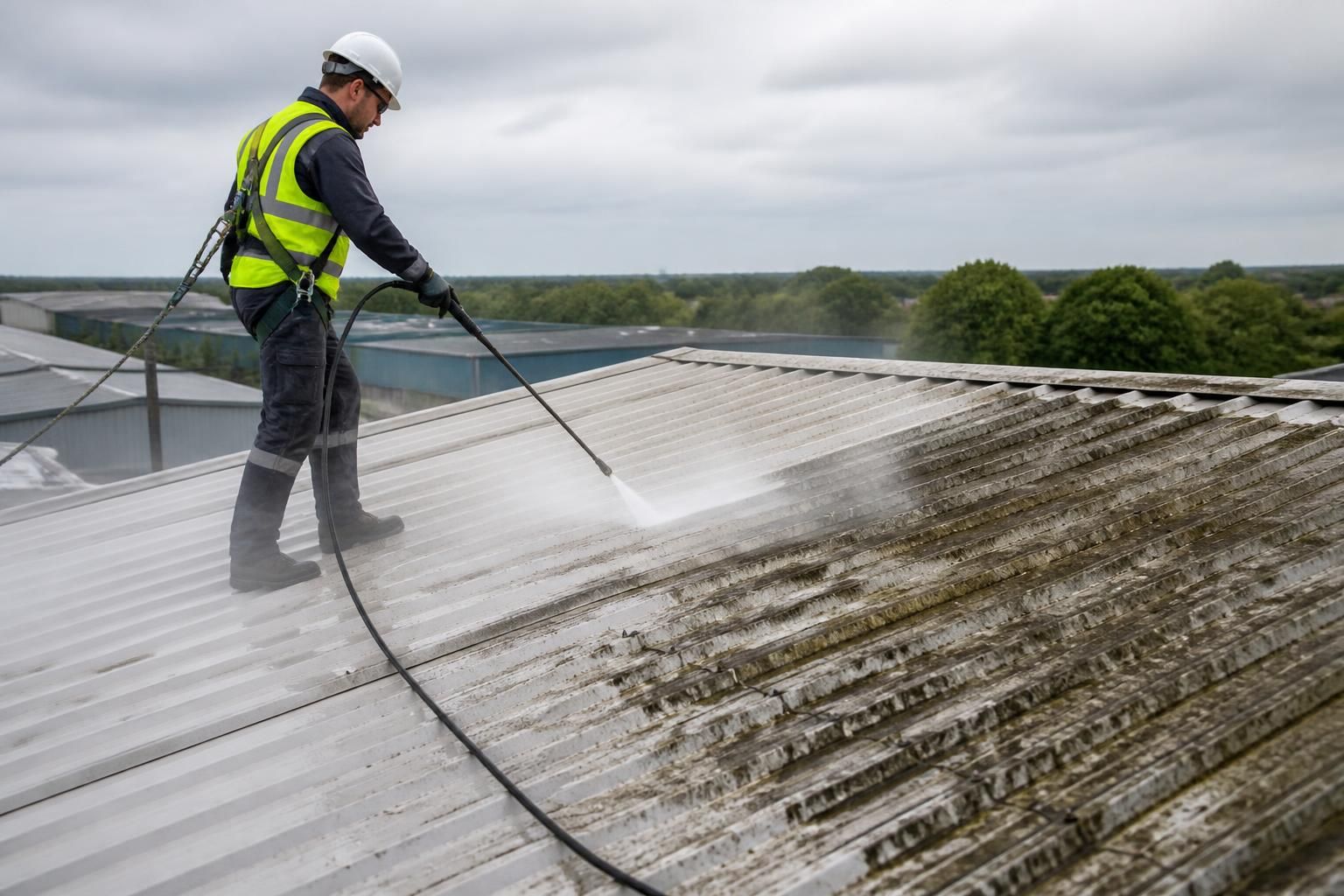
Application method also matters. Controlled application at low pressure can reduce misting and overspray compared with indiscriminate spraying. The operator should use equipment that delivers the required coverage without producing unnecessary aerosol or allowing treatment to run off the roof. On sensitive or heavily occupied sites, applying the product to smaller controlled areas may make it easier to observe runoff and stop work if conditions change.
Prevent contamination before applying treatment
A site assessment should identify roof falls, gutters, downpipes, gullies, inspection chambers, surface-water drains, foul-water connections, ponds, streams, planted areas, habitats and neighbouring land. It should also establish where water from the roof will go during and after treatment. Surface-water drainage must not be assumed to lead to a treatment facility; in many locations it discharges directly to the environment.
Before application:
- Check the forecast and postpone work if rain is likely to wash the product from the roof before the specified contact or drying period has been achieved.
- Avoid strong or gusty winds that could cause spray drift. Conditions should remain suitable for the duration of the work, not only when mixing begins.
- Protect or isolate vulnerable drains and prevent product from entering downpipes where the label or site assessment requires this.
- Shield nearby planting, water features, habitats, stored materials and pedestrian areas from accidental spray.
- Confirm that access equipment, hoses and containers are secure and will not create a trip hazard or spill risk.
- Keep mixing and decanting on a stable, contained surface away from drains and watercourses.
Drain protection must be planned rather than improvised. Covers, drain mats, bunds or temporary containment may be suitable in some situations, but they must not create a route for contaminated water to escape elsewhere or cause flooding. Any protection must be compatible with the drain and removed only when contamination has been dealt with safely.
Control runoff and post-treatment discharge
Runoff management is often the most important environmental control on a roof treatment project. Do not allow contaminated water to flow untreated into a surface-water drain, open ground or a watercourse. Where runoff or rinsing is required, it should be contained, collected and managed in accordance with the product instructions, site procedures and applicable environmental requirements.
Depending on the site, controls may include temporarily disconnecting or diverting downpipes, using collection systems, working in manageable sections, or capturing water at the discharge point. Collected liquid should not be released simply because it appears clear: biocidal residue may not be visible. It should be stored securely and dealt with through an appropriate waste or drainage route confirmed by a competent person.
Not every roof should be rinsed after treatment. Some products are intended to remain on the surface and work gradually, while others specify a particular rinsing procedure. Follow the label rather than applying a standard wash-down approach. If a separate pressure-washing stage is planned, consider whether it will mobilise treatment residue and whether the wash water can be contained.
Protect people, plants and wildlife
Keep people, pets and animals away from the work area for the period stated on the product label and prevent access to wet or contaminated surfaces. Treat nearby vegetation as vulnerable to overspray, particularly young plants, edible crops and plants close to gutters or downpipes. Physical shielding is preferable to relying on later rinsing, which may spread the substance into soil or drains.
Inspect the area after application and during any subsequent cleaning or rainfall. Look for unexpected pooling, blocked or overflowing containment, damaged drain protection, spray deposited outside the work zone and signs that treatment is moving towards planted areas. If a spill or uncontrolled discharge occurs, stop work, prevent further spread if it is safe to do so, and follow the product emergency instructions and the site’s incident procedure. Significant pollution incidents may need to be reported to the appropriate environmental authority.
Handle storage, equipment and waste responsibly
Store concentrates in their original, correctly labelled containers, secured against damage and away from drains, food, animal feed and incompatible materials. Do not leave containers where they can be knocked over by wind, vehicles or site activities. Mixing should use the correct measuring equipment, and surplus diluted product should not be prepared without a clear plan for lawful use or disposal.
Equipment should be checked for leaks before use and cleaned in a controlled location. Rinse water, contaminated absorbents and other residues must not be poured into surface-water drains or onto soil. Empty containers and chemical-related waste should be managed according to the label, site waste procedures and applicable waste requirements. Operators should use the PPE specified by the COSHH assessment, but PPE should not be treated as a substitute for preventing environmental release.
Use a documented, proportionate process
For commercial and industrial premises, the environmental controls should be recorded in the method statement and risk assessment. The documentation should identify the product and active substance, dilution and application method, weather limits, drainage controls, runoff arrangements, emergency measures, PPE, waste route and responsibilities on site. This provides a clear standard for the operative and allows the property manager to understand how the work will be controlled.
Professional application does not mean that every roof requires the same treatment. A sound approach is to inspect first, remove loose debris where appropriate, select a treatment suited to the roof and growth, apply only the necessary amount, and monitor the site afterwards. Where the environmental constraints cannot be controlled, the correct decision may be to postpone the work, change the method or choose a non-biocide option.
For a roof near a watercourse, pond, surface-water drainage network or sensitive planting, arrange an assessment before booking the treatment. Providing roof plans, drainage information, access details and known environmental restrictions allows the cleaning plan to include realistic containment and disposal measures rather than treating them as an afterthought.
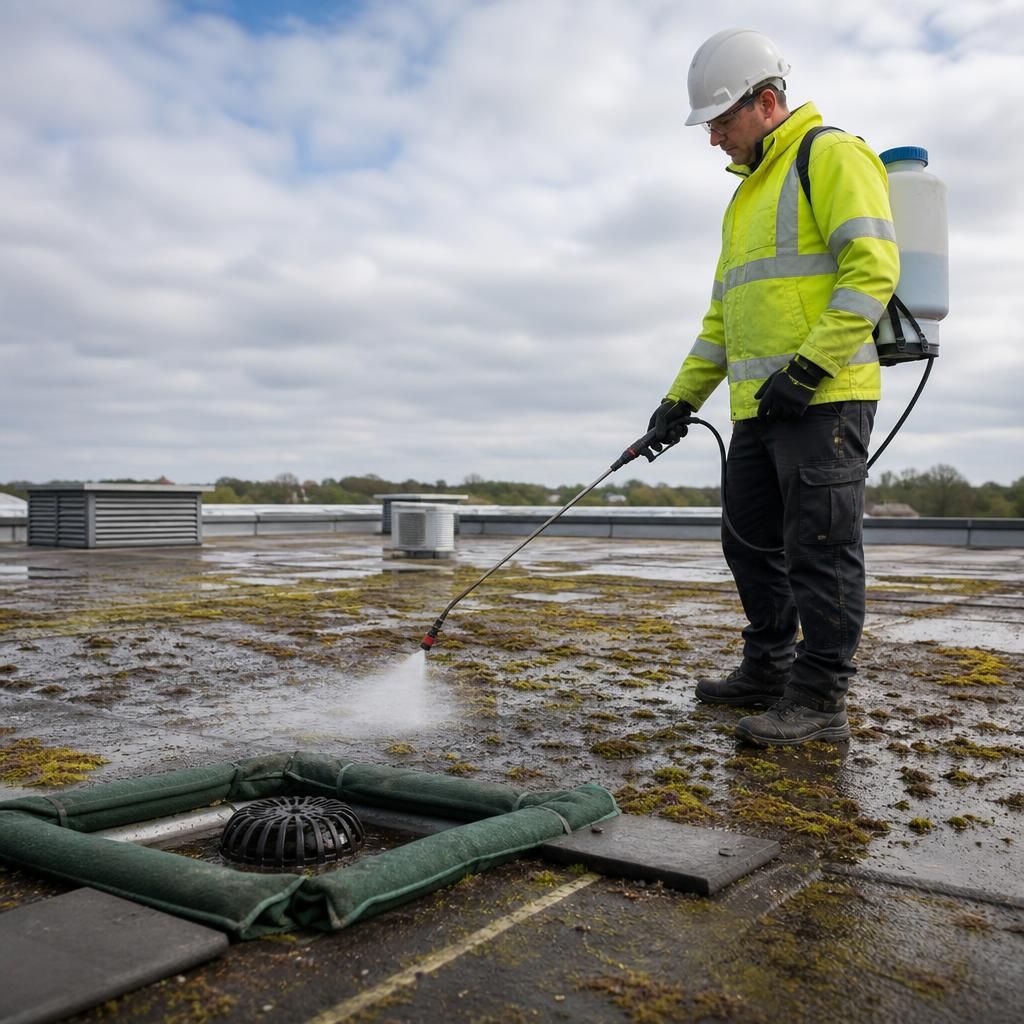
The main environmental risk from a roof biocide treatment is contaminated runoff entering surface-water drains, soil, ponds or watercourses. Before application, identify where roof water flows and protect vulnerable drainage points, planted areas and habitats from product, spray drift and treatment residue.
Use only the amount and dilution specified on the product label, apply in calm, dry conditions, and avoid rinsing unless the instructions require it. Where runoff cannot be safely discharged, it should be contained and managed through an appropriate waste or drainage route. Covers, drain mats, temporary downpipe diversion and sectional application may help, but controls must be planned so they do not simply redirect contaminated water elsewhere.
A documented assessment should also cover spill response, equipment cleaning, storage and waste disposal. If the roof is close to a watercourse, pond or sensitive planting, changing the application method or using a non-biocide cleaning option may provide better environmental control.
Discuss Your Roof Treatment’s Environmental Controls
Discuss your roof treatment’s environmental controls with our team before work begins, particularly where the roof is close to surface-water drains, watercourses or sensitive planting. We can review the application method, runoff controls and waste arrangements for the site.