
What considerations should be taken into account when planning the application schedule for biocide roof cleaners to maximise their effectiveness?
Plan the application of biocide roof cleaners around suitable weather, roof condition, surface dryness, dwell time and site safety, avoiding rain, frost, strong winds and intense heat that can reduce performance or increase run-off. Timing should also account for the type and severity of organic growth, the product manufacturer’s instructions, and any follow-up treatment needed to control regrowth without harming the roof or surrounding environment.
The most effective application schedule for a biocide roof cleaner is based on the product instructions, the roof’s condition, the type and extent of organic growth, and a suitable period of stable weather. The roof should generally be clean enough for the treatment to reach the affected surface, dry before application, and protected from rain, frost, strong wind and excessive heat for the required dwell and drying period. Scheduling must also allow for safe access, controlled run-off and any follow-up treatment required to manage regrowth.
Start with a roof inspection. Before choosing an application date, assess the roof covering, pitch, age, condition and accessibility. Identify whether the growth is mainly moss, algae, lichen or a combination of these, and check how firmly it is attached. Heavy moss may need to be removed mechanically or by an agreed low-impact cleaning method before applying biocide. A treatment applied over thick organic debris may not contact the roof surface consistently, which can reduce its effectiveness and leave protected areas where regrowth can continue.
The inspection should also identify cracked or displaced tiles, deteriorated pointing, defective flashings, blocked gutters and fragile areas. These defects should be addressed or recorded before work begins. Biocide treatment will not repair a failing roof, and cleaning a damaged surface can increase the risk of water ingress if the work is not planned correctly.
Follow the product label and safety information. Different formulations have different dilution rates, application methods, contact requirements, restrictions and post-treatment instructions. The manufacturer’s label, safety data sheet and any site-specific risk assessment should take priority over a standard timetable. Do not assume that a schedule suitable for one biocide is suitable for another, particularly where products differ in concentration or are intended for different roof materials.
Allow sufficient time for the product to remain on the surface and work as directed. Some treatments are intended to be left to weather naturally, while others may require rinsing or a controlled follow-up process. Avoid applying additional product simply because visible improvement is not immediate. Moss, algae and lichen can die back at different rates, and premature reapplication may increase chemical use without improving the result.
Choose a stable weather window. Weather is one of the main factors affecting biocide performance:
- Rain: Rain shortly after application can dilute or wash the treatment from the roof before it has had adequate contact time. Check the forecast for the full period specified by the product instructions, including the time needed for the surface to dry.
- Frost and very cold conditions: Frost can affect the surface, the product and the safety of access equipment. Do not apply treatment to frozen, icy or frost-damp surfaces unless the product documentation specifically permits it.
- Strong wind: Wind can cause spray drift, uneven coverage and contamination of nearby walls, vehicles, gardens, water features and drainage areas. Postpone work when conditions cannot be controlled safely.
- Intense sunlight and high temperatures: Rapid evaporation can shorten the product’s working time and make coverage inconsistent. Hot surfaces may also increase the risk of visible runs or damage to adjacent materials. Overcast, mild conditions are often easier to manage, provided rain is not expected.
- Persistent dampness: Heavy dew, mist or a roof that remains wet after rainfall can dilute the treatment and make coverage difficult to judge. The surface should meet the product’s stated requirements before application.
A forecast should be checked when the work is booked and again before the team attends. Local conditions can vary significantly between exposed roof areas and sheltered elevations, so the decision should be based on actual site conditions as well as the general forecast.
Consider the season, but do not rely on the calendar alone. Spring and autumn can provide moderate temperatures, although rain and prolonged dampness may make scheduling difficult. Summer can offer longer dry periods but may create problems with heat, rapid evaporation and strong sunlight. Winter work can be restricted by frost, short daylight hours, wet surfaces and unsafe access. The best date is the first suitable period in which the roof can be prepared, treated and monitored without compromising safety or the product’s required contact time.
Seasonal planning should also account for the client’s surrounding activities. Avoid periods when premises are busy, outdoor areas are in frequent use or vehicles are parked close to the work zone. On commercial and industrial sites, coordinate the treatment with deliveries, maintenance, construction activity and other contractors so that exclusion zones and access equipment can be managed properly.
Plan preparation and application as one process. The schedule should include time for setting up access equipment, protecting surrounding surfaces, clearing gutters where appropriate, removing loose growth and checking the roof again immediately before treatment. Applying biocide too soon after preparation may leave residual dirt or loose material in place; leaving the prepared roof exposed for too long may allow it to become wet or contaminated again.
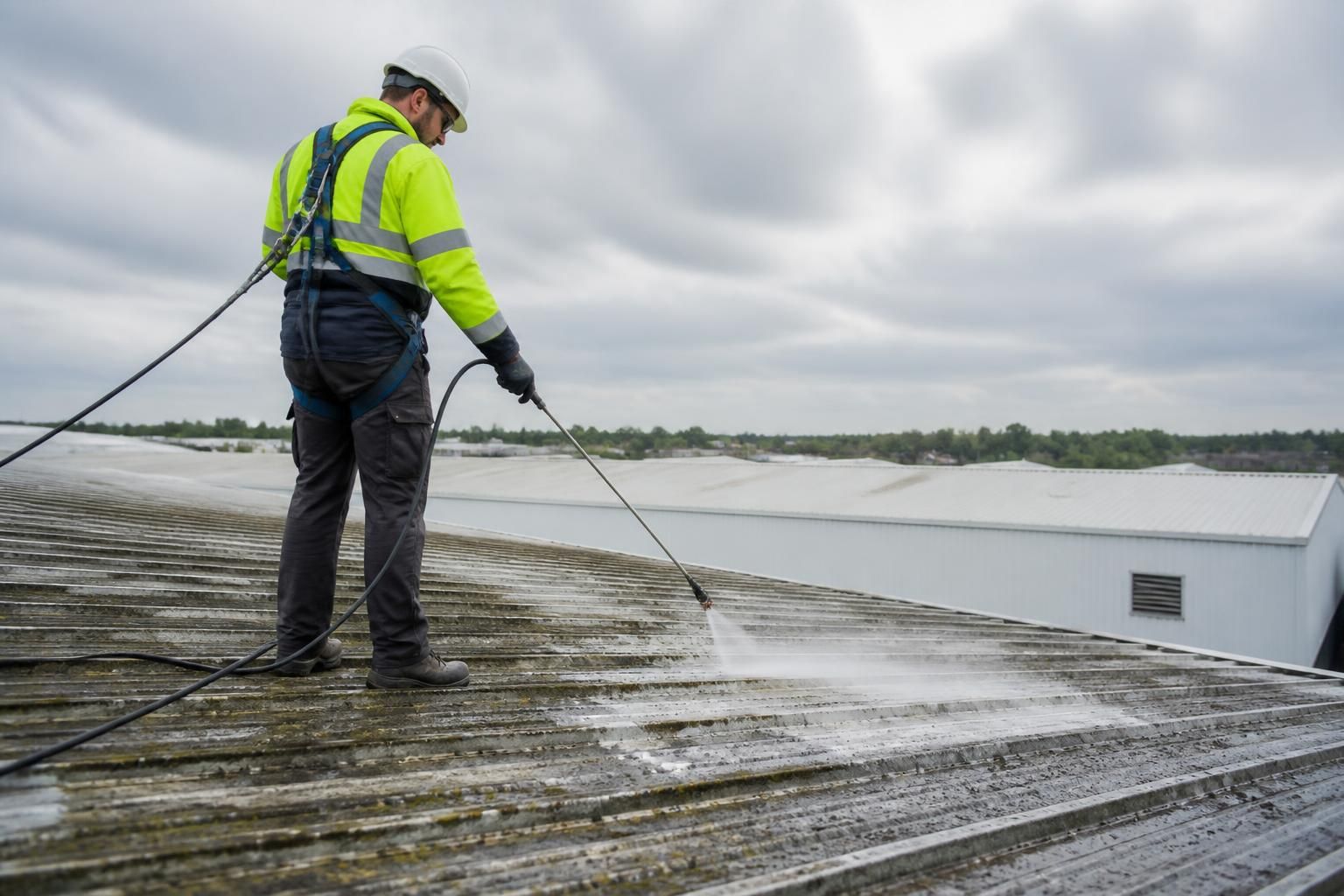
Application should be even and controlled rather than excessive. The aim is to wet the intended surface without creating unnecessary run-off. Use the application equipment and pressure specified or permitted for the product and roof covering. Low-pressure application is commonly preferred for vulnerable roof materials, but the correct approach depends on the product, the substrate and the site assessment.
Allow for safe containment of run-off. A roof treatment schedule must include time to protect or temporarily isolate drainage routes, manage contaminated water and prevent the product from reaching watercourses, ponds, planted areas or neighbouring property. Gutters and downpipes may need suitable controls, and the method must comply with the product label, environmental requirements and the site risk assessment. Do not schedule work if there is no practical way to control run-off or protect people and sensitive areas below.
Wind direction is particularly important on commercial sites, where neighbouring façades, loading bays, parked vehicles and air-intake systems may be close to the roof. A job that is technically suitable in dry weather may still need to be postponed if drift cannot be prevented.
Match the schedule to the growth and roof material. Light surface algae may require a different treatment plan from established moss or lichen. Dense growth can conceal the roof and require staged preparation, while delicate or weathered materials may limit the amount of physical cleaning that can be carried out beforehand. Roof coverings, coatings, membranes, metalwork, glazing and adjoining surfaces may have different compatibility requirements, so the treatment should be planned around the least tolerant material present.
Where a roof contains mixed materials, test an inconspicuous area when appropriate and allow time to assess the result before treating the whole surface. Protect or exclude areas that are not suitable for the chosen product. This is especially important around rooflights, painted details, solar equipment, signage, sealants and sensitive façade finishes.
Build in inspection and follow-up time. A biocide treatment is not always an instant visual-cleaning process. Organic growth may change colour, loosen or disappear gradually, depending on the product and conditions. Schedule a later inspection to check coverage, remaining growth, gutter condition, surrounding surfaces and any signs of regrowth. If a repeat application is recommended, it should be carried out only at the interval and dilution stated by the manufacturer.
For roofs with recurring growth, an ongoing maintenance plan is usually more effective than waiting until heavy deposits have returned. The interval should reflect the roof’s exposure, shading, moisture levels, nearby vegetation, drainage and the severity of previous growth. Record the product used, dilution, application areas, weather conditions, defects and follow-up recommendations so future treatments can be planned consistently.
Include access and workforce safety in the timing decision. Roof cleaning should not be scheduled solely around chemical performance. Confirm that suitable access equipment, edge protection, fall-prevention measures, ventilation controls and ground-level exclusion zones are available. Roofs become particularly hazardous when wet, and treatment may increase slip risk. The work should be planned under the relevant risk assessment and COSHH controls, with appropriate personal protective equipment and emergency arrangements.
Where the premises remain operational, allow time for signing, isolating work areas and informing occupants or site personnel about access restrictions. The application may need to be divided into manageable sections so that the team can maintain control of the roof, chemical handling and run-off throughout the work.
In practice, the ideal schedule is a planned weather window following a proper roof inspection, with enough time for preparation, controlled application, manufacturer-specified contact time, safe drying or rinsing, waste and run-off management, and a documented follow-up inspection. If the roof is wet, frozen, exposed to strong wind, subject to unsuitable temperatures or impossible to protect from run-off, postponing the treatment is usually safer and more effective than applying it under marginal conditions.

The most important scheduling consideration for biocide roof cleaners is allowing a stable, suitable weather window for application and contact time. The roof should be dry, free from frost and unlikely to receive rain for the period specified by the product manufacturer. This helps prevent dilution, run-off and uneven coverage before the treatment has had time to work.
Strong wind, intense heat and persistent dampness can also reduce control over the application. Wind may cause spray drift towards façades, vehicles, planting or drainage areas, while hot surfaces can make the product evaporate too quickly. Check the forecast before attendance and reassess conditions on site, postponing the work if the roof or surrounding area cannot be treated safely and contained effectively.