
What are the benefits and limitations of using biocide roof cleaners compared to traditional cleaning methods?
Biocide roof cleaners target moss, algae and mould at their source, usually requiring less abrasion and reducing the risk of damage associated with aggressive pressure washing or scraping. Their limitations are that results can take time, heavy deposits may still need gentle removal, and safe application requires careful control of runoff, surrounding surfaces and treatment conditions.
Biocide roof cleaners control living organic growth such as moss, algae, mould and lichen by treating the organisms rather than relying solely on physical force. Compared with traditional methods such as aggressive pressure washing, scraping or brushing, they can provide a lower-abrasion approach and help reduce regrowth. However, biocide treatment is not an instant substitute for all mechanical cleaning: heavily established growth may still require careful removal, and the treatment must be selected and applied correctly for the roof material and surrounding environment.
How biocide cleaning differs from traditional methods
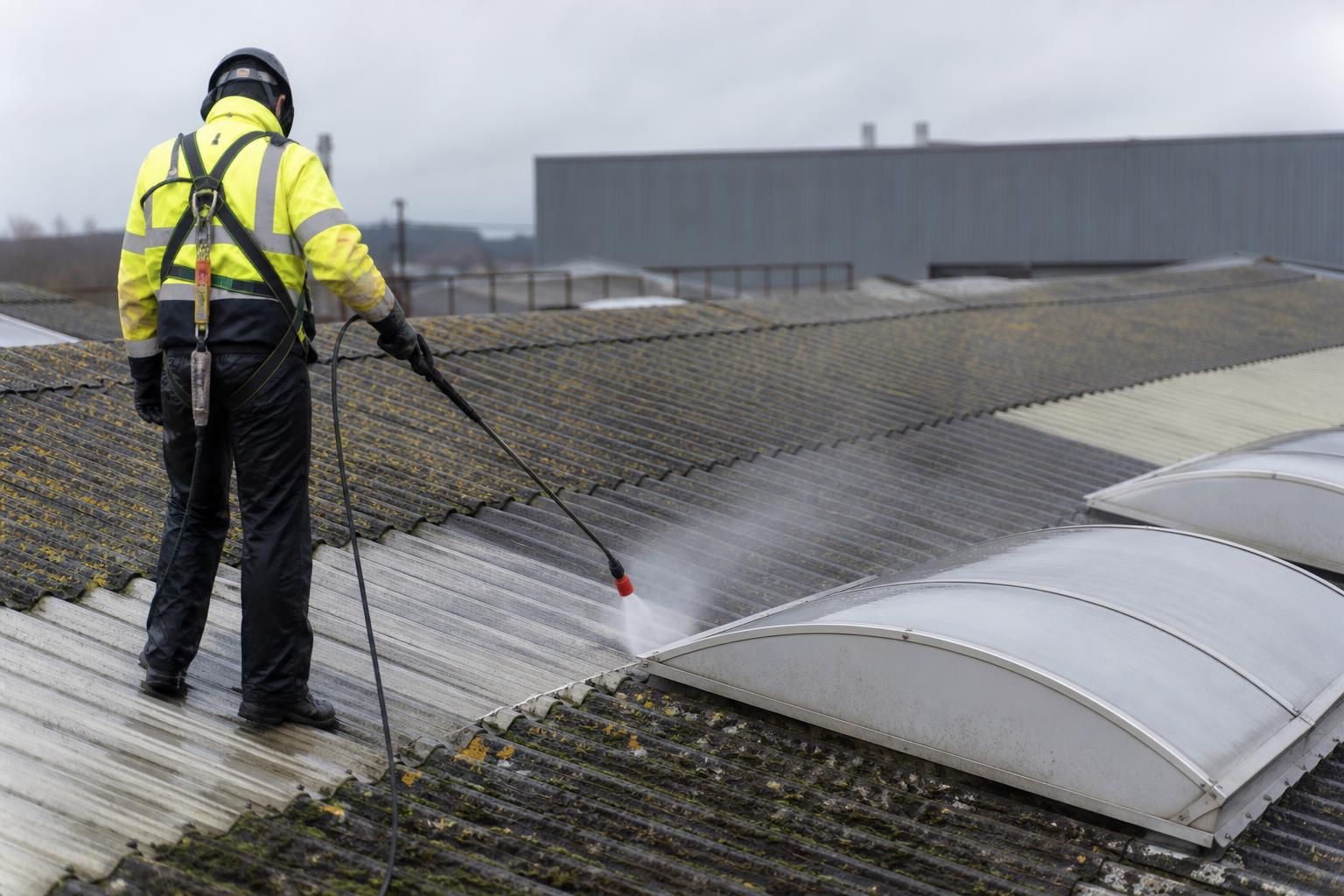
Traditional roof cleaning generally aims to remove visible contamination from the surface. Pressure washing uses water impact, while scraping and brushing use direct mechanical action. Steam cleaning uses heated water, often at lower pressure, to loosen contamination. These methods can produce a rapid visual improvement, particularly where moss has formed a thick layer, but the process may place more stress on fragile tiles, surface coatings, pointing, flashings and roof-mounted equipment if it is not carefully controlled.
A biocide cleaner works chemically. Its active ingredients are designed to kill or suppress organic growth, allowing dead material to break down and weather away or be removed with gentler methods. The outcome is usually more gradual than pressure washing, but the approach can be better suited to roofs where preserving the surface is more important than achieving immediate physical removal.
Benefits of using biocide roof cleaners
- Reduced abrasion: Biocide treatment can limit the need for forceful scraping or high-pressure water. This is important on older, weathered or granular roof surfaces where aggressive cleaning may dislodge the finish or cause unnecessary wear.
- Targets the cause of organic growth: Pressure washing may remove visible moss and algae without eliminating all viable growth in pores, joints and shaded areas. A suitable biocide is intended to act on the organisms themselves, helping to reduce the likelihood of rapid return.
- Useful on awkward or porous surfaces: Correctly applied treatment can reach small surface irregularities and areas that are difficult to clean consistently with a brush or washer.
- Less reliance on high-pressure water: Lower water impact can reduce the risk of forcing water beneath tiles, into vulnerable roof details or around poorly sealed penetrations. It can also reduce the amount of dislodged material entering gutters and drainage systems during the cleaning stage.
- Suitable for planned maintenance: Biocide cleaning can form part of a periodic roof maintenance programme, particularly where the roof is affected by recurring algae, moss or mould but does not require intensive restoration at every visit.
- Can complement other methods: A treatment may be applied before or after controlled soft washing, brushing or low-pressure rinsing. This allows the cleaning method to be adjusted to the condition and construction of the roof rather than applying the same process to every surface.
Limitations of biocide roof cleaners
- Results are not usually immediate: Dead or weakened growth may remain visible after application and can take time to loosen, break down and weather away. A roof that requires an immediate change in appearance may need a carefully managed removal stage as well.
- Thick moss may need physical removal: A chemical treatment will not necessarily detach a deep moss layer, accumulated organic debris or blocked gutter deposits. Removing heavy growth may require hand tools or soft brushing, carried out without damaging the roof covering.
- It does not repair roof defects: Biocide cleaning cannot correct cracked tiles, failed bedding, defective flashing, damaged membranes, blocked outlets or poor drainage. These issues should be identified and dealt with separately.
- Effectiveness depends on conditions: Rain soon after application, very low temperatures, strong sunlight, wind or an unsuitable surface condition can affect contact time and treatment performance. The product instructions and weather requirements must be followed.
- Not every product suits every material: Roof tiles, slate, coated metal, membranes and other coverings have different tolerances. An appropriate product must be checked against the manufacturer’s guidance, and a small test area may be needed before wider application.
- Runoff requires control: Biocide solution and contaminated wash water must not be allowed to enter watercourses, ponds, planted areas or neighbouring property. Gutters, downpipes, drains, vehicles, façades and landscaping may need protection and controlled rinsing.
- It is not a permanent guarantee against regrowth: Roofs remain exposed to moisture, shade, airborne spores and organic debris. Good treatment can suppress growth, but no cleaning method can prevent future contamination indefinitely.
Comparison with pressure washing and scraping
Pressure washing is generally faster at removing loose dirt and established surface growth, but the pressure must be appropriate for the covering and its condition. Excessive pressure can erode finishes, loosen protective granules, drive water into vulnerable areas or damage adjacent components. Scraping can remove thick moss effectively, although careless tools or excessive force may scratch, chip or lift the surface.
Steam cleaning can provide a controlled alternative where heat and access conditions are suitable. It still requires a method-specific assessment because heat may affect certain coatings, sealants, membranes or fittings. Biocide treatment is often preferable where the priority is to reduce biological activity with minimal surface agitation, while controlled mechanical or steam cleaning may be more suitable where substantial deposits must be removed promptly.
Choosing the most suitable approach
The correct method depends on the roof covering, age, condition, pitch, access, drainage arrangement and type of organic growth. The assessment should also consider whether the roof is above occupied premises, whether rainwater is collected for reuse, and what sensitive surfaces are nearby. A professional specification may combine hand removal of heavy growth, a compatible biocide treatment and gentle rinsing rather than treating biocide and traditional cleaning as mutually exclusive options.
For commercial and industrial premises, records of the product used, application conditions, protection measures and waste or runoff controls are useful for planned maintenance and site compliance. The roof should also be inspected after cleaning so that damaged coverings, blocked gutters and areas of persistent damp or shade can be reported.
In practical terms, biocide roof cleaners are most valuable where organic growth needs to be controlled while limiting abrasion and water impact. Traditional methods remain useful for rapid removal of heavy deposits, but they should be matched carefully to the roof material. The safest and most durable result usually comes from assessing the roof first and combining treatment and physical cleaning only where each is needed.
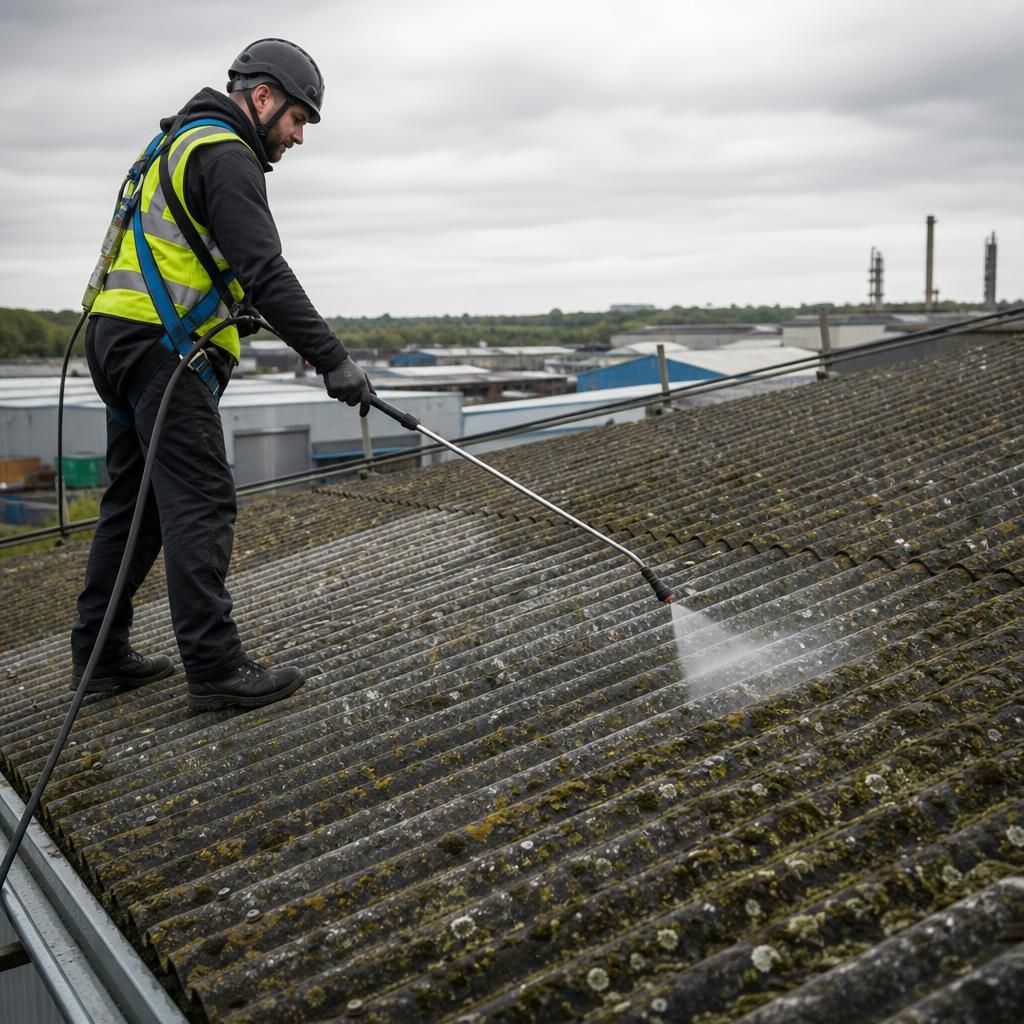
Biocide roof cleaners are most effective when used as part of a controlled cleaning plan rather than as a complete replacement for traditional methods. They can suppress moss, algae and mould with less abrasion than aggressive pressure washing, helping to protect weathered tiles, slate and surface coatings. However, thick moss and accumulated debris may still require careful hand removal or gentle brushing, while the treatment itself needs suitable weather, correct product selection and controlled runoff. Combining targeted biocide application with appropriate physical cleaning often provides a safer and more durable result than relying on either approach alone.