
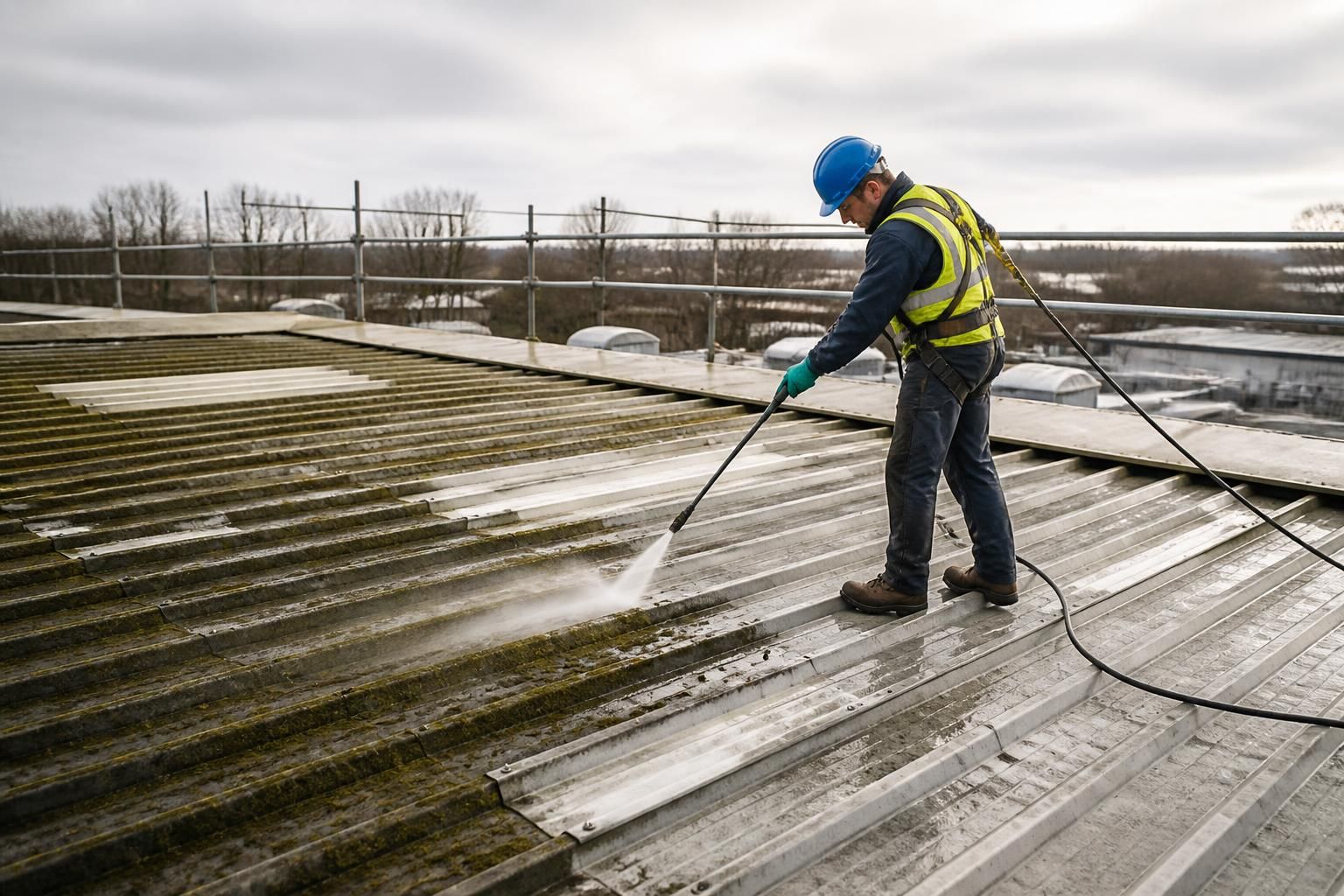
How do biocide roof cleaners prevent regrowth of moss and algae?
Biocide roof cleaners prevent moss and algae regrowth by killing the organisms and disrupting the spores and organic residues that allow them to re-establish on the roof surface. Their residual action helps keep treated areas cleaner for longer, although weather, moisture, shade and nearby vegetation can eventually encourage new growth.
Biocide roof cleaners prevent moss and algae regrowth by killing existing organic growth and leaving an active treatment on the roof surface that makes re-establishment more difficult. Unlike a purely mechanical clean, which removes visible contamination but may leave microscopic growth and organic residues behind, a correctly selected and applied biocide continues to work after the initial treatment. This helps keep commercial roofs cleaner for longer, although no treatment can prevent regrowth indefinitely where moisture, shade and airborne spores remain present.
Moss and algae spread when their spores settle on a suitable surface and conditions remain damp enough for them to develop. Roofs shaded by neighbouring buildings or trees, poorly ventilated roof areas, and surfaces that retain dirt or moisture are particularly susceptible. Moss can establish in joints, laps and textured finishes, while algae often forms a thin green, brown or black film across larger areas. This contamination can retain additional moisture and organic debris, creating more favourable conditions for further growth.
A biocide addresses this cycle in several ways:
- It damages or kills the active growth. The treatment affects the biological processes that moss, algae, mould and related organisms need to survive. Existing contamination may change colour, loosen or break down gradually rather than disappearing immediately.
- It reaches residues that pressure washing may not remove fully. Organic material can remain in surface texture, joints and other difficult-to-access areas after visible dirt has been removed. Treating these residues reduces the viable material left behind.
- It provides residual protection. Depending on the formulation and the surface, an active treatment can remain effective for a period after application. This discourages newly settled spores from developing into established growth.
- It reduces the conditions that support rapid return. Removing biological films and the debris they hold can leave the roof less hospitable to new moss and algae, particularly when drainage and surrounding vegetation are also managed.
The treatment process is important to the result. The roof is first assessed for its covering, condition, drainage, access requirements and the type and extent of organic growth. Loose contamination may be removed using a suitable low-pressure or controlled cleaning method, where the roof material allows it. The biocide is then applied evenly at the concentration and coverage rate specified for that product and surface. It needs sufficient contact time to work; rinsing too soon, applying it to a heavily saturated surface or allowing it to dry in unsuitable conditions can reduce its effectiveness.
Some products are designed as a post-clean treatment, while others are intended to break down organic growth over time with the help of normal weathering. These approaches should not be treated as interchangeable. A roof with thick moss may require physical removal before treatment, whereas a lightly affected roof may respond well to a carefully controlled application. The product label, roof manufacturer’s guidance and site risk assessment should determine whether rinsing is required and how runoff is controlled.
Biocide does not permanently sterilise a roof. New spores can arrive from nearby vegetation, buildings and the wider environment, and persistent dampness can eventually overcome the treatment’s residual effect. Regrowth is more likely where gutters are blocked, rainwater cannot drain correctly, branches overhang the roof or the roof remains shaded for much of the day. Defects such as leaks, failed flashings or damaged roof coverings should also be addressed, because trapped moisture can undermine the cleaning result and may cause deterioration independently of biological growth.
For that reason, prevention is most effective when cleaning is combined with practical roof maintenance. Keeping gutters, outlets and valleys clear helps remove moisture and organic debris. Cutting back vegetation that touches or heavily shades the roof can improve drying. Regular inspections allow early algae or moss deposits to be treated before they become dense and hold significant moisture. On larger commercial premises, planned inspections and repeat biocide applications can be scheduled according to the roof’s exposure and history of regrowth rather than waiting for heavy contamination to return.
Application conditions also affect performance. The surface should be suitable for treatment and free from conditions that cause excessive dilution or uncontrolled runoff. Rain shortly after application may reduce contact time, while strong wind can create drift and uneven coverage. Cold conditions can slow biological activity, and very hot or rapidly drying conditions may prevent the product from remaining in contact with the growth for long enough. A competent contractor checks the forecast, protects adjacent surfaces and follows the product instructions rather than relying on a fixed routine.
Correct selection matters because not every biocide is suitable for every roof covering or surrounding environment. The formulation must be compatible with the material, existing coatings, seals and drainage arrangements. The likely organisms, degree of contamination and intended cleaning method should also be considered. Where runoff could reach planted areas, watercourses or sensitive surfaces, containment and collection measures may be needed. Product handling, dilution and application should follow the manufacturer’s instructions and relevant site safety controls.
In practical terms, biocide roof cleaning does not create an invisible permanent barrier against moss and algae. Its benefit is that it deals with biological contamination at a deeper level than appearance alone, reducing viable growth and slowing the conditions that lead to rapid return. When the treatment is matched to the roof, given adequate contact time and supported by drainage, vegetation control and planned inspections, it provides a more durable approach than removing visible growth without treating the underlying biological contamination.
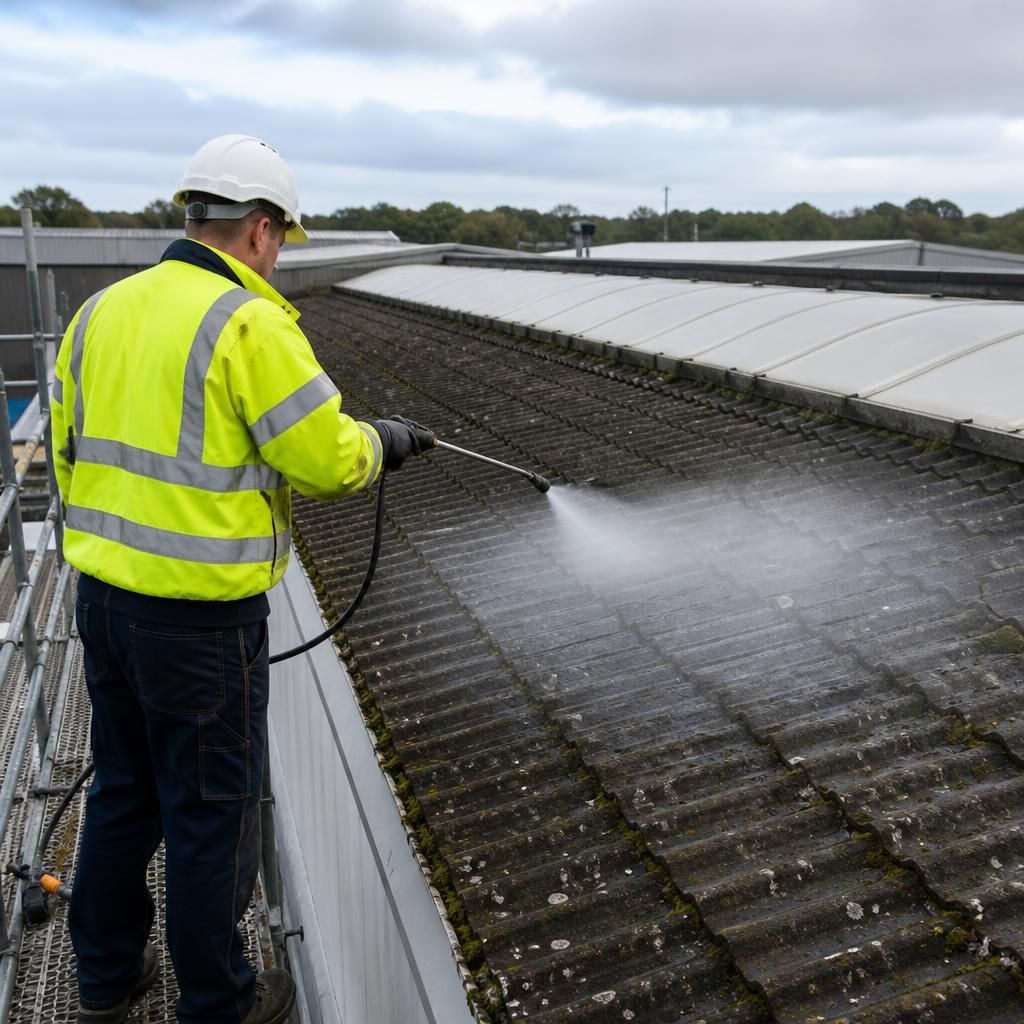
Biocide roof cleaners help prevent moss and algae regrowth by treating microscopic organic residues as well as visible contamination. Once applied correctly, the active treatment can continue discouraging viable growth after cleaning, making it harder for newly settled spores to establish on the roof surface.
This protection is not permanent. Persistent dampness, shade, blocked drainage and overhanging vegetation can encourage regrowth as the treatment’s residual effect reduces. Keeping gutters and outlets clear, improving roof ventilation where possible and arranging periodic inspections helps extend the cleaner condition.