
How does the application method affect the effectiveness of biocide roof treatments?
The application method affects how evenly the biocide reaches the roof, how long it remains in contact with organic growth, and how much product is lost through runoff. Low-pressure spraying or soft washing usually provides more controlled coverage than high-pressure application, helping the treatment work effectively while reducing the risk of roof and surface damage.
The application method directly affects how evenly the biocide covers the roof, how long it remains in contact with algae, moss, lichen and other organic growth, and how much treatment is lost through runoff. For most roof surfaces, controlled low-pressure spraying or soft washing is more effective and safer than high-pressure application because it delivers the product without unnecessarily disturbing the tiles or forcing water beneath them.
A biocide only works where it reaches the growth at the correct concentration and remains in contact for the required dwell time. An application that is too light, uneven or heavily diluted may leave untreated areas and produce inconsistent results. Conversely, excessive application can increase runoff, waste product and create avoidable environmental and surface-management concerns. The method must therefore be selected alongside the product instructions, roof material, condition of the surface and the nature of the contamination.
Low-pressure spraying is commonly used for roof biocide treatments because it allows the operative to apply a relatively even coat across larger areas without relying on force to remove the growth. The spray can be directed into textured tiles, overlapping joints and shaded sections where organic contamination tends to persist. Good control of the nozzle, spray pattern and application speed helps prevent missed strips, excessive pooling and unnecessary overspray.
Low-pressure application is particularly useful on roofs where the objective is to treat the underlying spores and growth rather than strip the surface aggressively. The roof may look unchanged immediately after treatment, as biocidal action is generally gradual. Dead or weakened growth can then weather away naturally or be removed using a separately assessed cleaning method.
Soft washing combines a low-pressure application with a suitable cleaning or biocidal solution. Its effectiveness depends less on pressure and more on thorough preparation, correct product selection and sufficient contact time. Where moss or lichen has formed a thick layer, loose material may need to be removed carefully before treatment. This allows the solution to reach the roof surface instead of being absorbed mainly by the outer layer of growth.
Soft washing is not a single universal process. The solution strength, application equipment and rinsing approach must be appropriate for the roof material and the product label. A competent contractor will consider whether a treatment should be applied in sections, whether it needs to remain damp for a specified period and how rainfall, wind and temperature may affect the result.
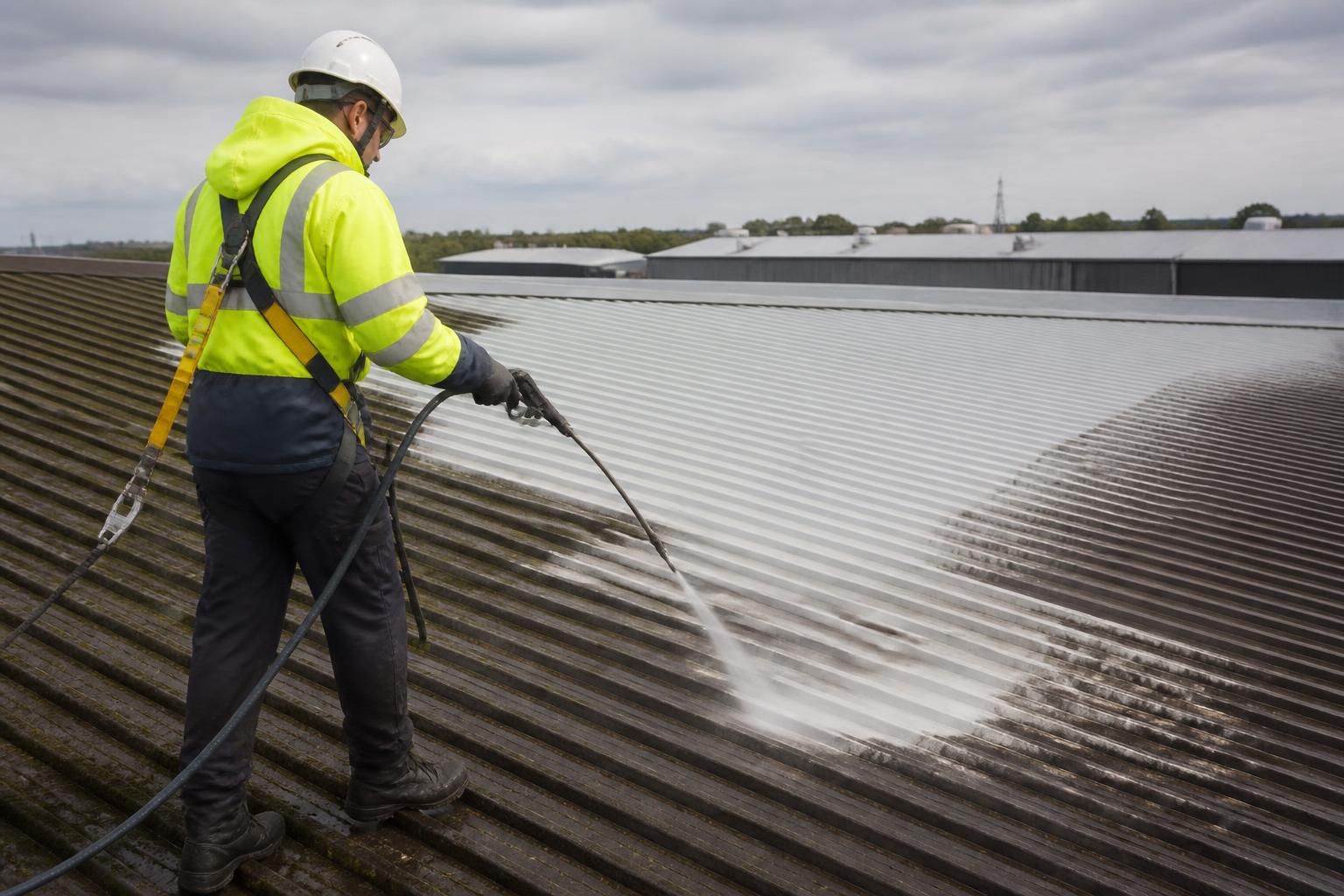
High-pressure washing can remove visible growth quickly, but it does not necessarily provide the same residual biocidal benefit. Pressure may dislodge contamination before the treatment has had time to work and can create uneven results if some areas are cleaned mechanically while others remain untreated. It can also damage fragile or weathered tiles, remove surface finishes, drive water beneath laps and increase the risk of water entering vulnerable roof details.
For these reasons, high pressure is generally unsuitable as the primary way to apply a roof biocide. Where pressure washing is considered for a particular roof, it should follow a material and condition assessment, use controlled settings and be carried out only where the roof construction can tolerate it. In many cases, a lower-pressure treatment provides a better balance between coverage, surface protection and long-term control of regrowth.
Manual or targeted application can be appropriate for small, intricate or difficult-to-reach areas. Hand-held sprayers, extension equipment or carefully directed applications allow the operative to treat verges, ridges, roof details and shaded sections with greater precision. The disadvantage is that coverage can become inconsistent if the work is rushed or if access makes it difficult to maintain a uniform spray pattern across the roof.
Application method also affects how much product reaches the roof rather than surrounding surfaces. Wind can carry a fine spray beyond the intended area, while a heavy application can run towards gutters, walls, drains and planted areas. Professional work should include appropriate protection of vulnerable surroundings, control of overspray and suitable management of collected residues. Weather conditions should be checked before and during application, as rain soon after treatment can dilute or wash away the product, while strong wind can make accurate application difficult.
The roof’s condition is equally important. A smooth, sound roof may accept a consistent spray more readily than a heavily weathered, porous or uneven surface. Thick moss can shield the roof beneath it, and lichen may be firmly attached to the tile surface. In these circumstances, simply changing the spray pressure is not a reliable solution. The surface may require gentle preparation, additional treatment or a planned follow-up inspection rather than a more aggressive application.
For an effective treatment, the contractor should establish:
- Whether the product is suitable for the specific roof material and type of organic growth.
- How the product should be diluted and applied according to its technical and safety instructions.
- Whether the roof needs preliminary removal of loose moss, debris or other contamination.
- Which application method provides even coverage without damaging tiles, membranes, coatings or flashing.
- How long the treatment needs to remain in contact with the surface.
- What weather conditions could reduce performance or increase overspray and runoff.
- How gutters, drains, vehicles, windows, cladding and vegetation will be protected during the work.
- Whether a follow-up visit or further treatment is needed to address remaining or returning growth.
Application records are also useful on commercial and managed properties. Recording the roof areas treated, the product used, site conditions and any areas requiring additional attention helps provide a clear maintenance history. It can also support future inspections, particularly where different roof materials or extensions are present on the same site.
In practical terms, the most effective method is usually the one that achieves complete, controlled coverage at low pressure, gives the biocide adequate contact time and limits runoff. The correct approach is not determined by application speed or visible short-term removal alone. It is determined by how well the treatment reaches the growth, how safely it can be applied to the roof and how consistently the surface can be monitored afterwards.
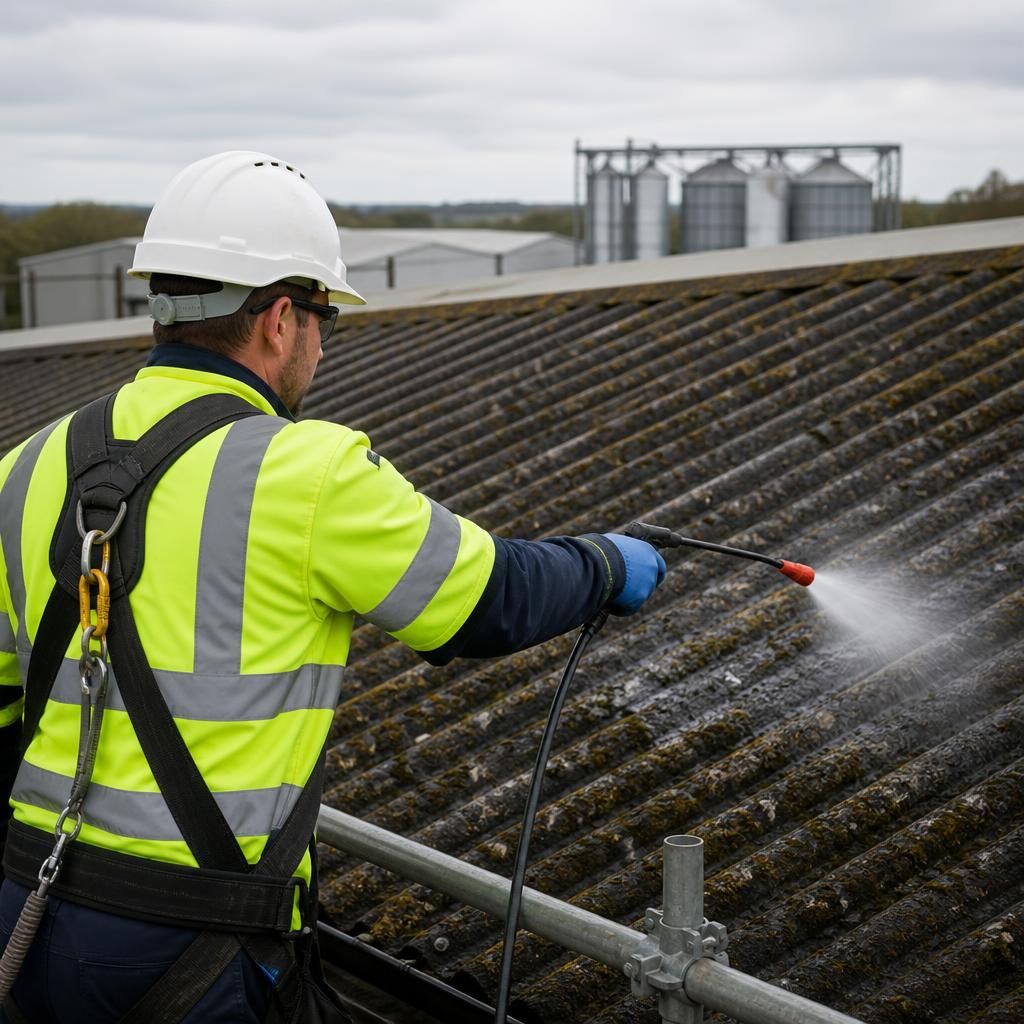
Low-pressure spraying is usually the most effective application method because it distributes the biocide evenly without forcing water beneath overlapping tiles or disturbing fragile roof surfaces. The solution must reach the algae, moss and lichen, then remain in contact for the period specified by the product instructions. If thick growth shields the roof, loose material may need to be removed carefully first; increasing pressure is not a suitable substitute for thorough coverage and correct dwell time.