
Are biocide treatments safe for all types of roof materials?
Biocide treatments are not automatically safe for every roof material; suitability depends on the product formulation, the roof’s condition and the manufacturer’s guidance. Slate, tiles, metal, coated systems and membrane roofs may require different approaches, so the surface should be assessed and a compatible treatment applied carefully to avoid staining, corrosion or damage.
Biocide treatments are not automatically safe for every roof material. Suitability depends on the treatment formulation, the roof’s age and condition, existing coatings, contamination, drainage arrangements and the manufacturer’s instructions. A product that is appropriate for traditional tiles may be unsuitable for a coated metal roof, a single-ply membrane or a roof with deteriorating surfaces. A material assessment should therefore take place before any treatment is selected or applied.
Biocides are used to control or reduce organic growth such as moss, algae, lichen and some fungal staining. They are not a universal substitute for cleaning, repairs or coating renewal. The correct treatment should be compatible with the roof surface and applied at a controlled concentration, using methods that avoid unnecessary wetting, pressure or run-off.
Common roof materials require different considerations:
- Concrete and clay tiles: These are often suitable for carefully selected biocide treatments, provided the tiles are sound and the product is approved for use on them. Weathered, porous or cracked tiles may absorb treatment unevenly, and loose surface material can be disturbed during preparation.
- Natural slate: Slate can be sensitive to aggressive cleaning methods, abrasion and unsuitable chemicals. The condition of the slate, its porosity, fixings and any adjacent materials should be checked. Treatment should not be used to disguise slipped, delaminated or damaged slates.
- Metal roofing: The main risks are corrosion, staining and damage to protective finishes. The treatment must be compatible with the metal, paint system, sealants and fixings. Chloride-containing or otherwise unsuitable products may be particularly problematic, and residues should not be allowed to remain on the surface.
- Coated or painted roofs: A biocide may affect the appearance or adhesion of an existing coating if it is chemically incompatible. A small, discreet test area can help identify colour change, whitening, softening or other reactions before wider application.
- Fibre cement and older manufactured sheets: These surfaces require careful assessment because age, weathering and previous repairs can affect their stability. Cleaning must not release hazardous fibres or damage the sheet. Where asbestos may be present, the roof should be handled only in accordance with the relevant legal and safety requirements by appropriately qualified contractors.
- Single-ply membranes, liquid-applied systems and other synthetic roof coverings: These materials can react adversely to solvents, strong alkalis, oxidising agents or incompatible surfactants. The membrane manufacturer’s written guidance should be followed, including any requirements for dilution, contact time, rinsing and protection of seams.
- Thatched, green and specialist roofs: These should not be treated with a general-purpose roof biocide without specific approval. Organic roofing materials, planted systems, waterproofing layers and associated drainage or irrigation components may be affected by chemical applications.
Roof condition is as important as roof material. A compatible treatment can still cause problems if the surface is friable, cracked, heavily corroded, poorly sealed or already suffering from water ingress. Moss can conceal broken tiles, open laps, failed flashings and blocked drainage. A pre-treatment inspection should identify these defects, as chemical cleaning will not correct them and may expose weaknesses that need repair.
Previous treatments also matter. Residues from detergents, fungicides, sealants, paints or waterproofing products can react with a new biocide or change how it spreads across the roof. The applicator should establish what has previously been used where this information is available, and should avoid mixing products unless the manufacturers expressly confirm that this is safe and effective.
Before treating a commercial or industrial roof, the following checks are appropriate:
- Identify the roof covering, coatings, membranes, sealants, flashings and drainage materials.
- Inspect for cracks, corrosion, loose sections, failed joints, water ingress and fragile areas.
- Review the product label, safety data and manufacturer’s compatibility guidance.
- Carry out a controlled test patch where the surface, coating or previous treatment creates uncertainty.
- Check whether the treatment could affect solar panels, rooflights, plant, ventilation equipment, painted façades, vehicles or neighbouring property.
- Plan controls for run-off, overspray, access, weather conditions and the protection of people and drainage systems.
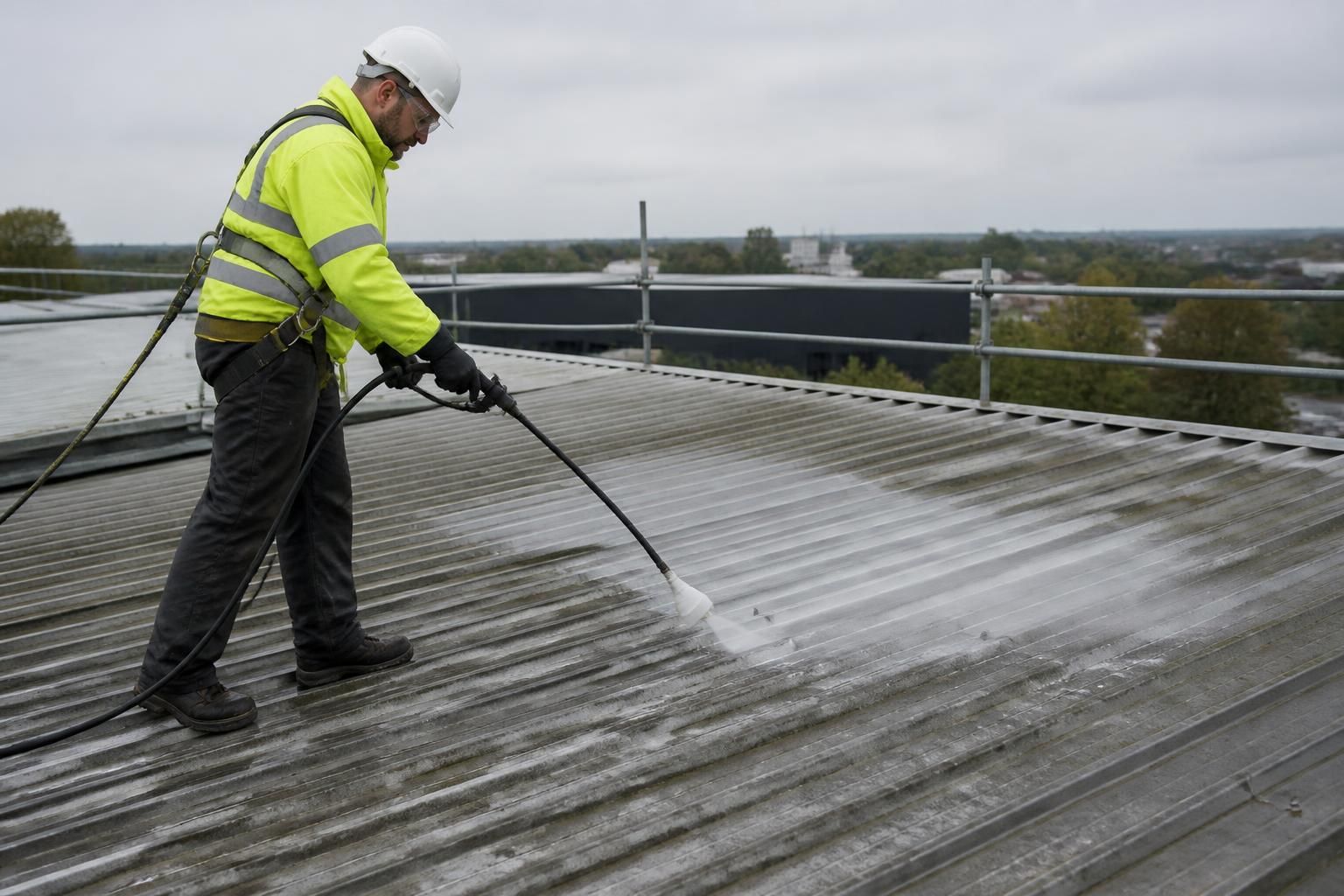
Application should follow the product instructions rather than a standard process used for every roof. In many cases, low-pressure application is preferable to forceful cleaning because it reduces the risk of driving water beneath laps, seals or damaged areas. However, low pressure does not make an unsuitable chemical safe. The product still needs to be correctly selected, diluted and distributed, with contact time controlled and rinsing carried out where required.
Weather and site conditions can affect both safety and performance. Strong wind can carry spray beyond the intended area, while rain may dilute the treatment and increase run-off. Excessively hot or dry conditions can cause rapid drying and uneven results. Applications should be planned around the product guidance and the need to protect occupants, pedestrians, vehicles, planted areas and watercourses.
Particular care is needed around gutters and downpipes. Biocide residues, loosened organic matter and contaminated wash water should not be allowed to enter surface-water drains or natural watercourses without suitable controls. Downpipes may need to be isolated or redirected during application, and surrounding surfaces may require protection. Any waste and residue should be managed in accordance with the product instructions and applicable environmental requirements.
A treatment is generally unsuitable if the manufacturer does not approve it for the roof material, if a test patch shows an adverse reaction, or if the roof is too damaged or fragile to treat safely. It may also be inappropriate where run-off cannot be controlled, where sensitive equipment cannot be protected, or where the intended result requires repairs rather than biological treatment.
For a commercial or industrial property, the safest approach is to combine a roof survey with product selection and a documented method statement. This should record the roof construction, identified defects, treatment used, application controls, protection measures and any post-treatment requirements. Where compatibility is uncertain, obtain confirmation from the roof-system manufacturer or use a specialist product supported by clear technical guidance.
In summary, biocide treatments can be suitable for many tiled, slate, metal and coated roofs, but safety is material-specific and condition-dependent. Correct assessment, a compatible product, controlled application and responsible run-off management are essential. Treating every roof with the same chemical or method creates avoidable risks such as staining, corrosion, coating failure, membrane damage and environmental contamination.
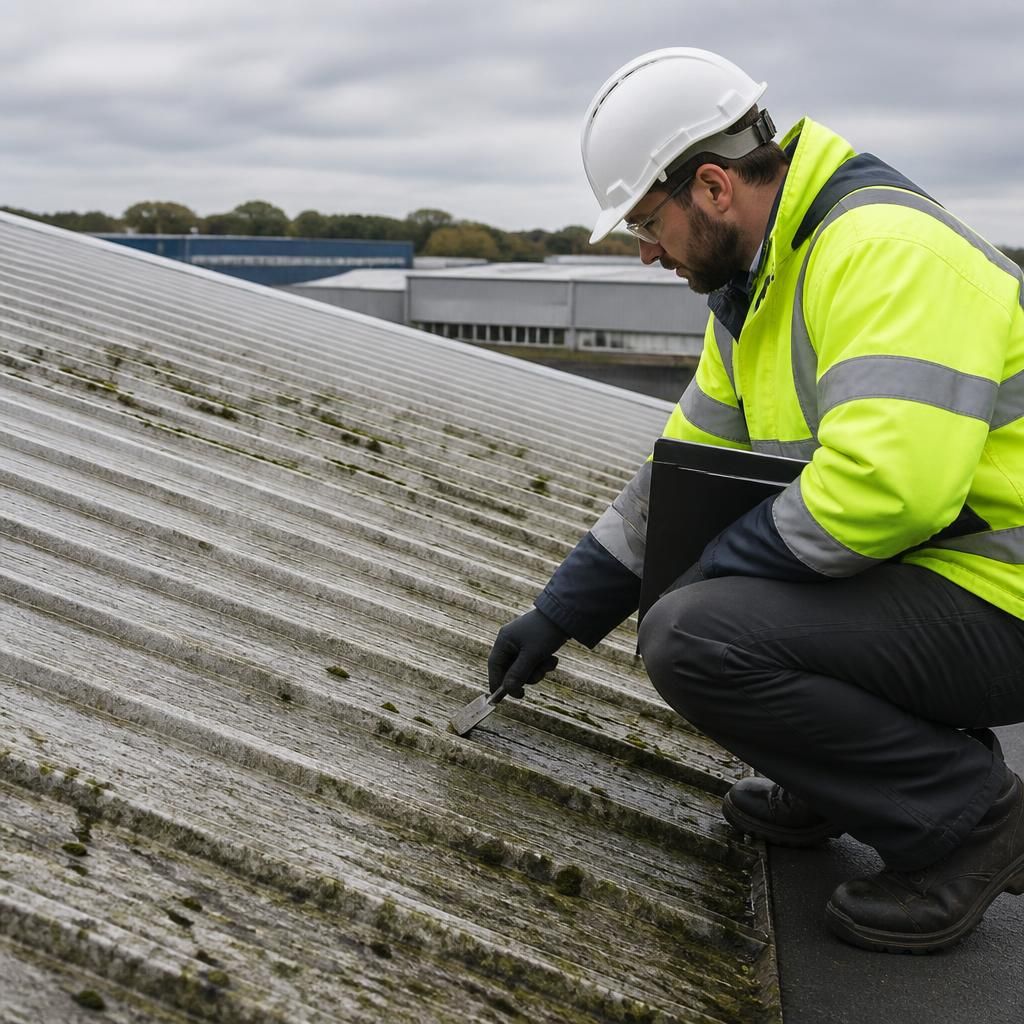
Biocide treatments are only safe when the product is compatible with the roof material and its existing coatings, seals and fixings. Before wider application, the roof should be inspected and a small test patch carried out in a discreet area where compatibility is uncertain.
The test should be checked for staining, colour change, whitening, softening, corrosion or loss of coating adhesion. Product instructions must also be reviewed for dilution, contact time and rinsing requirements. This is particularly important on coated metal, natural slate, fibre cement, single-ply membranes and older or weathered roofs, where an unsuitable treatment may cause damage even when applied at low pressure.
Arrange a Roof Material Compatibility Assessment
Arrange a roof material compatibility assessment before treatment to confirm the covering, coating and existing condition are suitable for the proposed biocide. We can identify potential risks and recommend appropriate application controls for your commercial or industrial roof.