
What are the advantages of using cryogenic blasting for stone cleaning?
Cryogenic blasting uses dry ice pellets to remove dirt, staining, coatings and biological residue from stone without leaving abrasive media or significant moisture behind. It can clean delicate or historic surfaces with less risk of scratching, water penetration and secondary waste, provided the stone and soiling are assessed first.
Cryogenic blasting is a low-moisture cleaning method that propels dry ice pellets at a stone surface to remove dirt, coatings, staining and biological residue. Its main advantages are that the dry ice sublimates on impact, leaves no blast media behind, uses little or no added water, and can clean many delicate or historic stone surfaces with less risk of scratching, water penetration or salt contamination than conventional abrasive or wet cleaning.
It is not suitable for every stone or every type of soiling. The correct pressure, pellet size and technique must be selected following an assessment of the stone, its condition, previous treatments and the material being removed. A controlled trial area is particularly important on historic masonry, friable stone and surfaces with existing defects.
Reduced secondary waste
Dry ice changes directly from a solid into carbon dioxide gas when it strikes the surface. Unlike sand, grit or other abrasive media, it does not remain mixed with the removed dirt. This can simplify site clearance and reduce the amount of contaminated blast material requiring collection and disposal. The debris that remains—such as loosened paint, soot, biological growth or failed coating—can be collected separately using suitable containment and extraction equipment.
This benefit can be valuable on commercial, industrial and heritage sites where waste handling is restricted, drainage is limited or the material being removed may require controlled disposal. It does not eliminate the need for responsible waste management: removed coatings, hazardous residues and contaminated dust must still be assessed and handled appropriately.
Minimal moisture and faster drying
Because cryogenic blasting does not saturate the stone, it can reduce the risk of water entering pores, joints and cracks. This is useful where masonry is vulnerable to damp-related deterioration, where moisture could affect internal finishes, or where the cleaned area must return to service without a prolonged drying period.
Low moisture also helps avoid some problems associated with wet cleaning, including run-off, pooling and the movement of soluble salts through porous stone. However, the process can still create condensation in cold or poorly ventilated conditions, and the surface may need monitoring after cleaning. Existing dampness, salts and unstable mortar should be considered before work begins.
Less abrasive impact than traditional blasting
When correctly specified, the dry ice pellets remove contamination through a combination of impact and thermal shock without leaving a hard abrasive substance travelling across the surface. This can make the method appropriate for some carved details, textured finishes and historic masonry where aggressive grit blasting could erode the face of the stone or soften sharp profiles.
The process is not automatically non-abrasive. Incorrect pressure, an unsuitable nozzle, prolonged working in one area or a weak stone surface can still cause damage. A competent operator should adjust the equipment to the substrate rather than treating cryogenic blasting as a universal solution for delicate materials.
Effective removal of several types of contamination
Cryogenic blasting may remove or loosen:
- surface dirt, soot and industrial residue;
- grease and some oily deposits;
- peeling paint and certain failed coatings;
- adhesive residues and process contamination;
- moss, algae, lichen and other biological deposits where the bond to the stone is suitable; and
- deposits within textured or detailed areas that are difficult to reach with hand tools.
The result depends on the bond between the contamination and the stone. Deep staining, rust marks, dissolved salts, aged oil penetration and biological growth rooted in joints may not be fully removed by blasting alone. Follow-up treatment, gentle rinsing, poulticing, biocide application or repairs may be required. Biological growth should also be treated at its source where appropriate, otherwise it can return.
Access to detailed and awkward surfaces
Specialist nozzles and controllable air pressure allow the operator to work around carved features, recessed joints, mouldings, masonry profiles and equipment without dismantling every component. This can reduce preparation time and make the method useful for façades, entrances, architectural stonework, industrial structures and areas where water recovery would be difficult.
Access planning remains essential. Dry ice blasting produces airborne dust and can be noisy, so nearby occupants, ventilation systems, sensitive equipment and public areas may need protection or temporary isolation. The work area should be assessed for safe access, containment and suitable ventilation before cleaning starts.
Potentially safer for the stone than high-pressure water
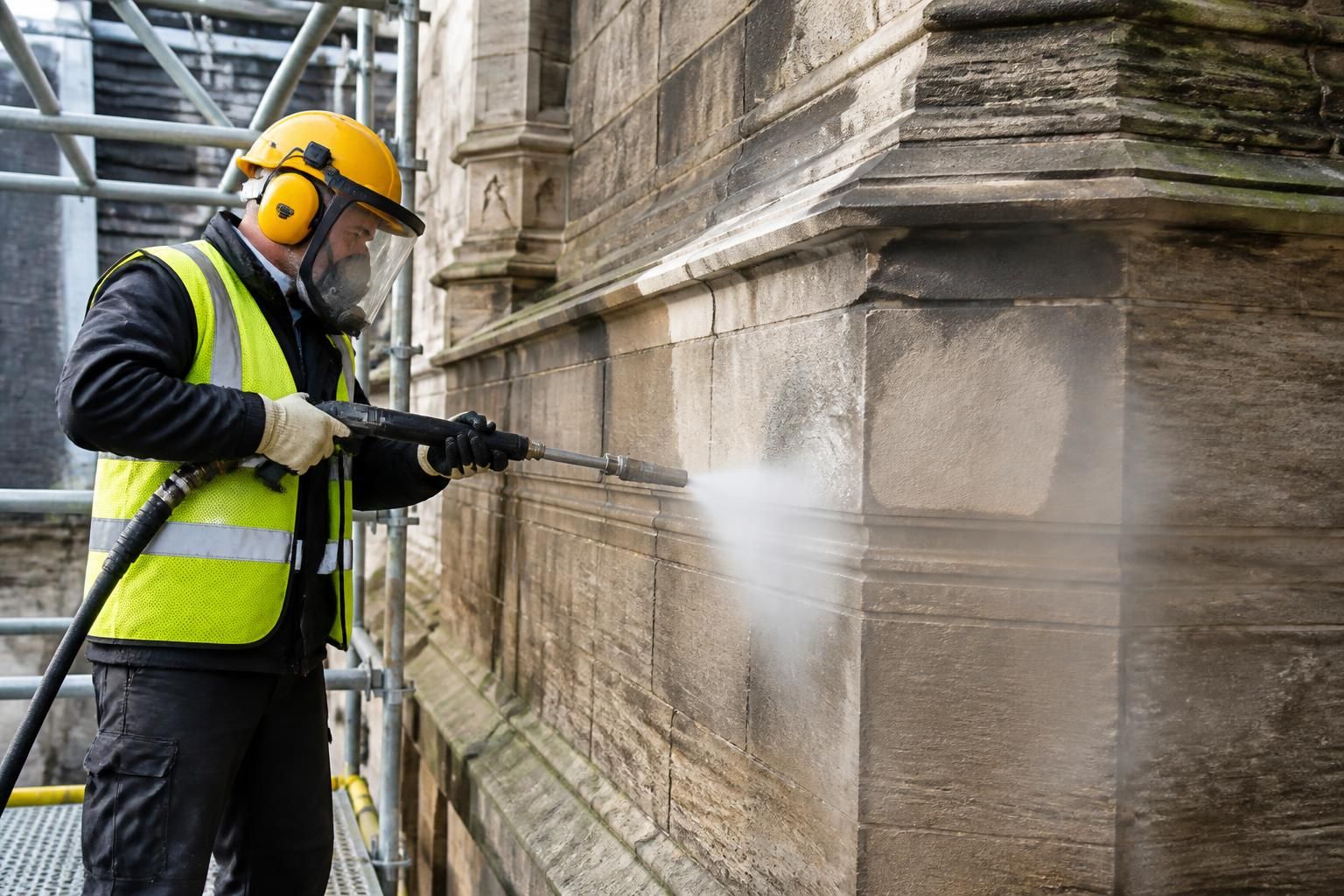
Compared with high-pressure washing, cryogenic blasting can reduce the likelihood of forcing water into open joints, porous masonry, cracks and construction interfaces. It also avoids some risks associated with water run-off reaching electrical equipment, occupied areas or sensitive landscaping. These benefits are especially relevant to buildings where the stone is weathered or where uncontrolled water could create additional defects.
Pressure washing may still be the more efficient and appropriate choice for robust, sound stone with heavy surface dirt, particularly where thorough rinsing is needed. Steam cleaning can be preferable for certain biological or greasy deposits and may provide a more controlled low-pressure process. The choice should be based on the substrate and the contamination, not on the cleaning method alone.
Important limitations and precautions
Cryogenic blasting requires specialist equipment, a reliable supply of dry ice and trained operation. Carbon dioxide gas can displace oxygen in enclosed or poorly ventilated spaces, so ventilation and atmospheric safety must be considered. Operators should use appropriate respiratory, eye, hearing and hand protection, and the site should be managed to control dust, flying debris and noise.
Dry ice blasting may also expose weaknesses that were hidden beneath dirt or coatings. Loose pointing, delaminated stone, failed repairs and unstable surface layers should be identified before cleaning. Any vulnerable areas should be protected or addressed separately. A pre-cleaning inspection should record the stone type, surface condition, previous coatings, likely contaminants and any areas requiring conservation advice.
When cryogenic blasting is a good option
It is often worth considering where the project requires low moisture, limited secondary waste, careful removal of surface contamination or access to intricate stonework. It can be particularly useful for selected historic, architectural and industrial surfaces when a test panel confirms that the stone responds safely.
For the most reliable result, the cleaning method should be compared with low-pressure steam, controlled pressure washing, gentle abrasive cleaning and appropriate chemical or biocidal treatments. A site survey and test clean allow the process to be specified around the stone rather than forcing the surface to suit a particular machine.
In summary, the key advantages of cryogenic blasting are controlled cleaning, little residual moisture, no spent abrasive media, reduced risk of water penetration and the ability to address some difficult contamination without aggressively abrading the stone. Its effectiveness depends on correct assessment and operation, so it should be used as part of a planned stone-cleaning system rather than as a one-size-fits-all treatment.
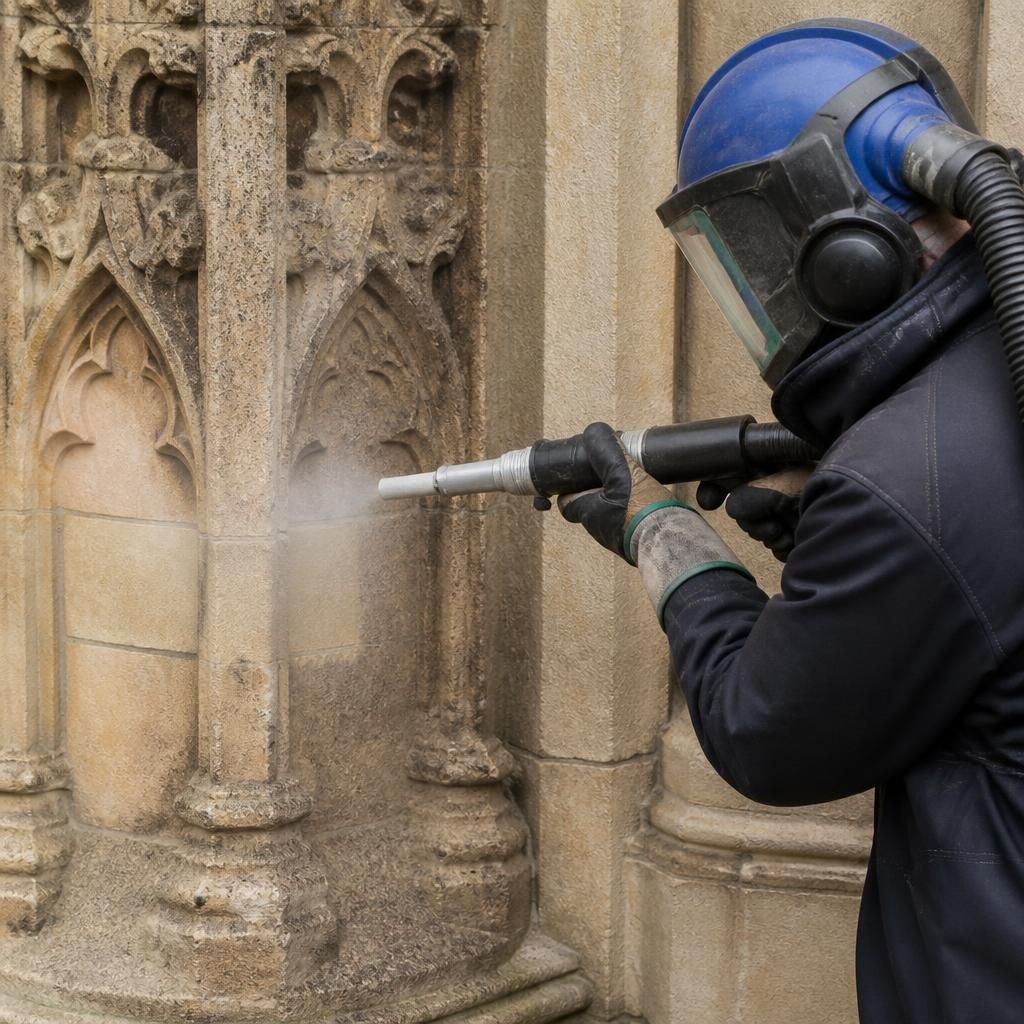
Cryogenic blasting cleans stone with dry ice pellets that sublimate on impact, so the process leaves little added moisture and no spent abrasive media on the surface. This can help reduce water penetration into porous masonry, joints and cracks while simplifying the collection of loosened dirt, coatings and biological residue.
The method is particularly useful where run-off, prolonged drying or contaminated blast waste would create practical problems. It still requires suitable containment, extraction and waste handling, especially when removing old coatings or hazardous deposits. A test area should confirm that the stone and its existing finish can tolerate the selected pressure and nozzle settings.