
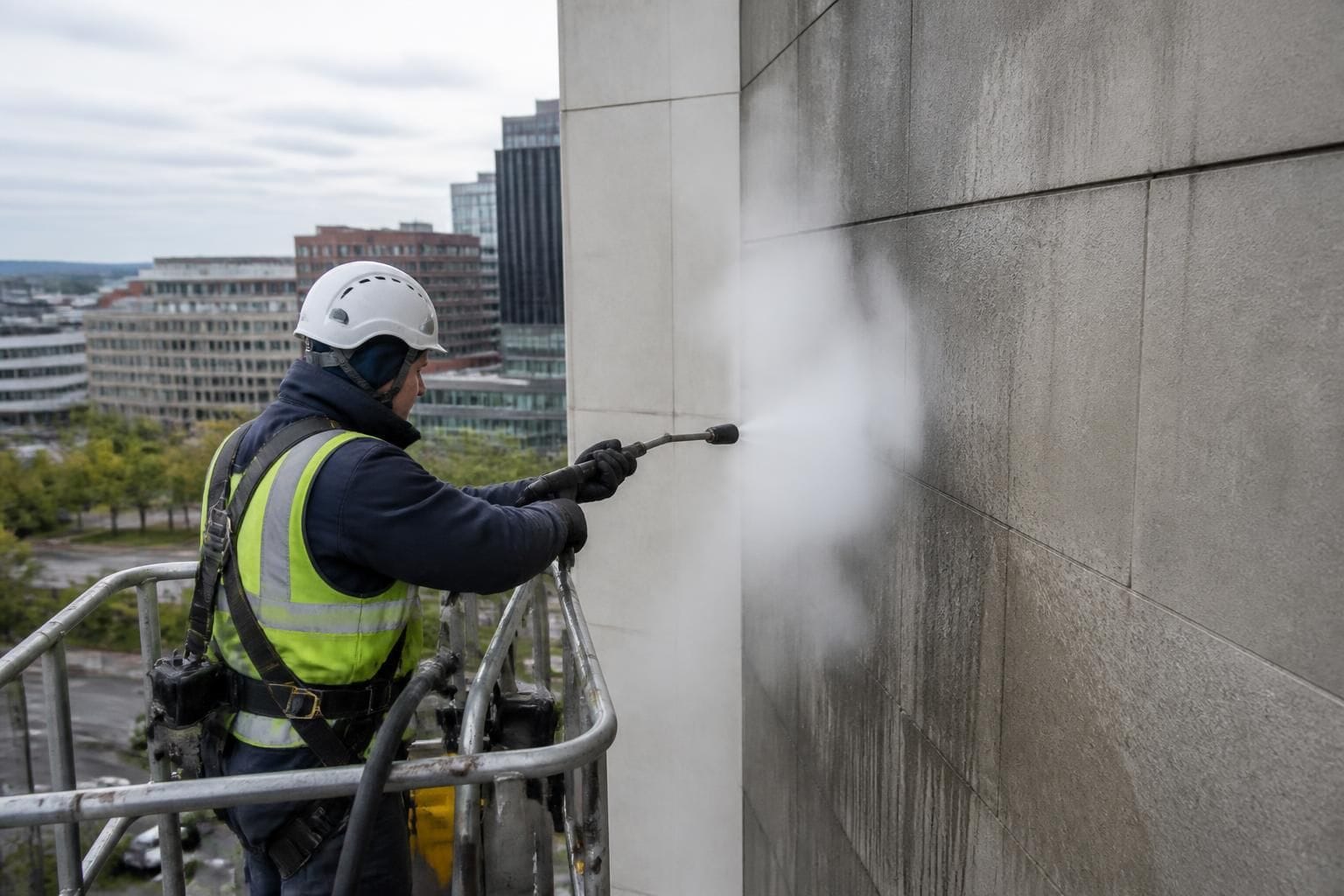
What benefits does industrial steam cleaning offer for maintaining high-rise building exteriors?
Industrial steam cleaning uses high-temperature steam to remove grime, algae, pollution residue and biological growth from high-rise façades with less water and lower surface pressure than conventional washing. It can improve the building’s appearance and hygiene, reduce the risk of material damage and water ingress, support safer access operations, and help extend the service life of cladding, masonry and other exterior finishes.
Industrial steam cleaning benefits high-rise building exteriors by removing pollution film, algae, moss, atmospheric grime and other biological growth with high-temperature steam and comparatively low water use. Because steam cleaning can work at lower pressure than conventional washing, it helps clean façades, cladding and other external surfaces while reducing the risk of surface erosion, forced water penetration and unnecessary disturbance to joints or coatings.
Key benefits for high-rise exteriors include:
- Effective removal of stubborn contamination: Heat softens and breaks down greasy pollution residue, bird fouling, organic growth, soot and ingrained dirt. This is particularly useful on façades exposed to traffic emissions, industrial pollution and run-off from surrounding structures.
- Lower risk of substrate damage: Steam cleaning relies more on heat and dwell time than on aggressive water pressure. When the method is selected and controlled correctly, it can be gentler on masonry, render, coated metal, stone, glazed surfaces and some cladding systems than conventional high-pressure washing.
- Reduced water use and run-off: Steam systems generally use less water than pressure washing. This can reduce the volume of contaminated run-off requiring control, although collection, filtration and responsible disposal may still be necessary where pollutants, oils, paint or biological residues are present.
- Improved façade appearance: Removing the surface film that causes staining and discolouration can restore a more uniform appearance without relying on abrasive cleaning. This supports planned presentation standards for offices, residential blocks, retail premises and public buildings.
- Support for building hygiene: High-temperature treatment can help remove organic contamination and reduce surface conditions that support algae, moss and other growth. It is not a substitute for specialist disinfection where a confirmed biological or health hazard is present, but it can form part of an appropriate exterior maintenance programme.
- Protection of façade details: Lower-pressure cleaning can be more suitable around pointing, sealants, expansion joints, vents and architectural features than forceful washing. A competent contractor will still assess these areas individually, as steam, heat and moisture can affect defective or vulnerable components.
- Less abrasive cleaning: Unlike some mechanical or abrasive methods, steam cleaning does not depend on grit or aggressive scouring to remove contamination. This helps avoid unnecessary scratching and the loss of decorative finishes, provided the temperature, pressure and cleaning distance are suitable for the material.
- Support for planned maintenance: Regularly removing pollutants and biological growth makes it easier to inspect façade condition. Cracks, failed sealant, corrosion, loose coatings and damaged joints may be more visible after cleaning, allowing remedial work to be planned before defects become more extensive.
- Potentially longer service life for finishes: Persistent grime, salts, moisture and biological growth can contribute to staining and deterioration over time. Removing these contaminants as part of a suitable maintenance schedule can help protect coatings and façade materials, although cleaning cannot correct existing structural, waterproofing or weathering defects.
- Useful for complex access operations: High-rise cleaning can be carried out from suitable powered access equipment, cradles, scaffold or rope-access systems, depending on the building and risk assessment. Steam cleaning may reduce the amount of water and equipment needed at each work area, but it does not remove the need for robust access planning.
How the benefit is achieved depends on correct preparation. Before work starts, the façade should be inspected to identify the substrate, coating type, previous repairs, weak joints, open cracks, electrical fittings, vents and areas where water could enter the building. A small test clean in an inconspicuous location helps establish whether the selected temperature, pressure, nozzle and cleaning product achieve the required result without marking, softening or discolouring the surface.
Steam is not automatically suitable for every high-rise material. Heat and moisture may damage poorly bonded coatings, uncured repairs, friable masonry, timber, sensitive sealants or concealed components. Glazing, insulation systems and composite panels also require method-specific controls. Where detergent or biocide is needed, it should be compatible with the façade and managed in accordance with the product instructions and environmental requirements.
High-rise work also requires controls for falling materials, overspray, wind, public access, electrical hazards, water ingress and contaminated run-off. Operatives should use appropriate access systems, exclusion zones and personal protective equipment, with the work coordinated around occupants, pedestrians and nearby traffic. Steam can cause serious burns, so hoses, connections, nozzles and operating distances must be controlled by trained personnel.
After cleaning, the façade should be checked for remaining deposits, changes in finish and newly exposed defects. Any failed sealant, damaged coating, corrosion or water-entry risk should be recorded and referred for suitable repair rather than concealed through repeated cleaning. In this way, industrial steam cleaning provides more than a cosmetic improvement: it becomes a controlled part of high-rise exterior maintenance, helping preserve appearance, support inspections and reduce avoidable wear while keeping the cleaning method appropriate to the building fabric.
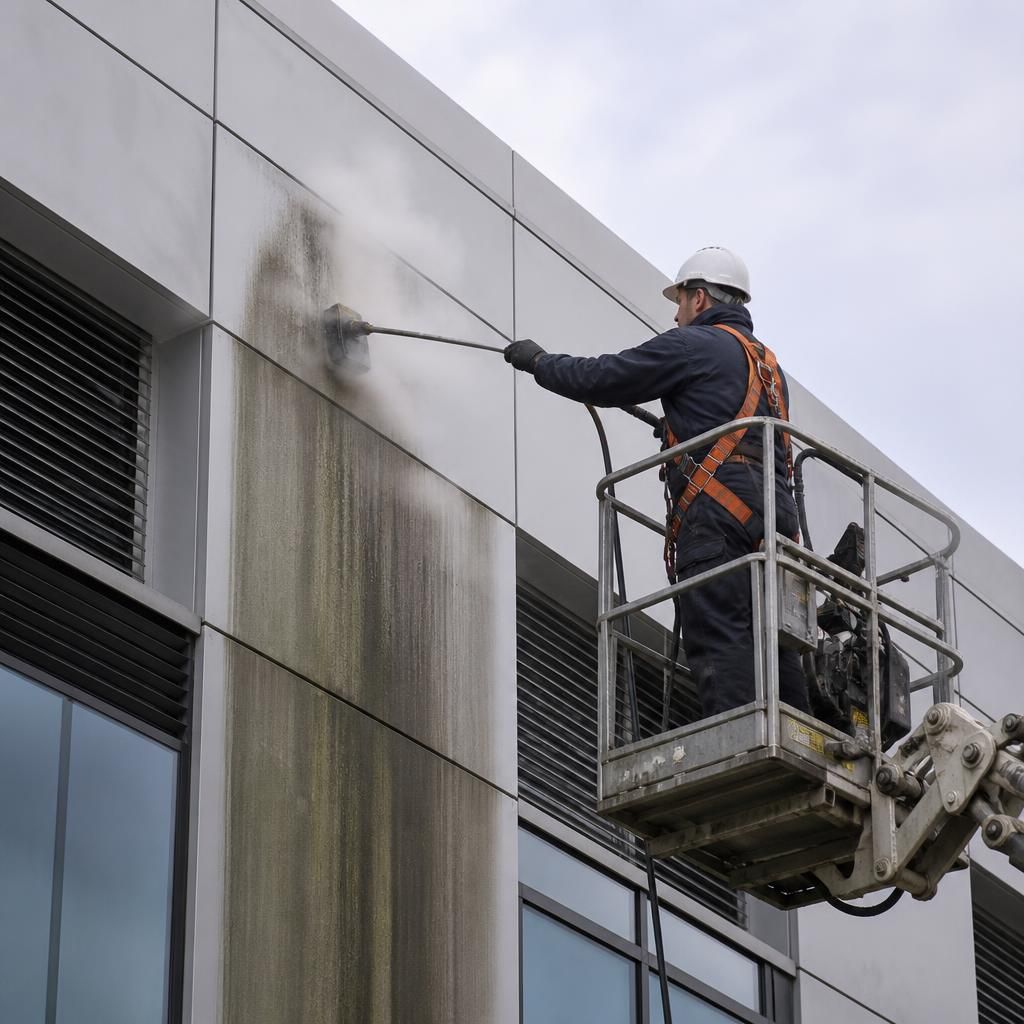
One important benefit of industrial steam cleaning for high-rise exteriors is that it can remove pollution film, algae and ingrained dirt with less water and lower pressure than conventional pressure washing. Heat softens the contamination, allowing trained operatives to clean façades, cladding, masonry and architectural details without relying on aggressive force.
This controlled approach can reduce the risk of eroding weathered surfaces, disturbing pointing or driving water into defective joints, cracks and façade details. It is particularly useful where the building has delicate coatings, sealants or areas close to vents and openings. The method must still be tailored to the substrate: a pre-clean inspection and test area should confirm that the temperature, pressure and cleaning distance are suitable before work continues across the elevation.