
What factors should be considered when choosing between pressure washing and steam cleaning for concrete and stone surfaces?
Choosing between pressure washing and steam cleaning for concrete and stone depends on the surface’s condition, porosity, age and sensitivity, along with the type of soiling, required finish, water availability and environmental constraints. Pressure washing is often effective for robust concrete and heavily soiled areas, while steam cleaning is better suited to delicate, historic or sensitive stone where lower water use and reduced mechanical impact are important.
The choice between pressure washing and steam cleaning for concrete and stone should be based on the surface material, its condition, the type of soiling, the required finish and the risks associated with water, heat and mechanical pressure. Pressure washing is generally suitable for sound, robust concrete and heavily soiled external areas, while steam cleaning is often preferable for sensitive, porous, historic or difficult-to-access surfaces where reduced water use and gentler mechanical action are important.
Surface material and construction
Concrete is usually more tolerant of pressure washing than natural stone, particularly where it has a sound, well-cured surface and no exposed aggregate or failing coating. However, concrete can still be damaged by excessive pressure, incorrect nozzle selection or holding the lance too close to the surface. These issues can strip the cement-rich surface, expose aggregate, enlarge existing defects or leave visible cleaning patterns.
Natural stone requires a more specific assessment. Sandstone is porous and may contain friable layers that can be loosened by aggressive pressure. Limestone, slate, granite and manufactured stone also respond differently according to their hardness, porosity, finish and mineral composition. A method that is appropriate for dense granite may be unsuitable for a soft or weathered sandstone façade. Mortar joints, pointing, sealants and nearby render must also be considered because they may be weaker than the stone itself.
Condition, age and existing damage
The condition of the surface is as important as the material. Pressure washing may be appropriate for stable slabs, loading areas and sound concrete walls, but it should be approached cautiously where there are cracks, delamination, scaling, spalling, open joints or loose aggregate. Water forced into defects can worsen deterioration or carry contamination deeper into porous materials.
Older and historic structures require particular care. Weathering may have weakened the outer surface, even where the stone appears structurally sound. Steam cleaning can reduce mechanical impact, but heat and moisture can still affect vulnerable stone, old mortar and previous repairs. A test area should therefore be completed before deciding on the full cleaning method, especially where the surface has architectural, historic or conservation value.
Type and severity of soiling
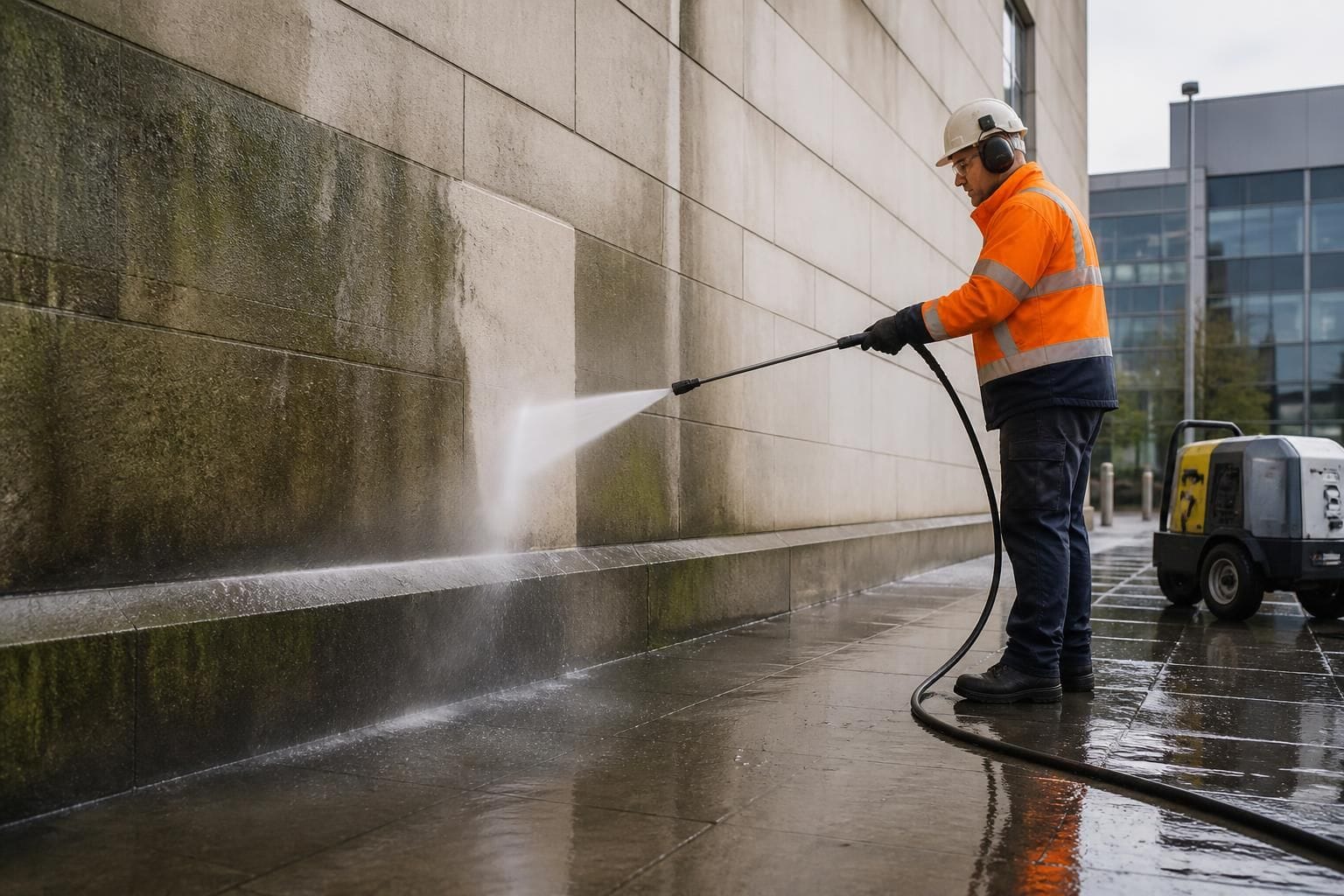
Pressure washing is effective at removing loose dirt, mud, soil, grit and some surface deposits from robust concrete and hard stone. It can also be useful for large car parks, yards, paths and service areas where heavy traffic has embedded general grime into the surface.
Steam cleaning uses heated water with relatively low water volume and can be effective against organic growth, algae, moss, grease residues, chewing gum, atmospheric grime and some biological contamination. Heat can soften deposits so that they can be removed without relying on high mechanical force. It is not automatically the best option for every stain: deeply absorbed oil, rust, paint, cement residues and certain efflorescence deposits may require a compatible cleaning treatment in addition to pressure or steam.
The age of the contamination also matters. Fresh surface dirt may be removed with a straightforward wash, whereas long-standing deposits can have bonded to the substrate or entered its pores. Using greater pressure to compensate for unsuitable chemistry or insufficient dwell time can cause avoidable damage. The cleaning process should be selected to remove the contamination while preserving the surface beneath it.
Required level of control
Pressure washing provides strong mechanical cleaning and can cover large areas efficiently, but the result depends on the pressure, flow rate, nozzle, distance, angle and movement speed used by the operator. Uncontrolled application can create striping, streaks, etching or inconsistent shading.
Steam cleaning generally offers greater control on delicate surfaces and can reduce the amount of water entering joints and porous materials. This can be useful on façades, ornamental stone, entrances and areas where saturation could affect internal finishes. Steam is not risk-free, however. Excessive heat or prolonged application may affect coatings, sealants, resin repairs or heat-sensitive materials. The equipment must be set according to the substrate rather than treated as a universal low-risk solution.
Water sensitivity, drainage and drying
The amount of water used is a practical consideration on every commercial or industrial site. Pressure washing can produce substantial runoff, which may carry silt, oil, detergents and biological material into drains or surrounding ground. Drainage capacity, containment requirements and the lawful disposal of wastewater should be assessed before work begins.
Steam cleaning uses less water in many applications and may allow the surface to dry more quickly, although the overall moisture impact still depends on the equipment, duration and porosity of the material. Neither method should be selected without considering water-sensitive adjoining areas, internal spaces, electrical equipment, stored goods, public routes and weather conditions.
Where water cannot be safely controlled, a lower-water method may be more practical, but the cleaning team must still manage condensate, loosened debris and contaminated residues. Drying time should also be considered if the surface will be sealed, painted, reopened to pedestrians or returned to vehicle use.
Environmental and regulatory considerations
The preferred method should minimise water consumption, chemical use, runoff and disturbance without compromising the required result. Steam can reduce the need for detergents in some applications, particularly when heat is sufficient to loosen organic or greasy deposits. Pressure washing may still be the more efficient choice for extensive, open areas where water recovery and filtration can be properly managed.
Cleaning agents should be selected for compatibility with the concrete or stone and used only when necessary. Runoff must not be allowed to enter surface water or drainage systems in breach of site or environmental requirements. On commercial premises, the method statement should identify water sources, discharge arrangements, chemical controls and any protection needed for planting, wildlife or adjacent properties.
Access, scale and site operations
Large ground-level areas with reliable water access often suit pressure washing, especially where the principal requirement is the rapid removal of heavy, loose contamination. Steam cleaning may be more suitable for façades, entrances, detailed stonework and locations where water overspray would disrupt operations or affect neighbouring surfaces.
Access equipment, exclusion zones, pedestrian management and working height can influence the choice. Pressure washing produces spray and may spread debris, while steam can create heat and reduced visibility around the work area. Both methods require suitable personal protective equipment, controlled access and protection of doors, vents, glazing, electrical installations and vulnerable finishes.
Appearance and future maintenance
The desired finish should be agreed before cleaning starts. Removing all weathering from old stone may create an unnatural appearance or highlight historic repairs. On concrete, aggressive cleaning can produce a brighter patch that contrasts with untreated sections and may expose differences in age or wear. A controlled test area helps establish the achievable finish and confirms whether the whole surface can be cleaned consistently.
Where a surface is cleaned regularly, a gentler method may help prevent the repeated mechanical wear associated with frequent high-pressure washing. Conversely, a robust concrete service yard with substantial traffic may require periodic pressure cleaning because light steam treatment alone may not remove embedded grit or heavy deposits. The most suitable long-term approach may combine methods, such as controlled pressure washing for open concrete and steam cleaning for adjacent stone details or sensitive edges.
Inspection and testing before work
A professional assessment should identify the substrate, surface finish, previous treatments, drainage arrangements, contamination, defects and nearby materials. Small test areas should be carried out using conservative settings, with the result checked after drying. Testing should assess more than immediate cleanliness: it should also look for colour change, surface erosion, disturbed pointing, water penetration, staining and any difference between cleaned and untreated areas.
The final decision should then balance cleaning effectiveness against preservation, water management, safety, access, environmental controls and future maintenance. In practical terms, pressure washing is usually selected for sound, hard-wearing concrete and stone where efficient removal of heavy surface dirt is required. Steam cleaning is usually selected where the substrate is porous, delicate, historic or detailed, or where low water use and reduced mechanical impact provide a clear advantage. When neither method is suitable on its own, carefully controlled settings and a combined process can provide a safer and more consistent result.
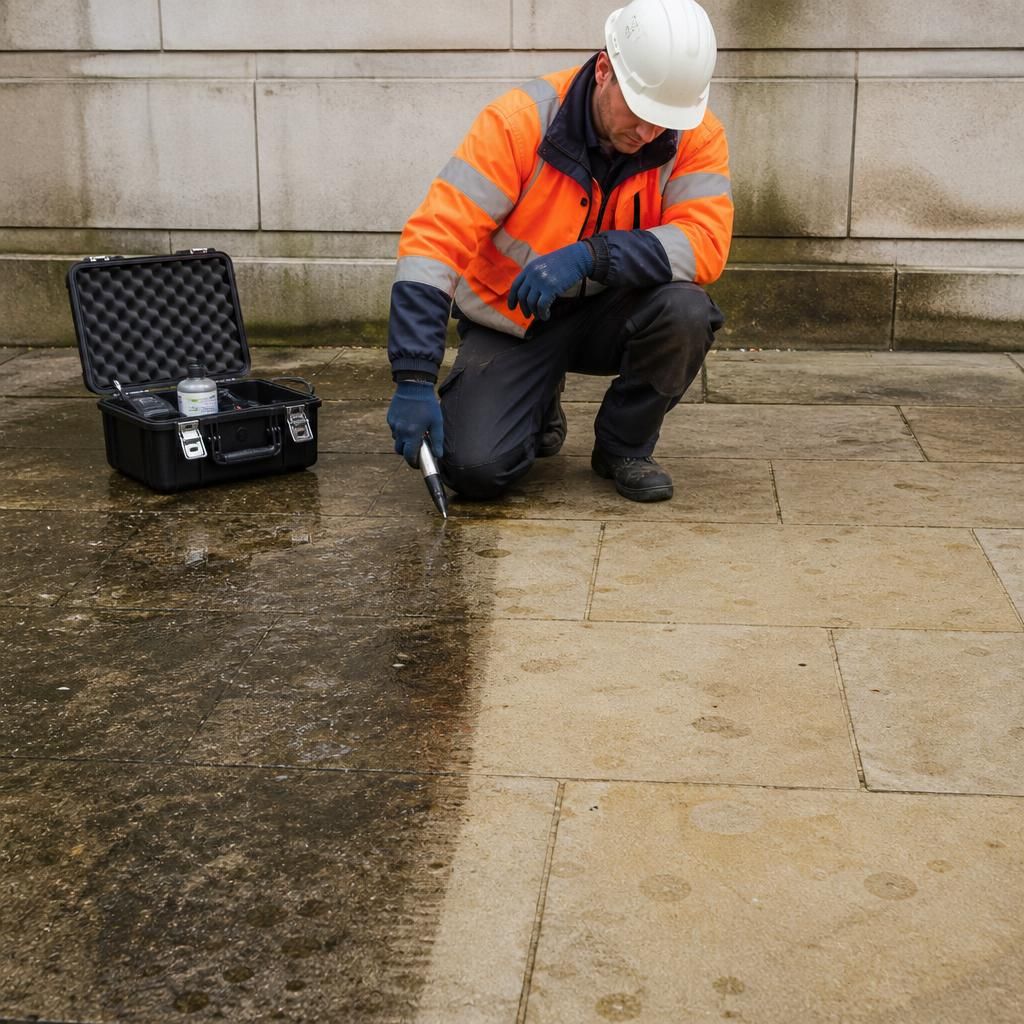
Choosing between pressure washing and steam cleaning for concrete and stone should begin with a small test area, rather than the appearance of the surface alone. Testing shows how the material, existing damage, pointing, coatings and contamination respond to each method before work is extended across the site.
A controlled test should use conservative pressure, temperature, nozzle distance and cleaning solution settings. After the area has dried, it should be checked for colour change, surface erosion, disturbed joints, increased staining or visible differences from the untreated surface. This is particularly important for porous sandstone, weathered concrete and historic masonry, where damage may not be immediately obvious while the surface is wet.
The test result helps determine whether pressure washing, steam cleaning or a combination of both will provide the required finish with the lowest practical risk. It also allows the cleaning specification, wastewater controls and access arrangements to be agreed before larger-scale work begins.
Request a Concrete and Stone Cleaning Assessment
Request a concrete and stone cleaning assessment to establish whether pressure washing, steam cleaning or a combined approach is suitable for your surfaces. We can review the material, condition, soiling, access and water-management requirements before preparing a practical cleaning specification.