
How does the choice of cleaning method impact the preservation of historical stone and concrete structures?
The choice of cleaning method directly affects whether historical stone and concrete structures are preserved or damaged. Low-impact techniques such as controlled steam cleaning are often preferable for delicate or weathered surfaces, while pressure washing should only be used at carefully selected pressures after assessing the material, condition, joints and existing coatings.
The cleaning method used on a historical stone or concrete structure can determine whether its original surface is preserved or progressively damaged. The safest approach is usually the least aggressive method that removes the identified soiling without eroding the substrate, opening joints, driving water into the structure or stripping historically significant finishes. Controlled steam cleaning, gentle low-pressure washing and carefully selected specialist cleaning agents may all be appropriate, but the correct choice depends on the material, its condition, the type of contamination and the significance of the surface.
Why historic surfaces require particular care
Older stone and concrete are not necessarily equivalent to modern construction materials. Weathering, previous repairs, rising damp, freeze-thaw action, settlement and the loss of protective coatings can leave them more porous and vulnerable. Sandstone and other softer stones may have a weakened outer layer, while limestone can react adversely to unsuitable acidic products. Historic concrete may contain exposed aggregate, decorative finishes, cement-rich details or early repair materials that respond differently to cleaning.
The surface may also contain evidence of the building’s history. Patina, limewash, mineral staining and aged coatings are not always defects that should be removed. Cleaning that produces a uniform, bright appearance can erase original finishes and alter the character of a heritage structure. Before work begins, it is therefore important to distinguish harmful soiling, such as biological growth or corrosive deposits, from stable weathering that contributes to the building’s significance.
How pressure washing affects preservation
Pressure washing can remove traffic film, loose dirt, algae, moss, surface deposits and some coatings efficiently, particularly from sound concrete and robust stone. However, the pressure, nozzle type, working distance, water volume and operator technique all affect the result. A powerful jet can remove the weathered face of sandstone, enlarge existing pores, dislodge aggregate from concrete or wash out soft mortar joints. It can also force water behind slabs, into cracks and beneath coatings, creating problems that may not be visible immediately.
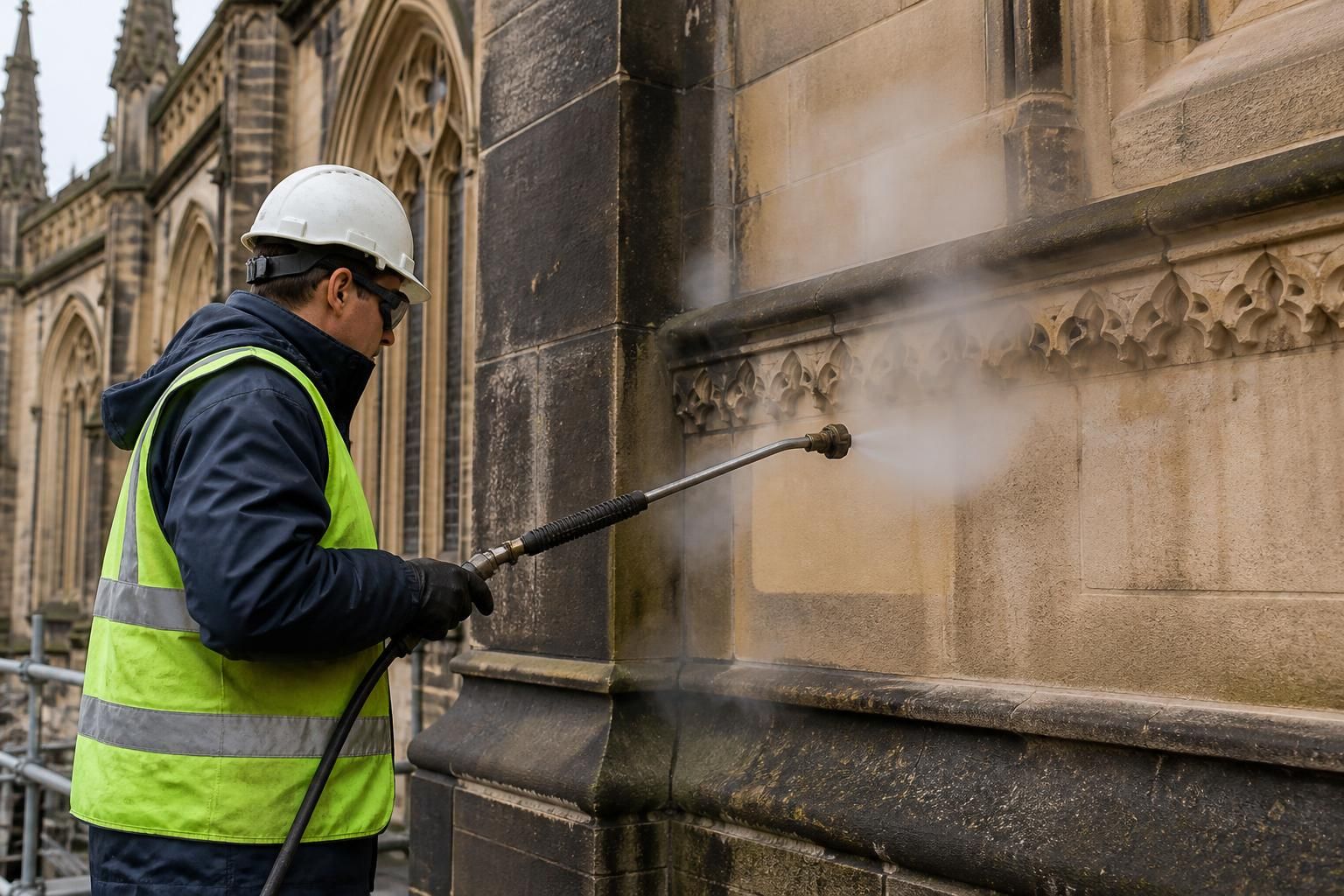
Pressure washing should not be selected simply because a surface appears heavily soiled. The substrate must first be inspected for scaling, delamination, open joints, spalling, previous patch repairs and areas of trapped moisture. Where pressure washing is appropriate, it should be carried out at the lowest effective setting, with suitable spray control and careful protection of joints, openings and vulnerable details. A broad, controlled spray is generally preferable to a concentrated jet, while rotary or abrasive attachments require particular caution on historic surfaces.
How steam cleaning affects preservation
Controlled steam cleaning generally uses lower mechanical force than conventional pressure washing. It can soften greasy deposits, biological growth, atmospheric grime, some paints and carbon-based staining, allowing contamination to be removed with less abrasion. This can make it suitable for carved stone, older masonry, decorative concrete and façades where retaining the surface profile is important.
Steam is not automatically risk-free. Heat and moisture can still affect friable stone, failing coatings, poorly bonded repairs and structures with existing damp problems. Rapid temperature changes may stress some materials, and water can enter open joints or cracks if the operator works too aggressively. Steam cleaning must therefore be controlled according to the material and condition, with attention to dwell time, runoff and drying. It should not be treated as a universal substitute for assessment.
The role of chemical cleaning agents
Chemical cleaners can be useful where deposits cannot be removed safely by water alone. Biocidal treatments may help control algae, moss and lichen, while specialist formulations can address oils, soot, paint or other bonded contamination. The chemical must be compatible with the stone, concrete, mortar, metalwork, glazing and surrounding landscaping. Incorrect products can etch limestone, discolour concrete, attack joints, leave residues or accelerate corrosion in embedded or adjacent metal.
Application time, dilution, temperature and rinsing are as important as product selection. A cleaner that is suitable for dense concrete may be inappropriate for porous sandstone. Products should be tested in a discreet area and fully removed or neutralised where required. Runoff must also be contained and managed so that cleaning residues do not enter drains, soil or watercourses.
Why abrasive methods are often unsuitable
Abrasive blasting, aggressive mechanical cleaning and hard brushing can remove contamination quickly, but they may also remove the original surface. On historic sandstone, the loss of the weathered face can expose softer material underneath. On concrete, abrasive action may reveal aggregate, alter the texture or remove a protective cement-rich layer. These methods can also leave the surface more receptive to water and pollutants.
Such techniques should only be considered after less aggressive options have been rejected and the work has been authorised where heritage controls apply. In many cases, the apparent efficiency of abrasive cleaning is outweighed by the need for repairs, repointing or replacement of damaged material.
Assessment and testing before cleaning
A preservation-led cleaning specification should begin with a condition survey. This should record the material type, areas of deterioration, previous repairs, joints, coatings, biological growth, staining and sources of moisture. The cause of the soiling should be considered as well as its appearance. For example, recurring algae may indicate persistent dampness, while white deposits may be associated with salts migrating through the masonry. Removing the visible deposit without addressing the cause is unlikely to provide a lasting solution.
Small test patches should be carried out using the proposed method, equipment and cleaning agent. The test should be reviewed after the surface has dried, because wet stone can conceal colour changes, etching and disrupted texture. A suitable method should remove the unwanted deposit while retaining the original profile, patina and joint integrity. Test results should be recorded so the agreed approach can be applied consistently across the elevation.
Considerations specific to stone and concrete
- Sandstone: Usually requires restrained pressure and careful moisture control because its open structure can be friable and absorbent. Strong chemicals and abrasive techniques can cause irreversible surface loss.
- Limestone: May be sensitive to acidic cleaners, which can dissolve or etch the mineral surface. Neutral or compatible specialist treatments are generally safer where chemical cleaning is necessary.
- Granite and dense stone: Can tolerate more mechanical action when sound, but polished, carved or repaired areas may still be vulnerable to uneven cleaning and staining.
- Historic concrete: May contain exposed aggregate, decorative textures or weak surface layers. Excessive pressure can cause spalling, surface erosion or loss of detail, particularly where reinforcement corrosion has already caused cracking.
- Mortar and joints: Often deteriorate sooner than the surrounding stone or concrete. Water jets and strong chemicals can widen joints, remove pointing or allow further water penetration.
Preservation does not always mean maximum visual removal
The objective should be a stable, sound and appropriately clean surface rather than the brightest possible finish. Some staining may be embedded in the material or linked to historic weathering and cannot be removed without unacceptable loss of the substrate. Where complete removal would require damaging the original surface, retaining a small amount of stable discolouration may be the more responsible conservation decision.
After cleaning, the structure should be inspected for newly exposed defects, open joints, trapped moisture and areas requiring repair. Repointing, drainage improvements, removal of vegetation or compatible protective treatments may be needed to prevent the same contamination returning. Any protective coating should be breathable and demonstrably compatible; impermeable coatings can trap moisture and salts within historic masonry.
For listed or otherwise protected structures, the proposed method may need to be reviewed by the responsible conservation professional or relevant authority before work starts. A written record of the inspection, test patches, products, equipment settings, weather conditions and completed areas provides a useful maintenance history and helps ensure future cleaning is carried out consistently.
In practice, preservation is best supported by a planned combination of inspection, testing and controlled cleaning. Low-impact steam or gentle washing may be suitable for one elevation, while a different method may be required for a sound concrete plinth, a painted section or a heavily contaminated access area. Selecting the least aggressive effective method protects the historic fabric, reduces avoidable repairs and maintains the structure’s appearance without sacrificing its original material.
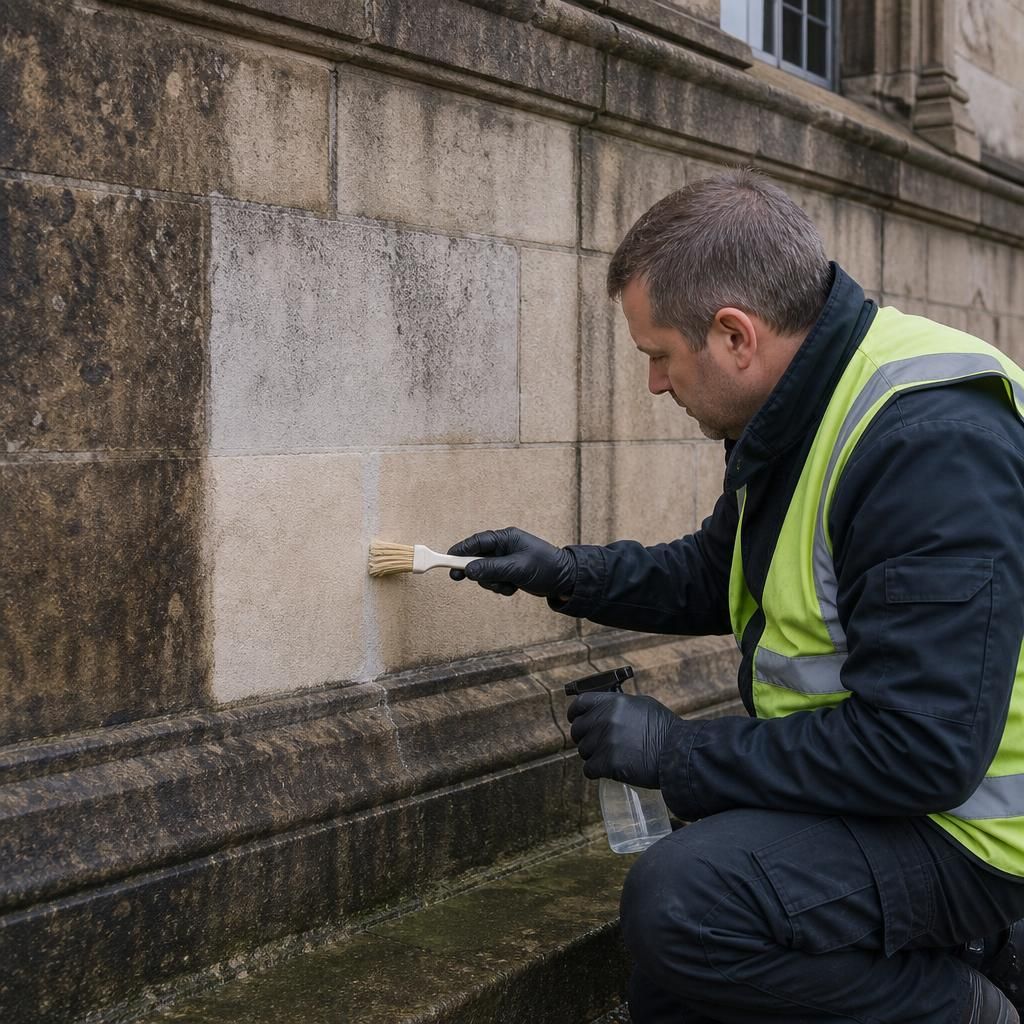
Test patches are essential when cleaning historical stone or concrete because they show whether a proposed method removes soiling without damaging the original surface. A discreet area should be treated using the intended equipment, pressure, temperature and cleaning product before work proceeds across the wider structure.
The test area should be assessed after it has fully dried. This helps reveal etching, colour changes, surface erosion, disturbed joints or altered texture that may not be visible while the material is wet. If the deposit can only be removed by damaging the substrate, retaining some stable staining is usually preferable to losing historic fabric. The approved method and settings should then be recorded so the cleaning remains consistent across the elevation.