
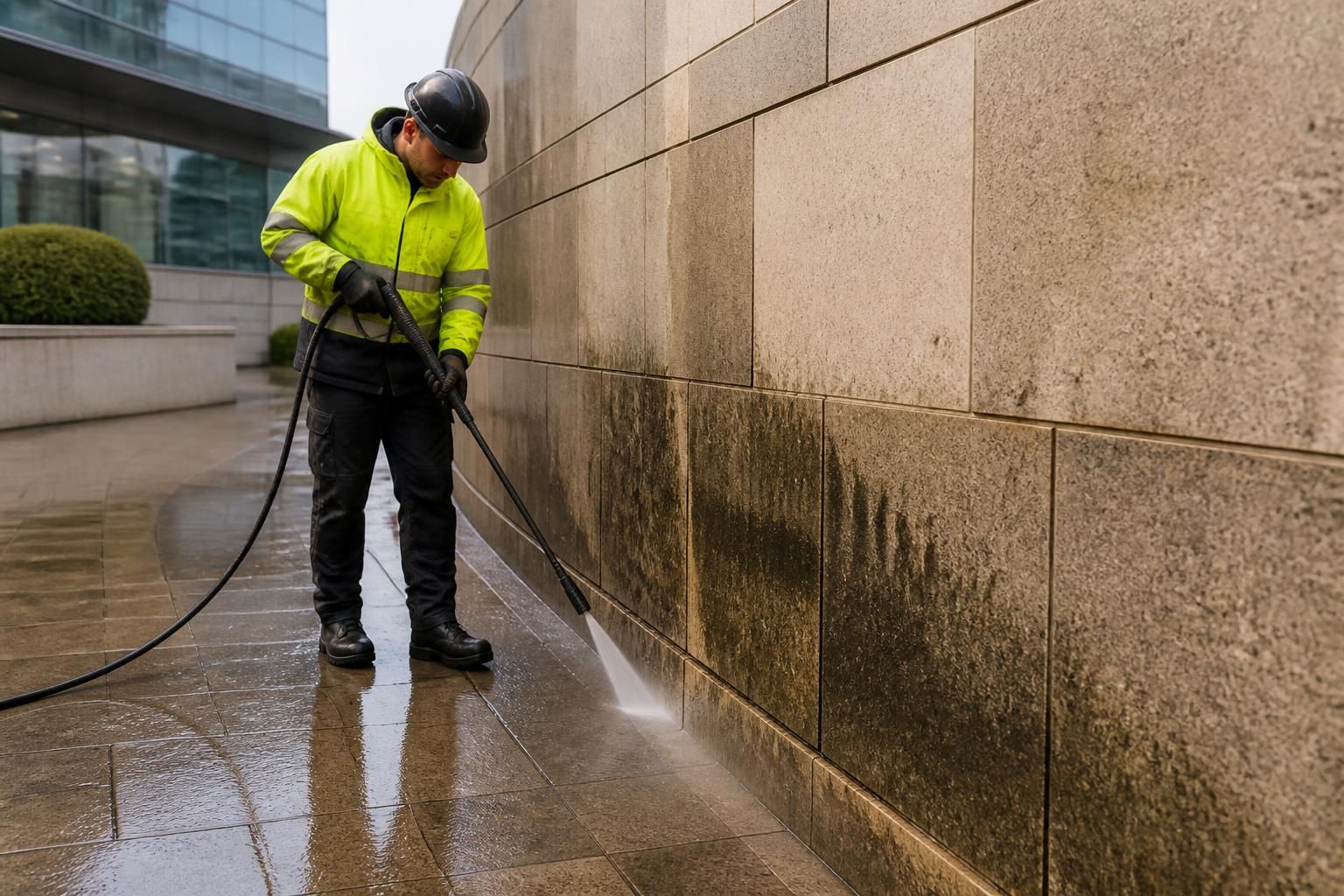
How does regular maintenance of concrete and stone surfaces contribute to their longevity and appearance?
Regular maintenance removes dirt, algae, staining, salts and other contaminants that can retain moisture and accelerate surface deterioration. It helps prevent cracking, spalling, staining and discolouration, extending the service life of concrete and stone while preserving a clean, professional appearance.
Regular maintenance extends the service life of concrete, stone and sandstone surfaces by removing contaminants that hold moisture, encourage biological growth and accelerate deterioration. It also preserves colour, texture and uniformity, helping external areas remain clean, safe and professional in appearance.
Concrete and natural stone are durable materials, but neither is maintenance-free. Their surfaces are exposed to rainfall, frost, traffic, atmospheric pollution, oil, organic debris and repeated wetting and drying. Without suitable cleaning and inspection, these contaminants can gradually affect both the appearance and the condition of the surface.
How maintenance protects the surface
- Controls moisture retention: Algae, moss, soil and accumulated debris can remain damp for long periods. Keeping surfaces clear reduces prolonged moisture exposure, which can contribute to surface erosion, frost-related damage and the breakdown of joints or edges.
- Reduces staining and discolouration: Oil, rust, food residues, traffic film and atmospheric soiling can become increasingly difficult to remove when allowed to penetrate porous concrete or stone. Early treatment is generally more effective and less aggressive than removing established staining.
- Limits biological growth: Moss, algae and lichen can make paving, steps, ramps and access routes slippery. Their removal supports safer pedestrian areas while reducing the risk that roots or organic matter will work into joints and small surface defects.
- Helps prevent spalling and surface breakdown: Contamination does not directly cause every defect, but it can conceal cracks, failed joints, delamination and areas of weak concrete. Routine cleaning makes these conditions easier to identify and address before they spread.
- Protects the appearance of the material: Consistent cleaning prevents isolated dark patches, tide marks and contrasting areas caused by uneven weathering. This is particularly important on building façades, entrances, courtyards, car parks and public-facing commercial premises.
Maintenance also supports early defect detection
A clean surface is easier to inspect. During planned maintenance, operatives can identify cracking, open joints, loose aggregate, efflorescence, rust staining, damaged pointing and areas where water is collecting. These observations can be recorded and referred to the appropriate building, paving or structural specialist where necessary. Cleaning will not repair structural defects, but it can help ensure that emerging problems are not hidden beneath layers of dirt or biological growth.
On concrete, regular maintenance can help manage surface contamination before it becomes embedded in pores and textured finishes. On sandstone and other natural stones, it helps preserve the original colour and profile by preventing deposits from building up in recesses and softer areas. However, stone varies considerably in hardness, porosity, mineral composition and condition, so the cleaning approach must be selected for the specific material rather than applied as a standard treatment.
The cleaning method must match the surface
Effective maintenance is not simply a matter of using the highest pressure available. Pressure washing can be suitable for robust concrete and some sound stone surfaces when the pressure, nozzle, distance and water volume are properly controlled. Steam cleaning may be more appropriate where lower mechanical impact, reduced water use or careful treatment of sensitive areas is required. Soft, weathered or historic stone may need a gentler process, preliminary testing and additional protection for joints, edges and decorative details.
Cleaning agents should also be selected according to the contaminant and the material. Oil, organic growth, rust and efflorescence may require different treatments, and some chemicals can discolour stone, damage adjacent surfaces or affect vegetation and drainage systems. A controlled test area helps confirm that the proposed method removes the contamination without changing the surface finish.
Planned maintenance is more effective than reactive cleaning
A suitable maintenance plan normally combines routine visual inspections, removal of loose debris, targeted cleaning and prompt attention to defects. The appropriate frequency depends on factors such as footfall, vehicle movements, exposure to pollution, shade, drainage, nearby trees, the type of contamination and the porosity of the material. Entrances, shaded areas, loading bays, car parks and locations beneath trees may need closer monitoring than lightly used open areas.
Cleaning should be scheduled with the wider site operation in mind. Areas need to be assessed for pedestrian and vehicle safety, drainage, electrical equipment, nearby façades, landscaping and access requirements. After cleaning, the surface should be allowed to dry where practical and checked for remaining staining, damaged joints or areas requiring repair. Removing the cause of recurring soiling, such as blocked drainage or overhanging vegetation, is an important part of long-term maintenance.
Appearance, safety and service life are connected
A well-maintained surface is less likely to develop concealed moisture problems and is easier to keep free from slip hazards and unattractive staining. Maintaining a consistent appearance can also support site presentation, property management standards and the condition of shared or public areas. Where concrete or stone forms part of an access route, maintenance should be coordinated with inspections of drainage, lighting, kerbs, steps and other surrounding features.
Regular professional cleaning is therefore a preventative measure rather than an occasional cosmetic service. By using an appropriate method, controlling water and cleaning agents, protecting adjoining surfaces and reporting defects, maintenance can slow avoidable deterioration and help concrete, stone and sandstone retain their functional performance and appearance for longer. It should be combined with timely repairs, sound drainage and any sealing or protective treatment that is suitable for the particular material and site conditions.

Regular maintenance makes concrete and stone surfaces easier to inspect, allowing early signs of deterioration to be identified before they become more extensive. Removing algae, moss, soil, oil and other deposits can reveal cracks, open joints, loose aggregate, efflorescence, rust staining, damaged pointing and areas where water is collecting.
Cleaning does not repair structural defects, but it helps distinguish surface contamination from damage requiring further attention. Recording these findings during planned maintenance supports timely repairs, improves safety on access routes and helps prevent avoidable moisture-related deterioration.