
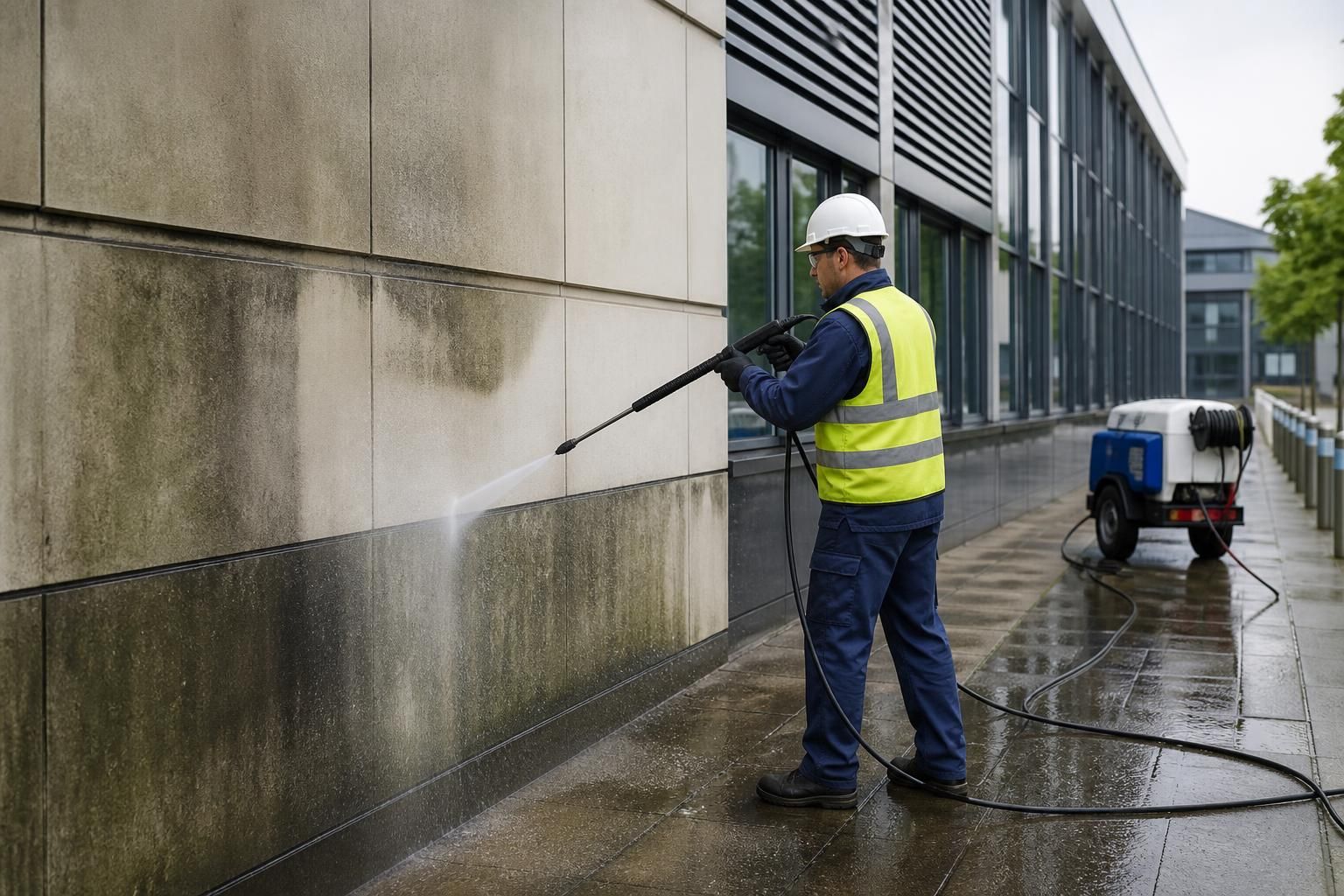
How does regular exterior cleaning impact the structural durability of concrete, stone, and sandstone surfaces?
Regular exterior cleaning protects the structural durability of concrete, stone and sandstone by removing dirt, algae, moss, pollutants and de-icing residues that can retain moisture and accelerate surface deterioration. Using an appropriate cleaning method and pressure prevents avoidable erosion, cracking, staining and water ingress, helping surfaces remain sound and serviceable for longer.
Regular, correctly specified exterior cleaning helps preserve the structural durability of concrete, stone and sandstone by removing contaminants that retain moisture, encourage biological growth and contribute to chemical or physical deterioration. It does not repair existing structural defects, but it can reduce the conditions that cause cracking, surface breakdown, staining, joint failure and water penetration when carried out with a suitable method and controlled pressure.
How contamination affects surface durability
Dirt, vehicle emissions, organic matter, algae, moss, bird deposits and de-icing residues can accumulate on external surfaces. These materials often hold moisture against the substrate and can obstruct drainage or conceal defects. Persistent dampness increases the risk of freeze-thaw damage during cold weather, while organic growth can extend into joints, pores and small cracks. As growth develops, it may loosen pointing, lift surface particles and make water penetration more likely.
Atmospheric pollution can also react with moisture and deposit acidic or staining compounds on concrete and natural stone. On concrete, this may contribute to surface soiling, reinforcement corrosion where carbonation and moisture have already reduced protection, and deterioration around cracks or exposed aggregate. On stone and sandstone, deposits can discolour the surface, block pores and accelerate the breakdown of weaker or more weathered areas.
Effects on concrete
Concrete is strong but porous. Water can enter through its capillaries, cracks, construction joints and damaged edges. Regular removal of dirt, moss and salts helps the surface dry more effectively and makes defects easier to identify before they become more extensive. Cleaning can also reduce slip risks on walkways, ramps and car parks where algae, oil residues or compacted grime have formed a film.
Cleaning must not be used to disguise concrete defects. Cracked slabs, spalled areas, exposed reinforcement, failing joints and sections showing movement require assessment before any work begins. High pressure applied to a deteriorated surface can remove weak cement paste, enlarge cracks or dislodge aggregate. Where reinforcement is exposed, water and cleaning operations may worsen corrosion if the underlying repair and protection requirements are not addressed.
Effects on stone and sandstone
Natural stone varies considerably in hardness, porosity, mineral composition and weathering resistance. Sandstone is particularly absorbent and may contain softer layers that respond poorly to aggressive pressure, abrasive techniques or unsuitable chemicals. Repeated contamination and wetting can encourage granular disintegration, where individual grains loosen from the face of the stone. Salt crystallisation can also exert pressure within pores as moisture evaporates, causing flaking, scaling or surface loss.
Careful cleaning removes harmful deposits without unnecessarily removing the stone’s weathered surface. This is especially important on façades, boundary walls, paving, steps and architectural features where the outer layer may provide some protection to the material beneath. Over-cleaning can leave a surface more open and vulnerable to future water uptake, so the objective should be controlled removal of soiling rather than making the substrate appear uniformly new.
Why the method and pressure matter
The durability benefit depends on matching the cleaning process to the material and its condition. Pressure washing can be effective on robust concrete and sound, dense stone, but the pressure, nozzle, distance, water volume and working pattern must be controlled. A test area should be used to confirm that the process removes contamination without etching the surface, opening pores, stripping coatings or damaging joints.
Steam cleaning or low-pressure hot-water cleaning may be more appropriate where deposits are bonded, biological growth is present, or the substrate is vulnerable to mechanical abrasion. Heat can help soften grime and reduce reliance on aggressive pressure or chemicals. It is not automatically suitable for every surface: thermal shock, trapped moisture, fragile coatings and pre-existing defects must be considered before work starts.
Cleaning agents should be selected for the specific contaminant and substrate. Incorrect acids, alkalis or solvents can discolour stone, attack cementitious materials, mobilise salts or damage surrounding metal, glass and landscaping. Dwell times must be controlled, and residues should be removed in accordance with the product and site requirements. Where possible, less aggressive methods and environmentally responsible solutions should be considered, with appropriate measures to prevent contaminated runoff entering drains or watercourses.
How regular cleaning supports preventative maintenance
A planned cleaning programme provides an opportunity to inspect the condition of the surface at intervals. Once deposits have been removed, it is easier to identify open joints, failed sealants, hairline cracking, localised dampness, staining caused by corrosion, displaced paving and areas of biological regrowth. Early reporting allows repairs, repointing, drainage improvements or water-management measures to be planned before deterioration affects a larger area.
The appropriate frequency depends on exposure, material, use and contamination levels. High-traffic car parks, loading areas, shaded elevations, coastal or heavily polluted locations, and sites exposed to winter gritting may need more frequent attention than sheltered, lightly used areas. Cleaning should be based on condition and risk rather than an arbitrary timetable. Excessive cleaning, particularly with high pressure, can itself contribute to wear.
Cleaning does not replace repairs or protection
Exterior cleaning removes damaging contamination, but it cannot restore lost material or correct movement, settlement, failed drainage or defective construction. Cracks, spalling, loose stone, persistent damp patches, open joints and recurring salt deposits should be investigated. After cleaning and drying, repairs may include repointing, concrete repairs, joint renewal, improved drainage or a compatible breathable protective treatment where appropriate.
Any protective treatment should be specified for the particular substrate and exposure conditions. On sandstone and other porous stone, an incompatible film-forming coating can trap moisture and accelerate deterioration. Breathability, vapour movement, appearance and future maintenance requirements should be considered before sealing or treating the surface.
Best practice for preserving structural condition
- Inspect concrete, stone and sandstone before cleaning, including joints, cracks, edges, coatings and drainage paths.
- Identify the contaminant and select the least aggressive effective process.
- Carry out a representative test clean and assess the result after the surface has dried.
- Use controlled pressure, suitable water temperature and compatible cleaning agents.
- Protect adjacent materials, fixtures, planting, vehicles and drainage systems from water and cleaning residues.
- Avoid forcing water into open joints, cracks, vents or building interfaces.
- Record defects exposed during cleaning and arrange remedial work where necessary.
- Schedule follow-up cleaning according to site conditions, contamination and material sensitivity.
For commercial and industrial premises, this approach makes cleaning part of planned fabric maintenance rather than an occasional cosmetic service. Properly managed, it helps concrete, stone and sandstone remain drier, easier to inspect and less exposed to the contaminants and moisture cycles that shorten service life. The main durability gain comes from consistent maintenance combined with technically appropriate cleaning, not from maximum pressure or the most intensive treatment.
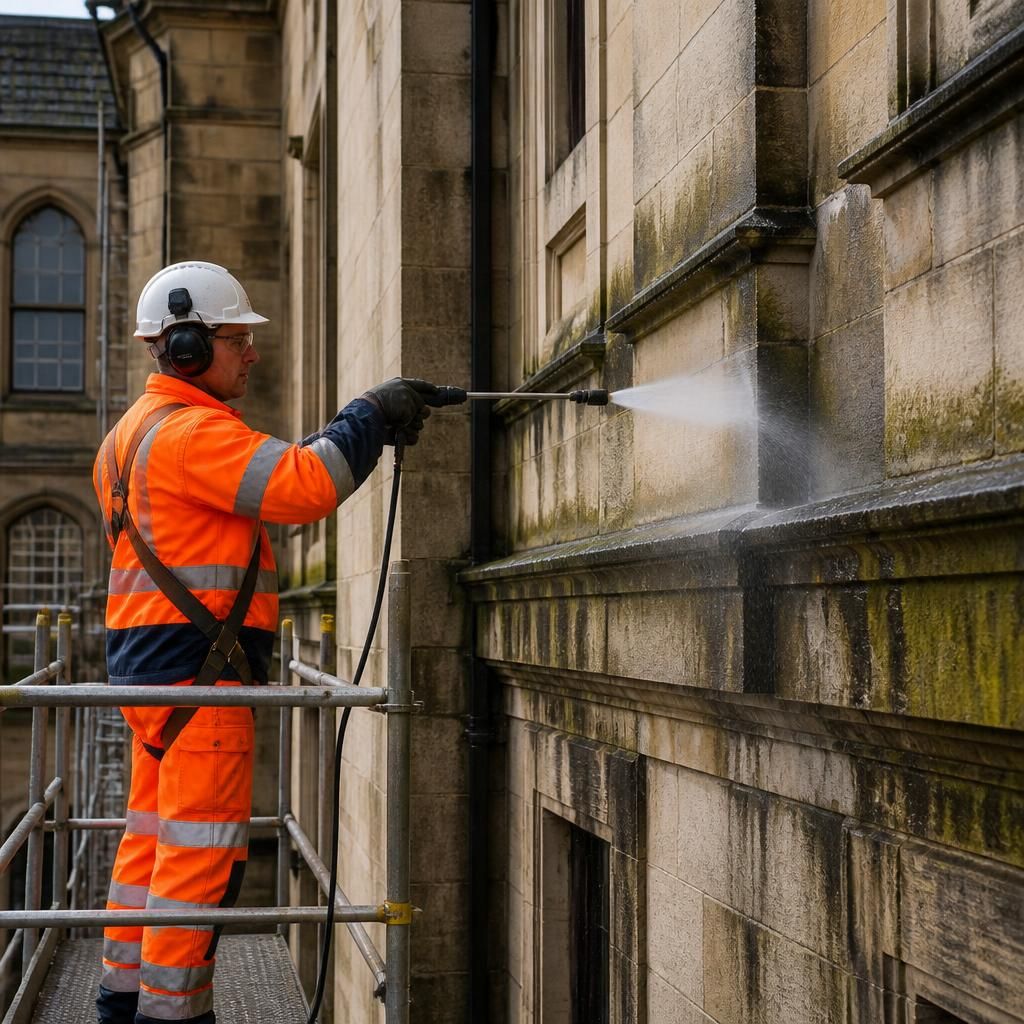
Regular exterior cleaning supports the structural durability of concrete, stone and sandstone by removing moisture-retaining contamination before it contributes to cracking, surface loss, joint failure or biological growth. The process must be controlled: excessive pressure, unsuitable chemicals or repeated aggressive cleaning can damage porous sandstone, weathered stone and weakened concrete.
Cleaning also provides a useful condition check. Once algae, moss, grime and salts have been removed, open joints, spalling, cracks, exposed reinforcement and persistent damp areas are easier to identify. These defects should be assessed and repaired rather than concealed through further cleaning. A suitable method, confirmed through a test area, helps preserve the sound surface while reducing the conditions that accelerate deterioration.