
How do pressure washing and steam cleaning differ when cleaning concrete, stone, and sandstone surfaces?
Pressure washing cleans concrete, stone and sandstone mainly through the mechanical force of pressurised water, while steam cleaning uses heated water vapour at lower pressure to loosen dirt, oil, biological growth and surface residues. Pressure washing is often effective on robust concrete and sound stone, whereas steam cleaning can provide more controlled cleaning for sensitive, weathered or historic surfaces when carried out by an experienced operator.
Pressure washing cleans concrete, stone and sandstone primarily through the mechanical force of pressurised water, while steam cleaning uses heated water vapour or low-pressure hot water to soften and lift contamination. Pressure washing is generally suited to sound, robust concrete and well-maintained stone; steam cleaning offers greater control for delicate, weathered, porous or historically significant surfaces. The correct choice depends on the material, its condition, the type of soiling and the required finish.
How pressure washing works
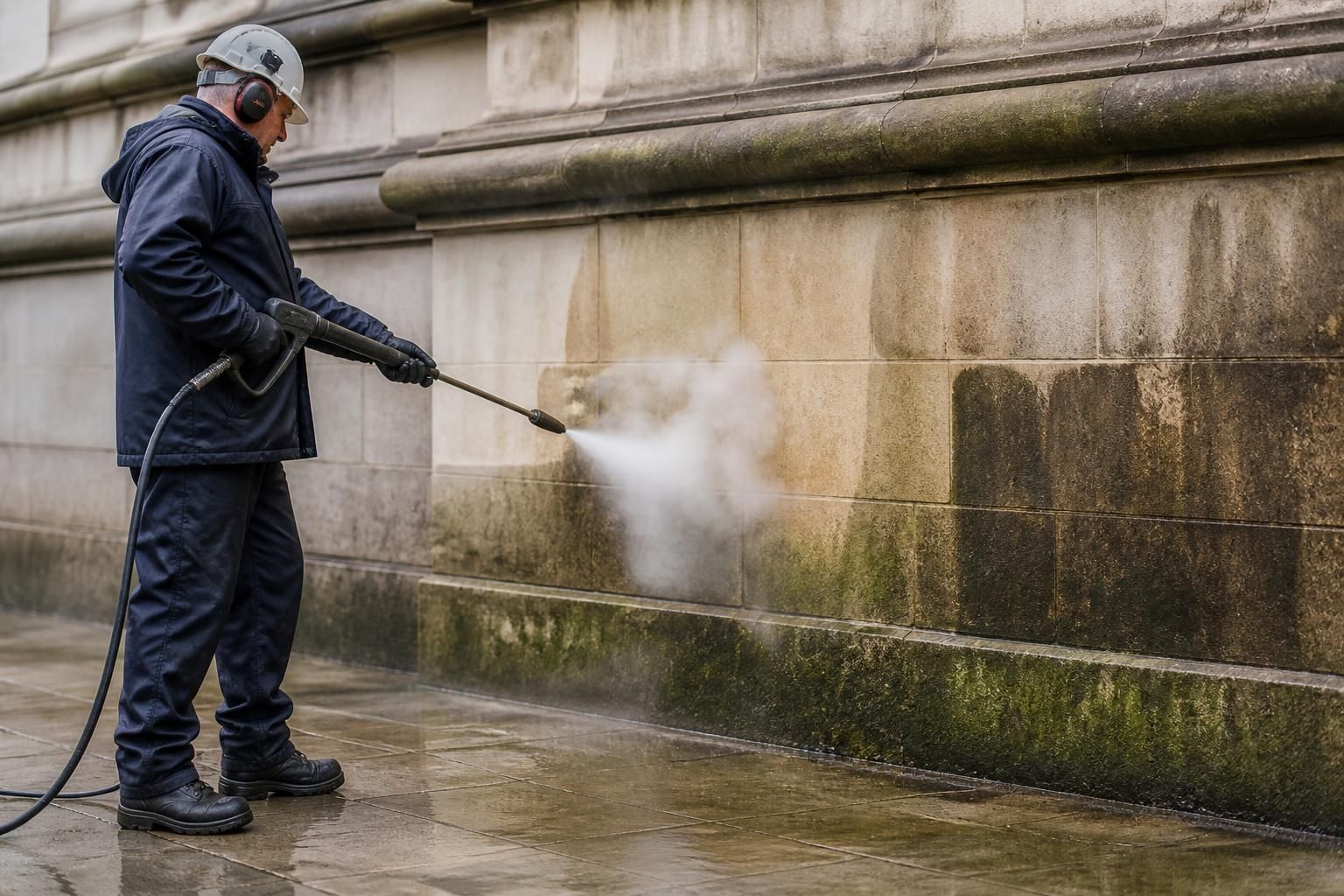
Pressure washing directs water through a specialised nozzle at sufficient pressure to dislodge dirt, algae, moss, lichen, traffic film, loose coatings and other surface deposits. On durable concrete and sound, dense stone, this mechanical action can remove heavy soiling efficiently across large areas such as paving, loading bays, car parks, steps and external walls.
Its effectiveness depends on more than the pressure rating of the equipment. The operator must select an appropriate nozzle, water flow, working distance and cleaning pattern. Excessive pressure or holding the lance too close to the surface can erode weak concrete, strip away a weathered surface, open existing cracks or drive water into joints and porous stone. A controlled approach is therefore essential, particularly where the surface contains exposed aggregate, decorative finishes or friable areas.
Pressure washing is particularly useful for:
- Sound concrete with embedded dirt, tyre marks or general traffic residue.
- Hard-wearing stone paving and steps that can tolerate mechanical agitation.
- Large external areas where rapid removal of loose and surface-level contamination is required.
- Surfaces requiring thorough rinsing after an approved cleaning treatment.
How steam cleaning works
Steam cleaning uses heat, moisture and controlled agitation to loosen contamination. The elevated temperature can soften oils, grease, chewing gum, biological residues and ingrained grime, allowing them to be removed with less reliance on high water pressure. Depending on the equipment and application, the process may use vapour, hot water at low pressure or a combination of heat and controlled rinsing.
Because the cleaning action is less dependent on force, steam cleaning can be preferable for aged, porous or vulnerable materials. It can reduce the risk of removing the surface patina, damaging delicate edges or disturbing weak mortar joints. However, low pressure does not make every surface automatically safe. Heat, moisture and repeated passes can still affect sensitive stone, old repairs, sealants and coatings if the method is poorly controlled.
Steam cleaning is often considered for:
- Sandstone and other porous materials where aggressive pressure could cause surface loss.
- Weathered or deteriorating stone with vulnerable edges, joints or repairs.
- Historic façades and structures where the existing surface character must be retained.
- Oil, grease, chewing gum and biological staining that responds well to heat.
- Areas where limiting splash and reducing the volume of rinse water is beneficial.
Differences when cleaning concrete
Concrete is usually more tolerant of pressure washing than sandstone, but its condition must still be assessed. Sound, well-cured concrete can often be cleaned effectively with a controlled pressure-washing system. Older concrete, exposed aggregate, cracked slabs, painted surfaces and areas with surface scaling require a gentler setting and careful testing.
Steam cleaning may be more suitable where concrete has oil contamination, gum deposits, delicate decorative finishes or localised staining. Heat can help release residues without relying solely on pressure. For extensive heavy soiling, a pre-treatment followed by pressure washing may be more efficient, provided the concrete is strong enough to withstand the process and wastewater is managed correctly.
Differences when cleaning natural stone
Natural stone varies considerably in hardness, porosity, mineral composition and weathering behaviour. Granite and some dense stones may tolerate controlled pressure well, whereas softer or more open-textured stones can suffer from pitting, discolouration or granular loss. Stone that appears sound may still have hidden cracks, failed pointing or areas weakened by frost and prolonged weathering.
Steam cleaning can provide a more measured method for removing surface dirt while limiting mechanical abrasion. It is not a universal solution, however. Some stains may require a compatible specialist treatment, and excessive heat or moisture can affect certain coatings, repairs or salts within the stone. A small test area should be used to confirm the result and check for colour change, surface disturbance and drying behaviour before full cleaning begins.
Differences when cleaning sandstone
Sandstone is comparatively porous and may contain softer layers or friable grains. High-pressure washing can dislodge particles, enlarge small defects and leave an uneven appearance if the cleaning action is too aggressive. It can also force water into the stone, joints and adjacent construction, which may increase drying time and contribute to salt movement or frost-related damage in unsuitable conditions.
For these reasons, sandstone commonly requires lower-impact cleaning, gradual testing and close observation. Steam or low-pressure hot-water cleaning may be appropriate where it can remove the contamination without abrading the surface. The operator should avoid concentrating the jet on edges, carved details, open joints or already weakened areas. Cleaning should also be planned around weather conditions so the stone can dry properly and any identified defects can be addressed.
Cleaning results and surface preservation
Pressure washing can produce a rapid visual improvement, but removing dirt is not the same as resolving the cause of staining. Algae, moss and lichen may return if moisture, shade or drainage issues remain. Oil can penetrate concrete and porous stone, while rust, efflorescence and atmospheric deposits may require different treatments. Steam cleaning can lift some of these deposits effectively, but it may also need to be combined with a compatible detergent, absorbent treatment or gentle rinsing.
The objective should be to remove harmful or unsightly contamination while retaining the sound surface and any appropriate aged character. Over-cleaning can be as damaging as under-cleaning, particularly on older masonry. A uniform bright finish is not always evidence of a successful treatment if it has been achieved by removing the surface layer or historic patina.
How the appropriate method is selected
A professional assessment should consider:
- The type and condition of the concrete, stone or sandstone.
- Whether the surface is porous, polished, textured, painted, sealed or previously repaired.
- The nature of the contamination, including biological growth, oil, grease, rust, atmospheric deposits or graffiti.
- The condition of joints, pointing, cracks, edges and drainage details.
- The age and historic significance of the structure.
- Access, surrounding materials, nearby occupants and the need to control spray or runoff.
- Wastewater collection and disposal requirements for the site.
Testing should begin in an inconspicuous area using the least aggressive method likely to achieve the required result. The test should be inspected after drying, as some damage, colour change or staining becomes apparent only when residual moisture has gone. The cleaning method can then be adjusted before work proceeds across the full elevation or paved area.
Using both methods on one project
Pressure washing and steam cleaning are not always alternatives. A project may use steam or hot-water treatment for grease, gum or delicate details, followed by controlled pressure washing on robust adjacent concrete. Different settings may also be required across one façade or site because stone condition, contamination and construction details vary. This combined approach can improve consistency while avoiding unnecessary force.
In all cases, cleaning should be followed by an inspection for remaining defects, displaced pointing, open cracks and areas requiring repair or protective treatment. Any sealant or surface treatment should only be applied once the material is clean, compatible and sufficiently dry. For commercial and industrial premises, a planned maintenance schedule can then reduce the build-up of contamination and limit the need for more intensive cleaning later.
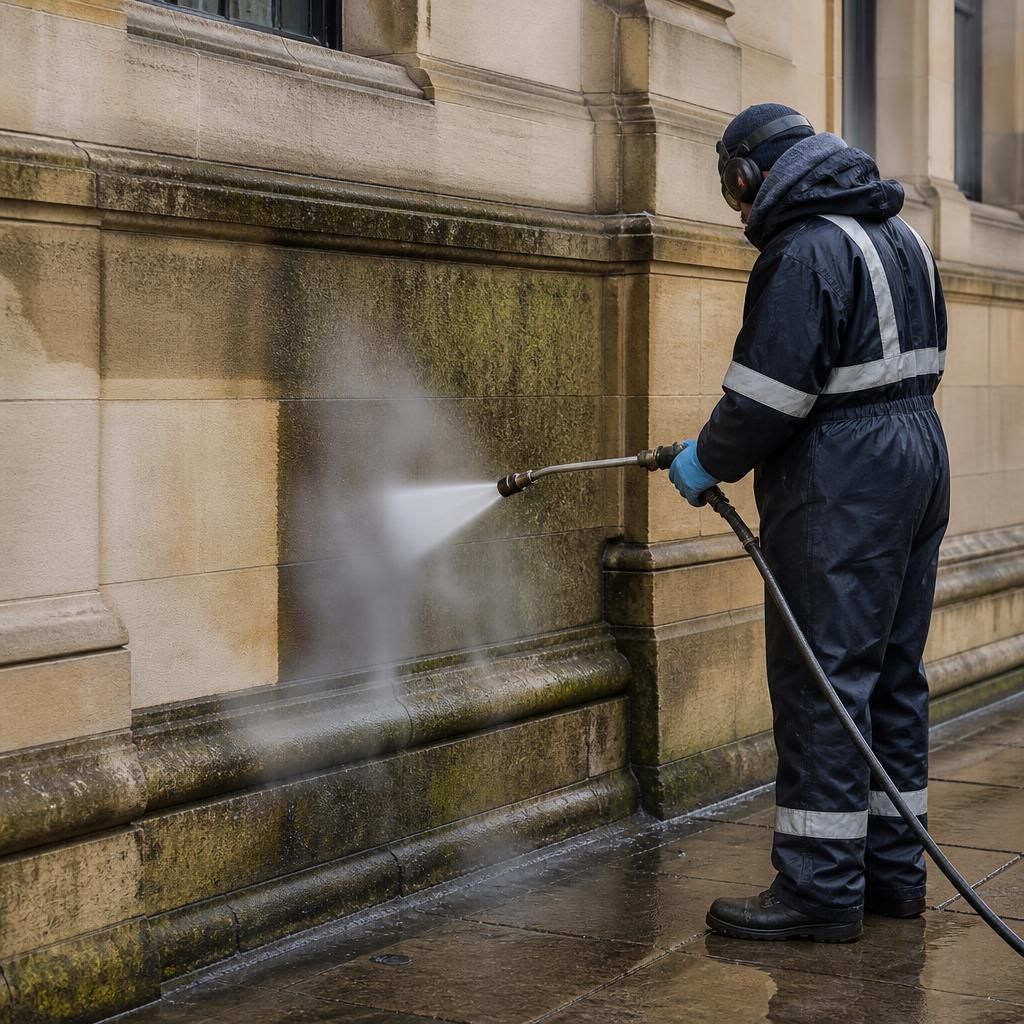
Steam cleaning uses heat with controlled pressure to loosen dirt while reducing the abrasive force applied to concrete, stone and sandstone. This can be particularly useful on porous or weathered sandstone, where conventional pressure washing may dislodge surface grains, damage edges or force water into open joints.
Pressure washing remains effective for sound concrete and robust stone when the pressure, nozzle and working distance are carefully controlled. The correct method should be confirmed with a discreet test area and reviewed after drying, as surface disturbance, colour changes and moisture-related staining may not be visible immediately. Where contamination varies across a site, steam cleaning and pressure washing can be combined to protect vulnerable areas while efficiently cleaning more durable surfaces.