
What are the key safety measures and precautions to follow when applying biocide treatments to roofs?
Safe roof biocide application requires a site-specific risk assessment, suitable access equipment, appropriate PPE and strict compliance with the product label and COSHH requirements. Protect people, roofing materials, vegetation and drainage systems by controlling runoff, preventing unauthorised access and using trained operatives to handle and apply the treatment.
Safe application of a biocide roof treatment depends on controlling chemical, access, environmental and public-safety risks before, during and after the work. A competent contractor should complete a site-specific risk assessment and method statement, follow the product label and safety data sheet, comply with COSHH requirements, and select access equipment and personal protective equipment (PPE) appropriate to the roof, chemical and surrounding site.
Complete a site assessment before starting. The assessment should identify the roof construction and condition, fragile areas, roof pitch, access points, skylights, rooflights, overhead services, nearby roads and occupied buildings. It should also consider wind exposure, weather conditions, drainage routes, watercourses, planted areas and the presence of members of the public, staff, vehicles or other contractors. Existing damage should be recorded, because biocide application will not make defective coverings, loose flashings or failed seals safe.
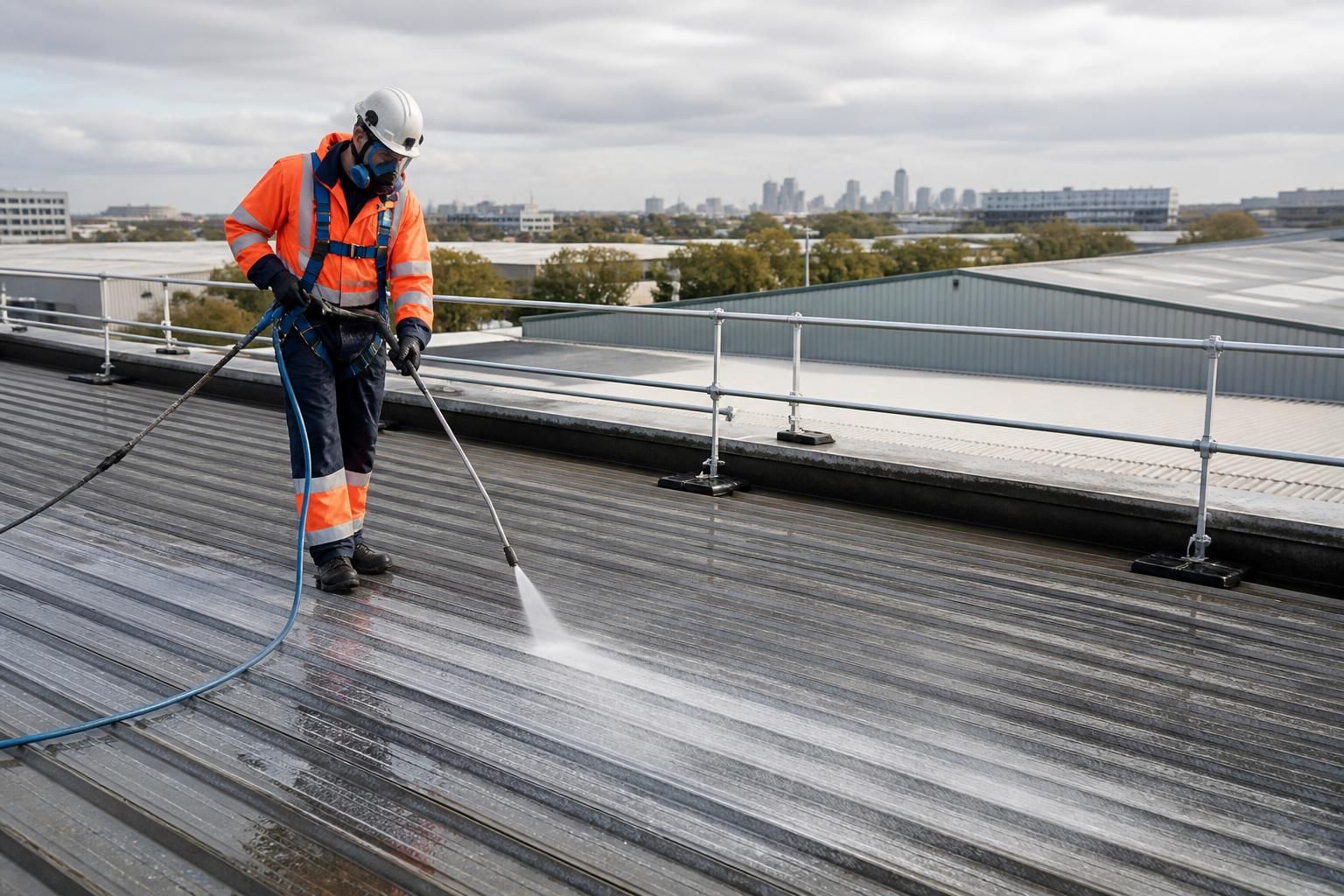
Work at height must be planned and carried out in accordance with the relevant UK requirements. Operatives should use a suitable combination of edge protection, scaffold, towers, mobile elevating work platforms, roof ladders, crawling boards or other access systems, depending on the site. Ladders should provide access rather than serve as a substitute for a safer working platform where prolonged work or two-handed spraying is required. Fragile roofs, rooflights and unsupported sheets must be identified and protected; operatives should never assume that a roof is safe to walk on because it appears sound.
Use only an appropriate, approved product and follow its instructions. The label and safety data sheet specify the permitted uses, dilution, application method, contact precautions, storage requirements and first-aid measures. A product intended for one surface or application method should not be substituted for another without confirming compatibility. Do not mix biocides with other chemicals, detergents or acids unless the manufacturer expressly permits it. Mixing can create hazardous reactions, reduce effectiveness or damage roofing materials.
Employers should assess exposure under the Control of Substances Hazardous to Health Regulations and provide suitable training, supervision and information. Operatives need to understand the product hazards, safe handling, spill response, emergency arrangements and waste controls. Product containers should remain clearly labelled, sealed when not in use and stored securely away from heat, ignition sources, food, drainage channels and unauthorised access.
Wear task-appropriate PPE. This commonly includes chemical-resistant gloves, protective clothing or coveralls, safety footwear with suitable grip, eye or face protection and respiratory protection where the product assessment and application method require it. PPE must be compatible with the biocide and maintained in good condition. It should be put on, removed and disposed of or cleaned in a way that prevents contamination. PPE is a final control, not a replacement for safe access, correct handling and good application procedures.
Protect people by establishing an exclusion zone below and around the work area. Use barriers and clear warning notices to prevent access beneath spray operations, particularly around entrances, pavements, loading bays and shared access routes. Coordinate with the site contact so that staff, visitors, residents and other contractors are kept away from the treated area. Vehicles, plant, air-conditioning intakes, windows and building entrances may need to be moved, isolated or covered to prevent contamination.
Check the weather before and during application. High winds can carry spray or mist onto people, vehicles, neighbouring property, glazing and vegetation. Rain can dilute the treatment, cause uncontrolled runoff or prevent the product from remaining on the roof for the required contact period. Very hot or rapidly drying conditions may also affect performance and increase the risk of drift. Work should be postponed when conditions fall outside the product instructions or the site risk assessment.
Application equipment should be selected and operated to minimise spray drift. Use the lowest practical pressure and a controlled application pattern rather than creating unnecessary mist. Check hoses, connections, lance controls and containers for leaks before use, and keep the equipment under the operator’s control. Do not spray towards people, open windows, ventilation intakes, electrical equipment or adjacent surfaces that have not been assessed as suitable for the treatment.
Prevent contamination of drainage systems and the wider environment. Before application, identify roof outlets, downpipes, gullies, soakaways, watercourses and areas of permeable ground. Where the product instructions and risk assessment allow, temporary protection or controlled collection may be used to prevent concentrated discharge. Runoff must not be allowed to enter surface-water drains, ponds, streams or planted areas unless the product is specifically approved for that situation and the discharge is managed as instructed. Do not block drainage in a way that creates flooding or building damage.
Vegetation, lawns, landscaped areas and adjacent façades should be protected from overspray and splash. The risk is not limited to visible staining: some biocides can harm plants, aquatic life, soil organisms or sensitive building materials. Any accidental spill or overspray should be dealt with immediately using the procedure in the safety data sheet. Contaminated absorbents, used containers and wash water should be handled and disposed of in accordance with the product instructions and applicable waste requirements, rather than poured into drains.
Inspect the roof and surrounding surfaces after treatment. Remove temporary protection only when it is safe to do so and confirm that outlets and gutters are clear. Check for visible runoff, pooling, damage to coverings, affected vegetation or contamination of nearby property. The site should be left secure, with warning information provided where the treated surface remains wet, slippery or subject to a specified re-entry period. The product label may require people or animals to be kept away until the surface is dry or another condition has been met.
Good records support safe ongoing maintenance. Keep the product details, batch or container information where relevant, risk assessment, method statement, application conditions, areas treated, dilution and any incidents or corrective actions. Record defects that need repair and agree when the roof should be inspected again. A biocide treatment should not be used to conceal a maintenance problem or replace repairs to damaged coverings, failed drainage or defective access systems.
Anyone exposed to the product should follow the first-aid instructions on the label and safety data sheet. In the event of skin or eye contact, inhalation or accidental ingestion, use the stated emergency procedure and seek medical advice where required. Spills should be isolated, kept away from drains and managed by trained personnel using suitable protective equipment. If the product, roof condition, access arrangements or environmental controls cannot be confirmed as safe, application should stop until a competent assessment and suitable controls are in place.
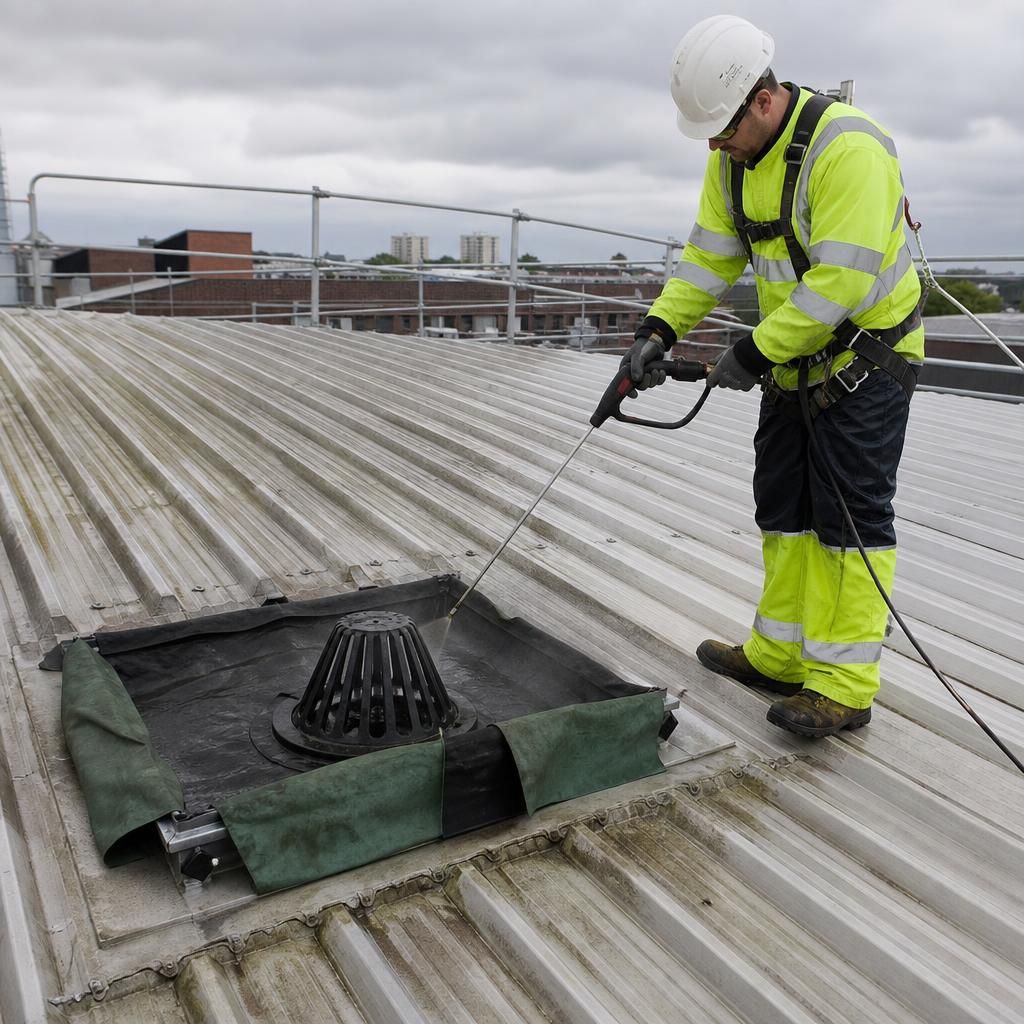
Preventing runoff and spray drift is a key safety requirement when applying biocide treatments to roofs. Before work starts, identify roof outlets, downpipes, gullies, soakaways, watercourses, planted areas and nearby surfaces that could be affected by the treatment.
Use the controls specified by the product instructions and risk assessment to keep concentrated biocide out of surface-water drains, ponds and soil. Protect vegetation, glazing, vehicles, air-conditioning intakes and building entrances from overspray, while avoiding any temporary measures that could cause flooding or damage to the roof. Application should be postponed in high winds or rain, and spray equipment should be operated at the lowest practical pressure to limit drift.
Any spill, overspray or contaminated wash water must be isolated and managed in accordance with the safety data sheet and applicable waste requirements. After treatment, check that gutters and outlets are clear and inspect surrounding areas for visible contamination before the site is reopened.