
How do biocide treatments compare to other roof cleaning methods in terms of effectiveness and long-term benefits?
Biocide roof treatments control moss, algae and lichen at their source, usually providing more gradual but longer-lasting results than pressure washing alone. Pressure washing gives an immediate visual improvement, but it can be more abrasive and may not prevent organic growth from returning; the most suitable approach depends on the roof material, its condition and the extent of contamination.
Biocide roof treatments are generally more effective for controlling moss, algae and lichen over the longer term, while pressure washing and manual cleaning provide a faster visible improvement. Biocides work by treating the organic growth at its source, but results develop gradually. The best method depends on the roof covering, its condition, the type and depth of contamination, access requirements and the level of disruption that can be accepted.
It is useful to distinguish between removing contamination and controlling its return. Mechanical methods such as pressure washing, brushing and scraping remove growth from the roof surface. A biocide treatment targets the organisms that remain in surface pores, joints and shaded areas, helping to reduce regrowth when it is applied correctly and supported by routine maintenance.
- Biocide treatments: These are applied to cleaned or lightly contaminated surfaces and left to act over time. Moss, algae and lichen may gradually weather away rather than disappearing immediately. This approach is usually less aggressive than high-pressure cleaning and can be suitable where preserving the roof covering is a priority.
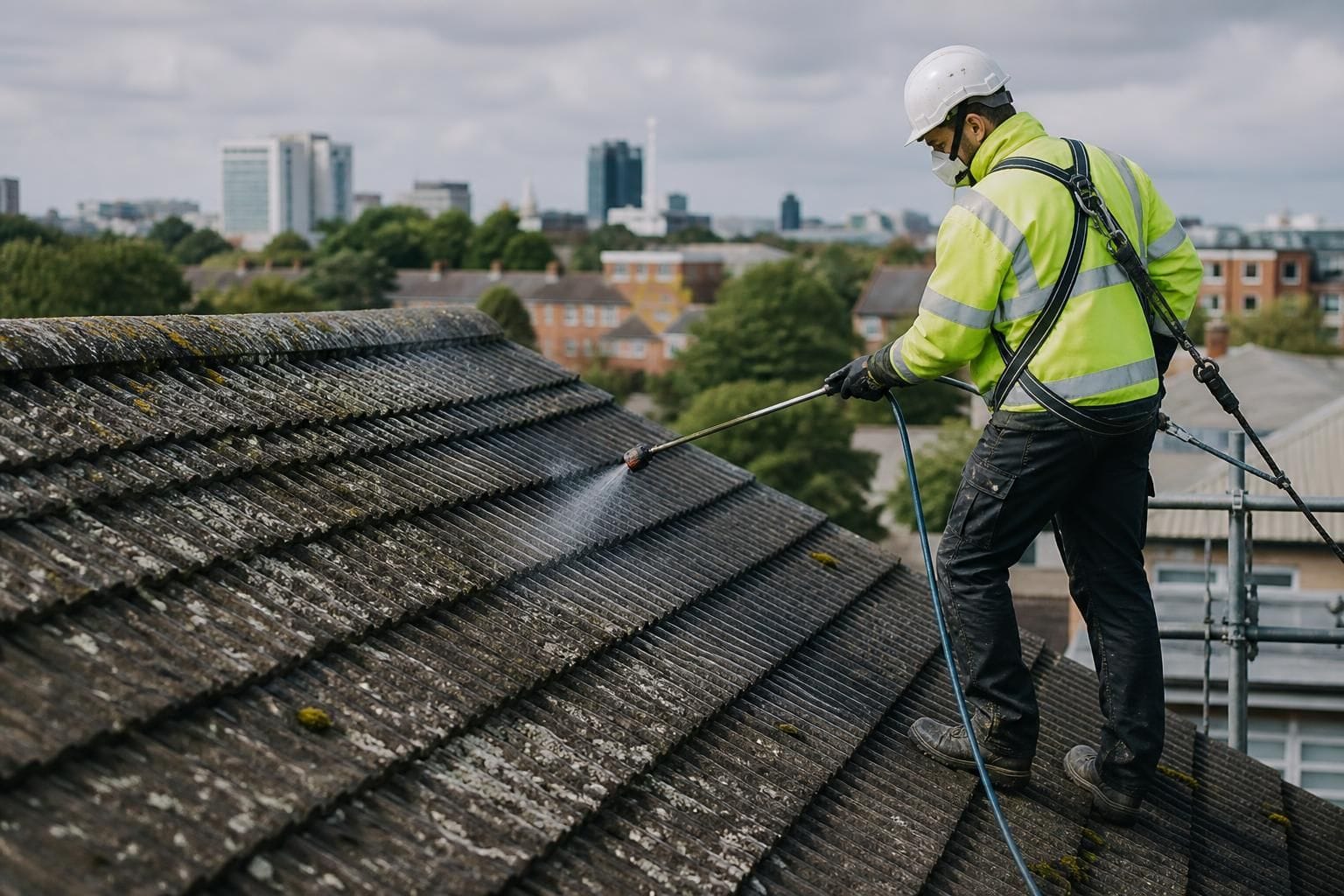
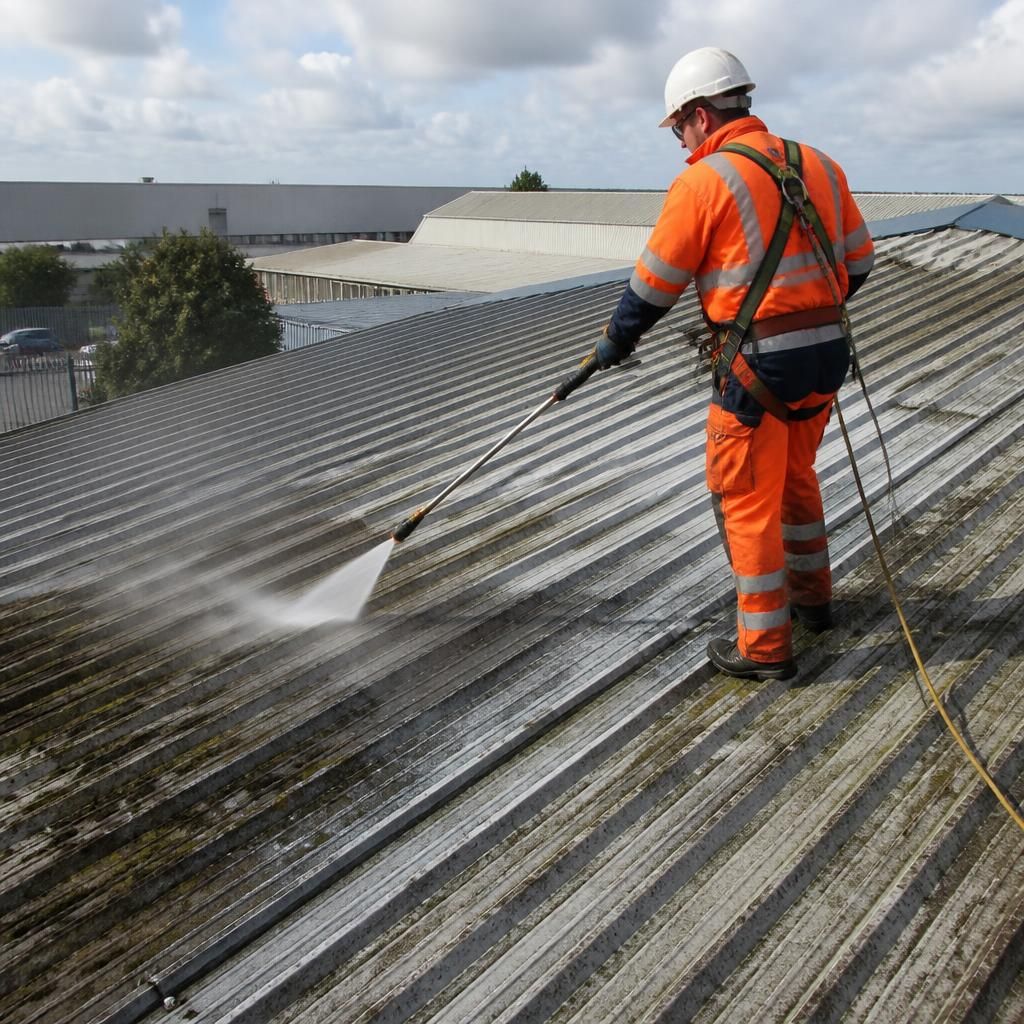
- Pressure washing: This can remove heavy surface contamination quickly and produce an immediate visual change. However, excessive pressure or an unsuitable nozzle can damage tiles, coatings, pointing, membranes and vulnerable roof details. It may also leave organic material in the surface, allowing growth to return if no suitable treatment follows.
- Manual scraping and brushing: This offers good control on fragile or uneven areas and limits the use of water. It is labour-intensive, may not remove staining embedded in the surface and must be carried out carefully to avoid breaking tiles or disturbing protective finishes.
- Steam cleaning: Low-pressure steam can remove some organic growth and staining with less mechanical force than conventional pressure washing. Its suitability depends on the roof material, moisture tolerance, access and the contractor’s ability to control heat and runoff.
- Combined cleaning and treatment: Where growth is established, controlled mechanical removal followed by a compatible biocide treatment can provide both an immediate improvement and longer-term biological control. The cleaning stage must still be proportionate to the roof’s condition.
The main long-term benefit of a biocide is reduced biological activity on the roof surface. Moss can retain moisture, lift or displace tiles, obstruct drainage channels and contribute to the deterioration of joints and roof-edge details. Algae and lichen can create persistent discolouration and, in the case of lichen, attach firmly to the surface. By addressing these organisms rather than only removing their visible growth, a correctly selected treatment can help maintain the roof’s appearance and reduce the frequency of intensive cleaning.
Biocide treatments are not an instant restoration process and should not be presented as a permanent solution. Their performance is affected by the product formulation, concentration, application method, weather conditions, roof exposure, shading, nearby vegetation and the amount of contamination present. Heavy moss may need to be removed first, and a follow-up inspection may be appropriate to confirm whether further treatment or maintenance is required.
Pressure washing may be preferable where a rapid result is essential and the roof covering is robust enough to tolerate the method. It is less suitable for aged, brittle, cracked, poorly fixed or heavily weathered materials. On some roofs, the force of water can drive moisture beneath tiles or into vulnerable areas, loosen surface material or expose defects that were previously protected by accumulated growth. A professional assessment should therefore take place before any pressure-based method is chosen.
For commercial and industrial premises, the most appropriate comparison is often not between one method and another, but between a one-off clean and a planned maintenance system. A contractor may recommend the following process:
- Inspect the roof covering, falls, drainage, access points and visible defects.
- Identify whether the contamination is moss, algae, lichen, dirt, pollution deposits or a combination of these.
- Select a cleaning method that is compatible with the roof material and its existing condition.
- Remove loose or heavy growth using controlled pressure, brushing or scraping where necessary.
- Apply a suitable biocide in accordance with the product requirements and site risk assessment.
- Manage overspray, runoff and collected debris so that surrounding surfaces, drains, vegetation and watercourses are protected.
- Record the completed work and schedule inspections or repeat treatment according to the roof’s exposure and rate of regrowth.
Biocide treatments can also reduce the need for repeated aggressive cleaning, which may help preserve roof coverings and finishes over time. This benefit is only achieved when the product is compatible with the material and applied by trained operatives. Treatment should not be used to conceal cracked tiles, failed flashings, blocked outlets or other defects that require repair.
Environmental and safety controls are important when comparing methods. Pressure washing uses more water and can create contaminated runoff, whereas biocide application requires careful control of chemicals, wind, spray drift, drainage and nearby plants. The chosen product should have clear instructions for use, storage and disposal, and operatives should use appropriate personal protective equipment. Where a roof drains towards sensitive landscaping or surface water, containment and runoff management should be agreed before work begins.
In practical terms, biocide treatment is usually the stronger option for long-term control of moss, algae and lichen, whereas pressure washing and other mechanical methods are stronger for immediate removal. Steam, brushing or scraping may be preferable on sensitive coverings or difficult details. A combined, low-impact cleaning and treatment programme often provides the best balance between appearance, roof protection, environmental control and future maintenance, provided the method is selected after a site-specific inspection.
Biocide treatments provide longer-term control of moss, algae and lichen, while mechanical cleaning methods such as brushing, scraping or pressure washing mainly remove visible growth. For heavily contaminated roofs, a controlled clean followed by a compatible biocide can combine an immediate improvement with reduced biological regrowth.
This approach must be matched to the roof covering and its condition. Excessive pressure can damage vulnerable tiles, coatings or roof details, while a biocide will not repair cracked materials, failed flashings or blocked drainage. A site-specific assessment is therefore important to determine whether treatment alone, gentle cleaning, steam cleaning or a combined method offers the best balance of appearance, roof protection and future maintenance.
Discuss the Right Biocide or Roof Cleaning Method
Discuss your roof’s covering, condition and level of organic growth with our team to identify whether a biocide treatment, gentle cleaning method or combined approach is most suitable. We can assess the roof and recommend a practical cleaning and maintenance plan.