
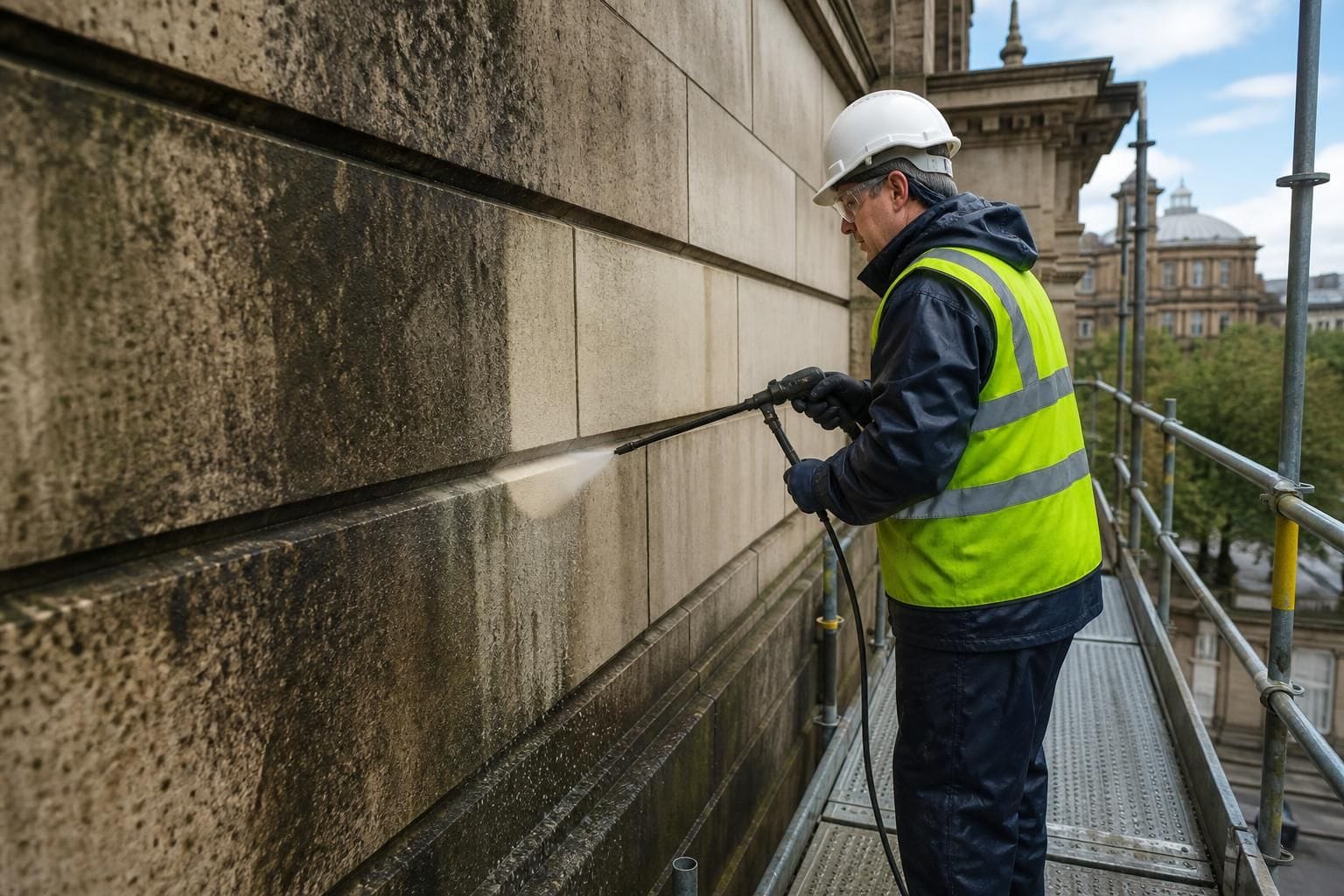
What factors should be considered when choosing bio cleaning over traditional methods for stone and cement?
Choosing bio cleaning over traditional methods for stone and cement depends on the surface material and condition, the type and severity of contamination, the risk of abrasion or chemical damage, environmental requirements, and the level of finish required. A professional assessment should also consider dwell time, access, wastewater controls and whether controlled mechanical cleaning or a combined approach would provide the safest result.
Choosing bio cleaning over traditional methods for stone and cement depends on the substrate, the type and age of the contamination, the required finish, environmental controls and the amount of time available for treatment. Bio cleaning can be the safer option where delicate stone, sensitive surroundings or restrictions on aggressive chemicals and abrasion are important, but it is not automatically suitable for every cement deposit. A professional assessment should confirm whether a biological or low-impact treatment will remove the contamination effectively, or whether it should be combined with carefully controlled mechanical cleaning.
Condition and type of surface
Stone is not a uniform material. Sandstone, limestone, natural cementitious surfaces, brickwork and repaired masonry can differ considerably in porosity, hardness, mineral content and sensitivity to water or chemicals. Weathered stone may have open pores, friable edges or existing surface loss, while newer cement and concrete can have a denser surface but still contain weak laitance, repairs or exposed aggregate.
Bio cleaning is more likely to be considered where preserving the surface texture and appearance is a priority. Traditional pressure washing, abrasive methods or strong chemical treatments can remove cement residues, but they may also enlarge pores, strip a surface coating, erode softer stone or alter the colour of the substrate. The method must therefore be selected for the actual material rather than simply for the appearance of the deposit.
Nature and severity of the cement contamination
Light cement film, mortar smears, construction residue and organic material mixed with cement may respond differently from thick, fully cured deposits. Bio cleaning or a specialist low-impact product may be appropriate for surface contamination that can be softened and removed progressively. Heavy, deeply bonded or aged cement may require more than one treatment stage and controlled agitation or rinsing.
It is important not to assume that a biological product will dissolve every hardened cement deposit. Cement is alkaline and mineral-based, and once it has cured it can be difficult to remove without a suitable chemical reaction or physical intervention. Where the deposit is substantial, the safest solution may be a combined process: controlled application to soften or reduce the residue, followed by gentle tools, low-pressure rinsing or steam cleaning. The objective is to remove the cement without transferring damage to the stone.
Risk of abrasion and chemical damage
Traditional cleaning includes several different approaches, including high-pressure water, abrasive cleaning, steam, alkaline products and acidic cement removers. Each has a different risk profile. Excessive pressure can drive water into porous masonry or dislodge weakened material. Abrasives can change the surface profile. Incorrectly selected acids may etch calcareous stone such as limestone or sandstone containing vulnerable mineral components, corrode nearby metals and affect joints or sealants.
Bio cleaning is often considered where a slower, more controlled reaction is preferable to aggressive treatment. However, the product still needs to be assessed against the stone, cement, joints, coatings and surrounding materials. “Biological” or “eco-friendly” does not mean risk-free. Application strength, dwell time, temperature, agitation and rinsing all affect the result, so the manufacturer’s instructions and a site-specific method statement should be followed.
Required appearance and level of finish
The desired result should be agreed before work starts. Removing loose cement from a historic façade is different from preparing a modern concrete surface for coating or returning a public walkway to a uniform appearance. A bio treatment may preserve more of the original texture, but it may not produce an instantly uniform finish where residues have penetrated pores or where the substrate has already been stained.
In some cases, retaining minor variation is preferable to over-cleaning. Removing every trace by force can expose repaired areas, create bright patches or leave a visibly different texture. A professional assessment should establish whether the requirement is residue reduction, complete cement removal, preparation for another treatment or general improvement of appearance.
Environmental and drainage requirements
Bio cleaning may be preferable where the site is close to planting, watercourses, landscaped areas or occupied premises and where reducing harsh chemical use is a priority. It can help limit the use of aggressive formulations and may be easier to manage in environmentally sensitive locations, subject to the product’s safety data and disposal requirements.
Environmental suitability must be assessed for the complete process, not just the cleaning product. Cement residue, removed coatings, suspended solids and the resulting wash water may still require containment, filtration, collection or controlled disposal. Drainage connections, surface water systems, nearby vegetation and local site rules should be considered before work begins. A product should only be used where its environmental claims, dilution requirements and disposal instructions are understood.
Time, access and operational constraints
Bio cleaning commonly requires adequate dwell time and may need repeated applications, particularly on porous stone or heavy contamination. This can make it less suitable where a façade, loading area or access route must be returned to service quickly. Traditional methods may provide faster visible removal, but speed should not override the risk of substrate damage or inadequate wastewater control.
Access also affects the choice. Work at height, confined areas and large façades may require platforms, mobile access equipment or other controlled systems. The method should minimise runoff, overspray and unnecessary handling while allowing the operatives to inspect the surface during cleaning. Where access is difficult, a slower treatment may reduce the need for force, but it still needs to be practical and safely managed.
Testing and compatibility
A small, representative test area is essential before full application. Testing should include sound and weathered sections, joints, repairs, different levels of contamination and any adjacent materials likely to be affected. The test should be left for an appropriate period so that colour change, residue, efflorescence, surface softening or delayed reaction can be identified.
The result should be assessed after rinsing and drying, rather than judged only while the surface is wet. A suitable test confirms the product, concentration, dwell time, agitation method, rinsing approach and expected finish. It also shows whether bio cleaning alone is sufficient or whether a controlled mechanical stage is required.
When a combined method is the better choice
Bio cleaning and traditional techniques are not always competing alternatives. A carefully planned combination can provide better control than relying on one method. For example, a low-impact treatment may loosen cement film, after which a non-abrasive tool and low-pressure rinse remove the softened material. Steam or gentle pressure may then be used to clear remaining residue, provided testing confirms that the stone can tolerate it.
This approach is particularly useful where the surface is valuable or vulnerable but the contamination is too extensive for a biological treatment alone. The least aggressive effective method should be used at each stage, with regular inspection to prevent over-cleaning.
Practical decision criteria
- Identify the stone, cement or concrete type, including repairs, joints, coatings and areas of deterioration.
- Determine whether the contamination is fresh, partially cured, fully hardened, porous, layered or mixed with organic staining.
- Assess the risks of pressure, abrasion, acidity, alkalinity, prolonged moisture and repeated treatment.
- Consider proximity to watercourses, planting, public areas, drainage systems and sensitive building materials.
- Allow for dwell time, repeat applications, access equipment, weather conditions and site operating hours.
- Define the required finish and decide whether complete removal is necessary or whether controlled residue reduction is more appropriate.
- Carry out and document a representative test area before committing to the full works.
- Plan containment, rinsing and wastewater management before cleaning starts.
Bio cleaning is generally the stronger choice when surface preservation, controlled treatment and environmental management outweigh the need for rapid removal, particularly on delicate or historically important stone. Traditional cleaning may be more appropriate for robust surfaces, heavy deposits or time-critical work, provided the selected pressure, chemical or abrasive method is demonstrably compatible. In many commercial and industrial settings, the most reliable decision is made through testing and a combined method statement rather than by treating “bio” and “traditional” cleaning as fixed categories.
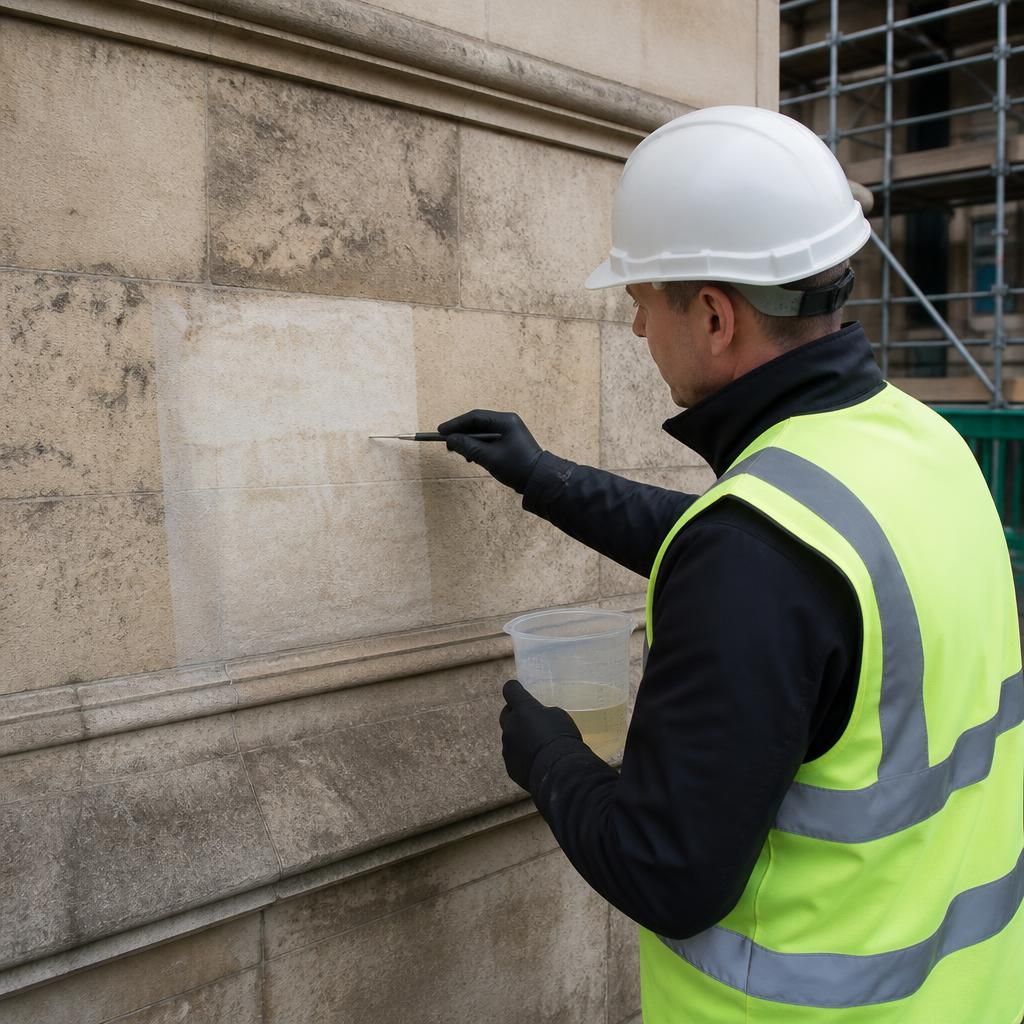
Choosing bio cleaning over traditional methods for stone and cement should be based on a controlled test area, not the product description alone. Testing shows whether the treatment can soften or remove the specific cement residue without damaging the stone, joints, coatings or adjacent materials.
The test should include both sound and weathered areas, with the proposed dilution, dwell time, agitation and rinsing method. Inspect the surface again after it has dried, checking for colour change, softening, residue, efflorescence or uneven cleaning. If bio cleaning reduces the deposit but does not remove it completely, a combined approach using gentle tools, steam or low-pressure rinsing may provide the safest finish. This evidence-led process helps confirm the most effective method before full-scale work begins.