
What are the most important safety considerations for industrial cleaning services?
The most important safety considerations for industrial cleaning services are thorough risk assessments, suitable personal protective equipment (PPE), safe use of pressure-washing and access equipment, hazardous-substance controls, and effective protection for workers, visitors, property and the environment. Work should be planned around site-specific hazards, carried out by trained personnel and monitored in line with relevant health and safety requirements.
Safe industrial cleaning depends on controlling the risks created by the site, the cleaning method, the substances being removed and the equipment required to reach or treat the work area. The essential controls are a site-specific risk assessment and method statement, competent and properly trained operatives, suitable personal protective equipment (PPE), safe management of access and machinery, effective control of chemicals and contaminated waste, and clear protection for employees, visitors, property and the environment.
Industrial cleaning should never be approached as a standard pressure-washing or housekeeping task. A factory, warehouse, plant room, construction site or external façade may contain moving machinery, electrical systems, fragile surfaces, hazardous residues, vehicle movements, work at height and restricted areas. The cleaning plan must therefore be based on the actual site conditions and revised when the scope, equipment or hazards change.
Risk assessment and method statements
Before work starts, the cleaning contractor should inspect the area and identify hazards associated with the premises, the cleaning activity and the substances present. The assessment should consider:
- Access routes, uneven ground, confined spaces, fragile roofs, open edges and work at height.
- Vehicle, forklift, plant and pedestrian movements.
- Electrical installations, overhead services, sensitive equipment and sources of ignition.
- Slips, trips and falls caused by water, oils, detergents, hoses, cables or debris.
- Dust, biological contamination, mould, oils, chemicals, metals and unknown residues.
- Water run-off, drainage capacity and the possibility of polluting land or surface-water systems.
- Weather conditions affecting external work, including wind, rain, ice, heat and visibility.
- Potential exposure of employees, visitors, members of the public and neighbouring premises.
The findings should be translated into a clear method statement explaining the work sequence, equipment, exclusion zones, control measures, emergency arrangements and responsibilities. Site rules and permit-to-work requirements must be followed, particularly where cleaning takes place near production lines, live electrical systems, confined spaces, hazardous substances or other contractors.
Competence, training and supervision
Only operatives with appropriate training, instruction and practical competence should carry out industrial cleaning. Training should match the work being undertaken rather than relying solely on general cleaning experience. Depending on the project, this may include safe pressure-washer operation, chemical handling, abrasive or steam-cleaning techniques, powered access, harness use, manual handling, traffic management and emergency procedures.
Equipment operators should understand the limitations of the machinery, including pressure, temperature, flow, reach, load capacity and the surfaces or materials that may be damaged. Supervisors should verify that controls are being followed throughout the work, not simply at the start. New hazards, changing weather, altered site operations or unexpected residues should trigger a review before cleaning continues.
Personal protective equipment
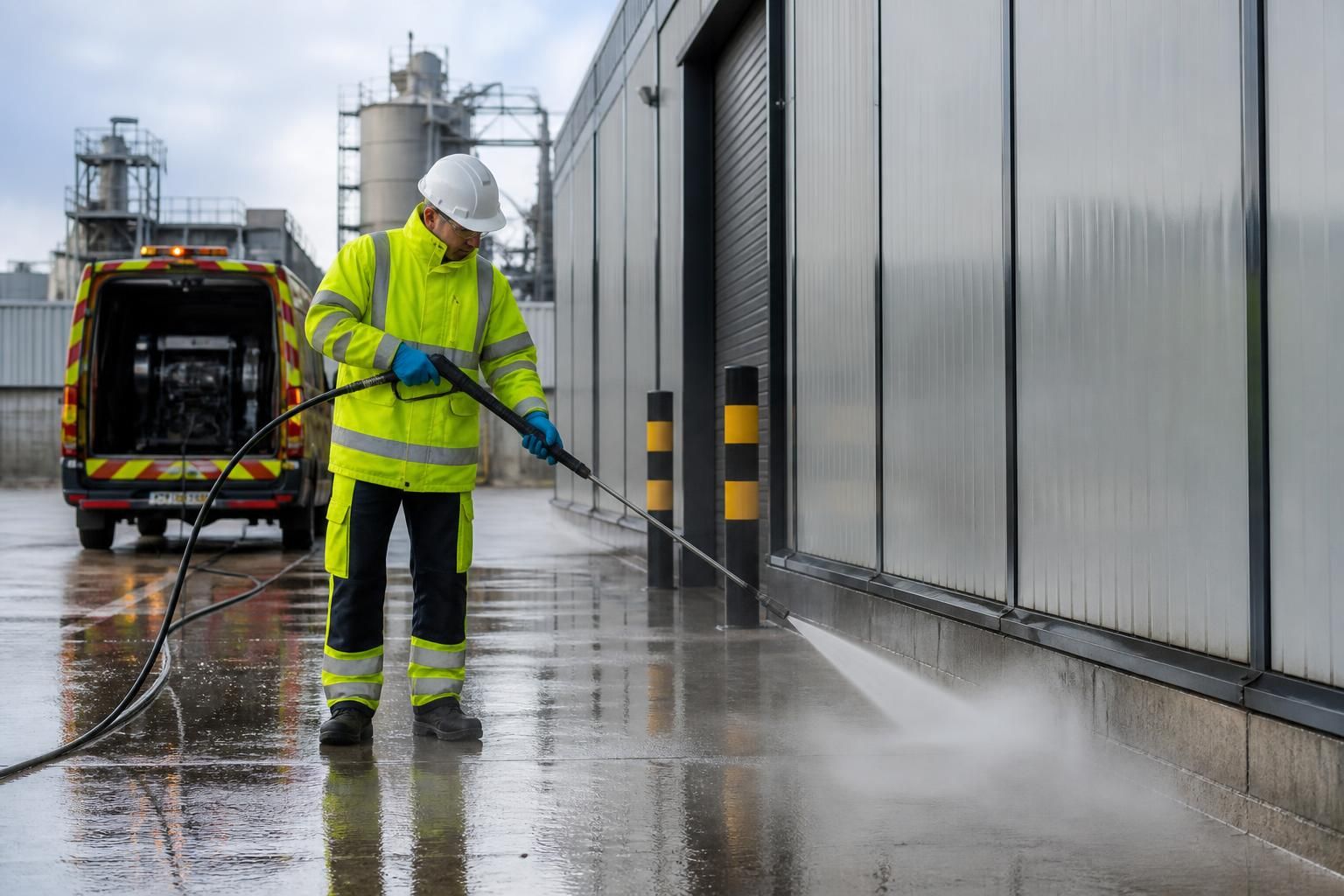
PPE is an important final layer of protection, but it should support rather than replace safer methods, isolation and engineering controls. The required PPE depends on the hazards identified. It may include protective footwear with suitable slip resistance, gloves selected for the chemicals and task, eye or face protection, hearing protection, waterproof or chemical-resistant clothing, head protection and respiratory protective equipment.
For high-pressure cleaning, eye and face protection, gloves, protective clothing and suitable footwear help control the risk from spray, loosened debris and contaminated water. Respiratory protection may be necessary where cleaning creates hazardous dust, mist or vapour, but it must be selected, fitted, maintained and used in accordance with the assessment. PPE should be inspected before use, kept clean and replaced when damaged or no longer provides the intended protection.
Safe use of pressure, steam and other cleaning equipment
High-pressure water can cut skin, inject fluid into tissue, dislodge materials and project debris. Operatives should maintain a stable stance, control the lance with both hands where required, avoid directing the jet at people or exposed electrical equipment, and establish an exclusion zone around the cleaning area. Hoses should be routed to prevent trip hazards, protected from vehicle movements and checked for damage, loose connections and signs of wear.
Steam cleaning introduces additional risks from heat, pressurised systems and hot surfaces. Operators should use equipment within its specified limits, allow surfaces and components to cool where necessary, and prevent unauthorised access to the work area. Cleaning methods should be tested on an inconspicuous section before full application, particularly on painted façades, cladding, coatings, insulation, masonry, roofs and sensitive machinery.
All equipment should be suitable for the task, maintained in accordance with the manufacturer’s instructions and subject to appropriate pre-use checks. Controls should cover damaged hoses, cables, guards, lances, nozzles, fuel systems, emergency stops and electrical connections. Equipment used at work must be selected and maintained in line with the principles of the Provision and Use of Work Equipment Regulations (PUWER), where applicable.
Work at height and access equipment
Façades, roofs, elevated plant and high-level structures require particular planning. The preferred approach is to avoid work at height where a safer ground-based method is reasonably practicable. Where access is necessary, the method should prioritise collective protection, such as suitable platforms, edge protection or scaffold, before relying on personal fall protection.
Mobile elevating work platforms, towers, scaffolds and other access systems must be suitable for the ground conditions, working height, load and task. They should be inspected and used by competent people, with controls for wind, overhead obstructions, falling objects and nearby traffic. Harnesses and lanyards must be compatible with the equipment and connected to approved anchor points. The Work at Height Regulations and, where lifting equipment is involved, the Lifting Operations and Lifting Equipment Regulations (LOLER), may apply.
Access equipment must not be improvised, overloaded or moved while occupied unless it is specifically designed and permitted for that operation. A rescue plan is also essential where a person could be suspended, trapped or otherwise unable to return safely to ground level.
Chemicals, residues and contaminated materials
Cleaning products, degreasers, biocides, solvents and descaling agents should be selected only after the residue and surface have been identified. Safety data sheets and product instructions should be available, and substances must be stored, labelled, diluted and used as specified. Chemicals must not be mixed unless the manufacturer expressly confirms that this is safe; incompatible products can generate toxic gases, heat or violent reactions.
The Control of Substances Hazardous to Health (COSHH) requires suitable assessment and control of exposure to hazardous substances. Controls may include substitution with a less hazardous product, closed application systems, ventilation, restricted access, safe decanting procedures and appropriate PPE. Staff should know how to respond to splashes, inhalation, spills and accidental mixing, including the location of emergency eyewash and other first-aid arrangements.
Unknown residues should be treated cautiously rather than disturbed without further assessment. Cleaning may release asbestos fibres, lead, biological agents or other hazardous contaminants if the material is not identified in advance. Specialist assessment, isolation or a licensed specialist contractor may be required before conventional cleaning can proceed.
Isolation, traffic management and site protection
Where cleaning is carried out near machinery, conveyors, vehicles or production activity, the responsible site contact should agree what must be stopped, isolated or protected. Lockout and tagout arrangements may be required to prevent unexpected start-up. Cleaning water must be kept away from electrical panels, control systems, stored goods and materials that could be damaged by moisture.
Barriers, warning signs and controlled access help separate the work area from employees, visitors and the public. Wet surfaces should be managed promptly, and access routes should be kept clear of hoses, equipment and removed debris. Vehicle movements may require a banksman, designated routes or temporary traffic controls. These measures reduce the likelihood of collision, unauthorised entry and slips or trips while the work is in progress.
Environmental and waste controls
Industrial cleaning can mobilise oil, silt, paint residues, detergents, heavy metals and other pollutants. Run-off should be contained, collected or treated using a method agreed with the site and appropriate to the waste involved. It should not be discharged to surface-water drains or land without confirmation that the discharge is permitted and suitably controlled.
Wastewater, sludge, contaminated absorbents, chemical containers and removed coatings should be segregated, stored securely and transferred through the appropriate waste management arrangements. Waste documentation and consignment records should be retained where required. Spill kits, drain covers and containment equipment should be available when the assessment identifies a pollution risk, with an escalation procedure for spills or accidental releases.
Emergency planning and incident reporting
Before work begins, everyone involved should know how to raise an alarm, stop equipment, summon assistance and reach a safe location. The plan should address chemical exposure, high-pressure injection injuries, falls from height, electric shock, fire, equipment failure, structural instability, spillages and unexpected contamination. A high-pressure injection injury requires urgent medical attention even when the visible wound appears minor.
Near misses, equipment defects, uncontrolled releases and injuries should be reported, investigated and used to improve the method statement and site controls. Certain serious incidents may also need reporting under the Reporting of Injuries, Diseases and Dangerous Occurrences Regulations (RIDDOR). Clear records of risk assessments, training, inspections, maintenance, chemical controls and waste movements provide evidence that the work has been planned and managed responsibly.
For an industrial cleaning project, the safest approach is to agree the scope and hazards with the site representative before mobilisation, isolate or protect affected areas, select the least hazardous effective method, and monitor conditions throughout the work. This creates a controlled process that protects people and property while supporting compliance with UK health and safety, environmental and workplace requirements.
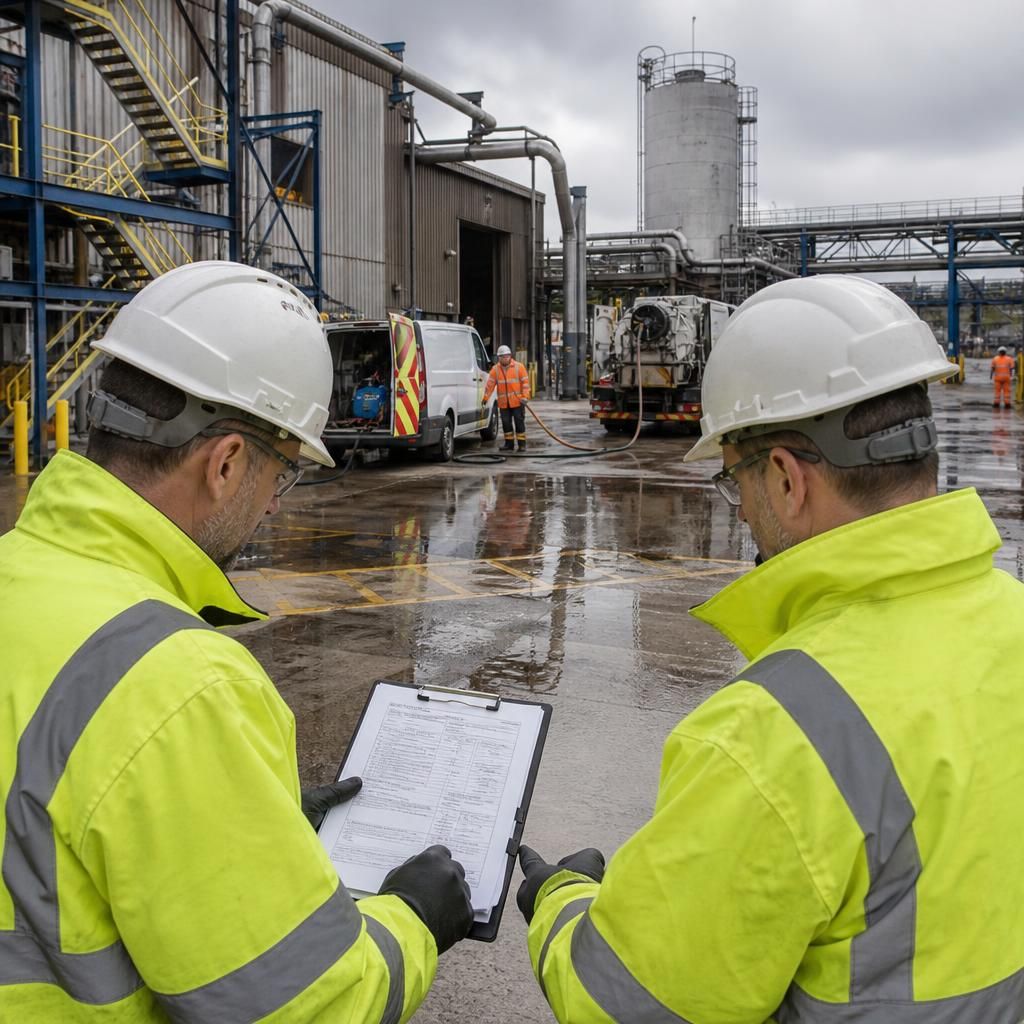
A site-specific risk assessment and method statement (RAMS) is the foundation of safe industrial cleaning. It should identify hazards such as moving vehicles, electrical systems, work at height, hazardous residues, contaminated run-off and slippery surfaces, then explain the equipment, exclusion zones, isolation procedures and emergency arrangements required to control them.
The RAMS must be reviewed if site conditions, weather, production activity, access arrangements or the cleaning method changes. This ensures operatives and the site team are working to current information rather than relying on a generic procedure prepared before mobilisation.