
What should I consider when choosing a post-construction cleaning service?
When choosing a post-construction cleaning service, assess the contractor’s experience with industrial sites, ability to remove construction residues safely, suitable equipment and access methods, and documented health, safety and environmental procedures. Confirm that they can work to your programme, protect finished surfaces, manage waste responsibly and provide a clear, itemised quotation covering the required scope.
Choosing a post-construction cleaning service requires more than comparing hourly rates. The contractor should demonstrate relevant experience, understand the surfaces and residues involved, provide suitable equipment and access systems, and show how the work will be completed safely, on programme and in accordance with environmental requirements. The quotation should also define the scope clearly, including preparation, cleaning, waste removal, final inspection and any remedial work.
Check experience with comparable sites. Construction cleaning varies considerably between a small commercial refurbishment, a new industrial unit, a multi-storey development and an external infrastructure project. Ask whether the contractor has worked on similar buildings, materials, access conditions and construction phases. Relevant experience may include removing cement residue, grout haze, mortar splashes, plaster, adhesive, paint, dust, packaging debris, oily deposits and general site contamination from façades, cladding, roofs, loading areas, plant spaces, car parks and service yards.
Experience should include working around other contractors and operating within partially completed premises. A capable service provider will understand that cleaning may need to be phased around commissioning, snagging, deliveries, inspections and handover. They should be able to explain how they will separate completed areas from active work zones and how they will respond if additional residue or access restrictions are identified.
Require a proper site survey. A reliable quotation should be based on an inspection, suitable drawings or detailed site information rather than a vague description of the building. The survey should consider the size and condition of the areas, the type and age of the contamination, drainage arrangements, water and power availability, working hours, vehicle access, lifting requirements and restrictions imposed by neighbouring properties or members of the public.
The survey should also identify the surfaces to be cleaned. Concrete, brick, natural stone, coated metal, powder-coated aluminium, glass, plastics, composite panels, painted surfaces and new sealants can all react differently to water pressure, heat and chemicals. Newly installed materials may be more vulnerable than established surfaces, and manufacturer instructions or warranty requirements may affect the cleaning method.
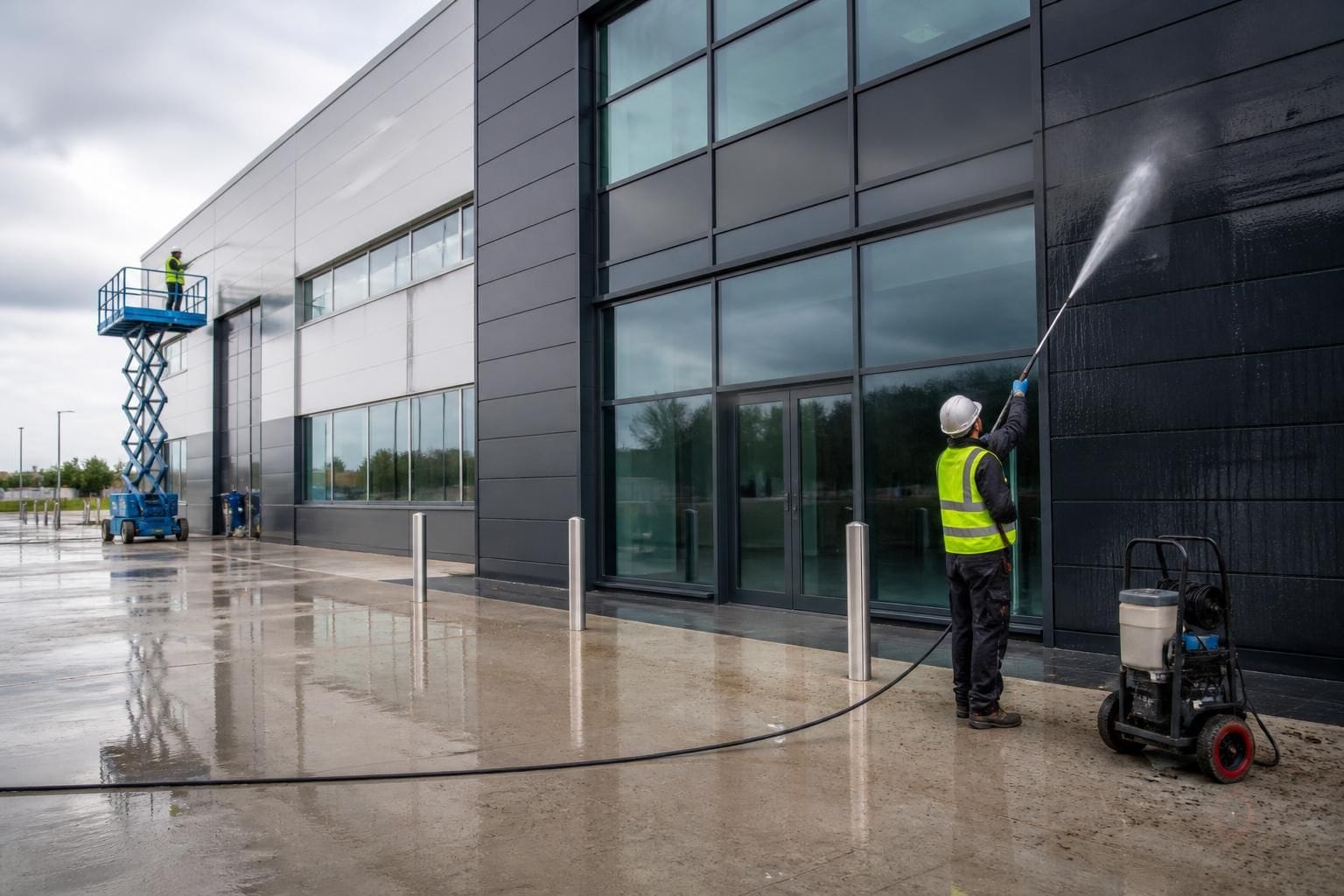
Assess the proposed cleaning methods. The contractor should match the method to the residue and substrate instead of applying the same process everywhere. Pressure washing can be effective for robust external surfaces and general dirt, but excessive pressure can damage pointing, coatings, seals, insulation systems and delicate finishes. Steam cleaning or heated water may be appropriate where controlled heat helps dissolve deposits while reducing the need for aggressive chemicals. Low-pressure washing, soft washing, manual tools or carefully selected cleaning agents may be preferable for sensitive areas.
Ask how the contractor will deal with cement, mortar and grout residue. These deposits may require controlled mechanical removal, a compatible specialist product or a combination of methods. The process should include precautions against etching, staining, spreading contamination or damaging adjacent finishes. Chemical products should be selected for the actual substrate, applied in accordance with their safety data and removed or neutralised where necessary.
Insist on testing before full-scale cleaning. A small test area allows the contractor to confirm that the method removes the residue without changing colour, gloss, texture or surface protection. Testing is particularly important on new brickwork, stone, architectural metalwork, coated cladding, glass, resin flooring and painted surfaces. The agreed test area and result should be recorded, with any limitations explained before the main works begin.
Review health and safety arrangements. Post-construction sites can contain sharp materials, unstable debris, open edges, temporary services, dust, chemicals, moving plant and incomplete access routes. The contractor should provide suitable risk assessments and method statements, commonly referred to as RAMS, and explain how these will be communicated to the cleaning team and coordinated with the principal contractor or site manager.
Where relevant, the plan should cover work at height, mobile elevated work platforms, ladders, scaffolding, pressure equipment, steam, chemical handling, confined or restricted areas, electrical risks, slips and trips, falling objects and vehicle movements. Operatives should have appropriate training and be supplied with suitable personal protective equipment. Do not assume that a contractor’s general safety statement is sufficient; the arrangements should address the specific building and cleaning activities.
Consider how the service will protect other people on site. The contractor should explain how areas will be segregated, how warning signs and barriers will be used, how overspray and falling debris will be controlled, and how cleaning will be coordinated with trades, visitors and building occupants. If the premises will remain partly operational, the programme and controls should reflect pedestrian routes, deliveries, emergency access and noise restrictions.
Check access capability and equipment. Large or complex sites may require powered access, scaffolding, abseiling arrangements, long-reach systems or specialist pressure and steam equipment. The chosen method should be suitable for the height, geometry and condition of the building, not simply the equipment that the contractor happens to own. Ask who will arrange access equipment, whether it needs ground assessments or permits, and how equipment will be positioned without damaging paving, roofs, landscaping or finished surfaces.
Access planning should include areas that are easy to overlook, such as roof edges, soffits, service yards, loading bays, plant enclosures, behind pipework and the underside of canopies. A detailed scope helps prevent these areas being excluded from the final clean or treated as unforeseen extras.
Clarify protection of completed work. Cleaning should not create new damage after construction work has finished. The contractor should explain how they will protect windows, doors, seals, vents, electrical equipment, fresh coatings, landscaping, floor finishes, drainage systems and installed fixtures. Water must be directed and controlled so that it does not enter the building, affect unfinished interiors or carry contaminants into clean areas.
It is also important to establish who is responsible for removing protective films, masking vulnerable items and reinstating covers after cleaning. Some films and temporary protections should be removed within specified periods, while others may be affected by heat, moisture or cleaning chemicals. Responsibilities should be agreed with the principal contractor and recorded before work starts.
Ask how water, chemicals and waste will be managed. Run-off from construction cleaning may contain cement, silt, oils, detergents or other contaminants. The contractor should explain how dirty water and solid waste will be contained, collected and disposed of, and whether drainage routes have been approved. Water should not be allowed to enter surface-water drains or neighbouring land unless it is suitable and authorised to do so.
Waste arrangements should cover packaging, construction debris, removed residue, contaminated absorbents and empty chemical containers where applicable. Ask whether waste will be segregated, transported and transferred through appropriate channels, and whether disposal records or other documentation will be provided when required. A contractor that cannot explain the route for contaminated water or debris has not fully planned the work.
Examine the quotation in detail. A useful quotation should identify the areas, surfaces and cleaning tasks included, together with exclusions, assumptions, access requirements, working hours, waste arrangements and any preparation needed from the client or main contractor. It should state whether the price covers equipment, water, power, access systems, traffic management, protection, testing, final snagging and removal of waste.
Be cautious of a low headline price that excludes essential activities or is based on an unverified area. Ask how variations will be authorised if additional contamination, inaccessible areas or damage are discovered. A written variation process avoids disputes and ensures that no extra treatment is undertaken without approval.
Verify competence, insurance and working arrangements. Check that the business has appropriate public liability and employers’ liability insurance and can provide evidence when requested. Depending on the project, you may also need confirmation of training, equipment inspection, access competence, chemical handling procedures, environmental controls and membership of relevant industry or contractor assessment schemes. These documents should support, rather than replace, a project-specific method statement and site assessment.
Ask who will supervise the work, who will be the point of contact and whether the same team will remain involved throughout the programme. Clear communication is especially important where cleaning is phased or where the contractor must coordinate with construction managers, facilities teams and building control or handover personnel.
Agree the quality standard and handover process. “Clean” should be defined in practical terms. Confirm whether the requirement is removal of visible construction residue, preparation for occupation, preparation for a coating, or a final presentation clean. Agree how inaccessible areas, minor staining, retained marks and surfaces that cannot be restored without replacement will be treated.
The final inspection should be completed with the relevant site representative, using agreed acceptance criteria. The contractor should provide a record of completed areas, outstanding items, photographs where useful and any recommendations for further treatment. A planned snagging visit can be valuable where dust settles after the initial clean or where other trades continue working nearby.
Use these questions when comparing contractors:
- Have you cleaned comparable industrial or commercial sites and similar construction residues?
- Which methods will you use on each surface, and what testing will be completed first?
- How will you control pressure, heat, chemicals, water run-off and overspray?
- What access equipment and permits are required?
- How will completed finishes, landscaping, drainage and building systems be protected?
- What RAMS, insurance evidence and operative training records can you provide?
- What is included in the quotation, and how will variations be approved?
- How will waste and contaminated water be collected and disposed of?
- Who will supervise the work, and how will progress and defects be reported?
- What inspection and handover process is included?
The strongest choice is the contractor that can connect its proposed method to the site’s actual materials, contamination, access limitations, programme and compliance duties. A clear survey, tested cleaning approach, documented controls and itemised quotation provide a more reliable basis for selection than price alone, while reducing the risk of surface damage, delays, uncontrolled waste and unfinished areas at handover.

A site survey and test clean should be completed before choosing a post-construction cleaning service. This allows the contractor to assess the residue, identify vulnerable materials and confirm that the proposed pressure, heat or cleaning product will achieve the required result without damaging the finished surface.
The test should cover representative areas such as brickwork, cladding, coated metal, glass, stone or resin flooring. The agreed method and result should be recorded, including any limitations, so the main works can proceed with a clear scope and fewer risks of staining, etching or re-cleaning.